Maria Montessori — natal chart
What does Maria Montessori’s natal chart reveal?
Maria Montessori (1870-1952) was an Italian physician and educator who developed the Montessori method of child-centered education, emphasizing independence, hands-on learning, and respect for a child's natural development. One of Italy's first female doctors, her teaching approach is used in schools worldwide.
 Share
Share
Birth
1870-08-31 · 03:30 · Chiaravalle, Italy Reliability: AA · vetted record
A reformer built from the inside out
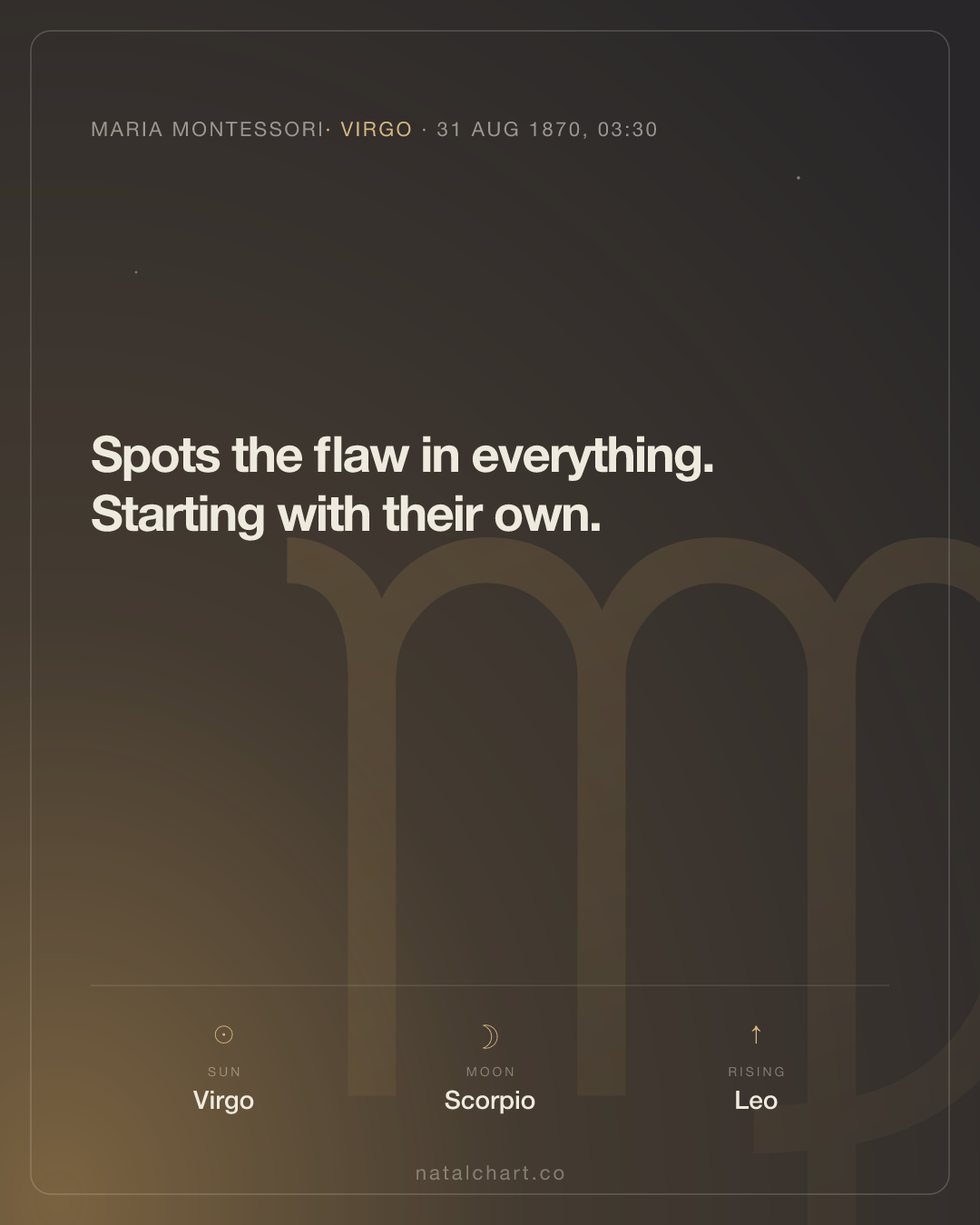
Maria Montessori did not arrive at her revolutionary method by theorising from a comfortable distance. She observed children — closely, systematically, over years — and let what she saw overturn everything she had been taught about how learning works. Her chart carries the signature of exactly this kind of person: a Leo Ascendant (the face she met the world with — warmth, directness, a natural authority that drew people in) paired with a Virgo Sun in the second house. The Leo rising gave her the presence to stand at the front of a room and be believed. The Virgo Sun gave her the precision, the patience for detail, and the scientific integrity to make sure she was right before she spoke.
The Virgo core: observation as a moral act
The Sun in Virgo in the second house — the house of resources, values, and what one builds over time — describes someone whose deepest sense of self is anchored in careful, practical work. Virgo does not deal in abstractions for their own sake; it wants to understand how things actually function, then improve them. For Montessori, this meant spending hours on the floor of the Casa dei Bambini in Rome watching three- and four-year-olds teach themselves to read, watching how concentration forms and breaks, cataloguing what helped and what did not. The second house anchors this in something concrete and lasting — not a passing theory but a method that outlives its creator.
Moon in Scorpio: the emotional engine
The Moon in Scorpio in the fourth house (the house of home, roots, and what lies beneath the surface) describes an emotional life of considerable depth and intensity that was rarely displayed openly. Scorpio does not feel things halfway; it digs. The fourth house keeps this depth private, protected. Montessori had a son, Mario, whose existence she kept secret for years — a painful arrangement forced on her by the conventions of the time and her own precarious social position as an unmarried woman in early twentieth-century Italy. The Moon in Scorpio in the fourth house carries exactly this kind of private, transforming grief, held close and rarely spoken of. The same placement, in its harder quality, gives a tenacity that does not give way: when Rome's educational establishment dismissed her ideas, when the fascist Italian government shut her schools, she rebuilt elsewhere and kept going.
Mercury in Libra: the diplomat of ideas
Mercury in Libra in the third house (the house of communication, ideas, and immediate environment) gives a mind that weighs carefully before it speaks. Libra's Mercury does not storm into a debate; it considers all sides, looks for balance, and then makes its case. This is the Mercury of someone who could write The Absorbent Mind — a book that had to convince both scientists and educators, both rationalists and those with a sense of child psychology — and land with all of them. It is also the Mercury of a gifted teacher: patient with the pace of others' understanding, able to meet people where they are.
Venus in Leo: the radiant classroom
Venus in Leo in the first house (the house of self, how one comes across) describes someone who brought genuine warmth and delight into the spaces she inhabited. Venus in Leo loves what it loves generously and visibly. For Montessori, this translated into classrooms designed to be beautiful — low shelves, real objects, natural materials, a physical environment that respected the child's dignity and invited genuine pleasure in learning. The beauty was not decorative; it was pedagogical. It was Venus in Leo doing what it does best: making the environment itself an invitation.
Mars and Uranus in Cancer: the quiet revolutionary
Mars and Uranus sit within 0.4° of each other in Cancer in the twelfth house (the house of what is worked on below the surface, out of public view). This is the tightest aspect in the chart, and it speaks to a deep, restless drive toward change that did not announce itself theatrically but simply could not be stopped. Mars in Cancer protects and nurtures; Uranus in Cancer breaks through inherited structures to find something more genuine. Together, in the twelfth house, they describe someone who was undertaking a kind of invisible revolution — reshaping the internal world of children in classrooms rather than marching in the street. Mars square Neptune (3.0° orb) and Uranus square Neptune (3.4° orb) add an element of idealism that could meet friction: the ideal of what a child's education could be ran against the institutional reality of what it was. She spent decades navigating that gap.
Jupiter and Saturn: the tension between expansion and structure
Jupiter in Gemini in the eleventh house (the house of wider community, collective impact, and long-term networks) and Saturn in Sagittarius in the fifth house (the house of creative work, teaching, and what one puts into the world for others) sit in opposition — pulling against each other. Jupiter in Gemini wants to spread ideas widely, freely, making connections across disciplines; Saturn in Sagittarius demands that those ideas be grounded in actual experience and not just conviction. The opposition (1.4° orb) describes the productive tension at the heart of Montessori's life's work: she wanted to reach every child everywhere (Jupiterian scope) and she refused to generalize beyond what she had actually seen in practice (Saturnian rigour). The Saturn trine Neptune (0.4° orb — the second tightest aspect in the chart) resolves this somewhat: it is the aspect of someone who can hold a vision and build something lasting toward it, without losing either the dream or the discipline.
Pluto and Lilith in Taurus, tenth house: vocation and what endures
Pluto in Taurus in the tenth house (the Midheaven — the public/career point) and Lilith also in Taurus in the tenth house describe a vocation that carried a transforming force, one that ran against the grain of established power. Pluto in the tenth does not achieve reputation quietly; it turns fields over. Taurus in the tenth wants what it builds to last — and the Montessori method, now practiced in over 20,000 schools in more than 110 countries, has lasted. Lilith in the tenth in Taurus speaks of a woman who occupied professional territory where women were not expected to be, and who refused to vacate it. Being one of Italy's first female medical graduates at a time when female doctors were a genuine novelty was not incidental to her work — it was continuous with it.
Chiron in Aquarius: the wound that becomes a gift to the collective
Chiron (an old wound that, once worked through, tends to become a gift one can pass on) in Aquarius in the seventh house (the house of significant relationships, collaborations, and how one meets the other) points to something tender in the area of belonging and acceptance within communities. Aquarius carries the idealist's isolation: the person who sees so clearly what could be that the present reality feels almost unbearable. For Montessori, this wound was visible in the repeated dismantling of her work by authorities — the fascist closure of her Italian schools in 1934, her years in India during the war, her long statelessness. Yet Chiron in the seventh house also describes the healing through collaboration: it was working alongside teachers and parents, training hundreds of educators, that turned her personal wound into something transmissible. The North Node in Cancer (the direction of growth) echoes this: toward nurturing, toward the child, toward belonging.
What the chart adds up to
Maria Montessori's chart is the portrait of someone who held two things together that often pull apart: the scientist's demand for evidence (Virgo Sun, Saturn rigour) and the educator's faith in the child's inherent capacity (Leo Ascendant, Jupiter's scope). The Leo rising meant she could walk into a room and claim it. The Virgo Sun meant she never trusted a claim she had not tested herself. The Mars-Uranus conjunction in the twelfth house meant that the revolution happened quietly, from the inside, one carefully observed child at a time. She did not need the world to agree with her quickly. She needed to be right — and then to wait.
The chart
How to read it →Frequently asked questions
What is Maria Montessori's zodiac sign?
Maria Montessori's Sun sign is Virgo — the Sun was in Virgo at birth (1870).
What is Maria Montessori's moon sign?
Maria Montessori has the Moon in Scorpio. The Moon sign describes the emotional and instinctive layer of the chart.
What is Maria Montessori's rising sign?
Maria Montessori's rising sign (ascendant) is Leo — the sign on the eastern horizon at the moment of birth.
When and where was Maria Montessori born?
Maria Montessori was born in 1870 in Chiaravalle, Italy.