Paco de Lucía — natal chart
What does Paco de Lucía’s natal chart reveal?
Spanish flamenco guitarist born in 1947 in Algeciras. He renewed flamenco with albums such as 'Almoraima' (1976) and accompanied Camarón de la Isla. Prince of Asturias Award for the Arts 2004.
 Share
Share
Birth
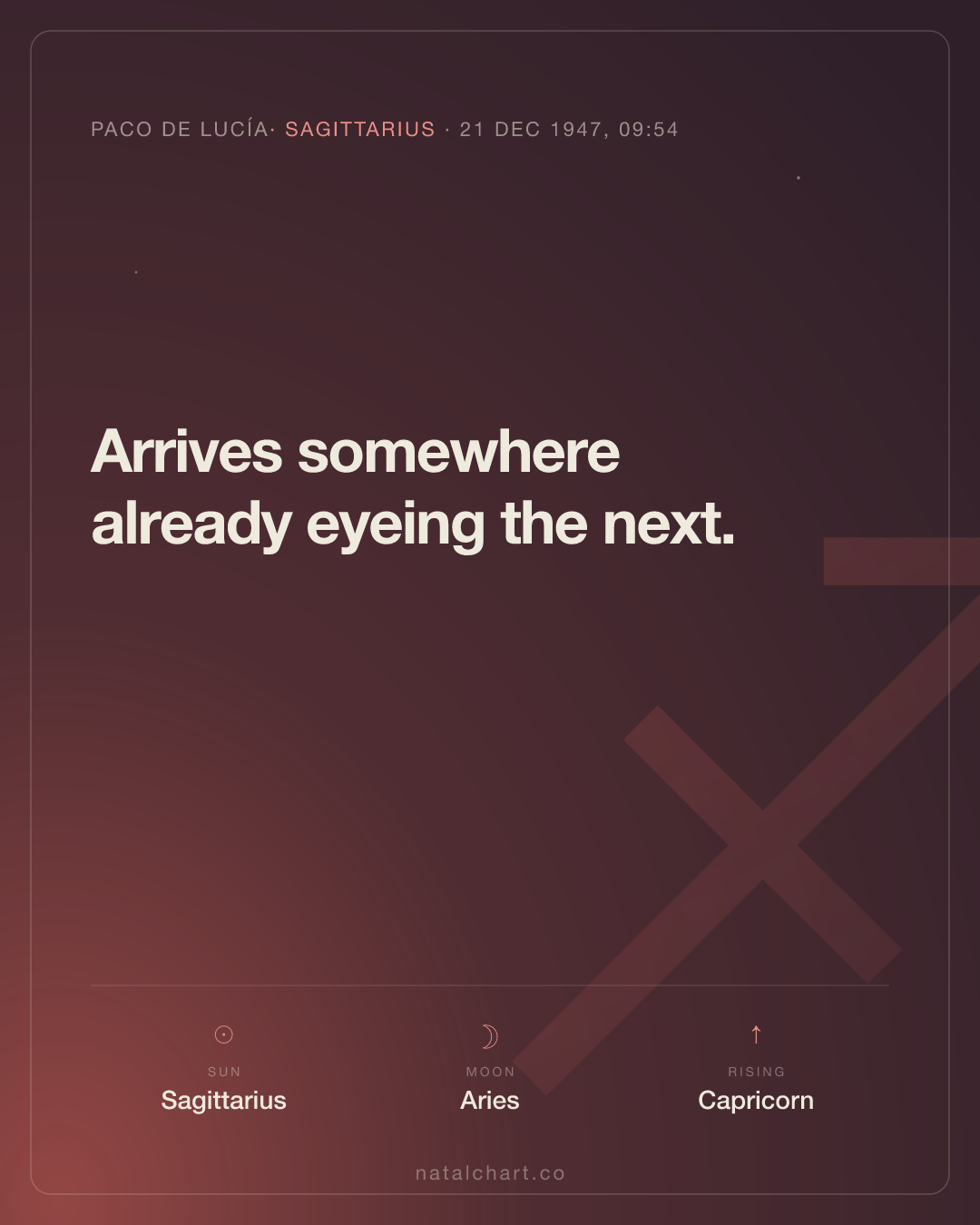
1947-12-21 · 09:54 · Algeciras, Spain Reliability: A · reliable data
The fire and the forge
Paco de Lucía built his art from the inside out. Three planets — the Sun, Mercury, and Jupiter — sit together in Sagittarius in the twelfth house, the part of the chart associated with solitude, invisible labour, and what a person carries alone. The paradox is vivid: the music he made was explosive, expansive, world-opening, yet the process that produced it happened behind closed doors. Those who knew him described a man who practised for hours in private rooms and said little about it. The Sagittarian restlessness — the need to go further, to cross the next border, to ask what flamenco could contain — was real and documented, from Almoraima in 1976 through his collaborations with John McLaughlin and Al Di Meola. But the engine ran quietly, fed by something hidden.
The face he showed the world
Capricorn rises on his Ascendant — the face he met the world with — and Venus, the planet of value and aesthetic sense, sits right there with it. The Ascendant is the first impression, the tone in the room before anyone speaks. Capricorn gives composure, economy, a certain gravity. Venus adds an acute sense of beauty and form. What audiences saw was controlled mastery: economy of gesture, a body very still except for the hands, no showmanship for its own sake. His Venus in Capricorn was not cold — it was devoted. The discipline was the love made visible. His ruler, Saturn, sits in Leo in the eighth house, lending a quality of earned, hard-won authority — someone who commanded a room not through charm but through the weight of what they had built.
The private emotional world
Under the composed exterior, the Moon — the emotional interior, what moves a person when no one is watching — sits in Aries in the fourth house, the house of roots and home. Aries is direct, immediate, fiercer than Capricorn will ever let itself appear. The fourth house anchors it in childhood and origin: Algeciras, the port city where he was born the son of a flamenco guitarist who trained him relentlessly from age seven. That early world — the tight community, the demand, the music as identity before it was career — left a mark that never faded. Moon in Aries in the fourth is someone whose deepest feelings ignite quickly and run hot, but are protected by the composed Capricorn surface. The fire was always there. The world saw the architecture; only those close to him saw the flame.
How he thought and how he worked
Mercury, the planet governing thought and communication, shares that twelfth-house Sagittarius space with the Sun. He thought in ranges, in comparisons, in bridges across traditions. His mind reached toward jazz, toward classical guitar, toward Brazilian music and West African percussion — not as novelty but as genuine inquiry into what flamenco was and what it might become. That Mercury forms a flowing connection with Saturn, the planet of structure and discipline: the wide-ranging intellectual curiosity was always yoked to the rigour of someone who would not release an idea until he had tested it fully. He spoke in interviews with careful precision, choosing words slowly, reluctant to generalize. The mind and the mouth worked together at the same deliberate pace.
The craftsman's drive
Mars, the planet of drive and physical energy, sits in Virgo in the ninth house — the house of philosophy, travel, and the wider world. Virgo Mars is the craftsman's Mars: it finds meaning in exactness, in the millimetre of a fingertip's position, in a rhythm corrected until it is beyond correction. The ninth house pushes that precision outward, toward other cultures and traditions, toward the big question behind the technique. His right-hand technique was a lifelong obsession; he is credited with expanding the technical vocabulary of flamenco guitar in ways that are still being absorbed. But the technical perfectionism was never an end in itself — it was always in service of something larger, a philosophical argument about what his art form could hold.
Jupiter and the transforming power
Jupiter — expansion, crossing of limits, the impulse that says more — sits with the Sun in Sagittarius in the twelfth house, and it connects in an exact, zero-degree alignment with Neptune in the tenth house (the public and career point, also called the Midheaven area). Neptune governs the transcendent, the dissolving of boundaries, the quality in music that makes a listener forget they are in a room. That exact connection between Jupiter and Neptune describes the quality his audiences most often reached for in words: the playing went somewhere unreachable by technique alone. Jupiter also connects in a flowing, easy relationship with Pluto in Leo in the eighth house. Pluto governs deep transformation and irreversible change. The work he did did not add to flamenco — it changed it at the root.
Career and vocation
The Midheaven — the public/career point at the top of the chart — falls in Scorpio, the sign of depth, intensity, and transformation. Neptune sits in the tenth house in Libra, just below it: an artist whose public face carried something dreamlike, a quality of beauty that seemed to arrive from outside ordinary craft. Scorpio on the Midheaven means a career built not on brightness or accessibility but on going further down than others were prepared to go, finding what was hidden in the tradition and pulling it to the surface. His work with Camarón de la Isla — another artist willing to strip flamenco back to its rawest elements — belongs here. So does the Prince of Asturias Award in 2004, a recognition that arrived after decades of work that had already rendered the question of recognition almost beside the point.
The tightest connections in the chart
The most exact connection in this chart is Jupiter aligned exactly with Neptune: the philosopher and the dreamer fused into one impulse. Mercury connects easily with Saturn — the inquiring, wide-ranging mind always disciplined by structure, which kept his innovations from becoming merely interesting and made them permanent. Saturn and Uranus (the planet of rupture and reinvention) connect in a productive relationship: he broke the inherited form from the inside, using the tradition's own rigour. The opposition between Mercury and Uranus — the most direct tension in the chart — meant that the mind could move so fast it sometimes outran what language or convention could contain. He solved this by working it out in the music rather than in words.
Chiron and the North Node
Chiron — the old wound that becomes the teacher's gift — sits in Scorpio in the eleventh house, the house of community, of belonging to a group. There is something here about the experience of being inside a tradition that can be both home and cage: flamenco was his language from childhood, but the price of speaking it differently was real friction within the community that had formed him. The wound around belonging, around being accepted by the tradition while also transforming it, is legible in the biographical record. The North Node — pointing toward growth — falls in Taurus, the sign of patient, embodied, lasting creation. The path was always to keep building something that would stand. He recorded into his sixties and was still touring when he died in February 2014. The patience was the answer.
A final word
What the chart describes is a man who contained more than he showed, who moved outward from an inner silence, who built something with the discipline of a craftsman and the reach of a philosopher. The composed exterior and the fierce interior were not in conflict — they were the mechanism. The control was the condition under which the fire could burn steadily instead of burning out. That is not a limitation. That is a kind of completeness.
The chart
How to read it →Frequently asked questions
What is Paco de Lucía's zodiac sign?
Paco de Lucía's Sun sign is Sagittarius — the Sun was in Sagittarius at birth (1947).
What is Paco de Lucía's moon sign?
Paco de Lucía has the Moon in Aries. The Moon sign describes the emotional and instinctive layer of the chart.
What is Paco de Lucía's rising sign?
Paco de Lucía's rising sign (ascendant) is Capricorn — the sign on the eastern horizon at the moment of birth.
When and where was Paco de Lucía born?
Paco de Lucía was born in 1947 in Algeciras, Spain.