Paulo Coelho — natal chart
What does Paulo Coelho’s natal chart reveal?
Paulo Coelho, born on August 24, 1947, in Rio de Janeiro, Brazil, is a novelist and one of the best-selling authors in history. After working as a songwriter for Brazilian musician Raul Seixas during the 1970s and as a journalist, he turned to fiction. His pilgrimage along the Camino de Santiago inspired his first major book, The Pilgrimage (1987). The following year he published The Alchemist (1988), a novel about a shepherd's journey that became an international phenomenon, translated into more than eighty languages and selling tens of millions of copies. His later works include Brida (1990), The Valkyries (1992), By the River Piedra I Sat Down and Wept (1994), Veronika Decides to Die (1998), and Eleven Minutes (2003). Coelho was elected to the Brazilian Academy of Letters in 2002 and has received numerous international honors.
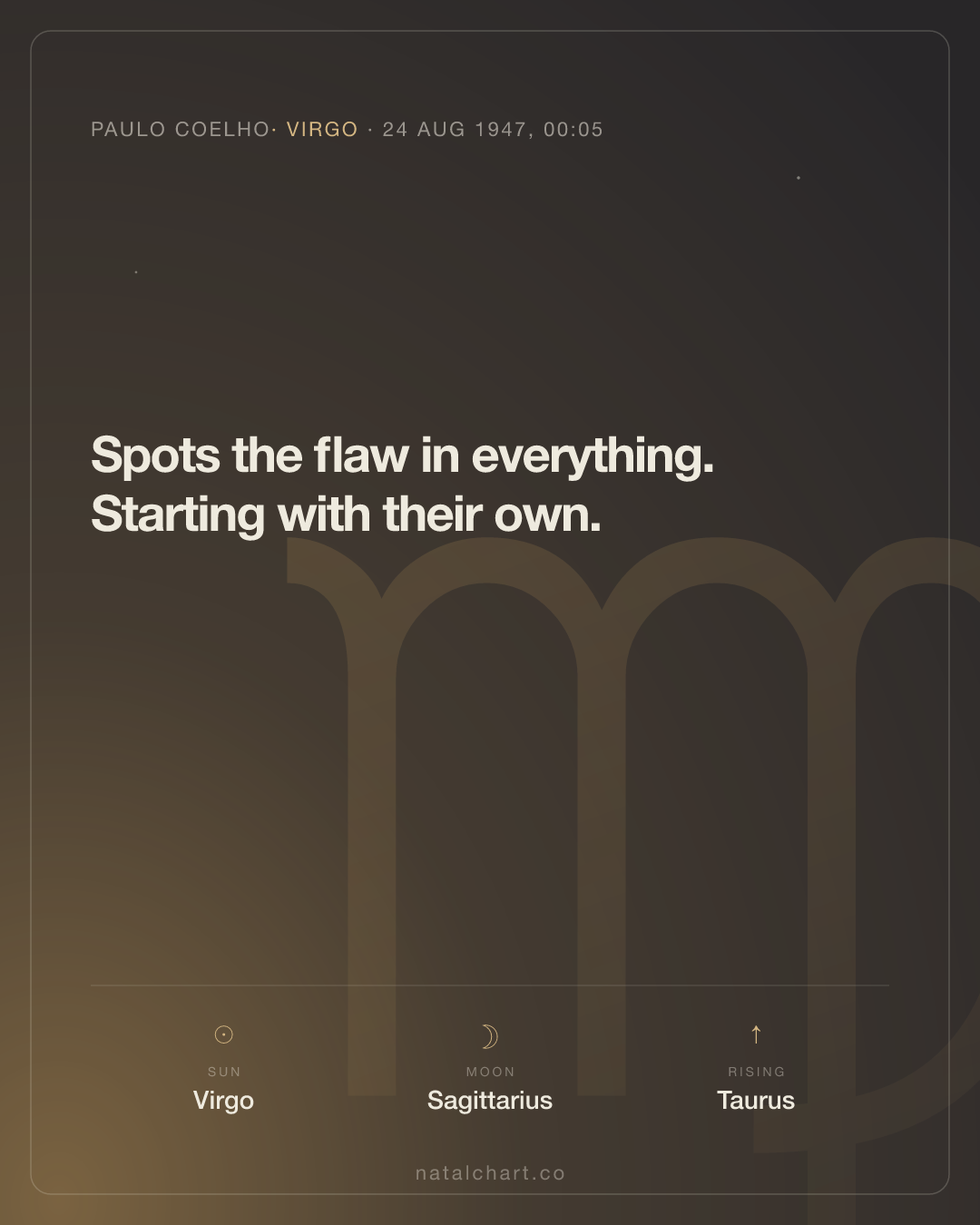 Share
Share
Birth
1947-08-24 · 00:05 · Rio de Janeiro, Brazil Reliability: A · reliable data
Sun in Virgo in the Fifth House: the craftsman who reaches for the infinite
Paulo Coelho was born on 24 August 1947 with the Sun in Virgo placed in the fifth house — the house of creative expression, storytelling, and the work that carries a person's deepest signature. Virgo is the sign of precision, of discernment, of the writer who crosses out nine words to keep the tenth. In the fifth house that precision becomes not just method but voice: the analytical mind that finds, through relentless refinement, the simple sentence that opens wide. The tension in Coelho's work — allegory pared down to the near-bare, philosophical questions wrapped in shepherd's clothes — is this tension made visible. The Alchemist is not a long book; it is a Virgoan book: everything extraneous has been removed until only the essential remains.
Ascendant in Taurus: the body that roots the vision
The Ascendant (the face a person meets the world with) is in Taurus — the sign of the earth, of patient construction, of sensory experience as the gateway to truth. Coelho's path to literature was not a young prodigy's sprint: he was imprisoned three times during the Brazilian military dictatorship, worked for years as a songwriter for Raul Seixas, wandered before he wrote, walked the Camino de Santiago at thirty-eight. The Taurus Ascendant describes someone who needs to put their feet on actual ground before they can speak of higher things. The Pilgrimage (1987) is literally that: the metaphysical discovered through the physical road. This embodied quality — journey as the method, not just the theme — is his Ascendant made narrative.
Moon in Sagittarius in the Eighth House: the pilgrim who must cross the dark
The Moon in Sagittarius speaks of an emotional life drawn to expansion, to foreign lands, to the quest for meaning beyond the local and familiar. In the eighth house — the house of transformation, of encounters with death and the depths — that quest is never comfortable or purely philosophical: it is existential, earned through passage. Coelho spent time in psychiatric institutions as a young man, was tortured during political imprisonment, and went through years of stagnation before finding his literary path. The Moon here describes someone for whom the search for meaning is not a hobby but a survival mechanism. Veronika Decides to Die (1998), which draws directly on Coelho's institutional experiences, is the eighth-house Moon speaking plainly.
Mercury, Venus, and Sun in Leo in the Fourth House: the storyteller rooted in heritage
Mercury in Leo in the fourth house, joined closely with Venus (separated by about two degrees) and with the Sun nearby, creates a powerful stellium in the house of origins, of ancestry, of the private self. Mercury in Leo communicates with warmth and authority; it tells stories, not just reports facts. Venus in Leo adds an aesthetic that favours the grand gesture, the universal myth over the local anecdote. That both sit in the fourth house — deep roots, the family matrix, the formative home — suggests that Coelho's writing draws its fuel from something foundational and personal, even when it appears to speak of universal truths. His Brazilian-Catholic upbringing, the Jesuit education, the fraught relationship with a father who wanted him to be an engineer: these fourth-house experiences are the compost from which the allegories grow.
Mars in Cancer in the Third House: the persistence of the quiet fighter
Mars in Cancer is an unusual placement for the planet of action: Cancer is the sign of the home, of caution, of the crab that moves sideways. Mars here does not charge; it persists. It returns to the wound. It defends with great tenacity what it loves. In the third house — the house of communication, of siblings, of the immediate environment — Mars in Cancer describes a fighter for words, someone who struggled to be heard in his immediate world before he was heard by millions. Coelho's parents had him institutionalised partly because of his determination to become a writer, not a professional. That determination, quiet and tenacious and unwilling to be defeated, is Mars in Cancer in the third house: the force that keeps returning, that crosses the Camino once more.
Jupiter in Scorpio in the Seventh House: the audience as deep mirror
Jupiter (the planet of expansion and meaning) in Scorpio in the seventh house — the house of partnerships, audiences, and the encounter with the other — is a remarkable placement for the world's most-translated living author. Jupiter in Scorpio expands through depth, through the excavation of hidden things, through the willingness to go where it is uncomfortable. In the seventh house that depth is directed outward: it is offered to the reader, to the partner, to the world as encounter. Coelho's books do not instruct from above; they sit alongside the reader in their confusion and say: look here, underneath this, there is something. More than eighty languages, tens of millions of copies: Jupiter in Scorpio in the seventh house at full scale.
Saturn conjunction Pluto in Leo in the Fourth House: the ordeal that forges the foundation
Saturn and Pluto joined together (about one degree apart) in Leo in the fourth house is the most demanding configuration in this chart. Saturn brings discipline, delay, and the weight of responsibility; Pluto demands total transformation, the death of what was in order for something new to be born; Leo insists on the individual voice, the need to be seen and heard. All of this sits in the fourth house — the private self, the foundation, what is built in the dark. The three psychiatric internments, the torture, the years of silence and failed attempts: this is Saturn-Pluto in the fourth house being lived through. The fact that Coelho went through this and emerged with a voice that reached the world is also this configuration: Pluto does not destroy without rebuilding, and Saturn does not withhold the prize from those who stay.
Mercury sextile Uranus: the breakthrough sentence
The tightest aspect in the chart — Mercury in Leo in easy flow with Uranus in Gemini, separated by barely half a degree — is the signature of the writer who finds the unexpected angle, the phrase that reframes everything. Uranus brings the flash, the leap across conventional logic; Mercury carries it into language. When Coelho writes "When you want something, all the universe conspires in helping you to achieve it" — a sentence simple enough to be quoted by people who have never read the book — he is using this aspect: the accessible surface that contains the short-circuit of ordinary thinking. The Mercury-Venus sextile to Uranus compounds the effect, adding aesthetic surprise alongside conceptual surprise.
Chiron in Scorpio in the Seventh House: the wound that becomes the gift of accompaniment
Chiron — the old wound that with time becomes something transmissible — falls in Scorpio in the seventh house. Scorpio's territory is shame, exposure, the fear of being seen in one's most vulnerable state. In the seventh house, this wound plays out in the encounter with others, in the public relationship. Coelho's own psychiatric history, which he has discussed openly and on which he based Veronika Decides to Die, represents this Chiron made conscious: the experience of being labelled, hospitalised, stripped of autonomy became, eventually, a gift he could give to readers who felt similarly trapped by other people's definitions of normality. The wound in the house of relationship became the point of deepest contact with the reader.
Midheaven in Pisces: the vocation without borders
The Midheaven (the public and professional point in the chart) in Pisces describes a calling that dissolves the ordinary boundaries between genres, disciplines, and cultures. Pisces does not belong to one tradition; it absorbs and reflects many. Coelho began as a lyricist, became a pilgrim, then a novelist whose books land differently in Brazil, Japan, China, Iran, and Portugal — not because they are deliberately globalised, but because Pisces-inflected work speaks to something that precedes cultural specificity. His election to the Brazilian Academy of Letters in 2002, the UNESCO Creative Economy Award, the international honors: these are the institutional markers of a Midheaven in Pisces that reached the widest possible water.
North Node in Taurus: toward the tangible, the lasting, the embodied
The North Node in Taurus points toward the direction of growth: from the abstraction and formlessness of Scorpio (where the South Node sits, and where Jupiter and Chiron also fall) toward the concrete, the sensory, the thing that can be held in the hand. For Coelho, this has meant the pilgrimage as physical act, the book as object, the sentence as something precise enough to be carved. The Alchemist is, at root, a Taurus book: the treasure that Santiago seeks turns out to be where he began, in the ground beneath his feet. The North Node in Taurus is the chart speaking to itself, completing its own instruction.
A unified portrait
Paulo Coelho's chart is not the chart of a mystic who floats above the world. It is the chart of a craftsman (Virgo Sun, Taurus Ascendant, Mercury tightly bound to Venus) who has passed through fire (Saturn-Pluto in the fourth house, Moon in the eighth) and come out on the other side with a voice clear enough to be heard in eighty languages. The tension that makes him interesting — between precision and transcendence, between the personal wound and the universal parable — is written in the aspects: Mercury sextile Uranus (the breakthrough word), Venus in Leo (the grand gesture), Mars in Cancer (the quiet, tenacious return). He did not become one of the world's most-read authors despite the suffering; he became one because the suffering was completely metabolised into the work.
The chart
How to read it →Frequently asked questions
What is Paulo Coelho's zodiac sign?
Paulo Coelho's Sun sign is Virgo — the Sun was in Virgo at birth (1947).
What is Paulo Coelho's moon sign?
Paulo Coelho has the Moon in Sagittarius. The Moon sign describes the emotional and instinctive layer of the chart.
What is Paulo Coelho's rising sign?
Paulo Coelho's rising sign (ascendant) is Taurus — the sign on the eastern horizon at the moment of birth.
When and where was Paulo Coelho born?
Paulo Coelho was born in 1947 in Rio de Janeiro, Brazil.