Queen Elizabeth II — natal chart
What does Queen Elizabeth II’s natal chart reveal?
British monarch from 1952 to 2022, longest reign in UK history (70 years). Daughter of George VI. Crowned in 1953. Mother of Charles III. Died at Balmoral in September 2022 at 96.
 Share
Share
Birth
1926-04-21 · 02:40 · Mayfair, London Reliability: AA · vetted record
The core: stability as a vocation
Elizabeth II reigned for seventy years — longer than any monarch in British history, longer than most living people can remember a world without her. To understand how a person sustains that kind of endurance, it helps to start with the chart's backbone: the Sun in Taurus with a Capricorn Ascendant. Both are earth signs, both are known for patience, for building on what is already there rather than tearing it down, for a relationship to time that is measured in decades rather than news cycles. Taurus adds constancy and an instinct for preserving what is valuable; Capricorn shapes the face she showed the world — composed, formal, reliable, always in possession of herself. The combination does not produce excitement. It produces permanence.
Taurus is the fifth house here, the house of self-expression and play. There is something in that placement that resists the purely institutional reading of her Sun: the well-documented love of horses, the dry sense of humour visible in candid moments, the genuine pleasure taken in the Balmoral estates, the corgis. The constancy was real, but it was never joyless.
The emotional interior: Moon in Leo in the eighth house
The Moon describes the emotional life, the private register beneath the public face. In Leo, it is a Moon with deep reserves of warmth, a need for dignity, a quiet but genuine requirement to be seen as significant — not in a vain sense, but in the sense that what one does and stands for actually matters. In the eighth house — the house of inheritance, of deep transformation, of things that outlast the individual — this Leo Moon sat at the intersection of personal feeling and historical weight.
This is not an easy placement to inhabit in full public view. Leo requires some stage of its own; the eighth house wants privacy, depth, the unseen work. Elizabeth's emotional life was largely conducted outside of public visibility — the Balmoral retreats, the deep loyalty to a small circle of people, the genuine grief that was only rarely permitted to surface on camera (the death of Prince Philip in 2021 being one of the rare moments when the controlled exterior gave way). The Moon in Leo's need for significance was met not through personal display but through the weight of the institution she embodied.
The mind: Mercury in Aries in the fourth house
Mercury in Aries thinks quickly, forms opinions without excessive hesitation, prefers the direct point to the diplomatic circumlocution. In the fourth house — the house of home, of private roots, of what lies beneath the public persona — this Mercury operated largely out of sight. Those who met Elizabeth privately consistently noted a directness that the formal public occasions rarely revealed: a pointed observation delivered with a dry wit, an impatience with vagueness, an instinct for the essential. Aries Mercury does not enjoy being kept waiting by qualified non-statements.
Chiron — the old wound that gradually becomes a specific gift — is also in Aries in the fourth house. The wound connected to home, to origin, to one's own roots. Elizabeth came to the throne as an unexpected queen — her uncle's abdication and her father's death restructured the entire architecture of her family home in the most public way possible. The gift that eventually grew from that wound was an understanding of what makes a family hold together when everything around it shifts: consistency, presence, the refusal to abandon the post.
Love and values: Venus in Pisces in the third house
Venus in Pisces is sensitive, receptive, capable of a tenderness that is rarely announced but often felt. In the third house — the house of communication, of nearby relationships, of the exchanges that make up daily life — this Venus expressed itself through the texture of steady connection rather than grand romantic gestures. The sixty-eight-year marriage to Prince Philip, which lasted until his death in 2021, was a relationship documented in small ceremonies: the private dinners, the identical daily rhythms, the unspoken coordination of two people who had been moving in parallel for most of their adult lives.
Venus is also in flowing alignment with Pluto (trine, orb 1.3°): the capacity for love that transforms over time, that survives loss, that keeps its depth through decades of change. There is something in that aspect that speaks to the quality of endurance in her emotional life — not passion, but a profound and durable attachment.
Energy and drive: Mars and Jupiter in Aquarius in the second house
Mars and Jupiter are closely joined in Aquarius, in the second house — the house of material resources, of what one builds and conserves. Aquarius brings a capacity for systematic thinking, for principle-driven action, for working within structures while maintaining a private independence of mind. Mars here acts with method; Jupiter here finds abundance through consistency rather than through risk.
The pairing of Mars and Jupiter is powerful but complicated by their aspects: both are in tension with Saturn (Mars square Saturn at 3.6°; Jupiter square Saturn at 1.9°), and both are in opposition to Neptune. This is a chart that carries real structural tension between the drive to act and expand (Mars-Jupiter) and the demand to hold the line, to defer, to wait (Saturn). Elizabeth's experience of the tension between personal agency and institutional constraint — between what she might have chosen privately and what the role required — is written across this part of the chart with unusual clarity.
The institutional framework: Saturn in Scorpio in the eleventh house
Saturn is the planet of structure, of long-term accountability, of the demands that do not yield to convenience. In Scorpio — a sign that deals with power, transformation, and what lies beneath the surface — Saturn in the eleventh house describes a relationship to the broader social institution that is never casual, always serious, and oriented towards what will still matter when the immediate moment has passed.
Saturn in tension with Neptune (square at 2.4°) creates one of the defining tensions of the whole chart: the opposition between hard institutional reality (Saturn) and the realm of image, projection, myth, and the intangible (Neptune). Elizabeth's reign was also a reign of image management — the deliberate cultivation of a symbol, a figure that meant something different to different generations and different corners of the Commonwealth. Saturn held the structure in place; Neptune was the medium through which the symbol circulated.
Saturn also flows easily with Uranus (trine at 2.9°): the ability to manage change without losing the thread of continuity. This is not a small thing in a seventy-year reign that spanned decolonisation, the Cold War, the digital revolution, and the dissolution of most of what had once constituted the British Empire. The capacity to preside over change without being consumed by it is written in this aspect.
The Midheaven in Scorpio: public vocation and transformation
The Midheaven — the point in the chart that describes the public vocation, the mark left on the world — is in Scorpio. Scorpio carries transformation, depth, the management of power and its shadow. A Scorpio Midheaven is not a figurehead's placement: it indicates someone whose public function is bound up with navigating power, with what persists through change and loss, with the aspects of institutional life that require courage to face.
Elizabeth's reign encompassed extraordinary institutional change — the Commonwealth reshaping itself, the monarchy losing most of its formal political power, the British Empire dissolving in stages — and she navigated all of it without the institution collapsing. That is a Scorpio Midheaven achievement: not preventing transformation but surviving it, shaping it from within, keeping what must be kept.
The Moon in Leo in the eighth house feeds into this Midheaven: personal meaning drawn from the weight of historical inheritance, private grief absorbed into the institutional role. Lilith is also in Leo in the eighth house — a point associated with the parts of a person that resist full domestication, that remain somewhat untameable. Something in Elizabeth's emotional life was never fully visible, never entirely contained by the role.
The outer planets and the generation
Neptune in Leo in the eighth house sits alongside the Moon and Lilith, adding a generational layer of myth-making and idealisation to an already symbolically loaded placement. Elizabeth was not merely a queen; she was a symbol, a vessel for a particular kind of collective feeling about continuity, tradition, and national identity. This was partly structural (the role) and partly personal (the Neptune-Leo capacity for the numinous image).
Pluto in Cancer in the seventh house describes a relationship to power that is inextricable from family, from nation, from what is protected and nurtured. Cancer is the sign of homeland; the seventh house is the house of significant partnerships and public counterparts. Pluto here speaks to the transformative weight of the alliances and relationships that defined her reign — from her marriage to her prime ministers to the leaders of the Commonwealth.
Chiron, the North Node, and the shape of growth
Chiron in Aries in the fourth house — the wound at the foundation, the disruption of home and roots — has been noted above. The North Node in Cancer points toward the direction of growth: toward nourishment, toward genuine care, toward the building of what actually sustains a family or a community rather than merely the appearance of it.
For Elizabeth, the North Node in Cancer sits in some tension with the Capricorn Ascendant's instinct for formal reserve. The path forward was never to drop the reserve entirely, but to find within the formal role ways to express genuine care — for the people of the Commonwealth, for the institution itself, for the continuity of something worth preserving. The dedication to the role, which was sometimes criticised as coldness, can also be read as exactly this: the decision to protect what she genuinely cared about by not exposing it to the volatility of display.
A portrait
A seventy-year reign is its own argument. But the chart gives the internal architecture of how it was possible: the patience and constancy of Taurus and Capricorn, the disciplined formal bearing; the Leo Moon's private warmth and its need for what it does to matter; the Scorpio Midheaven's capacity to hold power through transformation rather than against it; the Mars-Jupiter drive tempered by Saturn's insistence on holding the line.
The sharpest tensions in the chart — Mars and Jupiter against Saturn and Neptune — describe a life lived between the desire to act and the necessity of waiting, between personal feeling and institutional requirement, between the private person and the public symbol. That Elizabeth managed to keep the symbol coherent for seven decades, while remaining privately recognisable to those who knew her well, is the particular achievement this chart describes.
She was not warm in any easy or demonstrative sense. But the Venus-Pluto trine is there: the deep and durable attachment, the love that holds its shape through decades of change. That is its own form of warmth — quiet, steady, and ultimately more sustaining than the kind that announces itself.
The chart
How to read it →Frequently asked questions
What is Queen Elizabeth II's zodiac sign?
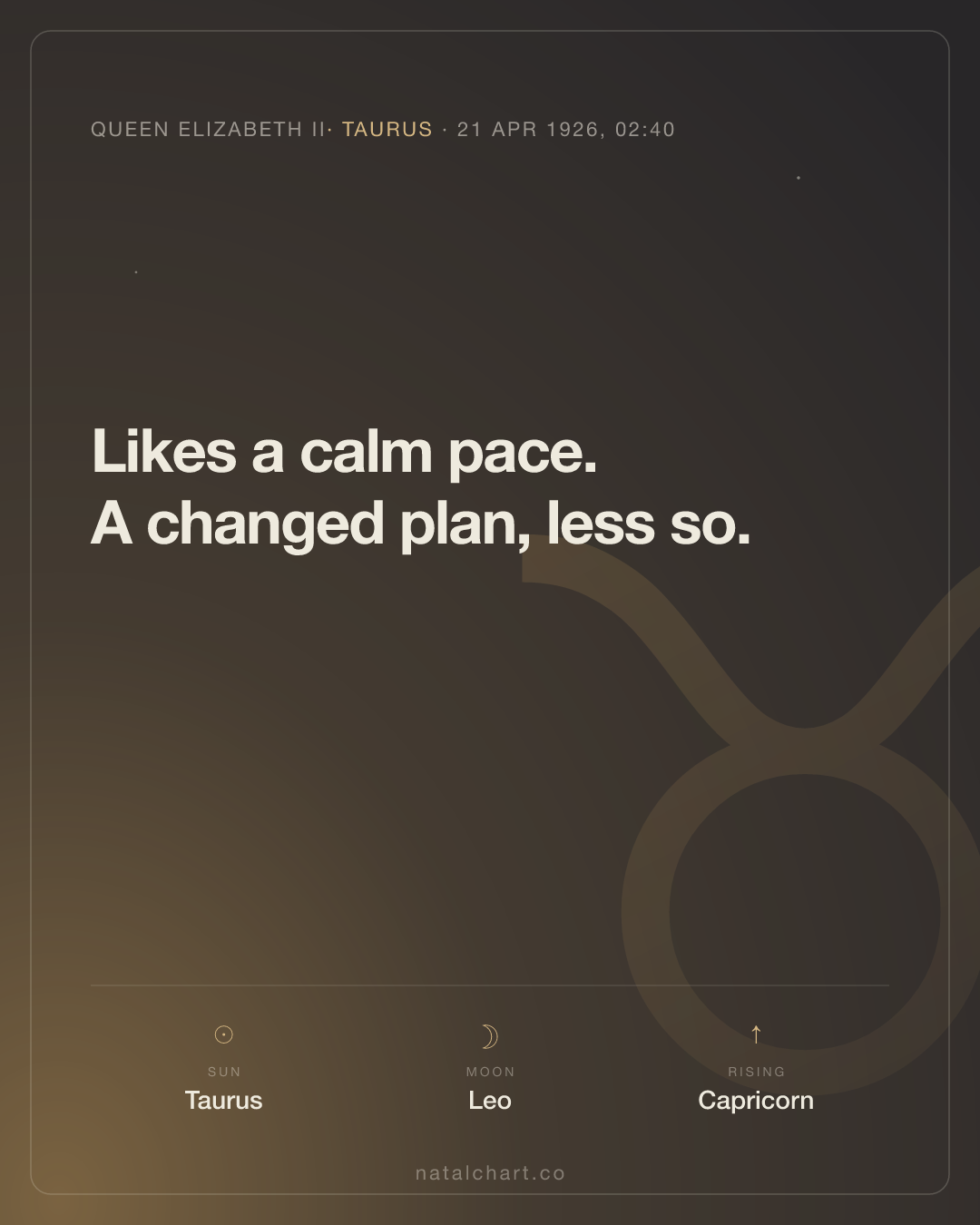
Queen Elizabeth II's Sun sign is Taurus — the Sun was in Taurus at birth (1926).
What is Queen Elizabeth II's moon sign?
Queen Elizabeth II has the Moon in Leo. The Moon sign describes the emotional and instinctive layer of the chart.
What is Queen Elizabeth II's rising sign?
Queen Elizabeth II's rising sign (ascendant) is Capricorn — the sign on the eastern horizon at the moment of birth.
When and where was Queen Elizabeth II born?
Queen Elizabeth II was born in 1926 in Mayfair, London.