Hilda Hilst — natal chart
What does Hilda Hilst’s natal chart reveal?
Brazilian writer born in 1930. Her work blends poetry, erotic fiction and philosophy. Published more than forty books, including A Obscena Senhora D and the 1990s obscene trilogy. Lived in seclusion at Casa do Sol in Campinas. Died in 2004.
 Share
Share
Birth
1930-04-21 · 22:45 · Jaú, São Paulo Reliability: A · reliable data
The Core
Hilda Hilst spent more than two decades living in near-total seclusion at Casa do Sol, the farmhouse outside Campinas she built in 1966, and almost never regretted it. That voluntary disappearance from public life was not eccentricity. It was the natural expression of a chart built around depth, discipline, and an absolute refusal to dilute. Saturn in Capricorn sits right on her Ascendant (the face she presented to the world), exact and unyielding. Saturn on the Ascendant means that first impressions run toward gravity rather than warmth, that the person takes their responsibilities very seriously, and that they tend to build things meant to last. What Hilst built at Casa do Sol — over forty books of poetry, erotic fiction, and philosophical prose — was meant to outlast her, and it has.
The Ascendant and the Mask
Capricorn rising, ruled by Saturn in the same sign, gives a portrait of someone who appears older than their years from early on, who earns trust slowly and keeps it permanently, and whose work is the primary lens through which they understand themselves. The Ascendant is the face the world meets; Capricorn's face is measured, serious, occasionally intimidating. This was the Hilst people met in public — angular, unsentimental, with no appetite for small talk or literary politics. Saturn square Uranus (the tightest hard aspect in the chart, just 0.6 degrees) tells a more complicated story. Uranus in Aries in the fourth house, the house of home and private foundations, means that underneath the Capricorn composure there was a genuine revolutionary: impatient, restless, willing to blow up what was not working. The tension between the two (structure versus disruption, endurance versus radical overhaul) drove her career into directions no one expected. The erotic trilogy of the 1990s — Obscena Senhora D, Contos d'Escárnio, Cartas de um Sedutor — detonated the careful literary reputation she had spent decades building, deliberately. This was Saturn-Uranus in action: she built the fortress, then dismantled it from inside.
Inner Life
The Moon in Aquarius in the second house describes an emotional interior that works with ideas rather than feelings in the conventional sense. Aquarius Moon tends to observe rather than immerse, to feel the pull of the collective (humanity, the species, the long view) more keenly than personal sentiment. This is not coldness — it is a different register of care. Hilst wrote about love, the body, death, and God not as personal confession but as universal investigation. The Moon forms an easy relationship with Uranus and Jupiter, meaning these Aquarian instincts for independence and the larger picture were well-supported by her sense of intellectual expansion and her capacity for creative surprise. Living at Casa do Sol, surrounded by animals and a handful of devoted friends rather than the São Paulo literary world, suited this placement exactly. Aquarius Moon does not thrive in conventional social structures; it thrives in the self-chosen community.
The Creative Life
The fifth house — the house of creative expression, artistic output, and the work that comes from deep pleasure — contains four planets: the Sun in Taurus, Mercury in Taurus, Venus in Taurus, and Chiron in Taurus. Mercury and Venus are separated by only 0.6 degrees, meaning the mind (Mercury) and the sense of beauty (Venus) were effectively fused. In Taurus, this fusion is embodied: language was tactile, sensory, earthy; it cared about texture and weight. Hilst did not write in abstractions. Her prose and poetry have a physical quality — words feel handled, turned over, tested for weight. The Sun trine Neptune (just 0.3 degrees, the tightest easy relationship in the chart) tells the other half of this story. Neptune dissolves borders and lets the visionary in. Hilst spent years in serious engagement with mystical literature and metaphysical questions — not as ornament but as genuine investigation. The trine to Neptune in the ninth house (the house of philosophy and the search for larger meaning) means this visionary capacity came easily and sustained her across decades. The erotic and the sacred, the dirty and the transcendent — she refused to keep them separate, and the chart shows why.
Chiron: The Creative Wound
Chiron (an asteroid whose position in the chart marks an old wound that, when worked through, becomes a distinctive strength) sits in Taurus in the fifth house alongside the Sun, Mercury, and Venus. The fifth house is the house of play, pleasure, and the creative impulse. Chiron there suggests that the act of creating was never purely joyful — that it carried a wound around whether the work was good enough, real enough, worthy of the pleasure it demanded. Hilst's deliberate turn toward obscene and erotic literature in the 1990s, which she called an attempt to finally be read, was a Chiron move: going directly toward the wound, making the discomfort itself into the work. That the literary establishment was largely horrified confirmed something she had suspected for decades.
Mercury and the Mind
Mercury in Taurus in the fifth house, joined to Venus, describes a mind that works slowly and carefully, that does not rush to conclusions, and that finds its clearest thinking through sensory engagement — writing by hand, living close to the physical world, letting images arrive in their own time. Mercury in Taurus is rarely brilliant in the flashy sense, but it is extraordinarily precise and patient. Mercury forms an easy relationship with Pluto (the planet of depth, transformation, and what cannot be unsaid), which in the seventh house (the house of encounter with the other) suggests that her writing was always oriented toward an extreme confrontation with the reader. She was not interested in being liked; she was interested in being met. The easy relationship between Mercury and Pluto meant she had the language for the deepest material — she could go there without losing her way.
Love, Venus, and the Body
Venus in Taurus in the fifth house is Venus in the sign she governs, which means the aesthetic instinct was strong, consistent, and uncompromising. Hilst loved beauty in the concrete sense: flowers, animals, food, the rhythm of a well-made sentence. The Taurus Venus in the fifth house also describes a person for whom physical pleasure and creative pleasure were not really separate — the body was not an obstacle to spiritual or intellectual life but its ground. The erotic writing of her final decades was not shock for its own sake; it was Taurus Venus making an argument that the physical is the sacred. Venus's easy relationship with Pluto in the seventh reinforces this: love and desire were always connected to depth, to transformation, to something that left both parties changed.
Jupiter, Saturn, and the Long Game
Jupiter in Gemini in the sixth house, the house of daily work, routines, and craft, describes an expansive approach to the day-to-day practice of writing. Gemini Jupiter multiplies: it wants variety, curious detours, the connection between unlike things. More than forty books across genres — poetry, prose, drama, philosophical dialogue, erotic fiction — this is Gemini Jupiter at work. Jupiter forms easy relationships with both Uranus and the Moon, meaning the intellectual restlessness and the emotional instinct for independence reinforced each other. Saturn in Capricorn on the Ascendant provided the container: the discipline, the refusal of shortcuts, the willingness to work for decades without mainstream recognition. The two together — Gemini Jupiter's abundance and Capricorn Saturn's patience — produced one of the most formally various and long-sustained bodies of work in Brazilian literature.
Vocation and the Public Point
The Midheaven (the public and career point in the chart) is in Libra, the sign of aesthetics, balance, and the considered relationship between form and content. Libra's Midheaven describes a public identity built around beauty and craft, around the idea that form is not separate from meaning. Neptune in Virgo in the ninth house sits in an easy relationship with the Sun and in an earth-to-earth resonance with several fifth-house placements; the search for philosophical truth was always grounded in practice, in detail, in the work itself rather than in pure abstraction. Pluto in the seventh house, in Cancer, describes a relationship with the reading public that was never neutral — it was always charged, intimate, and ultimately transformative. Readers of Hilst tend to report that the encounter changed them. This is seventh-house Pluto doing exactly what it does.
North Node and the Direction of Growth
The North Node (the point in the chart that marks the direction of growth in this life, the unfamiliar territory worth moving toward) is in Taurus. For someone whose chart was already so saturated with Taurus (Sun, Mercury, Venus, Chiron all in that sign), this feels like confirmation rather than challenge: the work was always to build something real, lasting, and sensory — to make the abstract tangible, to make the philosophical physical. That she spent her last decades trying to reach a broader audience (the erotic books were explicitly an attempt to be read) was the North Node pushing her toward the Taurus question: does this work, does it have weight, does it touch someone? The answer arrived after her death, when Brazilian readers finally came to her in large numbers.
A Warm Close
Hilda Hilst's chart is the portrait of someone who built a life of extraordinary rigor and paid for it in ordinary recognition, at least while she was alive. Saturn on the Ascendant carried her through decades of near-silence; the fifth-house stellium kept the work luminous even when no one was reading it. The Saturn-Uranus tension, which drove her to dismantle her own reputation in the 1990s, was not a failure of judgment — it was exactly what a chart like this eventually demands. The Sun trine Neptune, the tightest easy aspect in her chart, points to the real through-line: a person with an unbreakable connection to something larger than the literary moment, who wrote in the patient faith that the work would outlast the indifference. It did.
The chart
How to read it →Frequently asked questions
What is Hilda Hilst's zodiac sign?
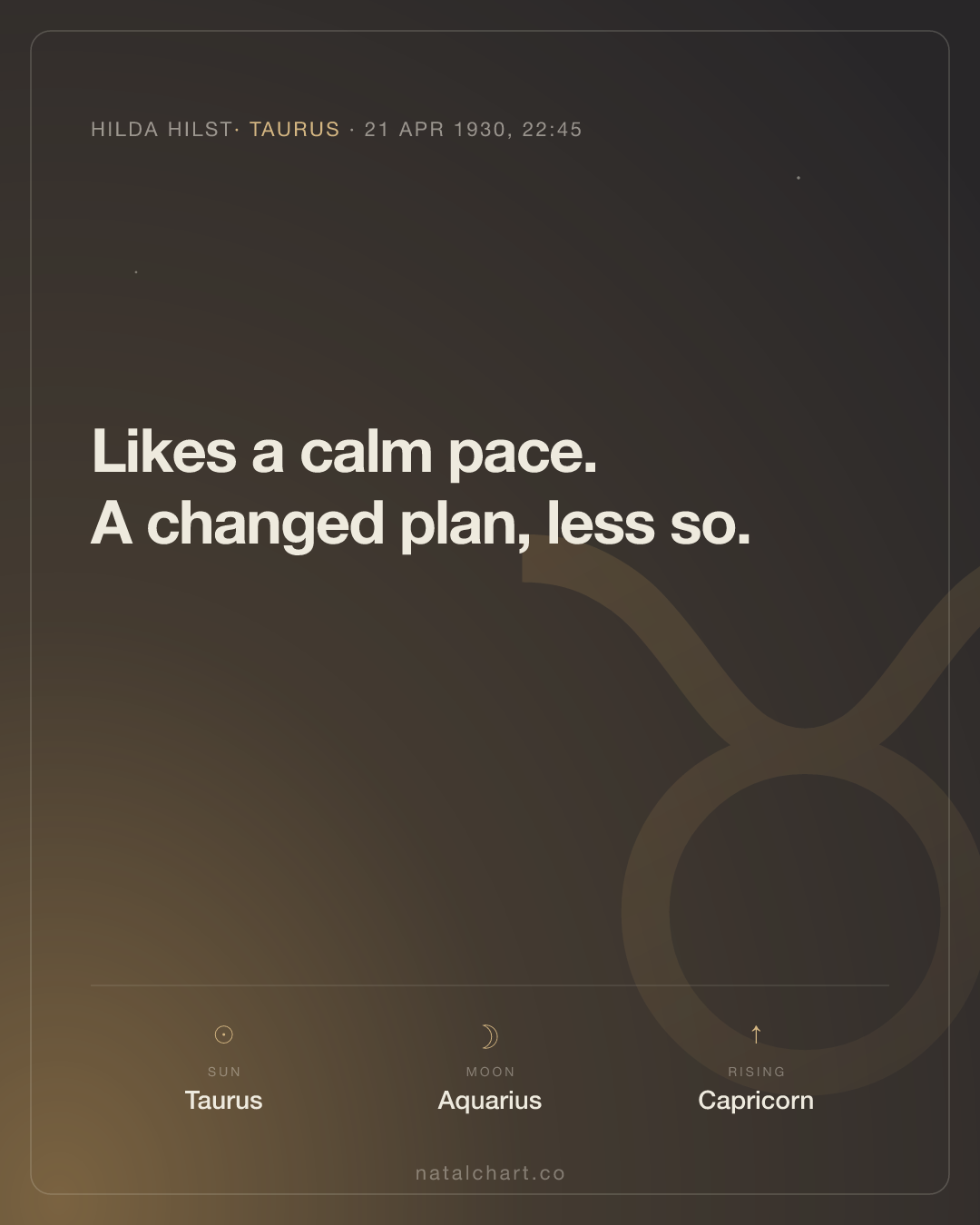
Hilda Hilst's Sun sign is Taurus — the Sun was in Taurus at birth (1930).
What is Hilda Hilst's moon sign?
Hilda Hilst has the Moon in Aquarius. The Moon sign describes the emotional and instinctive layer of the chart.
What is Hilda Hilst's rising sign?
Hilda Hilst's rising sign (ascendant) is Capricorn — the sign on the eastern horizon at the moment of birth.
When and where was Hilda Hilst born?
Hilda Hilst was born in 1930 in Jaú, São Paulo.