Salvador Dalí — natal chart
What does Salvador Dalí’s natal chart reveal?
Salvador Dalí, born Salvador Domingo Felipe Jacinto Dalí i Domènech on May 11, 1904, in Figueres, Catalonia, was a central figure of Surrealism. His best-known painting, The Persistence of Memory (1931), with its melting clocks set in a dreamlike landscape, became one of the most reproduced images of twentieth-century art. He also worked in sculpture, film—collaborating with Luis Buñuel on Un Chien Andalou (1929)—and stage design. In 1974 he opened the Dalí Theatre-Museum in Figueres, an institution he designed himself. Dalí died on January 23, 1989, in Figueres.
 Share
Share
Birth
1904-05-11 · 08:45 · Figueres, Catalonia Reliability: AA · vetted record
The Stubborn Visionary: A Taurus Sun in the Eleventh House
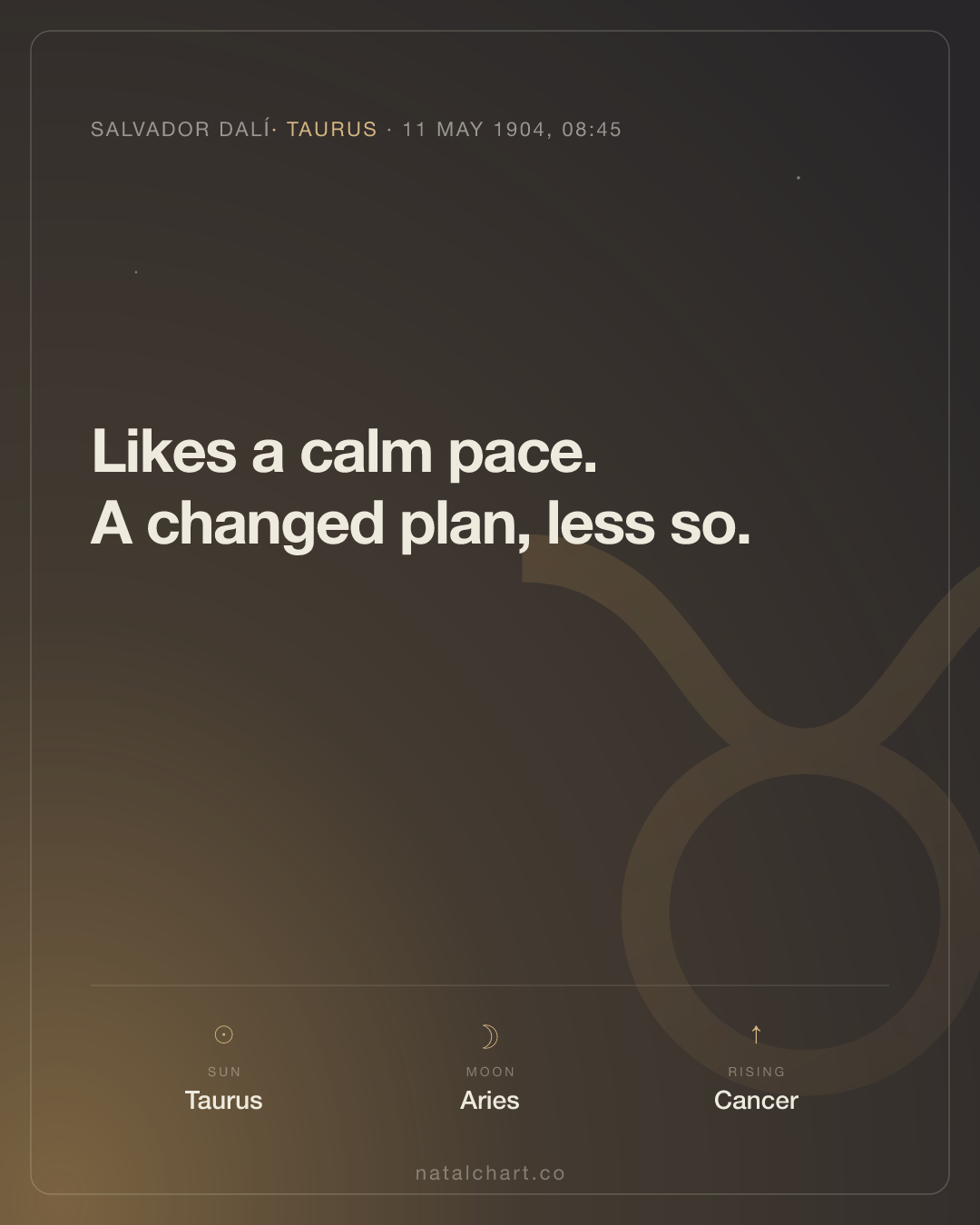
There is something fitting about the most flamboyant artist of the twentieth century being born under Taurus — a sign associated with persistence, the physical world, and an almost obsessive relationship with material form. Salvador Dalí's Sun in Taurus in the eleventh house placed his identity at the intersection of the concrete and the collective: what he built was real, tactile, permanent, and addressed to the world at large. The Persistence of Memory (1931) — those melting clocks draped over a dream landscape — made its argument through paint and precise draughtsmanship, not abstraction. The image stayed because it was made to last.
The eleventh house is the domain of the collective, the audience, the public idea. Dalí did not simply paint; he turned himself into a figure, a brand, a theatrical event. He understood that an artist's relationship with the public was its own art form, and he worked it with the same deliberateness he brought to the canvas.
A Constellation in Taurus: Mercury, Venus, and Mars Joined
Dalí had four planets in Taurus — Sun, Mercury, Venus, and Mars — all clustered in the eleventh house. This kind of concentration is not a trait; it is a gravitational field. Everything converged on the same set of qualities: the physical, the sensory, the enduring, the material transformed into meaning.
Mercury and Mars were joined within 1.7 degrees (a conjunction — two planets operating as one force): thought and action, word and drive, idea and the compulsion to make it real. In Taurus, this conjunction had a particular texture — slow in formation, immovable once decided. Dalí's famous declarations and provocations were not impulsive; they were considered, loaded, and delivered for maximum impact. When he said things designed to shock, he knew exactly what he was doing.
Venus in Taurus in the eleventh house — Venus in the sign it rules most comfortably — gave him a deep attunement to beauty as a physical force, something felt in the body before it was understood by the mind. His paintings are sensory before they are intellectual: the melting watches, the elephants on spindly legs, the impossible landscapes — they register as physical sensations first.
The Emotional Interior: Moon in Aries, Tenth House
While the outer world saw Taurus solidity, Dalí's emotional interior — shown by the Moon — was Aries in the tenth house: impulsive, urgent, competitive, needing to be first and to be seen. Aries Moon does not wait. It reacts before reflecting, feels before analyzing. In the tenth house, the zone of public life and reputation, this Aries urgency was constantly in play.
The square between Moon and Neptune (orb 1.6° — very close) made the emotional landscape complex. Neptune softens and blurs, while Aries wants clarity and movement. The result is a person whose inner experience was richer and more chaotic than the polished surface suggested — someone who felt things with high intensity, but who could also be genuinely confused about what he felt and what was a performance of feeling. Dalí's persona — the waxed mustache, the cane, the theatrical entrances — may have been partly a container for emotions too large and too unstable to carry in plain view.
The Moon also squared Uranus (orb 3.1°), adding a current of unpredictability: moods that shifted without warning, a nervous energy beneath the showman's composure.
The Face He Showed the World: Cancer Ascendant
The Ascendant (the rising sign at birth) is the face a person presents at first meeting — the quality that others encounter before they know anything else. Dalí's was Cancer: receptive, attuned, protective, and capable of tremendous sensitivity that did not always show itself directly. Cancer Ascendants often build shells around a soft center — not out of deception, but out of a genuine need to protect what is most vulnerable.
Neptune was in Cancer in the first house — right at the Ascendant itself. Neptune here is the planet of imagination, illusion, and the dissolution of boundaries: the image he projected was always slightly mythological, always larger and more ambiguous than the person inside. The young artist from Figueres became Dalí — a figure that was impossible to fully disentangle from the work, the legend, and the self-creation.
Mind and Method: Mercury Conjunct Mars in Taurus
Mercury governs thought, communication, and the structure of ideas. In Taurus, joined with Mars, Dalí's mind worked through the physical: he thought in images, in textures, in the precise visual weight of one object against another. The double negative, the paradox, the image that destabilizes its own logic — Un Chien Andalou (1929), made with Luis Buñuel, operated exactly this way. The film does not argue; it confronts.
The square between Mercury and Saturn (orb 2.8°) introduced friction: ideas met resistance, expression met limits. Saturn in the eighth house in Aquarius suggests that some subjects — the uncanny, the hidden, the transformative — demanded more precision than others. This tension was productive. The strictness of Dalí's technique — his insistence on the handcraft of painting at a time when many of his peers were abandoning it — may be Saturn insisting that the wild Mercurial imagination be anchored in something real and made.
Values and Beauty: Venus in Taurus, Sextile Neptune
Venus in Taurus in the eleventh house (in the sign it rules most harmoniously) was shaped by a sextile with Neptune (orb 0.6° — among the tightest aspects in the chart, a supportive relationship between two planets). This is the aspect of the artist who does not merely observe beauty but experiences it as something overwhelming and necessary — something that cannot be left alone. Neptune dissolves and expands; Venus in Taurus grounds and shapes. Together, they produced work that was at once grounded in precise technique and suffused with a quality of dream, liquidity, and unreality.
Galá — Elena Dmitrievna Diakonova, whom he met in 1929 — became inseparable from this Venus. She was his muse, his business manager, his emotional stabilizer, and his subject. He painted her dozens of times across decades. The devotion was total and idiosyncratic, very much in the spirit of a Taurus Venus: permanent, physical, singular.
Drive and Ambition: Mars in Taurus, Saturn Square Sun
Mars in Taurus has the drive that does not sprint but does not stop. It is the capacity for sustained, methodical effort — the kind that produces an artist whose technical control never slipped even as the imagery became more extreme. The Mars-Mercury conjunction in Taurus gave the ambition an intellectual quality: Dalí was not merely competitive for status; he was competitive in ideas, in theories, in the desire to be the one who articulated something no one else had seen.
The square between Sun and Saturn (orb 0.4° — the tightest aspect in the chart, a precise and unrelenting tension) is the most structurally significant feature of the nativity. Saturn squares the Sun: the sense of self meets resistance, authority, and the demand to prove itself. This aspect in a life often produces someone who works harder than necessary because the inner critic never fully quiets — who achieves enormously while always feeling, somewhere, that what they have built must be defended and justified.
Dalí was expelled from the Surrealist group by André Breton in 1934, accused of political and commercial opportunism. His response was to build an even larger public presence, to open his own museum in 1974, to become the institution himself. That is a Saturn-square-Sun response: when the establishment rejects you, you become the establishment.
Jupiter and Saturn: Scale and Structure
Jupiter in Aries in the tenth house — joined with the Moon — brought expansiveness and ambition to the public sphere. This is not a private Jupiter; it is one that wants recognition, impact, and scale. The Dalí Theatre-Museum in Figueres, which he designed himself and opened in 1974, is a Jupiter-in-the-tenth statement: the legacy is not a body of work stored elsewhere, it is a physical monument in the town where he was born.
Saturn in Aquarius in the eighth house — sextile Pluto (orb 1.2°), trine Pluto (in the context of the generational configuration) — gave a long view of transformation. The eighth house concerns inheritance, depth, and the psychology beneath the surface. Saturn here tends to produce serious engagement with subjects others find uncomfortable: death, obsession, the mechanics of the uncanny. Dalí's intellectual frameworks — his use of Freudian theory, his "paranoiac-critical method" — were Saturnian in their systematic rigor applied to Neptunian material.
The Outer Planets: Generational Forces Made Personal
Uranus in Sagittarius in the sixth house introduced an element of erratic unpredictability into the daily work — the creative method that could not be standardized, the working habits that others found impossible to follow or predict. The Surrealist techniques of free association and deliberate irrationality were given structure by the Taurus planets; the Uranus in Sagittarius provided the philosophical and slightly anarchic fuel.
Pluto in Gemini in the twelfth house — sextile Jupiter (orb 2.6°) — points to hidden depths of intellectual power and transformation. The twelfth house is what operates below the threshold of visibility. In a long career, the deepest shifts in Dalí's thinking — his religious turn in the late 1940s, his interest in nuclear physics and mathematics after Hiroshima — came from somewhere that was not fully visible in the public persona.
Vocation and Public Identity: Moon in Aries at the Midheaven
The Midheaven (the top of the chart, the point associated with career and public standing) was in Aries, with the Moon sitting in the tenth house. Aries at the Midheaven announces itself: it is the signature of someone who leads, who initiates, who makes the first move in a field. In Dalí's case, he did not follow Surrealism — he arrived, remade it, was expelled from it, and then proceeded to outlast it. The Moon's presence near the Midheaven made the public face emotionally charged and highly visible: what he felt translated directly into how the world knew him.
Chiron (a symbol of an old wound that gradually becomes a source of skill and teaching) was in Aquarius in the eighth house. The eighth house is the zone of what is hidden, shared, transformative, and irreversible. A wound in this territory is private and structural — not easily displayed, but shaping everything. Dalí's personal losses — his mother died when he was sixteen, his brother had died before he was born, the expulsion from his country during and after the Spanish Civil War — were not worn as symbols but absorbed into the work.
The North Node in Virgo: Craft as the Answer
The North Node (the lunar ascending node, a point indicating the direction a life tends to move toward) was in Virgo. Virgo is the sign of precision, craft, discernment, and the disciplined application of skill to material. Dalí's Aries Moon and his stellium of outer planet energies could have produced spectacle without substance. The North Node in Virgo is the corrective: growth came through taking the craft seriously, through the discipline of the hand, through the accumulated technical knowledge that made his paintings impossible to dismiss as mere novelty.
The paradox — and Dalí would have appreciated the paradox — is that the most irrational artist of his era was also one of the most technically accomplished. That combination did not happen by accident.
What Remains
Salvador Dalí's chart is one of unusual internal coherence: the Taurus stellium's insistence on materiality and permanence, the Aries urgency at the top of the chart pushing toward public impact, the Cancer Ascendant's Neptune-tinged protective shell, and Saturn's relentless discipline applied to Sun and Mercury both. These forces did not contradict each other — they organized around a single project: to take the contents of the irrational mind and make them, by force of technical mastery, permanently and physically real.
The Persistence of Memory is still in the Museum of Modern Art. The Dalí Theatre-Museum in Figueres still receives hundreds of thousands of visitors every year. These are Taurus outcomes: the work persists.
The chart
How to read it →Frequently asked questions
What is Salvador Dalí's zodiac sign?
Salvador Dalí's Sun sign is Taurus — the Sun was in Taurus at birth (1904).
What is Salvador Dalí's moon sign?
Salvador Dalí has the Moon in Aries. The Moon sign describes the emotional and instinctive layer of the chart.
What is Salvador Dalí's rising sign?
Salvador Dalí's rising sign (ascendant) is Cancer — the sign on the eastern horizon at the moment of birth.
When and where was Salvador Dalí born?
Salvador Dalí was born in 1904 in Figueres, Catalonia.