Roberto Carlos — natal chart
What does Roberto Carlos’s natal chart reveal?
Roberto Carlos Braga, born on April 19, 1941, in Cachoeiro de Itapemirim, Brazil, is a singer and songwriter widely regarded as one of the central figures of Brazilian popular music, often called "the King". In the early 1960s he helped lead the Jovem Guarda movement, a youth-oriented rock and pop style, and hosted a television programme of the same name. Many of his most enduring songs were co-written with Erasmo Carlos, including "Quero Que Vá Tudo Pro Inferno" (1965), "Detalhes" (1971), and "Emoções" (1981). From 1965 onward he released an album nearly every year, recording in Portuguese, Spanish, Italian, and English, which broadened his audience across Latin America and Europe. With sales estimated in the tens of millions, he ranks among the best-selling Latin music artists, and his annual end-of-year television specials became a fixture of Brazilian broadcasting.
 Share
Share
Birth
1941-04-19 · 10:00 · Cachoeiro de Itapemirim, Brazil Reliability: AA · vetted record
A voice built to last
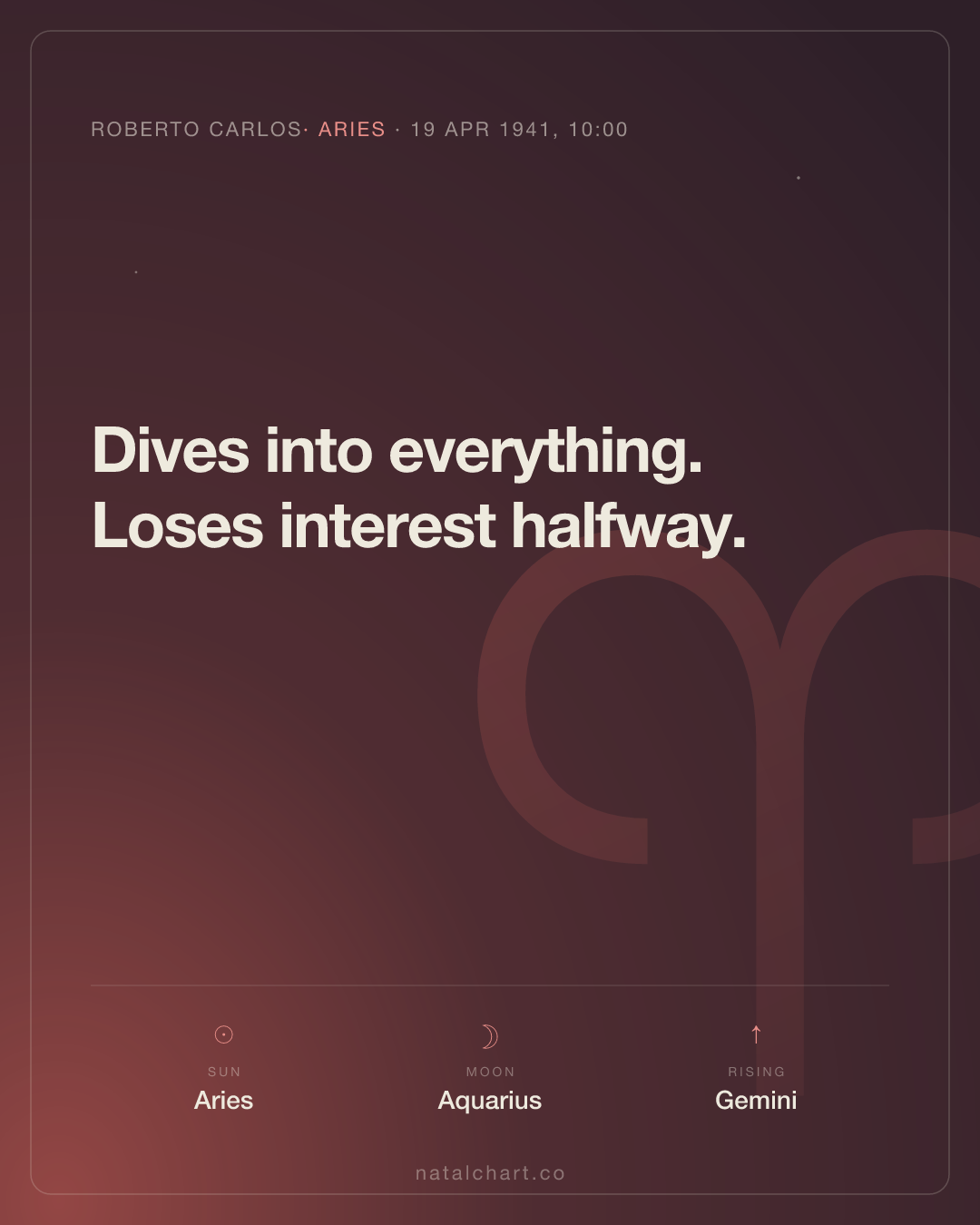
Roberto Carlos Braga was born on 19 April 1941 in Cachoeiro de Itapemirim, Brazil, with the Sun in Aries joined by Venus less than a tenth of a degree away — one of the tightest conjunctions possible in a natal chart. When two planets share almost exactly the same degree, they become inseparable in how a person moves through the world: identity and beauty, self-expression and the need to create something worth loving, fuse into one drive. In Roberto Carlos, that drive produced over six decades of recorded music. The Ascendant is Gemini — the sign of the communicator, the adaptor, the person who finds connection through words and voice — and with the Midheaven (the public and career point) also in Aries, his professional identity carried the full fire of that Sun-Venus conjunction into everything he built for an audience.
Moon and Mars: feeling as fuel
The Moon in Aquarius in the ninth house — the house of distant horizons, foreign cultures, and the search for meaning — sits joined to Mars in the same sign and house. Moon and Mars sharing a sign already describes someone whose emotional life has a restless, forward-moving quality: feelings that don't settle, that push toward action and new territory. In the ninth house, this energy consistently turned outward. Roberto Carlos recorded in Portuguese, Spanish, Italian, and English; his audience spread across Brazil, Latin America, and Europe. That was not just commercial strategy — it was a Moon-Mars in Aquarius finding its natural scale. He didn't want a local stage.
Mercury in Aries: the direct line
Mercury in Aries in the eleventh house — the house of the public, of collective belonging, of the artist's relationship to a community — describes a communicator who leads with instinct rather than deliberation. The words come fast, the melody arrives before the analysis. Mercury in easy flow with both the Moon and Mars in Aquarius reinforced this: his songwriting with Erasmo Carlos worked as a partnership of quick impulse and intellectual spark, producing songs like "Detalhes" (1971) and "Emoções" (1981) that feel simultaneously spontaneous and precisely crafted. The eleventh house placement also helps explain the annual television special — a ritual return to the national community that lasted decades.
Sun and Venus in tension with Pluto
The Sun and Venus in Aries both pull against Pluto in Leo — a tension that runs through the core of this chart. Pluto sits in the third house, the house of communication, voice, and immediate environment. This aspect describes a creative force that does not rest at the surface: beauty in this chart carries weight, yearning, sometimes darkness. The songs that have lasted — "Quero Que Vá Tudo Pro Inferno" from 1965, which broke him nationally, or the aching directness of "Detalhes" — carry an undertow beneath their melodic brightness. That is the Pluto signature: creation as a form of confrontation with something that cannot simply be resolved.
Venus and the act of creation
Venus in Aries joined so tightly to the Sun makes love and art the same project. There is no meaningful distinction in this chart between "who he is" and "what he makes" — they are the same impulse expressed in different forms. The Sun-Venus energy in Aries is immediate, ardent, and direct; it does not circle around its subject. This shows in the emotional frankness of Roberto Carlos's best work, the willingness to be plainly romantic or plainly heartbroken without irony. The tension with Pluto, however, means that the romantic declaration always carries more underneath it — a longing for something total, not easily satisfied.
Jupiter, Saturn, and Uranus together
Jupiter, Saturn, and Uranus all fall in Taurus in the twelfth house — the house of what is done out of sight, of discipline that happens before the audience arrives. Three planets in the twelfth, all in the same sign, describe someone whose capacity for sustained work has been largely invisible to observers. The longevity of Roberto Carlos's career — an album nearly every year from 1965 onward — is exactly what Jupiter-Saturn in the twelfth house looks like in practice: steady, private investment in craft, not just talent. Uranus alongside them adds the innovation that stopped the catalogue from becoming routine: the progressive Jovem Guarda years, the experimental arrangements of the 1970s, the eventual turn toward Latin pop.
Neptune in the fourth house
Neptune in Virgo in the fourth house — the house of roots, home, and private foundation — places a quality of emotional subtlety and longing at the base of this personality. Neptune here does not announce itself; it operates quietly in the background, as a deep current of sensitivity that finds expression indirectly. For Roberto Carlos, born in a small city in Espírito Santo and then absorbed into the enormous world of São Paulo and international fame, this placement describes the persistent, private relationship with where one comes from — the root sound that stayed in the music even as the production styles changed.
Pluto in the third house
Pluto in Leo in the third house — the house of voice, language, and local communication — returns to the same theme: the voice as an instrument of transformation. Leo adds the performance dimension, the awareness of being watched and heard. Pluto amplifies this into something with real stakes. The Jovem Guarda television programme Roberto Carlos hosted in the 1960s was not just entertainment: it reorganised what Brazilian youth culture sounded like. Hosting a programme that changed a generation's musical references is the third-house Pluto expressing its full range.
North Node in Libra
The North Node — in astrology, the point that marks the direction of growth — falls in Libra. With so much Aries energy in this chart (Sun, Mercury, Venus, and the Midheaven all in the same sign), the growth path runs toward balance, partnership, and the art of meeting another person halfway. Roberto Carlos's most enduring creative partnership — with Erasmo Carlos, spanning decades and hundreds of songs — is a lived expression of that Libra North Node: the solo voice that found its fullest expression through collaboration.
Chiron in Cancer
Chiron — the point in a chart that marks an old vulnerability that slowly becomes a strength — sits in Cancer in the second house, the house of resources, livelihood, and what a person values in material terms. Chiron in Cancer in the second house describes an early relationship with security that was not simple: Cancer brings the themes of belonging and emotional safety; the second house asks whether one's gifts have real, durable worth. For an artist from Cachoeiro de Itapemirim who built one of the most commercially sustained careers in Latin American music history, this Chiron was worked through very publicly — the answer to that early uncertainty, delivered song by song over sixty years.
The portrait
Roberto Carlos built his career on a paradox: a voice that felt utterly intimate with whoever was listening, coming from a chart packed with the most public, outward-facing placements imaginable. The Sun and Venus in Aries on the Midheaven in Aries, blazing into the eleventh house of the audience, with a Moon-Mars in Aquarius reaching across cultural borders — this was never a private project. But the twelfth-house discipline and the fourth-house depth gave the music its weight, the sense that something real was at stake. That combination — full public presence rooted in private sincerity — is what made the annual television specials a fixture, what kept the records selling decade after decade. Not just popularity. Staying power.
The chart
How to read it →Frequently asked questions
What is Roberto Carlos's zodiac sign?
Roberto Carlos's Sun sign is Aries — the Sun was in Aries at birth (1941).
What is Roberto Carlos's moon sign?
Roberto Carlos has the Moon in Aquarius. The Moon sign describes the emotional and instinctive layer of the chart.
What is Roberto Carlos's rising sign?
Roberto Carlos's rising sign (ascendant) is Gemini — the sign on the eastern horizon at the moment of birth.
When and where was Roberto Carlos born?
Roberto Carlos was born in 1941 in Cachoeiro de Itapemirim, Brazil.