Rocío Jurado — natal chart
What does Rocío Jurado’s natal chart reveal?
Rocío Jurado, born María de la O Mohedano Jurado on September 18, 1944, in Chipiona, Spain, was a singer and actress regarded as one of the most important figures in Spanish popular music of the twentieth century. Known by the nickname la más grande (the greatest), she combined the traditional copla genre with pop and ballad styles across a career spanning five decades. Her signature recordings include Como una ola (1981) and Como yo te amo (1980). She appeared in over twenty films and performed regularly at venues in Spain and Latin America. Jurado was appointed an Officer of the Order of Isabel la Católica. She died in Madrid on June 1, 2006, following a long illness.
 Share
Share
Birth
1944-09-18 · 12:00 · Chipiona, Spain Reliability: AA · vetted record
The Core: Precision in Service of Feeling
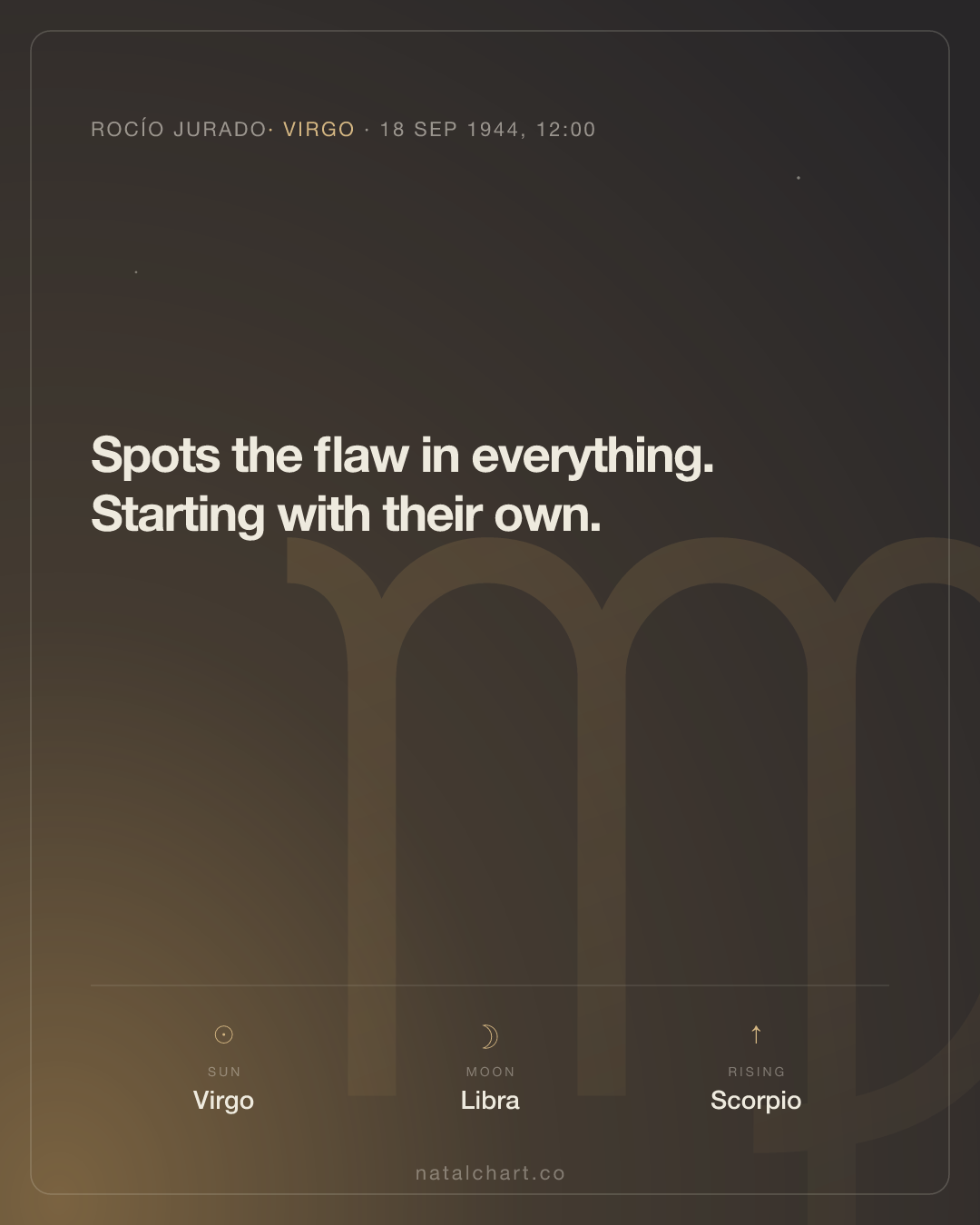
Rocío Jurado was known as la más grande — the greatest — and the chart of someone who carries that title without irony tends to be one where structure and feeling have learned, over a long career, to work together rather than against each other. The Sun in Virgo in the eleventh house places the central identity in a very specific context: the collective, the audience, the community of people who listen. Virgo is the sign of craft, of the detail that makes the difference, of an attention to quality that never quite relaxes. In the eleventh house, that Virgo precision was directed outward — not toward private perfectionism but toward the people in the room, the listeners, the public that became her life's work over five decades.
The Ascendant in Scorpio — the face she showed the world, the quality people sensed before she had said anything — added intensity and penetration to that Virgo steadiness. Scorpio does not perform lightly. It goes deep, it holds nothing back emotionally, it makes what it touches feel real. Jurado's voice had that quality: technically refined and emotionally unguarded at the same time. When she sang the final verses of Como una ola (1981), the technique was invisible — what remained was the feeling, raw and present.
The Moon: Private Depth in Public Places
The Moon in Libra in the twelfth house is a somewhat paradoxical placement for someone whose professional life was defined by public performance. The twelfth house is the house of what is hidden, what is carried inward rather than expressed outward — the life that happens offstage. The Moon in Libra here suggests an emotional world oriented toward beauty, harmony, and connection but lived largely in private. Jurado was a deeply public figure whose inner life remained, by all accounts, fiercely her own.
Venus joins the Moon in Libra in the twelfth house, and Neptune is there too — three planets in the house of the hidden. This is an unusual concentration: it describes someone whose richest emotional experience happened away from the lights, in the quieter moments. The Moon's closeness to Neptune (a little over a degree apart — a configuration where the boundary between imagination and feeling blurs) gave her performances their dreamlike quality, the sense that she was not just delivering a song but inhabiting a world.
Mercury and Jupiter: The Mind That Magnifies
Mercury in Virgo in the eleventh house, positioned close to Jupiter in the same sign and sector, describes how Jurado thought about her work and communicated it. Virgo Mercuiry is exacting — it notices the word that is not quite right, the phrase that could be more precise. But Mercury and Jupiter together in the eleventh house have an expansive quality: the capacity to take detailed observations and project them outward, to make the specific feel universal. This is exactly what the great copla singers do — take a very particular story, a single woman's grief or longing or defiance, and make a whole audience recognize it as their own.
Mercury's easy relationship with Saturn — at less than a degree, one of the tightest configurations in the chart — sharpens this further. Saturn adds discipline, long memory, the willingness to return to the same material until it is exactly right. Jurado was known for an approach to her repertoire that was both faithful and demanding: she could sing Como yo te amo (1980) hundreds of times across a career and bring it the same weight each time.
Mars and Venus: The Engine and the Refinement
Mars in Libra in the twelfth house — joined exactly to Uranus in Gemini in the eighth house in an easy flowing connection (at barely a tenth of a degree, the tightest aspect in the entire chart) — is striking. Mars and Uranus flowing together produce an impulsive, electric quality to action; when that connection runs between Libra and Gemini it operates through communication, through the voice, through the intelligent handling of material. The tightness of this aspect (0.1°) is unusual and says something about the degree to which her vocal and performing instincts were wired for the unexpected — a spontaneity within discipline that kept fifty years of performances alive.
Mars in tension with Saturn (in Cancer in the ninth house) introduces a counter-pull: the expansive, open-hearted quality of Mars in Libra meeting the caution and structure of Saturn in Cancer. This tension between free expression and disciplined restraint was not a flaw in Jurado's artistry — it was its architecture. The emotional openness was real; the structural command that held it in place made it communicable.
Pluto at the Midheaven: Power and Vocation
Pluto in Leo in the tenth house — the tenth house is the career and public standing point, and the Midheaven in Leo sits here too — is a signature of someone whose public presence carries genuine transformative weight. Leo at the Midheaven means the vocation was performance itself, the warmth and authority of the stage; Pluto in the same house means that presence was not decorative. It changed things. Jurado did not simply entertain audiences — she moved them, and the copla genre, a form associated with grief, longing, and survival, was exactly the vehicle for this kind of transformation. She was appointed an Officer of the Order of Isabel la Católica in recognition not just of her artistry but of what it meant culturally.
A career spanning more than five decades, over twenty films, and regular appearances across Spain and Latin America — Pluto in Leo in the tenth house is not a quiet placement, and it was not a quiet life.
Saturn and the North Node: The Long Work
Saturn in Cancer in the ninth house describes a relation to tradition that is both deep and sometimes difficult. Cancer holds what is inherited, what comes from the roots; Saturn asks that it be earned, not just assumed. The copla was a genre Jurado inherited, came from, and then made her own through decades of work. She did not arrive fully formed: she built the authority that came to define her. The ninth house — philosophy, the wider world, the long arc of meaning — gave this Saturn a quality of purpose. She was not simply maintaining a tradition; she was asking what it meant, what it could carry.
The North Node in Cancer — the point in a chart that indicates the direction of most authentic growth — pointed toward roots, nourishment, the home that is not a place but a quality of belonging. Jurado's art was saturated with this: the copla is a music of the south, of Andalusia, of a very specific cultural memory. She carried Chipiona with her everywhere she performed.
Chiron: The Craft as Healing
Chiron — an old wound that becomes, over time, a gift — falls in Virgo in the eleventh house, alongside the Sun, Mercury, Jupiter, and Lilith. This concentration in Virgo in the eleventh house tells a particular story: a wound around adequacy, around whether the work is good enough, around whether the audience — the community, the eleventh house — truly accepts what one offers. The gift that grew from this wound was visible in everything Jurado did: an obsessive refinement of craft, a refusal to settle, a perfectionism that was not vanity but care. The standard she set for herself made the standard she set for Spanish popular music.
Uranus and the Eighth House: What Endures
Uranus in Gemini in the eighth house — the house of transformation, of what survives loss — contributed an intellectual restlessness to a profile that might otherwise have been entirely traditional. Jurado combined the copla with pop and ballad styles not because it was fashionable but because that Gemini Uranus was genuinely curious, genuinely interested in what the old forms could carry when something new was brought to them. The eighth house dimension meant her art was always in some way about survival — about what outlasts the moment, what remains when the performance is over. She died in Madrid on June 1, 2006. Her recordings remain the best answer to that question.
A Final Note
Rocío Jurado's chart describes someone for whom craft and feeling were not opposites but partners — Virgo precision in service of Libra and Pisces depth, Scorpio intensity held in a framework of discipline and care. The Sun in the eleventh house says the audience was not incidental to her art: it was its destination. The copla is music that tells people their private griefs are shared, that what they have endured is not shameful but human. For five decades, Jurado was the person who delivered that message with the authority and warmth it required. That she is still called la más grande long after her death is the clearest possible confirmation of what this chart promised.
The chart
How to read it →Frequently asked questions
What is Rocío Jurado's zodiac sign?
Rocío Jurado's Sun sign is Virgo — the Sun was in Virgo at birth (1944).
What is Rocío Jurado's moon sign?
Rocío Jurado has the Moon in Libra. The Moon sign describes the emotional and instinctive layer of the chart.
What is Rocío Jurado's rising sign?
Rocío Jurado's rising sign (ascendant) is Scorpio — the sign on the eastern horizon at the moment of birth.
When and where was Rocío Jurado born?
Rocío Jurado was born in 1944 in Chipiona, Spain.