Serge Gainsbourg — natal chart
What does Serge Gainsbourg’s natal chart reveal?
Serge Gainsbourg, born Lucien Ginsburg on 2 April 1928 in Paris, was a French singer, songwriter, composer, and filmmaker, widely regarded as one of the most influential figures in French popular music. The son of Russian-Jewish immigrants, he began as a painter and cabaret pianist before turning to songwriting. He wrote provocative, literate hits including "Le Poinçonneur des Lilas" (1958), "La Javanaise" (1963), and the scandal-laden duet "Je t'aime... moi non plus" (1969) with Jane Birkin. His 1971 concept album "Histoire de Melody Nelson" became a landmark, and his 1979 reggae version of "La Marseillaise" caused national controversy. He died in Paris on 2 March 1991, leaving a body of work that reshaped French chanson.
 Share
Share
Birth
1928-04-02 · 04:55 · Paris, France Reliability: C · uncertain Birth time (4:55 AM) comes from astrological databases (Gauquelin); other sources cite 4:35 AM, so it is not fully reliable.
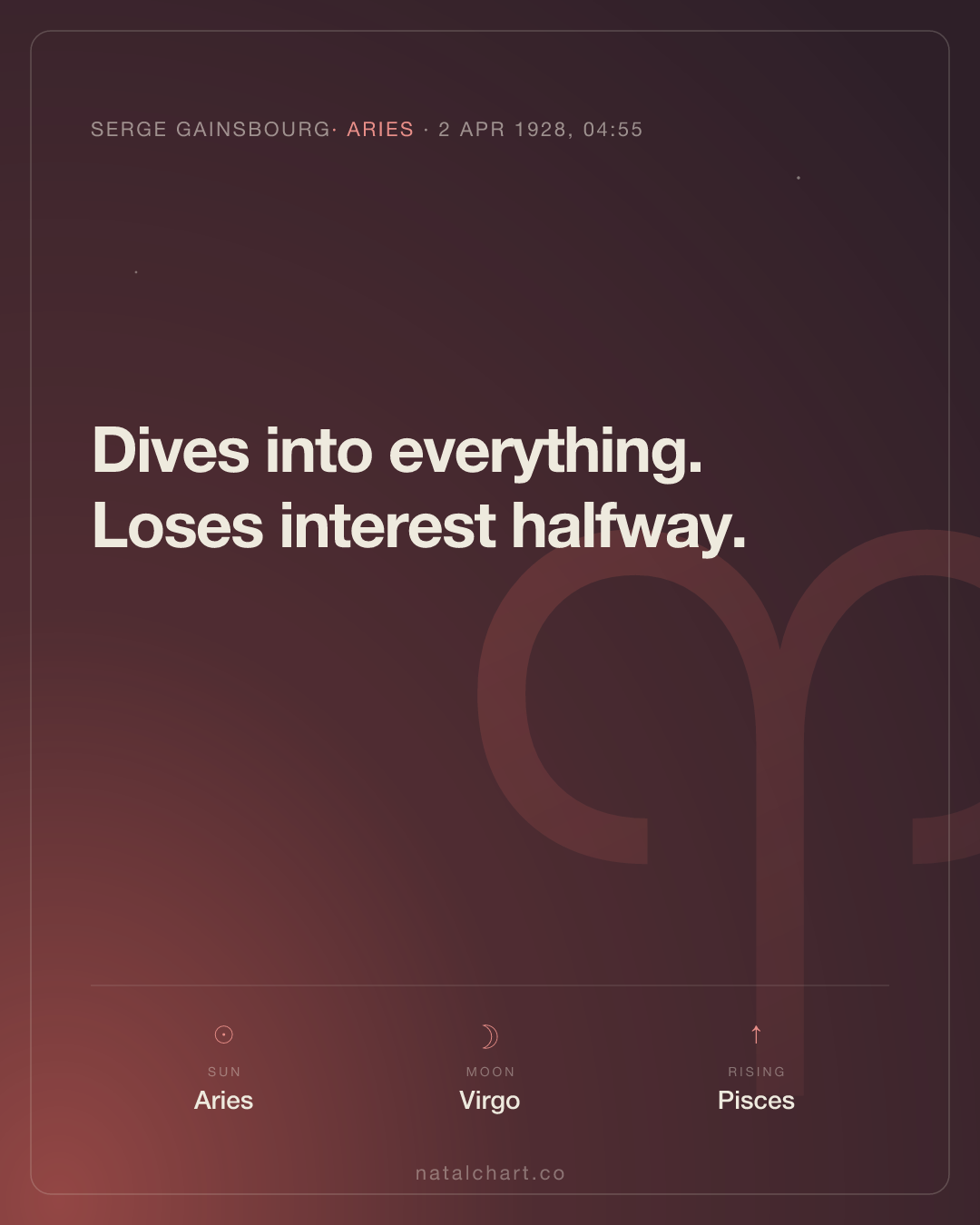
A Pisces mask over an Aries fire
Serge Gainsbourg was, by his own account, a man who didn't match his face — and the birth chart born at 4:55 in the morning on 2 April 1928 explains exactly why. The Ascendant in Pisces (the face he met the world with, the first impression) gave him the look of someone fluid, slightly blurred at the edges, hard to pin down — the aesthetic of a man who drifted between genres, between personae, between provocations. But underneath that dissolving surface was an Aries Sun in the second house: focused, combative, driven by a ferocious will to build something of value and to have it be recognized as such. The Aries Sun is joined by Jupiter and Uranus in the same sign — three planets in Aries in the house of personal worth. The man born Lucien Ginsburg, son of Russian-Jewish immigrants who had fled persecution, did not take his place in French culture for granted. He seized it, and he kept it, and he refused to relinquish it no matter how many times the establishment tried to look away.
The emotional interior
The Moon in Virgo in the seventh house — the house of partnership and public encounter — reveals the emotional register Gainsbourg rarely showed in interviews but expressed constantly in his work. Virgo is a precise, analytical, deeply observant sign: it catalogues detail, it notices what others miss, it is made uncomfortable by vagueness. The seventh house places that observation in relation to other people. Gainsbourg's lyrics are a masterclass in Virgo Moon craft: "Le Poinçonneur des Lilas" (1958) is a portrait of a metro worker so precise in its detail — the tiny holes, the routine, the numbing repetition — that it functions simultaneously as a pop song and as a sociological study. He watched people with the patience of someone who had been watching since childhood, and what he saw, he wrote.
The written voice: Mercury and Venus in Pisces
Mercury and Venus are joined together in Pisces in the first house, very close to the Ascendant. Mercury here governs the mind and language; Venus governs beauty, desire, and what a person finds worth making. In Pisces, both operate through suggestion rather than statement, through sound and rhythm as much as through literal meaning. Their closeness — less than two degrees apart — means that for Gainsbourg, language was always also seduction: the sound of a word mattered as much as its dictionary definition. "La Javanaise" (1963) is perhaps the purest demonstration of this: the lyrics are structured around a sound pattern (the syllable "ja") so insistently that the ear falls into a kind of hypnosis before the mind has fully processed the meaning. Mercury also forms an easy, flowing connection with Pluto: the writing goes deep, reaches into things that most people prefer not to name.
Love, beauty, and the cost of Saturn
The tightest difficulty in the chart is Venus in Pisces pulling against Saturn in Sagittarius — less than a degree of tension between them. Saturn here sits at the top of the chart, in the house of public reputation and vocation: it is the planet of structure, limit, consequence, and the weight of what one has done. Venus in Pisces, by contrast, dissolves limits; it is the planet of music without borders, of love offered without conditions, of beauty for its own sake. These two in tension describe the central drama of Gainsbourg's life in public: the extraordinary romantic work — "Je t'aime... moi non plus" (1969) with Jane Birkin, the Histoire de Melody Nelson album (1971) — achieved precisely by going further than convention allowed, and then immediately confronting the cost of that boundary crossing. The radio ban, the national scandal, the controversy over his 1979 reggae reworking of "La Marseillaise" — each of these was a Venus-Saturn collision made public.
Mars against Neptune: the hidden battle
Mars in Aquarius sits in the twelfth house — the house of what is concealed, what operates below the surface. It opposes Neptune in Leo, which sits in the sixth house of daily life and work. Mars represents drive, assertion, the willingness to act and fight; Neptune represents what dissolves, what fogs, what idealizes. These two in opposition describe a man whose fighting spirit (Mars) was perpetually in dialogue with self-doubt and self-dissolution (Neptune). The twelfth house placement of Mars suggests that much of this battle happened in private. The public persona of the provocateur was, in part, a construction — a way of being visible and aggressive in controlled conditions while the deeper uncertainty remained hidden. The cigarettes, the drink, the deliberately abrasive television appearances: defenses as much as expressions.
The Jupiter-Pluto engine
The single tightest aspect in Gainsbourg's chart is Jupiter joined with Pluto in Cancer in the fifth house — half a degree of separation. Jupiter is expansion, confidence, the capacity to take up space; Pluto is transformation, intensity, the refusal of superficiality. In Cancer, they operate in the realm of feeling and memory. The fifth house is creativity, pleasure, what one makes for the sheer love of making. This combination describes the quality that distinguishes Histoire de Melody Nelson (1971) from almost everything else in French popular music of the era: it is not a collection of songs but a single transformation, an arc from desire through loss, arranged with a density that pop had not previously been asked to carry. Jupiter-Pluto does not do things small, and the fifth house means it pours all of that intensity into making.
Saturn at the Midheaven: a public career built on consequence
Saturn sitting at the Midheaven (the public point, the career axis, what the world sees and remembers) is one of the most significant placements in the chart. Saturn here says that reputation is built slowly, seriously, and through work that outlasts the moment. Gainsbourg did not arrive famous — he spent years as a cabaret pianist and journeyman songwriter before "Le Poinçonneur des Lilas" caught attention in 1958. The Midheaven in Sagittarius adds a quality of reach: the career crossed borders, genres, media (film, television, records), and decades. A Saturn Midheaven is also a placement that tends to leave a heavier legacy after death than during life — the reassessment of Gainsbourg's work since 1991 has been relentless and, by now, definitive.
Chiron and the North Node: craft over accident
Chiron (a point linked to an old wound that gradually becomes a kind of mastery) sits in Taurus in the third house — the house of language, communication, the everyday exchange of words. Taurus speaks of material craft, of things made with the hands and the senses, of patient accumulation. The wound here is one of voice and communication: Gainsbourg grew up a shy, self-described ugly child who discovered that what he could make with language was more powerful than what he looked like. The movement from Lucien Ginsburg to Serge Gainsbourg was a movement from wound to craft. The North Node in Gemini reinforces this: the direction of the life was always toward more range, more curiosity, more of the pleasure of playing with words and ideas across multiple registers.
What the whole chart says
Gainsbourg's chart is a portrait of a man who used a dissolving, fluid exterior (Pisces Ascendant) to get close enough to the world to observe it with unsparing precision (Virgo Moon, Mercury-Venus in Pisces, Mercury-Pluto flowing connection), and then deployed that observation as both a creative weapon and a kind of tenderness. The tension between Venus and Saturn, between Mars and Neptune, between the expansive Jupiter-Pluto engine and the disciplined Midheaven — none of these resolved; they simply generated. The provocations were real, but so was the care inside them. The man who scandalized France with "Je t'aime" was the same man who wrote Melody Nelson as a fully realized piece of musical literature. That is not a contradiction: it is a Pisces Ascendant over an Aries Sun doing exactly what the chart promised.
The chart
How to read it →Frequently asked questions
What is Serge Gainsbourg's zodiac sign?
Serge Gainsbourg's Sun sign is Aries — the Sun was in Aries at birth (1928).
What is Serge Gainsbourg's moon sign?
Serge Gainsbourg has the Moon in Virgo. The Moon sign describes the emotional and instinctive layer of the chart.
What is Serge Gainsbourg's rising sign?
Serge Gainsbourg's rising sign (ascendant) is Pisces — the sign on the eastern horizon at the moment of birth.
When and where was Serge Gainsbourg born?
Serge Gainsbourg was born in 1928 in Paris, France.