Sertab Erener — natal chart
What does Sertab Erener’s natal chart reveal?
Sertab Erener is a Turkish singer and songwriter born on 4 December 1964 in Istanbul. She studied opera at the Istanbul University State Conservatory before turning to pop music, beginning her career as a backing vocalist for the prominent Turkish artist Sezen Aksu. Erener released her debut solo album, Sakin Ol!, in 1992, followed by Lâl (1994), Sertab Gibi (1997) and a self-titled album in 1999, producing several number-one hits in Turkey. In 2003 she represented Turkey at the Eurovision Song Contest in Riga, Latvia, winning first place with 167 points and the song 'Everyway That I Can'. This marked Turkey's first victory in the competition, and she received the Turkish State Medal of Distinguished Service. In 2004 she issued the English-language album No Boundaries for international markets. She has continued recording, releasing the studio album Ben Yaşarım in 2020.
 Share
Share
Birth
1964-12-04 · 04:00 · Istanbul, Turkey Reliability: A · reliable data The ascendant is based on the most widely cited birth time for this figure.
The Voice That Crosses Every Border
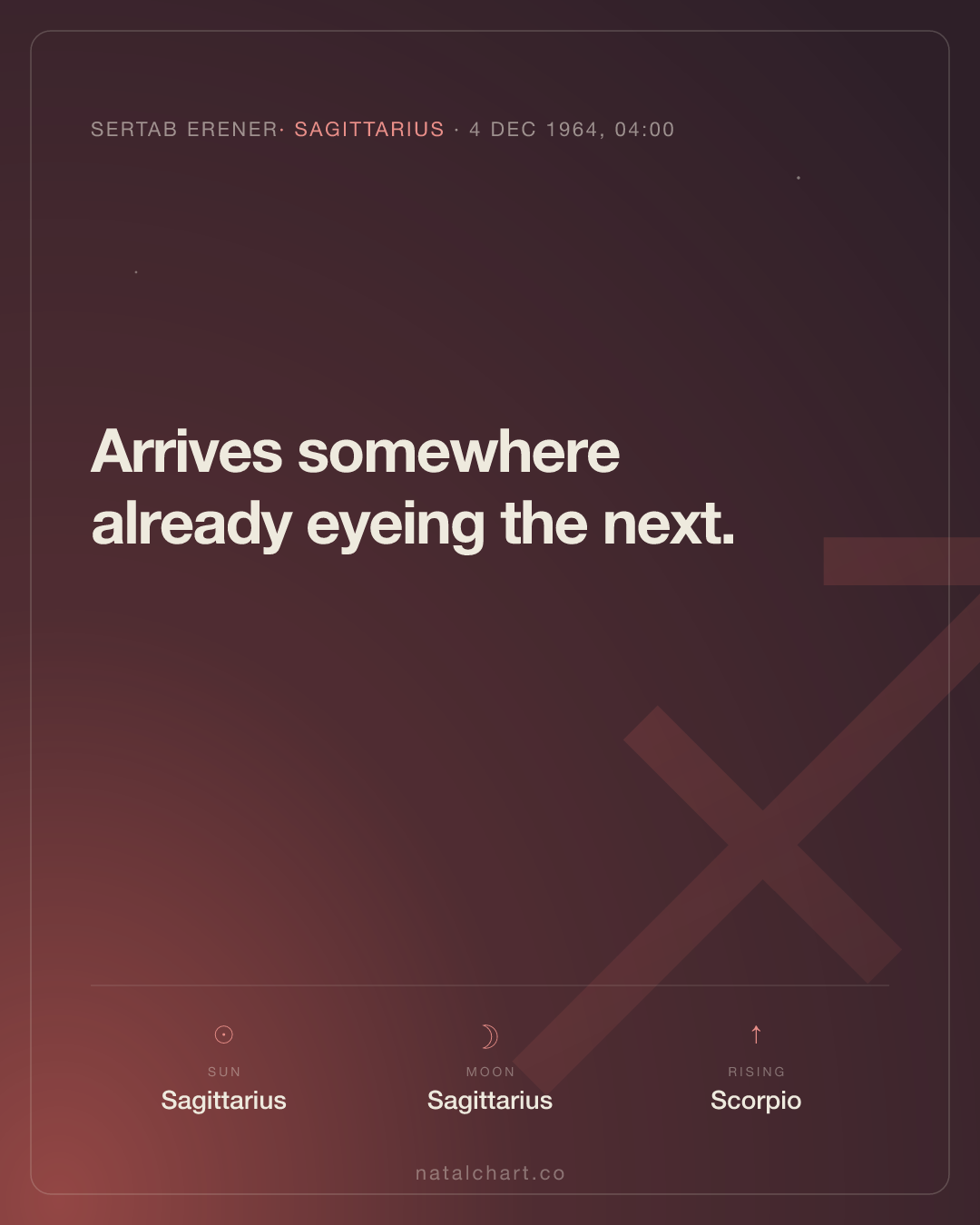
Sertab Erener's career has a shape that is rare in popular music: a conservatory-trained opera student who became Turkey's most internationally recognised pop voice, then won Eurovision with a performance of controlled theatricality and a song that still sounds like a singular event. What makes that trajectory legible is the natal chart. Sun and Moon are conjoined in Sagittarius in the second house — separated by just 0.3°, one of the tightest solar-lunar unions possible. When the Sun and Moon occupy the same degree, the conscious drive and the emotional need pull in the same direction. There is no inner division between what Sertab wants to be and what she needs to feel at home. That unity of purpose is what allowed her to pursue the conservatory, then leave it for pop, then step onto the Eurovision stage in Riga in 2003 and win with 167 points — each turn made from a place of coherent internal alignment, not restless searching.
Sagittarius is the sign of far horizons, of expansion, of the refusal to be contained by a single territory. The second house is about values and the resources a person builds around what matters most. Sun and Moon together there say: what fuels her is range itself — reaching further, claiming new ground. The English-language album No Boundaries (2004), released after Eurovision to break into international markets, is almost a literal translation of this placement.
The Ascendant: Depth as the First Impression
The Ascendant — the sign rising on the eastern horizon at birth, the face a person meets the world with — is Scorpio. The Ascendant is not the mask; it is the medium through which everything else is delivered. In Scorpio, that medium is intensity, precision, and a quality that tends to make people feel they are being read. Sertab's stage presence has always had this quality: a focused magnetism, a sense of controlled depth. Even in broadly commercial recordings, there is something underneath the surface that pulls at the listener.
Venus and Neptune are both in Scorpio in the first house, joining the Ascendant's energy. Venus here brings an allure that is not sweet but searching — beauty with an undercurrent. Neptune in Scorpio in the first house adds a quality of permeability, of emotional dissolve that the listener picks up as feeling rather than analysis. These are not separate traits layered on top of each other; they fuse into a single characteristic: the sense that when Sertab Erener sings, she is giving something real.
The Sun-Moon Conjunction and the Machine of Ambition
The Sun and Moon joined in Sagittarius form the core of the chart, but they are in tension with Mars in Virgo. The Sun squares Mars (1.6°) and the Moon squares Mars (1.3°) — both tight. A square describes two forces pulling against each other, creating friction that either stalls or generates heat. Here, the expansive Sagittarian impulse — the desire to reach wide, to trust the leap — meets Virgo Mars, which wants to check every detail, to get it right before committing. That tension is not a flaw in the chart; it is probably the engine of the work.
Virgo Mars in the eleventh house (the house of collective reach, professional networks, the wider world) means her drive to act is channelled through precision and discipline, and expressed in a context larger than herself. The conjunction of Mars and Uranus (1.1°) sharpens this further: Uranus adds sudden, disruptive energy. The combination of Virgo's technical exactness and Uranus's disruption explains how Sertab could begin as an opera student, pivot to pop, and then produce Everyway That I Can — a song that used traditional Turkish instrumentation inside an otherwise mainstream European pop structure, a genuinely innovative hybrid that Uranus-ruled novelty describes well.
Mercury in Capricorn: The Precision Behind the Performance
Mercury — the planet governing how a person thinks, processes, and communicates — is in Capricorn in the third house. Capricorn brings structure, ambition, and long-range thinking to the mental process. It is not the mind that improvises; it is the mind that builds. Capricorn Mercury tends to say what it means without decoration and to plan across years rather than weeks.
The third house is communication's natural home — local movement, language, the transmission of ideas. Lilith is here too, in Capricorn: a quality of unconventional authority in how she presents ideas, a willingness to say things others might soften. The decision to step out of Sezen Aksu's orbit and build a solo career, the decision to pursue the Eurovision slot when many Turkish artists might have deferred — these have the fingerprint of Capricorn Mercury: assess the structure of the situation, identify the leverage point, move.
Jupiter Opposite Neptune: The Gift and the Weight
Jupiter in Taurus in the seventh house sits in exact opposition to Neptune in Scorpio in the first house — an orb of just 0.1°, the tightest aspect in the entire chart. An opposition describes two principles pulling in opposite directions, each real, neither able to win outright. Jupiter in Taurus in the seventh house is the pull toward stability, toward concrete partnership, toward an understanding of value that is earthed and durable. Neptune in Scorpio in the first house is the pull toward the diffuse, toward the emotional and the imagined, toward the feeling of being merged with something larger than ordinary life.
This is a tension between solidity and permeability, between partnership and absorption. In a musical life, the productive version of this opposition shows as the ability to root a highly emotional, at times overwhelming performance experience in disciplined craft (the Taurus-Jupiter anchor). The Turkish State Medal of Distinguished Service that followed her Eurovision win acknowledged something about this combination: the ability to represent a nation — a collective, Jupiterian act — through an intensely personal artistic statement.
Saturn in Aquarius: The Collective Obligation
Saturn in Aquarius in the fourth house brings a particular quality to the foundations of Sertab's identity: a sense of responsibility toward the collective, toward history, toward what will outlast the individual. Aquarius thinks in communities and systems; Saturn demands that thinking be given form. In the fourth house, this shows as a deep-rooted awareness of where one comes from and what one owes to it.
Sertab Erener studied at the Istanbul University State Conservatory before the pivot to pop. That grounding in a tradition — classical, Ottoman, Western — runs through everything she has recorded. The ability to use the bağlama and traditional Anatolian rhythms inside a Eurovision entry while winning the thing outright is a Saturn-in-Aquarius act: honouring the collective inheritance while pushing it into a new shape.
The Midheaven in Leo: The Stage as Destiny
The Midheaven — the public/career point at the top of the natal chart, showing how a person's work lands in the world — is in Leo. Leo governs performance, radiance, the desire to illuminate. When the Midheaven is in Leo, the vocation is not incidental to who the person is; it is deeply central. Sertab's stage life did not happen alongside her real life; it was her real life. Jupiter in Taurus forms an easy flow (trine) with Pluto in Virgo (2.1°), and Pluto sits in the eleventh house of collective reach. The combination describes the capacity for work of scale — building something that transforms a collective, not just entertains it.
The Leo Midheaven is also squared by no planet in this chart, which means it operates without a major internal conflict tethering the vocation. The path to the stage was, from a structural standpoint, clear.
Chiron in Pisces: The Gift Inside the Wound
Chiron — the point that describes an old wound that becomes a source of skill and insight when the person has the courage to stay with it — is in Pisces in the fifth house. The fifth house covers creative expression, performance, and the vulnerability inherent in making art. Pisces adds the quality of boundlessness, of emotion that cannot be fully controlled or contained.
Chiron here suggests that the act of performance itself carries a particular exposure — the risk of dissolution, of being too open, of giving too much. The training at the conservatory can be read, in part, as a Chiron response: building technical discipline (Virgo Mars, Capricorn Mercury) as a container for the Piscean openness that Chiron marks. The North Node in Gemini points toward the growth direction — finding a voice that can name and communicate the subtle, the complex, the things that feel impossible to say. The pivot to pop, with its demand for lyrical clarity and mass communication, is one reading of this Node.
A Career That Earned Its Width
Sertab Erener's chart does not describe a person who arrived easily at her position. The Sun-Moon square to Mars says that the alignment of purpose and the drive to execute it were never frictionless. The Jupiter-Neptune opposition says that the pull between rootedness and the pull toward something larger and less defined was a constant negotiation. Saturn in Aquarius demanded that the collective dimension of her work be taken seriously, not just performed.
What the chart describes is a person who was built, across decades of careful and demanding work, to occupy a particular moment — a moment that arrived on a stage in Riga in 2003 when Everyway That I Can ended and the votes began. The score of 167 points and Turkey's first Eurovision victory followed. The medal of distinguished service followed. The international album followed. These are not coincidences or luck; they are the product of a chart that had the tension, the discipline, the range, and the depth to earn exactly that width of recognition.
The chart
How to read it →Frequently asked questions
What is Sertab Erener's zodiac sign?
Sertab Erener's Sun sign is Sagittarius — the Sun was in Sagittarius at birth (1964).
What is Sertab Erener's moon sign?
Sertab Erener has the Moon in Sagittarius. The Moon sign describes the emotional and instinctive layer of the chart.
What is Sertab Erener's rising sign?
Sertab Erener's rising sign (ascendant) is Scorpio — the sign on the eastern horizon at the moment of birth.
When and where was Sertab Erener born?
Sertab Erener was born in 1964 in Istanbul, Turkey.