Amedeo Modigliani — natal chart
What does Amedeo Modigliani’s natal chart reveal?
Amedeo Modigliani (1884-1920) was an Italian painter and sculptor who worked mainly in France. Known for portraits and nudes featuring elongated faces and forms, he developed a distinctive modern style and, though largely unrecognized in his short lifetime, became one of the most celebrated early-20th-century artists.
 Share
Share
Birth
1884-07-12 · 09:00 · Livorno, Italy Reliability: AA · vetted record
The Eye That Saw Through the Mask
Amedeo Modigliani painted faces the way a very attentive person listens — patiently, without judgment, looking for the particular life behind the social pose. Those elongated necks, asymmetric eyes, the slight tilt of a head: they are not distortions for their own sake but a technique for stripping the conventional portrait back to something private. His chart explains both the gift and the cost of that method.
How He Met the World — Virgo Rising, Mars and Chiron in the First House
The Ascendant is the face a person meets the world with — the instinctive register before the interior takes over. Modigliani's is Virgo: precision, craft, an almost nervous attention to form. But what sits directly on that Ascendant is telling. Mars in Virgo in the first house gives the body and the manner an edge — a restlessness, a physical urgency. Modigliani in his Paris years was famously intense in company, quickly combustible, carving and painting with relentless focus. Uranus also conjunct the Ascendant in Virgo deepens this: an unconventional, electrically charged presence that made him hard to ignore and even harder to contain. Chiron — an old wound that, over time, becomes a source of hard-won understanding — is here too in the first house. For Modigliani this wound was in the body itself: he contracted tuberculosis as a child and lived with chronic illness his entire short life. The fragility was built into his self-presentation, inseparable from how he moved through the world and ultimately from how urgently he worked.
A Triple Convergence in Cancer — Sun, Venus, Mercury
The most striking feature of this chart is the tight clustering of Sun, Venus, and Mercury in Cancer in the eleventh house, all within two degrees of each other. When the planet of identity, the planet of beauty, and the planet of perception are all joined in the same place and sign, they become almost impossible to separate. There is one mode of seeing, and it is simultaneously emotional, aesthetic, and communicative. Cancer is the sign of interiority: it perceives through feeling, attends to what lies beneath the surface, and is drawn to what is tender or undefended in another person. For Modigliani this convergence produced a radically unified artistic vision — every portrait is simultaneously an emotional read, an aesthetic statement, and a communication that bypasses conventional representation. His subjects look inward; their eyes are often blank or unfocused, not because he didn't see them but because he was painting their inner state, not their outward performance. The eleventh house is the house of the collective, of chosen communities and affinities. Modigliani's world was the bohemian circle of Montparnasse — Picasso, Soutine, Lipchitz, Rivera — a chosen family of fellow outsiders. His art was never made in isolation; it was always in dialogue with a group.
Feeling as Form — Moon in Pisces
The Moon describes the emotional interior, the register beneath conscious control. Modigliani's Moon is in Pisces in the seventh house — the house of one-to-one relationships, of the other. Pisces dissolves the boundary between self and other; it is the sign of deep empathic absorption, of feeling what the person in front of you feels. In the seventh house, this quality becomes the engine of every significant relationship. Modigliani's portraits are not observations from a distance — they are acts of momentary fusion. He sat with his subjects, talked with them, drank with them, and then painted what that contact had left in him. His great love, Jeanne Hébuterne, appears in his paintings with a tenderness so particular it could not have come from looking alone. The Moon in Pisces also carries the risk of dissolution — of losing one's own boundary in another, of being overwhelmed. Modigliani's personal life bore this out: his relationships were intense and consuming, and his use of alcohol and drugs reads in part as an attempt to manage the sheer permeability that made his art possible.
The Beauty Imperative — Venus in the Triple Conjunction
Venus so closely joined to the Sun — barely half a degree away — means that aesthetic response and personal identity were not separate functions. Modigliani did not decide to pursue beauty; beauty was what he was. His sculptural period, under the influence of Brancusi and African masks, produced stone heads with the same elongated, pared-back quality as his paintings — the formal obsession ran through every medium he touched. The Cancer placement means this beauty imperative was deeply personal, almost maternal: the faces he painted were not objects to be displayed but presences to be honored. His nudes — scandalous at his only solo exhibition in 1917, which was shut down by police — were entirely without the exploitative distance of the conventional nude. He painted vulnerability as something deserving of respect.
The Builder's Ambition — Saturn and Pluto in Gemini at the Midheaven
The Midheaven is the career and public-image point of the chart. Modigliani's is Gemini, with Saturn and Pluto both in the tenth house. Gemini at the Midheaven points to a vocation built on language in the broad sense — image, style, sign — the manipulation of visual grammar. Saturn here is the planet of long, slow construction and delayed recognition; Pluto is the force of total transformation. Together they describe a career built at enormous personal cost, largely invisible during the artist's lifetime, and then radically revalued after death. Modigliani sold almost nothing while alive. Within years of his death in 1920, at 35, his paintings were changing hands for amounts that would have paid his entire Paris rent for decades. Saturn's recognition comes late, but it comes.
Neptune in Taurus — the Philosopher of the Senses
Neptune, the planet associated with the dissolution of ordinary perception and with visionary states, sits in Taurus in the ninth house — the house of meaning, of the search for a larger frame. Taurus is the sign of the body, of material form, of the senses as the primary instrument of knowledge. Neptune in Taurus in the ninth house suggests that the pursuit of meaning for Modigliani ran through the physical and sensory rather than the abstract: form itself was philosophy, the body of a human being was a sufficient argument. This connects cleanly to his rejection of Cubist fragmentation and his insistence on the wholeness of the human figure even as he abstracted it — he was never interested in disassembling the human form, only in revealing what was essential within it. Uranus in Virgo flows easily with Neptune in Taurus — a trine, a harmonious current — giving the sensory vision a structural intelligence: the elongations are not random but precisely calculated deformations that make the emotional content land harder.
Mars in Easy Flow with the Sun and Venus — the Working Body
Mars in Virgo in the first house forms a sextile — a naturally cooperative angle — with the Sun-Venus conjunction in Cancer, and also with Mercury. This is the aspect pattern that made Modigliani's prodigious output possible. Mars is the planet of physical energy and directed action; in Virgo it is methodical, craft-oriented, tireless in refinement. The ease of connection with the Sun and Venus means there was no significant friction between the drive to work and the aesthetic vision that work served. He could translate inner perception into physical form with unusual directness. By the time of his death he had produced over five hundred paintings and nearly one hundred sculptures, most of them in the last six years of his life — all while ill, often destitute, and living on the social margins.
Chiron in the First House — Wound as Medium
Chiron in Virgo on the Ascendant, in the house of the self and the body, describes someone for whom the body is simultaneously the site of the wound and the primary instrument of work. Modigliani's tuberculosis was not incidental to his art — his awareness of physical frailty, of time running short, gave his portraits their particular quality of presence, as if each sitting might be the last chance to truly see another person. The North Node — the point indicating the direction of growth across a life — is in Libra, the sign of beauty, relationship, and balance. The trajectory was always toward the aesthetic made relational: not beauty as an abstract ideal but beauty as what happens between two people who are truly paying attention to each other.
What Remains
Modigliani died in January 1920 of tubercular meningitis; Jeanne Hébuterne, nine months pregnant with their second child, died the following day. He was 35. The recognition he never received in life came swiftly and completely after death, exactly as Saturn in the tenth house tends to arrange things. What the chart describes — the fused perceptual and aesthetic sensitivity, the intensity of presence, the physical urgency of someone who knew time was short — is legible in every one of those five hundred faces. They were painted by someone who looked at other people with genuine attention and found, each time, that it was worth the looking.
The chart
How to read it →Frequently asked questions
What is Amedeo Modigliani's zodiac sign?
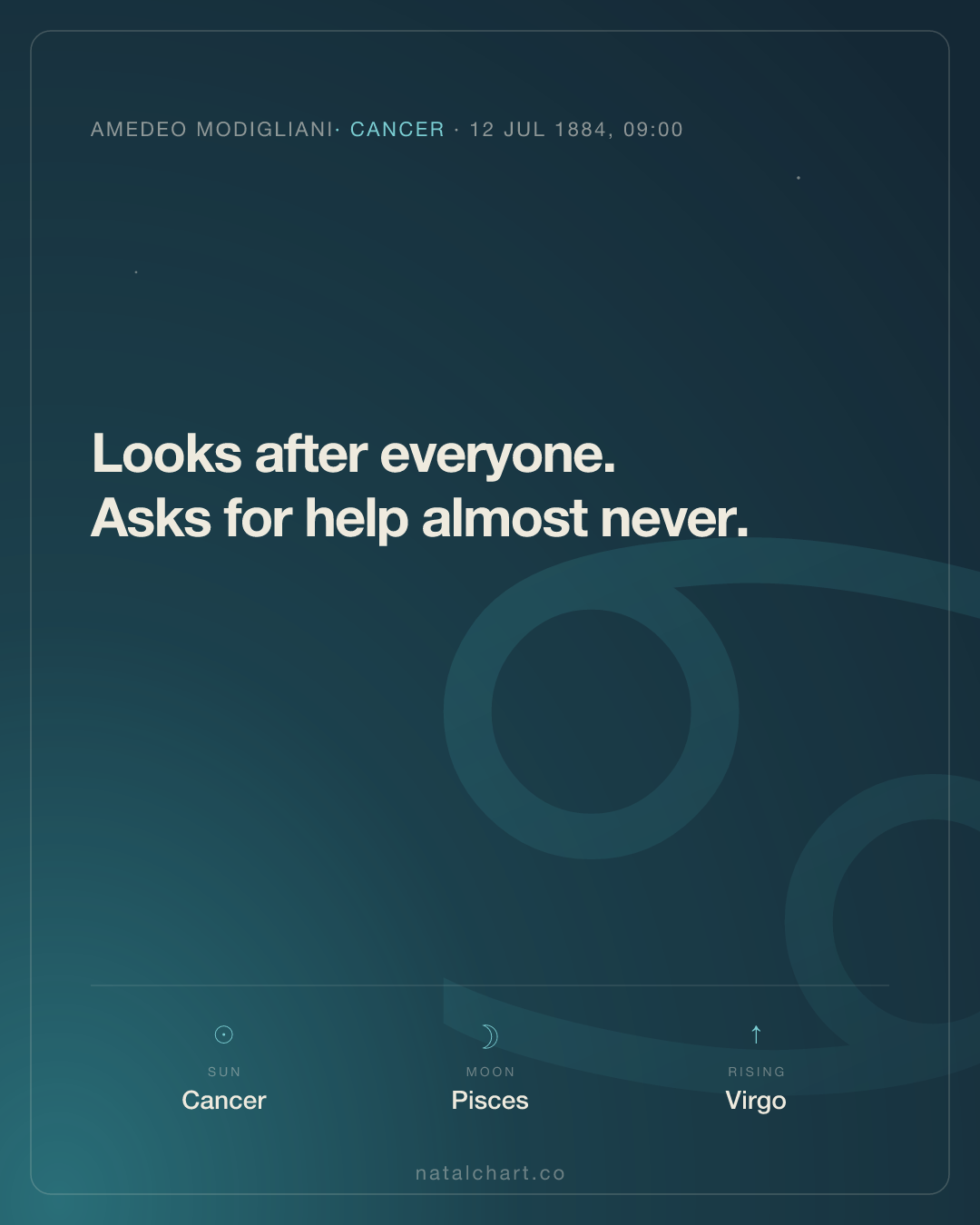
Amedeo Modigliani's Sun sign is Cancer — the Sun was in Cancer at birth (1884).
What is Amedeo Modigliani's moon sign?
Amedeo Modigliani has the Moon in Pisces. The Moon sign describes the emotional and instinctive layer of the chart.
What is Amedeo Modigliani's rising sign?
Amedeo Modigliani's rising sign (ascendant) is Virgo — the sign on the eastern horizon at the moment of birth.
When and where was Amedeo Modigliani born?
Amedeo Modigliani was born in 1884 in Livorno, Italy.