Antoni Gaudí — natal chart
What does Antoni Gaudí’s natal chart reveal?
Catalan architect born in 1852 in Reus. The leading exponent of Catalan Modernism, he designed the Sagrada Família (begun 1882), Park Güell (1900-1914) and Casa Batlló (1904-1906). Killed by a tram in Barcelona in 1926.
 Share
Share
Birth
1852-06-25 · 09:30 · Reus, Spain Reliability: AA · vetted record
Stone That Breathes: Sun in Cancer, Ascendant in Virgo
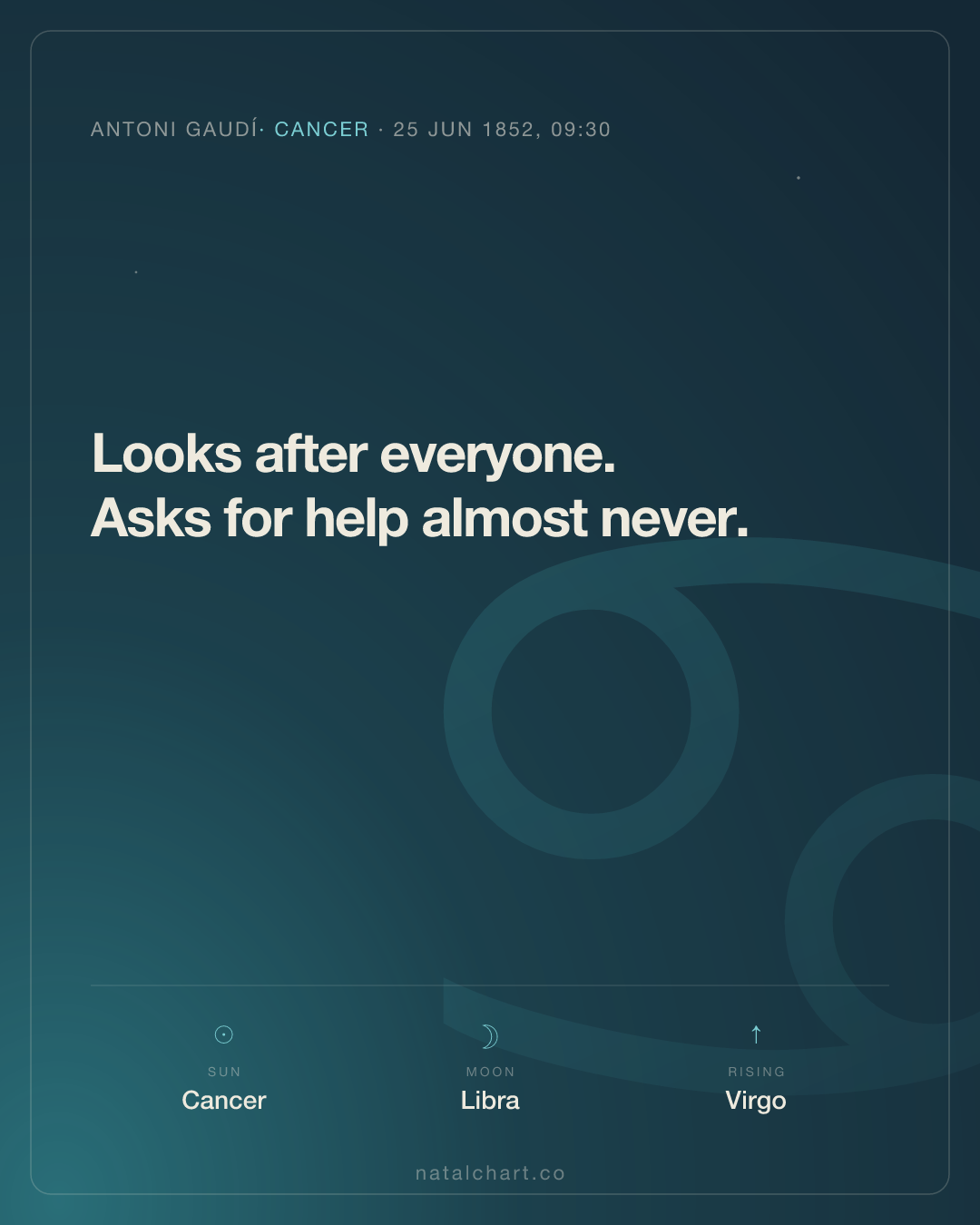
Antoni Gaudí was born on June 25, 1852, in Reus, Catalonia, at half past nine in the morning. His Sun sits in Cancer in the eleventh house, his Ascendant (the face he met the world with) in Virgo, and the combination gives the key to everything he built. Cancer builds a home — not a house, a home, shaped by organic memory, by the softness of a shell, by the curve of a wave. Virgo takes that vision and subjects it to meticulous craft: every stone must earn its place, every seam must be calculated. Gaudí's architecture is the living record of these two forces working together over decades.
The Sagrada Família, begun in 1882 and still unfinished at his death in 1926, is both monument. Its towers grow from the earth like stalactites in reverse; its facades read like illuminated manuscripts in stone. A Cancer Sun provided the devotional warmth; a Virgo Ascendant supplied the obsessive geometric logic underneath.
Mars in Virgo, First House: Craft as Discipline
Mars — the planet that describes how a person acts, builds, and fights — falls in Virgo in the first house, and it is almost exactly in flowing alignment with Uranus in Taurus (an orb of zero degrees, the tightest aspect in this chart). This pattern says something precise: Gaudí's drive was not impulsive but methodical, and his method was not conventional but radically innovative. He spent years cataloguing the shapes of natural forms — bones, shells, leaves, insect wings — and then translated them into structural solutions that engineers would not fully understand until decades after his death.
Parabolic arches, hyperboloid windows, helicoid columns: forms that appear to defy gravity but in fact follow it with perfect mathematical fidelity. The zero-degree alignment between Mars and Uranus made that union of discipline and innovation feel effortless from the inside, even if it looked miraculous from the outside.
Moon in Libra: Beauty as Necessity
The Moon in Libra in the second house describes the emotional life and what makes a person feel secure. For Gaudí, beauty was not ornament — it was structural. Libra's Moon needs harmony the way other placements need routine or affection: it is not optional. Park Güell, designed between 1900 and 1914, is perhaps the clearest expression of this: a public space conceived as a garden of organic beauty where the line between architecture and nature was deliberately erased. The undulating bench covered in ceramic mosaic — the longest bench in the world — is a Moon in Libra object: it exists to give pleasure, to invite rest, to make a stranger feel welcome.
The Moon in the second house also anchors this sensitivity to material: Gaudí had an encyclopaedic knowledge of tiles, ceramics, wrought iron, stone, and glass. He did not delegate materials — he handled them.
Mercury in Gemini at the Midheaven: The Communicating Builder
Mercury, the planet of thought and expression, occupies Gemini in the tenth house, very close to the Midheaven (the public/career point of the chart). Mercury in Gemini is fast, associative, and cross-disciplinary — it draws connections across fields that more specialised minds would keep separate. Gaudí read botany, zoology, and medieval theology with the same appetite he brought to structural engineering. His buildings are arguments: they propose ideas about nature, about divinity, about the relationship between the human hand and natural form.
The sextile between Mercury and Pluto (a flowing connection to the planet of deep transformation) gave these ideas a weight beyond the decorative. Gaudí was not designing surfaces — he was designing meanings.
Venus in Leo, Twelfth House: Hidden Splendour
Venus in Leo in the twelfth house is one of the most revealing placements in this chart. Leo asks for visibility, for applause, for recognition; but the twelfth house is the domain of solitude, retreat, and the interior life. In Gaudí, this tension played out as a lifelong commitment to work that would only be completed after his death. He knew the Sagrada Família would not be finished in his lifetime: he had studied the medieval cathedrals of Europe and understood that a building of that scale was a collective act across generations. He donated his personal savings to the project, lived in the workshop on site, and died in obscurity — killed by a tram in 1926, unrecognised by passers-by who assumed him a beggar.
The square between Venus and Uranus (a tension between the desire for beauty and the need for radical rupture) also speaks to his willingness to break entirely with the architectural conventions of his time, even at the cost of professional isolation.
Jupiter in Scorpio Pulling Against Saturn in Taurus
Jupiter in Scorpio in the third house pulls against Saturn in Taurus in the ninth house — an opposition of about 0.8 degrees, very tight. Jupiter in Scorpio reaches into mystery, into deep structural truth, into the hidden logic of forms; Saturn in Taurus insists on material reality, on what can be built with actual stone and mortar. This is the engine behind Gaudí's most characteristic solutions: the hanging chain models he used to calculate the shape of the Colònia Güell crypt, where he suspended weights from strings to find the perfect catenary arch by gravity alone. The vision was Scorpionic; the method was Taurean; the opposition made him push further than either planet alone would have.
Saturn and Uranus in the same sign (Taurus) and the same house (ninth) also point to a philosophical conservatism — Gaudí was a deeply devout Catholic — lived alongside a structural radicalism that had no precedent.
Neptune in Pisces, Seventh House: Architecture as Devotion
Neptune in Pisces in the seventh house dissolves the boundary between the individual and the sacred. In Gaudí's case, the "other" he was perpetually in relationship with was God. From his thirties onwards, his religiosity deepened into near-asceticism: he fasted, he attended daily Mass, he refused to design anything that was not, in some way, an act of worship. The Sagrada Família's nativity facade, the Park Güell chapel, the Bishop's Palace of Astorga: all were conceived as dialogue between the human craftsman and a divine geometry he believed was written into the forms of nature.
Jupiter in flowing alignment with Neptune (a trine of about 2.2 degrees) amplified this tendency: faith was not a constraint on imagination but its largest expansion.
Chiron and Lilith in Aries, Eighth House: The Unfinished Wound
Chiron — an old wound that, over time, becomes a gift passed on to others — falls in Aries in the eighth house, alongside Lilith. The eighth house is the domain of what outlasts a person: legacy, transformation, death and what survives it. Aries wounds tend to be wounds of agency — of being stopped, cut short, prevented from acting. Gaudí was killed before he could complete his central work, but the wound became a gift of another kind: the unfinished Sagrada Família became the most famous building site in the world, drawing millions of visitors to witness something still in process. His death made the work larger than it would have been had he lived to close it.
The North Node in Cancer points toward the direction his life was moving: toward nurturing, toward home, toward work that would root future generations.
A Cathedral Still Growing
Antoni Gaudí died on June 10, 1926, three days after being struck by a tram on the Gran Via de les Corts Catalanes. He was seventy-three and had spent the last years of his life living entirely within the Sagrada Família project, sleeping in the crypt, wearing out his clothes. The Sagrada Família is expected to be completed in the coming years — nearly a century after his death — according to the plans and models he left behind.
His chart is the map of someone who understood that great work is not personal property. Sun in Cancer gives the impulse to shelter and protect; Mars in Virgo gives the precision to build something that lasts; Uranus in Taurus gives the audacity to make it look like nothing that came before. The building grows. The stone breathes. The man is still there.
The chart
How to read it →Frequently asked questions
What is Antoni Gaudí's zodiac sign?
Antoni Gaudí's Sun sign is Cancer — the Sun was in Cancer at birth (1852).
What is Antoni Gaudí's moon sign?
Antoni Gaudí has the Moon in Libra. The Moon sign describes the emotional and instinctive layer of the chart.
What is Antoni Gaudí's rising sign?
Antoni Gaudí's rising sign (ascendant) is Virgo — the sign on the eastern horizon at the moment of birth.
When and where was Antoni Gaudí born?
Antoni Gaudí was born in 1852 in Reus, Spain.