Mustafa Kemal Atatürk — natal chart
What does Mustafa Kemal Atatürk’s natal chart reveal?
Mustafa Kemal Atatürk, born conventionally on 19 May 1881 in Thessaloniki (Selânik), then part of the Ottoman Empire, was a statesman and military officer who founded the Republic of Turkey and served as its first president. As an Ottoman commander he rose to prominence at the Battle of Gallipoli (1915), then led the Turkish National Movement in the War of Independence (1919–1923). After abolishing the sultanate (1922) and proclaiming the republic in 1923, he launched sweeping reforms: a secular constitution, the Latin-based Turkish alphabet (1928), the surname law (1934, under which he took the name Atatürk, "Father of the Turks"), and full voting rights for women (1934). He modernized law, education and industry along Western lines until his death on 10 November 1938. Remembered as the architect of modern Turkey, his ideas became known as Kemalism.
 Share
Share
Birth
1881-05-19 · Thessaloniki (Selânik), Ottoman Empire Reliability: X · no time No verified birth time: ascendant and houses are omitted. The birth date of 19 May 1881 is conventional and symbolic, not documented: no birth record survives, and Atatürk himself adopted 19 May because it marked his landing at Samsun in 1919. Contemporary sources disagree even on the year. No reliable birth time exists, so no exact horoscope can be cast.
A chart built for transformation
Mustafa Kemal Atatürk was born on 19 May 1881 in Thessaloniki, and his birth time was not recorded — so this reading draws only from the planets' positions in the signs and the patterns they form with each other, without reference to houses or an Ascendant. What those patterns reveal is still extraordinary: a chart almost entirely concentrated in one area of the zodiac, with an extraordinary cluster of seven planets in just three signs, and a set of aspects that describe exactly the kind of person who does not merely live in history but reshapes it.
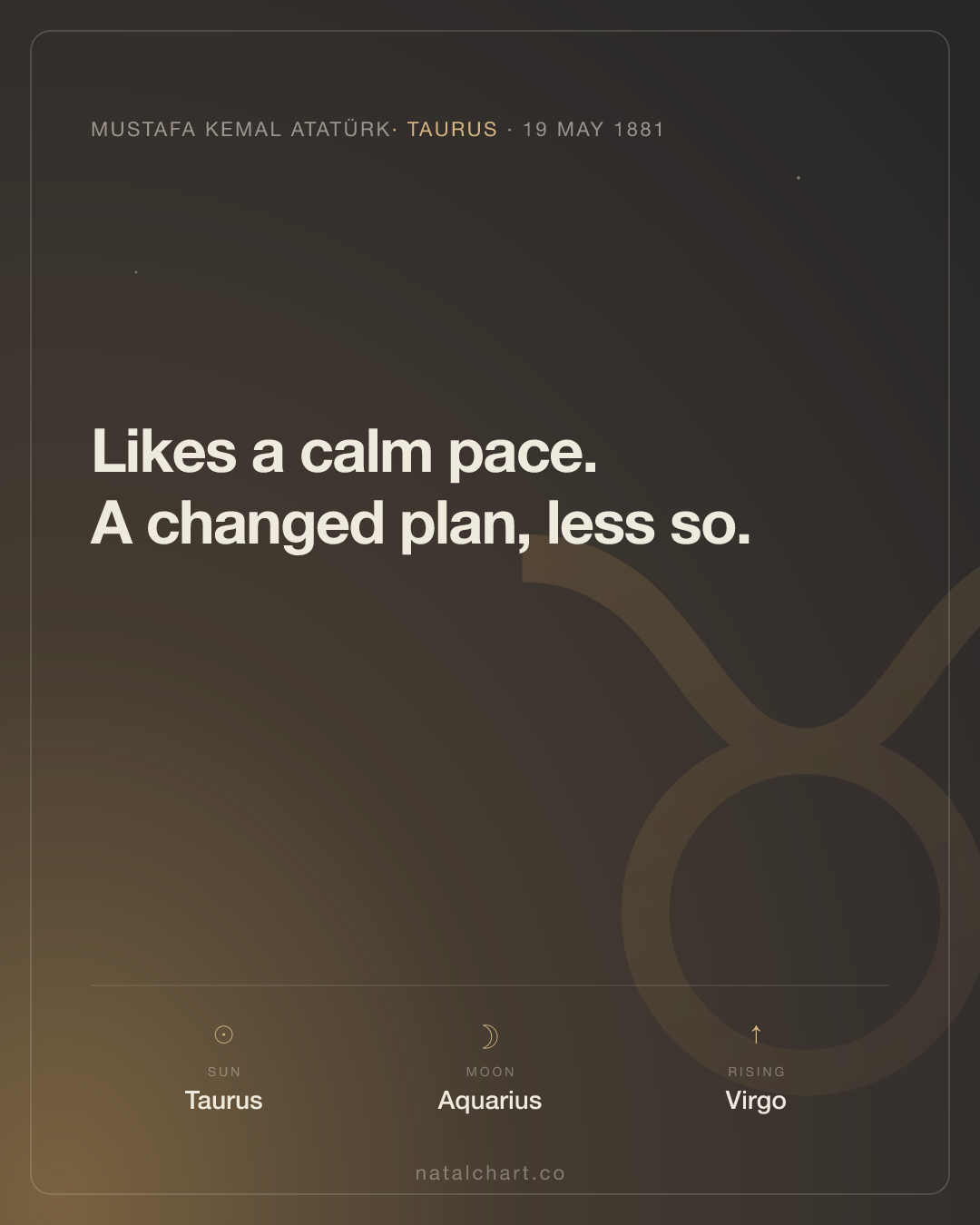
The Sun in Taurus sits alongside Venus, Jupiter, Saturn, Neptune and Pluto — all in Taurus — with Mercury just a step away in Gemini. The loudest note in the entire chart is Taurus: steady, concrete, patient, capable of extraordinary endurance, committed to making things last. This was not a man of grand abstract visions; he was a man of terrain, of building things that could be touched and measured. The Latin alphabet, the new legal code, the secular state — all tangible, all built to stand.
The absolute will to build
When the Sun and Pluto travel together in the same sign and degree — separated here by less than one degree — the result is a personality that does not do things by half measures. Pluto is the force of irreversible change, the pressure that breaks old structures and clears the ground for new ones. Joined with the Sun in Taurus, that force is channeled into something methodical and permanent: not upheaval for its own sake, but transformation in service of something that will endure. The abolition of the Ottoman sultanate in 1922, the declaration of the republic in 1923, the adoption of the Latin alphabet in 1928 — these were not impulsive moves. They were carefully sequenced, one after another, each building on the last.
Mercury also travels close to the Sun and Pluto, in Gemini — the sign of communication, language, the power of naming things differently. The surname law of 1934, the alphabet reform of 1928, the purification of the Turkish language: Atatürk understood that who controls the language controls the story, and he remade both.
Endurance and discipline
Venus and Saturn occupy exactly the same degree in Taurus — they are joined with essentially zero separation, the tightest aspect in the entire chart. Saturn is discipline, duty, the long game, the willingness to pay a cost now for a gain later. Venus here is not primarily about romance; in a chart this dense with Taurus, Venus rules the sign and gives it warmth and conviction. The two joined at zero degrees describe someone with an absolutely iron commitment to what they value: an insistence on loyalty, an expectation of quality, an unwillingness to accept less than complete dedication from themselves or from those around them.
Atatürk was famously demanding of the people who served the republic. He worked through illness, drove reform at a pace that exhausted his ministers, and allowed little room for sentimentality. Venus-Saturn together in this concentration says that the things he loved — Turkey, modernity, the idea of a sovereign people — he loved with the full weight of Saturnian obligation. It was devotion expressed as relentless work.
Jupiter and the wider horizon
Jupiter in Taurus, joining the cluster, forms an easy flow with Uranus in Virgo — a connection that links practical expansion with a talent for precise, systematic change. Uranus is the planet of disruption, of the break with what came before; in Virgo it operates methodically, reform by reform, detail by detail. Jupiter making easy contact with that Uranus describes a man for whom large-scale change was not frightening but natural, and who understood that lasting transformation comes from working through systems, not around them.
The Jupiter-Saturn pairing within the cluster adds a further dimension: the tension between growth and constraint, between ambition and the reality of what is possible. Anyone who carries both planets closely aligned knows that expansion always comes at a price, and that real achievement requires knowing when to hold and when to push. Atatürk spent fifteen years building modern Turkey's institutions, rarely moving faster than the ground could bear.
The moon and the deeper conflict
The Moon in Aquarius stands apart from the great Taurus cluster — it occupies a different sign entirely, and that separation tells a story. Aquarius is the sign of the collective, of humanity considered as a whole, of the future that hasn't arrived yet. The Moon in Aquarius brings an emotional attachment not to a person or a family, but to an idea: to a nation, to a project of civilization, to something larger than any individual life.
But the Moon in Aquarius is in tension with Neptune in Taurus — the aspect between them has a separation of less than two degrees. Neptune deals with ideals, with the blurring of boundaries between what is and what one wishes to be. In tension with the Moon, it creates an emotional life where the gap between vision and reality can feel acute, where the ideal image of what the people should become can clash with the slower, more reluctant pace of actual human beings. There are documented accounts of the frustration Atatürk felt at the pace of social change, at resistance from rural populations, at the difficulty of transforming a deeply traditional society in a single generation.
North Node in Sagittarius: the horizon as mission
The North Node — the point in a chart that indicates the direction of growth, the territory that is most fruitful even if the most demanding — falls in Sagittarius, the sign of the broader horizon, of teaching, of the transmission of knowledge. Atatürk founded not just a state but a system of public education; he personally toured the country teaching the new alphabet, standing at a blackboard in small towns and villages. The image of a head of state teaching elementary literacy is unusual in any era. With the North Node in Sagittarius, the direction of growth was always through spreading knowledge, opening the future to people who had been kept from it.
Chiron in Leo: the wound in the spotlight
Chiron — the old wound that over time becomes the source of an unusual gift — falls in Leo. Leo is the sign of the individual who steps into the light, of leadership and personal charisma. Chiron here often marks someone for whom visibility came with exposure: being seen meant being scrutinized, admired and resented in equal measure. Atatürk's position was unique and completely without precedent; there was no model for what he was building. That position of absolute visibility — celebrated as Atatürk, Father of the Turks, but also deeply alone in the finality of his decisions — carries the quality of Chiron in Leo: the person who leads from the wound of isolation, who gives to others the security and identity they could not entirely claim for themselves.
He took the surname Atatürk by law in 1934, the same year women received full voting rights — a double gesture that speaks to both the Leo need to name and consolidate legacy, and the Aquarius Moon's drive toward a more complete collective.
The tightest thread: Venus-Saturn at zero degrees
Return for a moment to that Venus-Saturn conjunction at zero degrees of Taurus, because it is the structural key of the whole chart. In a chart where everything is built to last, this aspect is the foundation. It describes a person who does not believe in shortcuts, who does not trust what has not been earned, who cannot separate love from responsibility. The reforms Atatürk pushed through — secular courts, women's suffrage, the separation of religious authority from state power — were not abstract ideology. They were the expression of someone for whom building something worthy of trust was a moral obligation, not a political calculation.
The fact that Taurus rules this aspect, and that Taurus is the dominant sign of the entire chart, gives these values their particular texture: they are earthy, concrete, and they are meant to endure. The Ottoman Empire had lasted six centuries. The Republic of Turkey, which Atatürk built from its ruins in the space of a decade, was designed to last at least as long.
A complete portrait
Mustafa Kemal Atatürk's chart is that of someone who had the patience to be radical. The Taurus concentration gave him the tenacity to see transformation through over years, not weeks; the Sun-Pluto joining gave that tenacity its irreversible quality; Mercury in Gemini near Pluto gave him mastery of the symbolic dimension of power — who names, who writes, who teaches. The Moon in Aquarius separated from the main cluster gave him the emotional connection to a collective ideal that transcended any personal attachment.
He died on 10 November 1938, at fifty-seven, his health broken by years of work and by cirrhosis. He left behind a state that was, in institutional terms, barely fifteen years old. That a state founded that recently, in the rubble of an empire and in the middle of a region in constant flux, was still recognisably itself decades later, is perhaps the clearest confirmation of what the chart already said: this was someone who built things to last.
The chart
How to read it →Frequently asked questions
What is Mustafa Kemal Atatürk's zodiac sign?
Mustafa Kemal Atatürk's Sun sign is Taurus — the Sun was in Taurus at birth (1881).
What is Mustafa Kemal Atatürk's moon sign?
Mustafa Kemal Atatürk has the Moon in Aquarius. The Moon sign describes the emotional and instinctive layer of the chart.
When and where was Mustafa Kemal Atatürk born?
Mustafa Kemal Atatürk was born in 1881 in Thessaloniki (Selânik), Ottoman Empire.