Barış Manço — natal chart
What does Barış Manço’s natal chart reveal?
Barış Manço (1943–1999) was a Turkish rock musician, singer-songwriter, composer and television presenter, widely regarded as a pioneer of Anatolian rock. Born Tosun Yusuf Mehmet Barış Manço in Istanbul, he began recording in the late 1950s and rose to prominence in the 1960s and 1970s by fusing traditional Turkish folk melodies and instruments with Western rock arrangements. His 1975 album "2023" became a landmark of the genre. Among his best-known songs are "Dağlar Dağlar," "Gülpembe," "Nick the Chopper" and "Lambaya Püf De," and he sold large numbers of records across Turkey and abroad. From 1988 he hosted the popular television programme "7'den 77'ye" ("From 7 to 77"), which combined travel reporting, music and cultural commentary and was broadcast in many countries. He performed in numerous languages and toured internationally. Manço died of a heart attack in Istanbul on 1 February 1999. His recordings and broadcasts remain influential in Turkish popular music.
 Share
Share
Birth
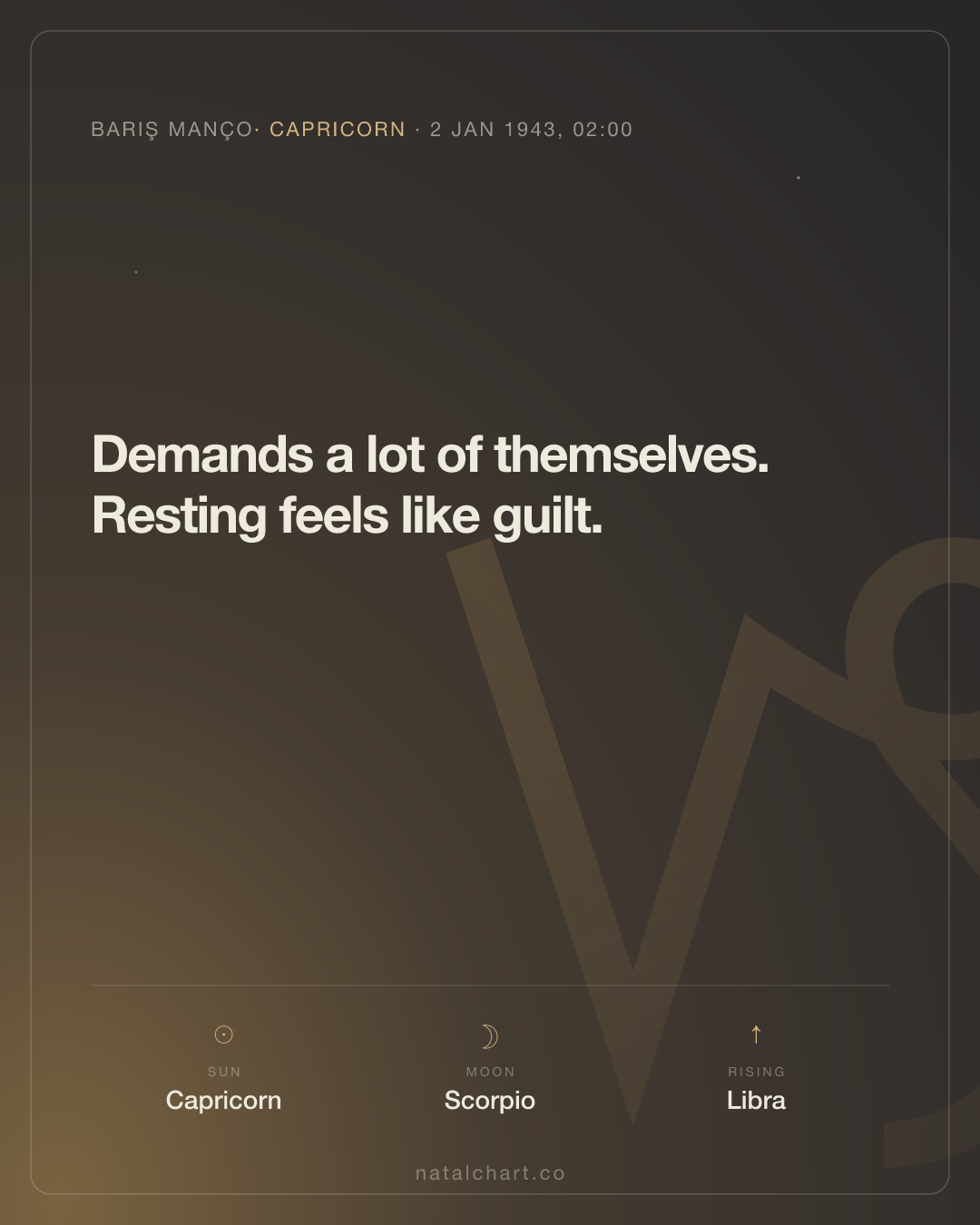
1943-01-02 · 02:00 · Istanbul, Turkey Reliability: A · reliable data The ascendant is based on the most widely cited birth time for this figure.
A builder who also dreamed
Barış Manço was a man who did large things methodically. He arrived at Anatolian rock — the fusion of Turkish folk instruments with Western electric guitar — not as an accident but as a calculated project carried out over years, album by album, tour by tour. That combination of grand ambition and patient construction runs through his entire birth chart: a Libra Ascendant lending him social fluency and a diplomat's instinct for bringing different worlds into conversation, wrapped around a Saturn-heavy Capricorn cluster that made sure the work actually got done. In him the dreamer and the craftsman were not in conflict — they were the same person operating at different speeds.
The Capricorn core
Sun, Mercury, and Venus all in Capricorn, all gathered in the fourth house — the sector of roots, private life, and what is built to last — describe a man whose creative center of gravity was quieter and more inward than the stage persona suggested. The fourth house Capricorn stellium does not perform for immediate approval; it builds toward permanence. Manço recorded his first singles in the late 1950s, long before he was famous, and kept recording through the 1960s until the sound he was looking for was finally within reach. The 1975 album 2023 — named for the centenary of the Turkish Republic — was not an impulsive gesture; it was a thesis statement that had been gestating for well over a decade. Sun in Capricorn in the fourth house builds foundations first. Everything else follows from that.
The emotional life
The Moon in Scorpio in the second house tells a different story about what moved him privately. Scorpio Moon does not process feelings on the surface — it goes deep, takes its time, and tends to hold intensity without releasing it easily. The second house connects this to questions of worth, security, and what a person considers genuinely their own. His songs often circled around exactly these themes: loyalty, belonging, the cost of love, the weight of memory. "Gülpembe" — the gentle, deeply felt portrait of a mother — is a Scorpio Moon song: intimate, loyal, unafraid of tenderness. But the Moon is also in tension with Pluto (these two planets pull against each other at about one degree of distance), which means that same emotional depth could tip into its difficult register — intensity that becomes pressure, or the refusal to let go of something that had already passed.
Mind and communication
Mercury in Capricorn in the fourth house thinks carefully and speaks with weight. It is not drawn to abstract theorizing; it wants to say something that holds. Manço built an entire body of songs with this Mercury: precise, narrative, rooted in place and people. "Dağlar Dağlar" is not a vague meditation on mountains — it is a specific, anchored image of longing and home. Mercury works in easy harmony with Uranus and Neptune — both in Gemini in the ninth house, the sector of travel, foreign languages, and wide cultural reach — and this triple connection explains how a man with such grounded creative instincts also produced work that absorbed Anatolian, Balkan, and Western rock influences simultaneously. The ideas were unconventional; the craft was not.
Venus and how he valued things
Venus also in Capricorn in the fourth house places affection and aesthetic sense firmly in the private and the enduring. What Manço loved, he loved with constancy — not with flash. This Venus is directly opposed by Jupiter in Cancer in the tenth house (the public/career point of the chart), a tension between a private, concentrated way of loving and a public career that demanded generosity, warmth, and visible largeness. Jupiter in Cancer in the tenth house is a remarkable placement for a television host: Cancer rules nurture and welcome; Jupiter expands everything it touches; the tenth house is where the world watches. His programme 7'den 77'ye — broadcast for more than a decade across Turkey and abroad — worked precisely because it felt like being invited into someone's home. The opposition between Venus and Jupiter created that warmth: private affection scaled up into public hospitality.
The public vocation
The Midheaven — the career and public-image point — in Cancer confirms this reading. Cancer at the top of the chart suggests a public identity built around care, cultural memory, and a familial quality of connection. His television work was explicitly about bringing people together across age and geography (the programme's title, "From 7 to 77," said it plainly), and it combined music with travel reportage — the Midheaven's Cancer quality of home-building applied to the whole world as a subject. Lilith in Cancer in the tenth house, right alongside Jupiter, adds a note of the unconventional to this public persona: something about his way of appearing on screen did not fit the standard broadcaster mold. He dressed differently, spoke differently, held his audience differently.
Saturn, Uranus, and the cultural bridge
Saturn and Uranus both in Gemini in the ninth house form an unusual pairing. The ninth house rules foreign cultures, languages, travel, and the expansion of worldview; Gemini works through contrast and connection; Saturn brings structure while Uranus brings disruption. Together in the same sector, they describe someone who could work seriously within multiple cultural frameworks without losing his own. Saturn in easy flow with Pluto (less than a tenth of a degree separation — the tightest connection in the chart) gives that cultural work a certain transformative weight: Manço did not just appreciate other musical traditions, he changed what Turkish pop music was allowed to sound like. Mercury in easy flow with Uranus and Neptune — both in that same ninth house — deepens the picture: the mind that absorbed influences from multiple traditions and synthesized them into something coherent.
The North Node and Chiron
The North Node — the point in the chart that indicates the direction a life tends to grow toward — is in Leo, sitting with Chiron in the eleventh house, the sector of community, audiences, and the groups one belongs to. Leo's direction is creative self-expression, generosity of presence, the capacity to be genuinely seen. Chiron here — Chiron marks a place of old sensitivity that becomes, over time, a kind of earned expertise — suggests that the ease with which Manço eventually held enormous audiences, the naturalness of his television persona, was not something he was born with. It was built over years of performance and rejection and persistence. The North Node in Leo in the eleventh house: an artist who discovered, gradually, that his deepest gift was his ability to make large groups of people feel personally addressed.
Neptune and the Libra Ascendant
Neptune in Libra sits right on the Ascendant — the face Manço showed the world — and this softens the Capricorn core considerably. Neptune on the Ascendant gives an almost musical quality to a person's presence: something aesthetically attuned, idealistic, sensitive to harmony and imbalance in the room. Combined with a Libra Ascendant, which already moves toward balance and connection, Neptune there produced a man who seemed, in person, gentler and more artistically open than the seriousness of his Capricorn core might suggest. Uranus in Gemini in easy flow with Neptune creates an intellectual restlessness that never fully settled: he was always looking for the next connection, the next fusion, the next conversation across a cultural frontier.
The arc of a life
Barış Manço died in February 1999, the year he would have turned 56. His recordings are still played across Turkey; his television archive is still watched; the musicians he influenced still cite him. The fourth house Capricorn cluster — Sun, Mercury, Venus, all gathered around the sector of things built to last — turned out to be the most accurate description of his career. He built for permanence. He got it.
The chart
How to read it →Frequently asked questions
What is Barış Manço's zodiac sign?
Barış Manço's Sun sign is Capricorn — the Sun was in Capricorn at birth (1943).
What is Barış Manço's moon sign?
Barış Manço has the Moon in Scorpio. The Moon sign describes the emotional and instinctive layer of the chart.
What is Barış Manço's rising sign?
Barış Manço's rising sign (ascendant) is Libra — the sign on the eastern horizon at the moment of birth.
When and where was Barış Manço born?
Barış Manço was born in 1943 in Istanbul, Turkey.