Bob Dylan — natal chart
What does Bob Dylan’s natal chart reveal?
American singer-songwriter, central figure in folk and rock since the 1960s. Wrote Blowin' in the Wind, Like a Rolling Stone, The Times They Are A-Changin'. Nobel Prize in Literature 2016, the first musician to receive it.
 Share
Share
Birth
1941-05-24 · 21:05 · Duluth, Minnesota Reliability: AA · vetted record
The Core: Three Planets in One Voice
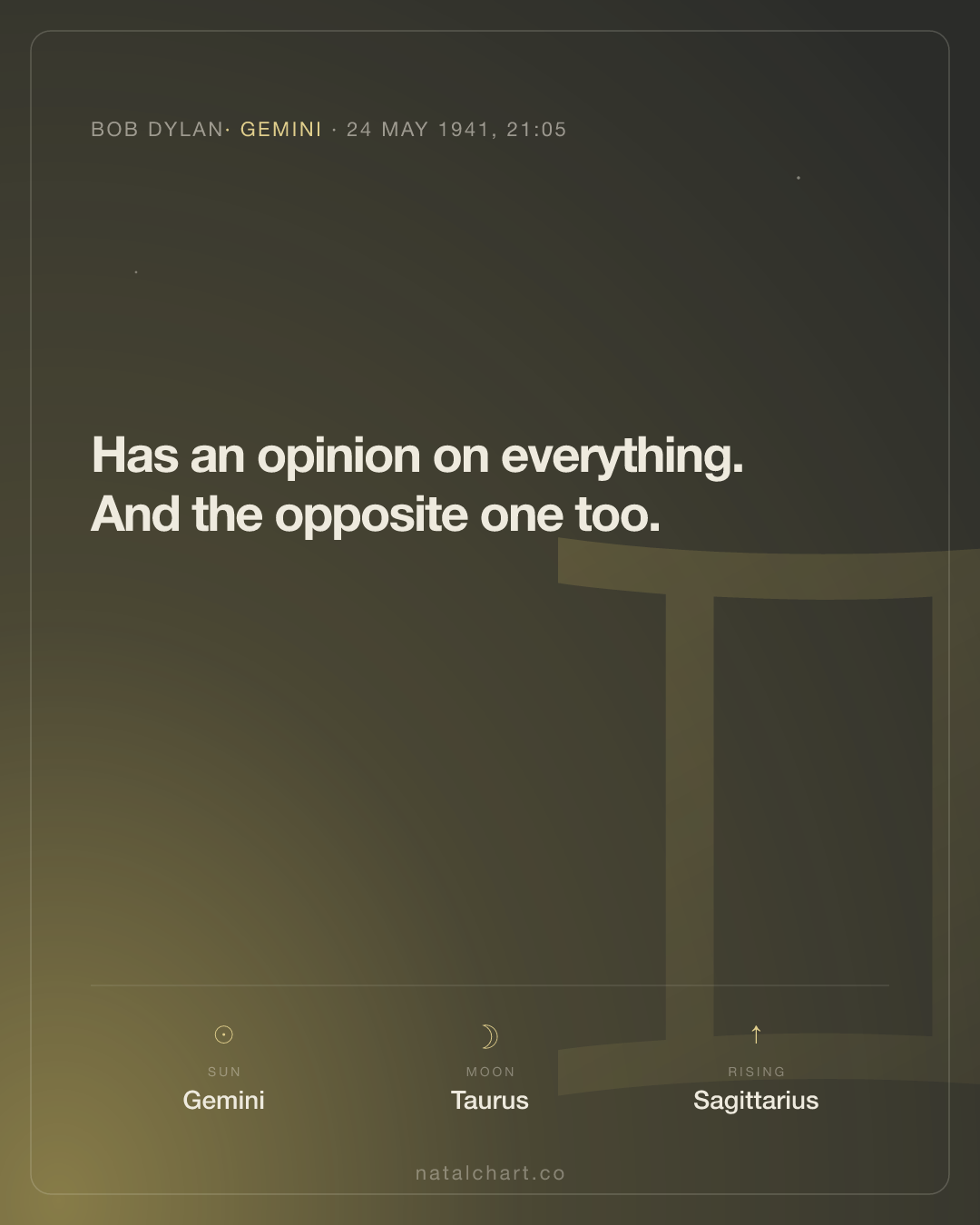
Bob Dylan's chart opens with a remarkable concentration: Sun, Mercury, and Venus all occupy Gemini, all gathered in the seventh house. Three planets in the same sign is already a strong signal; three personal planets stacked in the house of the other, of dialogue, of what gets reflected back — that is a mind that finds itself in conversation, in the friction of opposing viewpoints, in the moment language meets another person. Dylan did not write in solitude for its own sake. He wrote into an argument. "Blowin' in the Wind" was a question addressed to someone. "Like a Rolling Stone" is a six-minute confrontation. The Gemini multiplicity explains what listeners and critics struggled with for decades: there is never just one Dylan. There is the folk prophet, the electric provocateur, the Christian convert, the crooner, the Nobel laureate who refused to explain himself. Each is fully present, each is fully true, and they do not resolve into one another because a Gemini Sun in the house of dialogue does not settle — it keeps turning the prism.
The Sagittarius Ascendant — the face he met the world with, the outer manner that arrived before anyone heard a word — added the philosopher, the range-seeker, the man who turned up in Greenwich Village from Hibbing, Minnesota with a persona already constructed around myth and restlessness. Sagittarius Ascendant people travel toward meaning; they adopt a larger-than-life quality not out of arrogance but because the ordinary frame always feels too small.
The Interior: Moon Joined to Saturn
The Moon in Taurus would normally suggest emotional steadiness — a preference for the familiar, the sensory, the rooted. But Dylan's Moon sits less than one degree away from Saturn, and that closeness changes everything. This is the tightest aspect in the whole chart. When the Moon — the part that feels, needs, and reaches for comfort — is joined this closely to Saturn, emotional warmth does not flow easily. It meets structure. It meets discipline. It meets a voice that says: that softness is a luxury you cannot afford.
The effect in his work is unmistakable. There is warmth in the Dylan catalogue — "Forever Young" is a genuine tenderness — but it almost always arrives enclosed in irony, distance, or formal structure. The Moon-Saturn conjunction in the sixth house also points to an interior relationship with work as moral discipline: the sheer productivity of his output across six decades, the refusal to coast on reputation, the "Rough and Rowdy Ways" album at seventy-nine delivered with the same precision as the albums he made at twenty-three. That is Saturn on the Moon: feeling channelled into labor.
The Mind and the Word: Mercury in Gemini
Mercury in Gemini in the seventh house is Mercury in the sign it rules, in a house built for exchange. This is a mind that generates language the way a river generates current — not as effort but as nature. The sheer volume of Dylan's lyrical output (over 500 original songs, the ongoing Bootleg Series reaching into the dozens of volumes) is this Mercury running at full capacity. But Mercury in the seventh house means the language is always directed outward: Dylan's lyrics are rarely private confession. They address someone, debate someone, answer or contradict someone — even when that someone is abstract, a culture, a moment in time.
The tension between Mercury and Neptune (2.0° orb) adds the layer that makes the words feel larger than their literal meaning. Neptune blurs, expands, poeticizes. "The answer is blowin' in the wind" is not a bad answer to its own question — it is a deliberate evasion that becomes a kind of truth. That Mercury-Neptune tension is the mechanism behind the surrealism of "Desolation Row," the biblical freight of "Every Grain of Sand," the way a Dylan lyric consistently refuses to mean only one thing.
Love and Values: Venus in Gemini
Venus in Gemini in the seventh house intensifies the picture: wit, restlessness, the person who falls for the mind first and the rest follows. Venus in Gemini does not settle easily — there is always another conversation to be had, another angle not yet explored. In Dylan's personal life and his creative partnerships, this pattern held: Joan Baez, the intensity of the early 1960s folk scene, the series of collaborators and muses across decades. The seventh-house clustering means these relationships were also the mirror in which he understood himself — and when the mirror became too fixed, he moved on.
Drive and Ambition: Mars in Pisces, Sun in Tension with Mars
Mars in Pisces in the fourth house does not drive toward external conquest. It pushes inward, into the private territory of imagination. The fourth house is home, roots, the psychological base. A Pisces Mars here means the energy is spent on building an inner world vast enough to sustain the outer one. Dylan's creative withdrawals — the motorcycle accident in 1966, the self-imposed retreats to Woodstock, later to his Malibu farm — all have this flavor: replenishing the interior.
But the Sun pulls against Mars at 2.5° — one of the tightest tensions in the chart. Sun in Gemini against Mars in Pisces: the impulse toward relentless movement and articulation (Gemini) in direct friction with the impulse toward dissolution and inwardness (Pisces). This is the productive contradiction behind Dylan's entire public/private drama: the man who craved recognition and then spent fifty years subverting every attempt to pin him down.
Jupiter, Saturn, and the Sixth House
Three major planets sit in the sixth house alongside the Moon: Jupiter, Saturn, and Uranus, all in Taurus. This is an extraordinary concentration in the house of craft, routine, and daily discipline. Taurus in the sixth house is practical, patient, and thorough. Jupiter here expands the capacity for sustained work; Saturn disciplines it; Uranus injects sudden breaks and reinventions. The result is a creative life that looks spontaneous from the outside but is built on relentless practice: Dylan learning harmonica, guitar, piano, and then the craft of songwriting itself in a compressed few years in the early 1960s, followed by decades of unbroken touring. The Never Ending Tour — begun in 1988 and still ongoing — is this sixth-house stellium made visible. It is not performance anxiety or compulsion; it is the commitment of someone who understands that the skill lives in the doing.
The Outer Planets: Neptune on the Midheaven
Neptune in Virgo in the tenth house sits close to the Midheaven — the career point, the public role, the place where a life's work becomes visible to the world. Virgo-Neptune is precise mysticism: the poet who attends to the exact word, the syllable, the breath. And Neptune on the Midheaven dissolves the boundary between the public person and the mythological figure. By the time Dylan received the Nobel Prize in Literature in 2016 — the first musician ever to do so — the argument about whether he was real or constructed, sincere or performing, prophet or provocateur had been running for fifty years. Neptune does that: it makes a person genuinely hard to see clearly, not because they are hiding, but because they inhabit an in-between space that resists resolution.
Pluto in Leo in the ninth house adds the dimension of influence: the power to reshape how a whole generation thinks about poetry, protest, and the relationship between music and the written word.
The Midheaven: Vocation in Libra
The Midheaven in Libra (the career and public-role point) points to a vocation built around balance, aesthetics, and justice — the art that addresses fairness, that holds contradictions without collapsing them. "The Times They Are A-Changin'" was not a slogan. It was a precisely balanced statement that managed to sound like an anthem for everyone who had ever felt left behind by the powerful. Libra Midheaven does that: it creates work that people feel is speaking directly to them even when it is addressing something larger.
The Tightest Aspects: the Chart's Argument with Itself
The Moon-Saturn conjunction (0.9°) is the spine. It is the weight behind the wit, the longing beneath the irony, the discipline that converts raw feeling into finished art. The Sun-Pluto sextile (1.1°) gives the capacity for renewal: each Dylan reinvention — acoustic to electric, rock to country to gospel to standards — is less a betrayal and more a controlled demolition and rebuild. Uranus in easy flow with Neptune (1.7°) links originality to vision: the breakthrough is always connected to something larger than just the next song. And the Sun's cluster with Jupiter and Mercury (Sun-Jupiter joined, 3.8°; all in Gemini) creates the engine of sheer generative abundance — the reason there are no drafts, no archives with decades of unfinished fragments, but instead a publicly documented record of almost superhuman output.
Chiron and the North Node: the Wound and the Direction
Chiron — an old wound that becomes, over time, a peculiar gift — sits in Cancer in the eighth house. The eighth house concerns itself with what is hidden, with what belongs to others, with mortality and inheritance. Chiron in Cancer here suggests a tenderness about belonging, about the family and the roots that are not as solid as one needs them to be. Robert Allen Zimmerman became Bob Dylan not as a marketing decision but as an act of psychological self-creation: the construction of an identity that could carry more than the one he was born with. That wound of not-quite-fitting, of needing to build the self from scratch, became the engine of one of the most fully realized artistic personas of the twentieth century.
The North Node in Virgo (the direction the life moves toward most authentically) points to the craft itself: precision, service through skill, the discipline of getting the detail right. Not the vision alone — the execution that makes the vision real.
A Closing Note
Bob Dylan's chart is the portrait of a mind that needed multiplicity to be true — three Gemini planets, a Sagittarius Ascendant, a Neptune that dissolves every fixed reading. The hardest thing for anyone who loved his early work was the reinventions, the apparent betrayals, the refusal to stay still. But the Moon-Saturn conjunction tells the other half of that story: under all the movement was an extraordinary seriousness, a private commitment to the work that never wavered. The Nobel committee in 2016 said they gave him the prize for having created new poetic expressions within the American song tradition. The chart says the same thing in different language: a Gemini mind in the house of dialogue, Saturn holding the Moon accountable, Neptune making the whole thing shimmer just out of reach.
The chart
How to read it →Frequently asked questions
What is Bob Dylan's zodiac sign?
Bob Dylan's Sun sign is Gemini — the Sun was in Gemini at birth (1941).
What is Bob Dylan's moon sign?
Bob Dylan has the Moon in Taurus. The Moon sign describes the emotional and instinctive layer of the chart.
What is Bob Dylan's rising sign?
Bob Dylan's rising sign (ascendant) is Sagittarius — the sign on the eastern horizon at the moment of birth.
When and where was Bob Dylan born?
Bob Dylan was born in 1941 in Duluth, Minnesota.