Fernando Henrique Cardoso — natal chart
What does Fernando Henrique Cardoso’s natal chart reveal?
Brazilian sociologist and politician born in 1931. Dependency theorist exiled during the dictatorship, he served as finance minister and created the Plano Real in 1994 to halt hyperinflation. President of Brazil from 1995 to 2002 with the PSDB.
 Share
Share
Birth
1931-06-18 · 00:15 · Rio de Janeiro Reliability: A · reliable data
The through-line: thought as action
Fernando Henrique Cardoso spent his life proving that ideas have consequences. Not ideas in the abstract — ideas written down, argued in print, spoken in exile, eventually enacted through policy. Three planets cluster in Gemini in the third house (the zone of language, analysis, and communication): his Sun, Mercury, and Venus all land here. The Sun is who a person most fully is; having it in Gemini in the house of the written word means that Cardoso was, at the deepest level, a thinker who needed an audience — and his audience, over sixty years, happened to be Brazil itself.
The Ascendant — the face a person presents to the world, the way others read them at first contact — is Aries. Aries rising gives a direct, combative, initiating quality to the outer manner: someone who enters a room and sets the terms, who doesn't wait to be asked. The planetary ruler of that Aries Ascendant is Mars, placed in Virgo in the sixth house (the house of work, craft, and daily discipline). That combination — a bold Aries face driven by a Virgo-Mars engine — explains the particular flavour of his ambition: not conquest for its own sake, but conquest in service of a precise result. The Plano Real, his most consequential act in government, was exactly that: a surgical, technically intricate intervention, prepared in detail, launched with precision.
The private weight
Below the public intellectual there was a different emotional register entirely. The Moon — the interior self, what a person carries when no one is watching — sits in Cancer in the fourth house, the zone of home, roots, and what was inherited. Cancer is where the Moon is most at home, which gives emotional depth and an acute sensitivity to belonging, to continuity, to the people and places that formed him. But this Moon is in almost exact opposition to Saturn in Capricorn at the Midheaven (the orb is 0.1°, barely measurable): the career and public role pulling in one direction, the need for private shelter and family continuity pulling in the other. Saturn in opposition to the Moon, at that tightness, tends to leave a person with the feeling that the outer demands and the inner needs are perpetually in conflict — that public duty arrives at the cost of something quieter and more personal. Cardoso spent long stretches in exile in Chile and France after the 1964 coup. That uprooting — forced departure from the country that is also home — is written directly in this opposition.
Also in the fourth house: Jupiter and Pluto, both in Cancer, both clustered near the Moon. Jupiter here expands the emotional world, adds philosophical weight to questions of national identity and collective memory; Pluto adds intensity, depth, and the experience of irreversible transformation in the family and national root. His theoretical work on dependency — how Latin American nations were structurally shaped by their colonial and economic inheritance — came from a Cancer-fourth-house thinker, someone for whom the past is not background noise but the main event.
Language as instrument
Mercury in Gemini in the third house functions without friction: the planet of the mind in the sign it rules, in the house that expresses exactly what Gemini does. Cardoso wrote prolifically — academic sociology, political theory, newspaper columns, presidential memoirs. The quality that distinguishes his prose from most academic writing of his era is the same quality Gemini rewards: clarity, movement between registers, a refusal to let jargon obscure the argument. He could write for a seminar and for a newspaper on the same day, in the same week, without losing precision in either register.
Venus in Gemini in the same house adds an aesthetic dimension to the intellectual life: an appreciation for dialogue, for the pleasure of ideas exchanged, for the kind of sociability that happens around a table where the conversation is good. For Cardoso, intellectual exchange was not merely professional — it was where he felt genuinely at ease.
Drive and method
Mars in Virgo in the sixth house is the workhorse placement. Virgo's orientation is toward precision, toward the detail that others miss, toward the system behind the apparent disorder. Mars here does not charge in the open field; it prepares, it analyses, it finds the point of maximum leverage and presses there. The sixth house is the zone of daily work and of institutions — the machinery of governance, the ministry, the technical committee. Cardoso's return from exile brought him into exactly that terrain: Senate, Foreign Ministry, Finance Ministry. The Plano Real was not an improvised act of will; it was the fruit of months of detailed preparation, with a team of economists, built around a precise understanding of the inflationary mechanism Brazil had to break.
Mars in Virgo is in tension with Venus in Gemini — the two planets are in a square, an almost exact one at 0.2°. The tension is between the two modes of engagement that defined his career: the Geminian pleasure of ideas and dialogue on one side, the Virgoan demand for precision and implementation on the other. The ideas had to be made to work. The dialogue had to produce a result. Throughout his career, his intellectual partners were also functional collaborators: the debate was inseparable from the work.
Mars also sits joined to Neptune in Virgo in the sixth house. Neptune brings idealism, vision, and occasionally the willingness to act on incomplete information in the hope that the larger picture will hold. For a Marxist-trained sociologist who became a market-reform president, that Neptune-Mars combination carries its own irony: the vision large enough to move a nation, the method precise enough to implement it, joined in the same house of daily labor.
Career and vocation
Saturn at the Midheaven (the career and public point of the chart) in Capricorn is one of the more unambiguous placements in any natal chart. Capricorn is the sign Saturn rules — it operates here with full authority. The Midheaven is the highest visible point, the zone of vocation, reputation, and public role. Saturn here in its own sign points unambiguously toward institutional authority, long-term structural work, and a career that is earned slowly, through accumulation, rather than handed over. Cardoso's ascent was exactly that: decades of academic work, decades of political apprenticeship, exile, return, ministry, Senate, presidency — each stage built on the previous one, nothing shortcut.
Saturn at the Midheaven also carries a certain public gravity: the sense that the person inhabiting this position takes the weight of the role seriously, possibly too seriously to ever look relaxed in it. His two-term presidency (1995–2002) was marked by structural reforms — privatisation, fiscal adjustment, the Real Plan's consolidation — built to last beyond his tenure. That is the Saturn-Capricorn-Midheaven instinct: build for permanence, not for popularity.
The opposition between Saturn at the Midheaven and the Moon-Jupiter-Pluto cluster in Cancer below it runs through the whole career. The public architect and the rooted intellectual were not always comfortable with each other. The man who theorised dependency was also the man who supervised the conditions attached to IMF agreements. That tension was real, and it was public — his critics on the left named it clearly.
The outer pattern: rupture and depth
Uranus in Aries in the first house — placed in the zone of the self and the physical presence — adds an unpredictable, disruptive charge to the Aries Ascendant. This is a person for whom personal freedom and the right to break with established frameworks is not negotiable. In the 1960s, when the military dictatorship classified his sociology as dangerous, they were responding to something real: this chart does not accommodate intellectual submission.
Uranus in the first house is in tension with Pluto in Cancer in the fourth — a square (orb 1.0°). Pluto governs transformation that goes to the root; placed in Cancer and the fourth house, that transformation operates in the domain of national identity and collective belonging. The Uranus-Pluto square is a generational signature of the 1930s, shared by many who would become agents of radical change in the mid-twentieth century — but with Uranus sitting on the Ascendant, Cardoso inhabited that signature more personally than most. He was not merely shaped by the upheavals of his era; he was one of the people doing the shaping.
Neptune in Virgo in the sixth house — at work in the detail of method — adds the dimension of idealism to the practical. The dependency theory he developed was not merely analytical; it was animated by a conviction that the structural conditions it described could be changed. That conviction persisted even through the accommodations of power.
Chiron and the North Node
Chiron — an old wound that over time becomes a specific kind of competence — sits in Taurus in the second house, the zone of resources, material security, and what a person relies on to feel stable. Taurus Chiron points to an early fragility around economic security, around the question of what can be counted on. For a man who grew up in 1930s Brazil and spent years in exile, that fragility was not merely personal — it was structural. The wound around economic uncertainty became the specific expertise: decades later, as Finance Minister, he built the monetary stabilisation plan that ended hyperinflation. The second house wound produced the second house solution.
The North Node — the direction of growth, the point toward which development pulls — is in Aries, joining the Ascendant. This reinforces the Aries quality: the growth direction is toward self-direction, toward the willingness to act without waiting for consensus, toward standing as an originator rather than a respondent. The Cancer fourth house, with its powerful cluster, is the gravitational pull backward — toward the familiar, the rooted, the inherited framework. The Aries North Node asks for movement in the opposite direction: into new terrain, without a guarantee.
The tightest thread
Every chart has one aspect that functions as its central nerve, and in this chart it is the Moon opposing Saturn at 0.1° — barely any separation, the two planets almost locked. The Moon in Cancer (home, belonging, private feeling) and Saturn in Capricorn at the career peak (public duty, structure, cold requirement) are in permanent tension. This is the aspect of someone who is never entirely off duty, because the public role has colonised the private world. It is also the aspect of genuine durability: people with this configuration tend not to collapse under pressure, because they have spent their whole lives managing the weight.
In Cardoso's case, the weight was also historical: he was intellectually formed in a period of dictatorship, exiled, returned, and then had to govern a country in permanent economic crisis. The Moon-Saturn opposition was not merely a psychological trait — it was matched, point for point, by the circumstances of a life.
The full portrait
What the chart shows, taken together, is a person whose public role and private depth were always in productive friction. The Gemini third-house stellium gave him the instrument — language, analysis, the ability to think in public. The Cancer fourth-house cluster gave him the motivation — a deep investment in what Brazil was and what it might become. The Aries Ascendant gave him the readiness to act when the moment arrived. And Saturn at the Midheaven in Capricorn gave him the patience to build, slowly and methodically, the kind of change that outlasts the builder.
The tensions are real — between thought and action, between the exile intellectual and the reform president, between the theorist of dependency and the practitioner of structural adjustment. But the chart does not describe a contradiction. It describes a person who held those tensions together long enough to make them productive, and who left institutions — a stable currency, a reformed state — that were, in his own Saturn-Capricorn terms, meant to last.
The chart
How to read it →Frequently asked questions
What is Fernando Henrique Cardoso's zodiac sign?
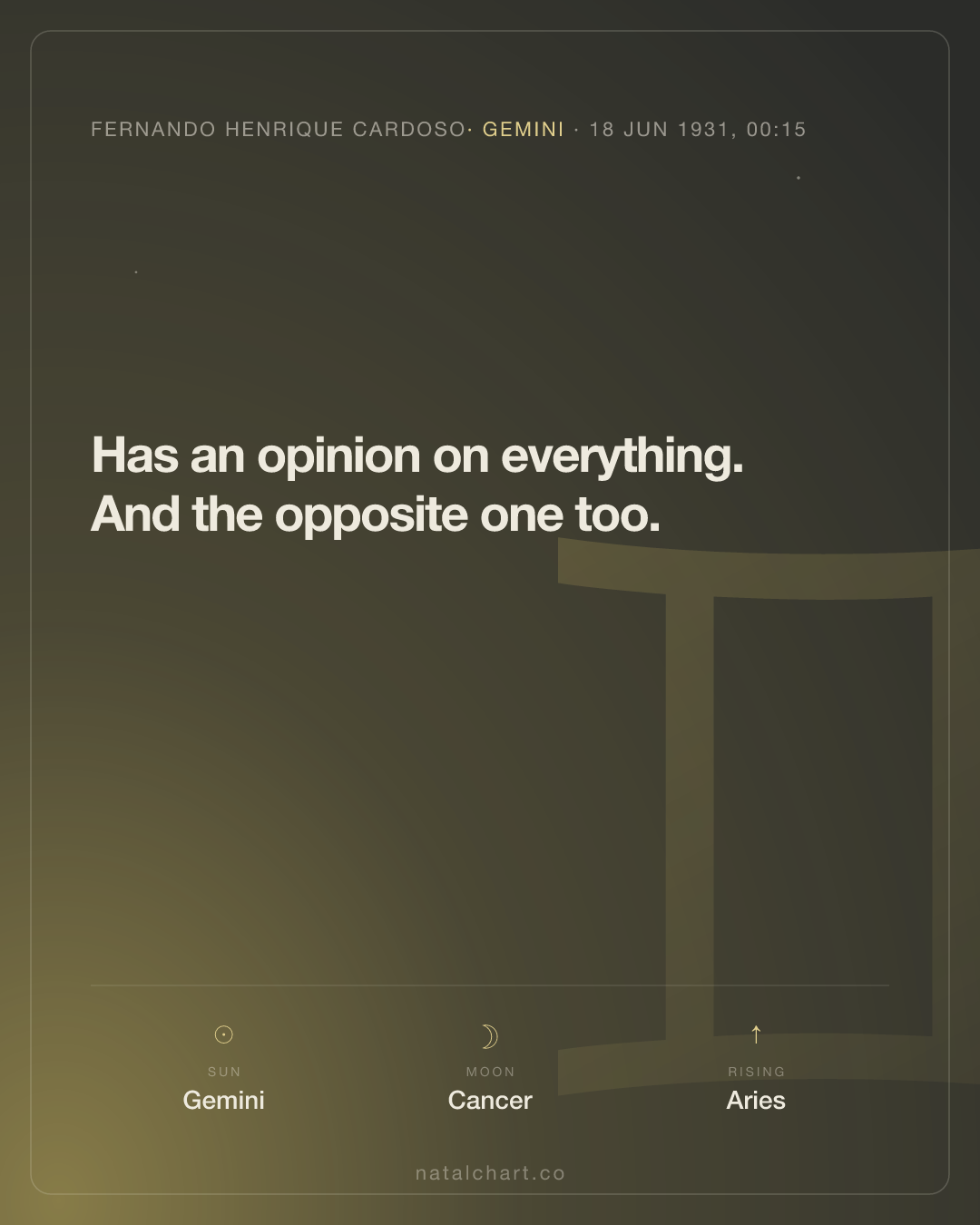
Fernando Henrique Cardoso's Sun sign is Gemini — the Sun was in Gemini at birth (1931).
What is Fernando Henrique Cardoso's moon sign?
Fernando Henrique Cardoso has the Moon in Cancer. The Moon sign describes the emotional and instinctive layer of the chart.
What is Fernando Henrique Cardoso's rising sign?
Fernando Henrique Cardoso's rising sign (ascendant) is Aries — the sign on the eastern horizon at the moment of birth.
When and where was Fernando Henrique Cardoso born?
Fernando Henrique Cardoso was born in 1931 in Rio de Janeiro.