Chico Buarque — natal chart
What does Chico Buarque’s natal chart reveal?
Chico Buarque, born Francisco Buarque de Hollanda on June 19, 1944, in Rio de Janeiro, Brazil, is a singer-songwriter, playwright, and novelist who has shaped Brazilian popular culture for six decades. His early albums, including Chico Buarque de Hollanda (1966) and Construção (1971), established him as a defining voice of MPB. During the military dictatorship he employed allegory and wordplay to evade censorship. He has also published acclaimed novels: Estorvo (1991) and Budapest (2003) each won the Jabuti Prize, Brazil's most prestigious literary award. He received the Camões Prize in 2023.
 Share
Share
Birth
1944-06-19 · 21:15 · Rio de Janeiro, Brazil Reliability: AA · vetted record
The Core: A Gemini Constellation
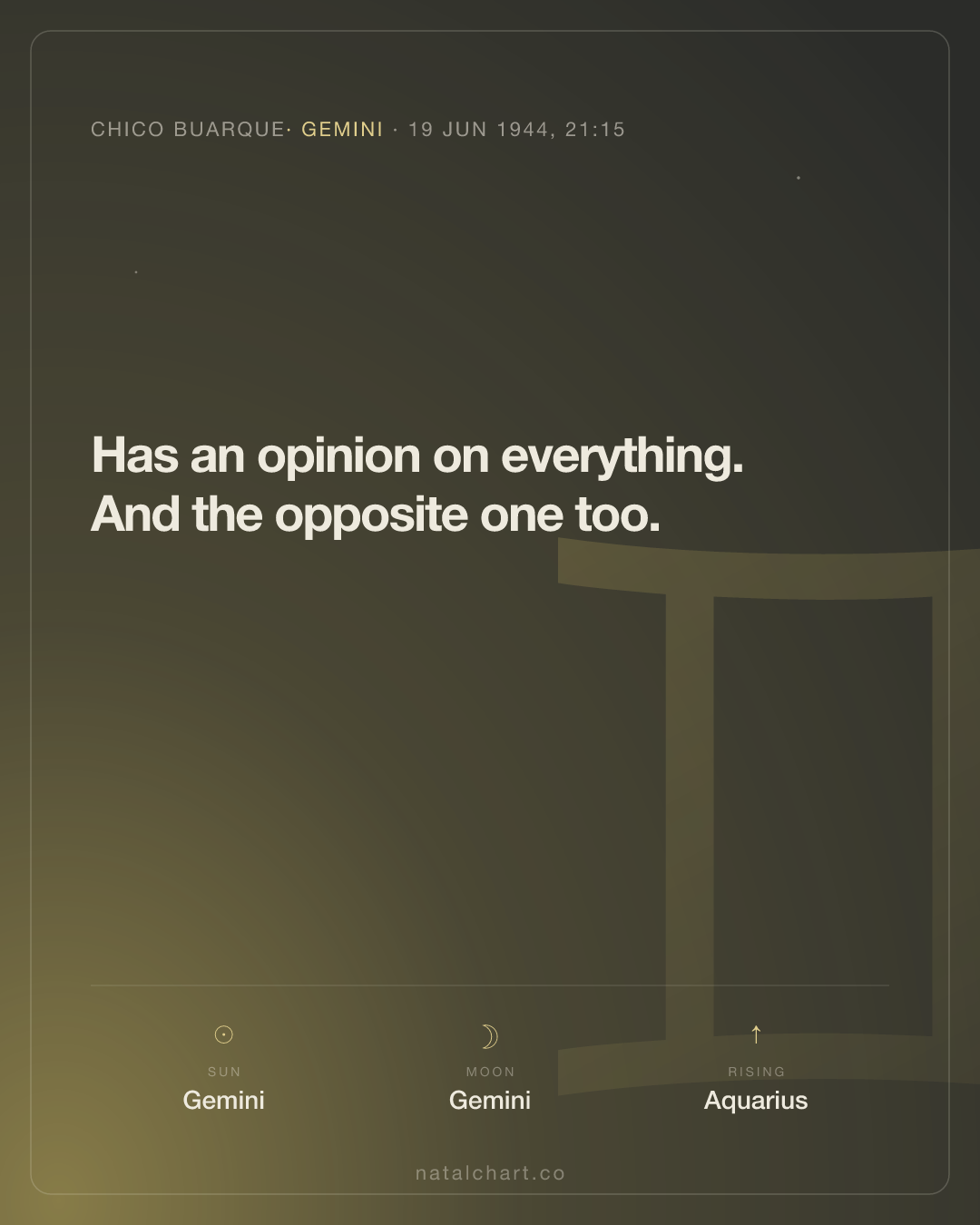
Chico Buarque was born on June 19, 1944, with a remarkable concentration of planets in Gemini: Sun, Moon, Mercury, Venus, Saturn, and Uranus all gathered in that sign. For an astrologer, this is not a chart that hedges its bets — it commits entirely to the Gemini principle of language, duality, wit, and the transformative power of the word. Gemini is the sign of the storyteller, the lyricist, the person who can hold two contradictory truths in the same breath. That Francisco Buarque de Hollanda became Brazil's most celebrated songwriter and one of its finest novelists is not a biographical coincidence; it is the lived expression of this extraordinary stellium. His Ascendant — the face he presents to the world — is Aquarius, the visionary air sign associated with collective ideals, social progress, and a certain deliberate distance from convention. Together, the Gemini stellium and the Aquarian Ascendant produce a figure who is at once intimate (the personal lyric, the confession hidden in a song) and universal (the political allegory, the voice of a generation).
The Fifth House: Art as Life
This concentration falls in the fifth house — the house of creative expression, artistic invention, and everything produced from genuine joy. Sun, Moon, Mercury, Venus, Saturn, and Uranus all occupy this domain, which in traditional astrology also rules theatre, music, and literature. In Chico Buarque's life, the boundary between the art and the person barely existed. His debut album in 1966, released when he was twenty-one, immediately established him as something more than a songwriter: a voice with a distinct sensibility. Construção (1971), widely considered his masterpiece, was built on a construction of language — each verse assembling and disassembling the same words like bricks — that belongs entirely to this fifth-house Gemini logic: the word as material, as structure, as architecture.
Sun Conjunct Saturn: Beauty Under Pressure
The tightest aspect in the chart is the conjunction between Sun and Saturn, separated by just 1.4 degrees. Saturn is the planet of discipline, structure, and hard-won form; in conjunction with the Sun, it sits at the center of the self. This aspect does not soften the chart; it provides the skeleton that holds everything together. Chico Buarque's songs are not casual improvisations — they are crafted with a precision that borders on the architectural, every syllable weighed, every rhyme earned. Saturn in Gemini means that the discipline is applied specifically to language: words are not ornament but load-bearing material. The conjunction with the Sun at 2 degrees' orb also means that this discipline is not experienced as external constraint but as an internal demand — the standard he sets for himself is the one he can never quite escape.
Saturn square Neptune (1.5°) runs directly beneath this conjunction: the tension between concrete structure and the dissolving, the dreamed, the impossible. During the military dictatorship that ruled Brazil from 1964 to 1985, Chico Buarque lived this tension in a politically literal way. He could not name what he was writing about; he could only suggest, imply, encode. The censors blocked Cálice (1973), a song whose title is a homophone of cale-se — "be silent" — in Portuguese. The entire song is a prayer for the cup to pass, a biblical phrase twisted into a cry against silencing. That is Saturn square Neptune in practice: meaning made out of prohibition.
Mercury Sextile Mars: The Sharpened Word
Mercury in Gemini in flowing connection with Mars in Leo (1.5° orb) is the aspect that explains the edge in Chico Buarque's best writing. Mercury in Gemini is the natural home of linguistic facility — quick, versatile, agile. Mars in Leo adds ambition, fire, and the desire to command an audience. In easy flow — as a sextile — these two energies don't fight each other; they accelerate one another. His lyrics carry a forward momentum that is almost physical: they move, they have direction, they arrive somewhere. The playfulness of Gemini is sharpened by Leonine will. His play Roda Viva (1968), which provoked right-wing thugs to attack the theater and tear the set apart, shows that his art was never merely decorative — it had force, and people felt that force directly.
Venus and the Music: What Beauty Costs
Venus in Gemini in the fifth house is, in many respects, the perfect placement for a songwriter: beauty expressed through language, love rendered into words, aesthetics inseparable from communication. Venus conjunct Sun (2° orb) places this love of beauty at the core of the identity. But Chico Buarque's relationship to beauty was never easy or uncomplicated. Sun square Neptune (2.9°) introduces a thread of longing and disillusionment running through the beautiful: the sense that the ideal and the real are always slightly out of reach. Some of his most beloved songs — A Banda (1966), Apesar de Você (1970), O Que Será (1976) — carry this quality: a deep sweetness that contains within it an awareness of what cannot be, what is lost, what is dreamed of rather than lived.
Moon Sextile Jupiter: The Generous Emotional Range
Moon in Gemini in the fifth house, in flowing connection with Jupiter in Leo in the seventh, speaks to the emotional generosity that runs through Chico Buarque's songwriting. The Moon here is emotionally curious, versatile, and capable of holding many registers at once: tenderness, irony, grief, humor. Jupiter in Leo in the seventh house — the house of relationships and the public — expands this outward. His audience felt seen and held by his music in a way that went beyond mere entertainment. During the dictatorship years, his songs became a form of shared shelter; Apesar de Você sold 100,000 copies before the censors understood what it was about. The collective emotional function of his art is a Moon-Jupiter story.
Mars, Jupiter, and Pluto in Leo: The Seventh House
Mars, Jupiter, and Pluto all gather in Leo in the seventh house, which governs relationships, public engagement, and the encounter with the other. Leo here gives these interactions grandeur and presence; even Chico Buarque's most intimate relationships had a quality of drama and consequence. His exiles — he spent time in Rome in the late 1960s and early 1970s — and his ongoing negotiation with Brazilian authorities were seventh-house battles, conducted with Leonine pride. Uranus sextile Pluto (2.9°) connects his fifth house Gemini cluster with the seventh house Leo cluster, indicating that the creative disruption (Uranus in Gemini, fifth house) was always in service of a larger transformation of the public sphere (Pluto in Leo, seventh house).
The Midheaven in Scorpio: Vocation as Investigation
The Midheaven — the point in the chart that marks the public vocation and career trajectory — is in Scorpio, the sign of depth, investigation, and the willingness to go where others prefer not to look. While the Gemini stellium gives Chico Buarque his instrument, the Scorpio Midheaven gives him his direction. His novels — Estorvo (1991) and Budapest (2003), both winners of Brazil's Jabuti Prize, the country's most prestigious literary award — are not the light entertainments one might expect from a Gemini musician. They are dark, labyrinthine, concerned with identity, loss, and the uncanny. Budapeste is the story of a ghostwriter who loses his sense of who he is; Estorvo is a novel of paranoia and menace. The Scorpio Midheaven demands that the most public expression of the self go to the deepest places.
Chiron and the North Node: The Wound and the Direction
Chiron — an old wound that gradually becomes a gift — sits in Virgo in the eighth house, alongside Lilith. The eighth house is associated with the hidden, the transformative, and the irreversible. Virgo's Chiron suggests a wound related to criticism, inadequacy, or the impossibility of perfection. For a figure of Chico Buarque's stature, this may have expressed itself as the gap between the immense public adoration and a private sense of always falling short of the standard — Saturn conjunct Sun, the impossible internal judge, working in tandem with Chiron's Virgoan self-criticism. The North Node in Cancer — the compass point indicating the direction of growth across a lifetime — suggests that the deepest evolution ran toward roots, belonging, the nourishment of memory. His late career novel O Irmão Alemão (2014) draws on his father's biography and traces a family secret: a move toward the personal, the ancestral, the emotionally rooted.
Neptune in Libra: The Idealism Behind Everything
Neptune in Libra in the ninth house adds an idealistic philosophical dimension to the chart. The ninth house governs belief, higher learning, and the search for meaning. Neptune in Libra dreams of harmony, justice, and a world in which beauty and fairness coexist. This is the quiet engine behind Chico Buarque's political commitment — not the strident sloganeering of a pamphleteer but the persistent faith that song could hold the society together, that beauty was a form of resistance, that art had an obligation to the common life. He received the Camões Prize in 2023, the highest distinction in the Portuguese-speaking world, an acknowledgment that his work had always spoken beyond Brazil.
Closing: The Language Itself
Chico Buarque's chart is ultimately a portrait of language in service of life — not language as decoration or virtuosity, but language as the way a person makes sense of the world, resists what is unjust, holds what is lost, and reaches toward what might still be possible. The extraordinary Gemini stellium gives him the instrument; Saturn gives it structure; Scorpio Midheaven gives it depth; and the Aquarian Ascendant gives it a horizon beyond the merely personal. He is, in the truest sense, a public poet — someone whose private observations became, over six decades, a shared vocabulary for an entire culture.
The chart
How to read it →Frequently asked questions
What is Chico Buarque's zodiac sign?
Chico Buarque's Sun sign is Gemini — the Sun was in Gemini at birth (1944).
What is Chico Buarque's moon sign?
Chico Buarque has the Moon in Gemini. The Moon sign describes the emotional and instinctive layer of the chart.
What is Chico Buarque's rising sign?
Chico Buarque's rising sign (ascendant) is Aquarius — the sign on the eastern horizon at the moment of birth.
When and where was Chico Buarque born?
Chico Buarque was born in 1944 in Rio de Janeiro, Brazil.