Orhan Pamuk — natal chart
What does Orhan Pamuk’s natal chart reveal?
Orhan Pamuk, born on June 7, 1952, in Istanbul, Turkey, is a novelist whose fiction explores the intersection of Eastern and Western culture, the weight of history, and personal and collective memory. His major novels include The White Castle (1985), My Name Is Red (1998)—a mystery set in sixteenth-century Ottoman Istanbul—and Snow (2002). He was awarded the Nobel Prize in Literature in 2006. In 2008 he founded the Museum of Innocence in Istanbul, inspired by his novel of the same name (2008), one of the few author-conceived museum projects in the world. Pamuk has taught comparative literature at Columbia University in New York.
 Share
Share
Birth
1952-06-07 · 22:30 · Istanbul, Turkey Reliability: A · reliable data
A Mind Built for Two Worlds
Orhan Pamuk was born on June 7, 1952, in Istanbul, at half past ten at night. His chart opens with a striking cluster: the Sun, Mercury, and Venus all gathered in Gemini in the fifth house — the house of creative expression, of making things that last. Three personal planets in one sign, in one house of creation: thinking, naming, and loving beauty are not three separate activities for Pamuk, but one single motion. A sentence, for him, is already an aesthetic and philosophical act at once.
The Ascendant in Aquarius
The Ascendant (the face someone brings to the world, the first impression) falls in Aquarius, whose traditional ruler is Saturn. This gives Pamuk a quality of measured remove, of intellectual independence — the sense that he stands slightly apart from any single crowd, observing. Istanbul knows this quality in him: someone who moved through the city not quite at home in any one neighbourhood of it, watching. His fiction consistently inhabits that position — the observer, the walker, the person on the edge of belonging who sees more clearly because of the distance.
The Moon in Sagittarius, House 11
The Moon represents the emotional interior — what someone feels before they think. Pamuk's Moon falls in Sagittarius in the eleventh house (the house of wider communities, of the world beyond the personal). Sagittarius carries an innate pull toward what is foreign, philosophical, and far away — a restlessness of the mind that cannot settle into a single tradition or horizon. His novels reach persistently across that divide: East toward West, Ottoman past toward Turkish present, individual memory toward collective history. This is not an intellectual position chosen strategically; it is the emotional architecture.
The Moon in Sagittarius pulls in exactly the opposite direction from his Venus in Gemini — and the chart's tightest aspect confirms this tension: Moon pulling against Venus, with an orb of just 0.2 degrees. A polarity between the desire to roam freely and philosophically (Moon Sagittarius) and the pleasure taken in fine detail, precise language, intimate beauty (Venus Gemini). In his work, this is the tension between the grand panoramic sweep of history and the single still object in a room. My Name Is Red holds both at once: it is an epic and it is about the specific problem of how to paint an eye.
Mercury and Venus in Gemini, House 5
Mercury (the mind, the writer's instrument) and Venus (beauty, pleasure, what one loves) are both in Gemini in the fifth house, and they sit close together — less than four degrees apart. Mercury in Gemini is the natural writer's placement: agile, curious, in love with language itself, capable of inhabiting multiple registers and voices simultaneously. This plurality is unmistakable in Pamuk's fiction — My Name Is Red has over a dozen narrators, each with a fully realised voice, including a dog, a corpse, and a coin. Venus alongside Mercury in Gemini means that beauty, for him, lives in language — not in gesture or melody, but in the sentence.
Mars in Scorpio, House 10
Mars — the drive that shapes a career — sits in Scorpio in the tenth house, which is the house of public vocation and reputation. Scorpio gives Mars a particular quality: the willingness to go where it is uncomfortable, to pursue what others avoid. Pamuk's confrontation with Turkish identity and history — particularly his 2005 interview in which he acknowledged the Armenian genocide and the killing of Kurds, which led to criminal charges under Article 301 — was an act that only someone with this kind of Mars could sustain. It was not reckless; it was deliberate. Scorpio Mars in the tenth house does not flinch from what the public record demands.
The Midheaven (the public vocation point of the chart, the career horizon) is also in Scorpio: his legacy is tied to depth, to the unsaid, to the things a culture refuses to look at. He spent years building a museum in Istanbul from a fictional collection — the Museum of Innocence — converting a novel into a physical space. That is a Scorpio Midheaven project: obsessive, meticulous, turning the private and painful into something permanent.
Jupiter in Taurus, House 4
Jupiter (the planet of expansion, of what grows) sits in Taurus in the fourth house — the house of roots, family, and the deep private interior. Taurus holds what is reliable, physical, sensory: memory attached to objects, to smell, to texture. The Museum of Innocence (2008) is the perfect expression of this placement: an entire novel, and then a real museum, built around objects — a saltshaker, a cigarette stub, earrings — as containers for memory and longing. Jupiter here says that his richest vein of material is always in the domestic, the tactile, the inherited.
Saturn and Neptune in Libra, House 9
Saturn (structure, discipline, what is earned slowly) and Neptune (imagination, the porous border between self and world) both sit in Libra in the ninth house — the house of philosophy, long journeys, and the wider search for meaning. Libra carries a preoccupation with balance, with seeing two sides of every question. For Pamuk, the ninth-house question has always been cultural and civilisational: East and West, faith and secularism, tradition and modernity. Saturn here means he has treated that question with intellectual rigour — not as a romanticised theme but as a structural problem in his fiction. Snow (2002) sets these forces in direct collision in a snowbound Anatolian city, and the novel refuses easy resolution.
The Sun: Identity and the Writer's Task
The Sun in Gemini in the fifth house, joined to Mercury (1.5 degrees apart), describes someone whose identity is fundamentally the act of writing — not writing about a self that already exists, but discovering the self through the act of naming. Pamuk has described in his memoir Istanbul: Memories and the City (2003) that writing gave him a way to be present to his own experience that nothing else could offer. The Sun in easy flow with Neptune (trine, 2.1 degrees) adds an imagination that is naturally immersive, that dissolves the border between what is lived and what is invented. The Sun in collaborative aspect with Pluto (2.4 degrees) grounds this imagination in something more serious: a drive to transform, to make the personal historically meaningful.
Chiron in Capricorn, House 12
Chiron (an old wound that, worked over time, becomes a point of strength) sits in Capricorn in the twelfth house — the house of what is private, hidden, not easily spoken. Capricorn carries questions of authority, legitimacy, and recognition from institutions. The twelfth house is where things gestate unseen. Pamuk spent years writing before international recognition came — and even then, the Nobel Prize in Literature in 2006 arrived alongside the domestic controversy over his public statements. This Chiron says that the question of legitimacy — being recognised for what one actually does, not diminished for saying true things — was a recurring sore point. It is also where the resilience came from.
The North Node in Aquarius
The North Node (the direction a life tends forward) is in Aquarius — the sign of his Ascendant, whose traditional ruler Saturn sits in the ninth house of philosophy. The arc of his life bends toward what serves a larger community, what makes the collective more conscious of itself. Teaching comparative literature at Columbia, writing essays about the relationship between East and West, building a museum that belongs to everyone: these are Aquarian acts. The Nobel citation noted that in his work he had discovered "new symbols for the clash and interlacing of cultures." That is the North Node fulfilled.
A Portrait
Orhan Pamuk is someone who writes because it is how he makes the world coherent — not as an aesthetic preference but as a necessity. The Gemini cluster at the centre of his chart means that language is his primary sense organ: he understands things by finding the right words for them, and when the words run out, he builds a museum to hold what language alone cannot contain. The tension between Moon Sagittarius and Venus Gemini — the broadest philosophical pull against the finest aesthetic detail — is precisely what makes his fiction feel both sweeping and intimate at the same time. He has spent a lifetime standing at the edge of two worlds, looking carefully in both directions, and writing down what he sees.
The chart
How to read it →Frequently asked questions
What is Orhan Pamuk's zodiac sign?
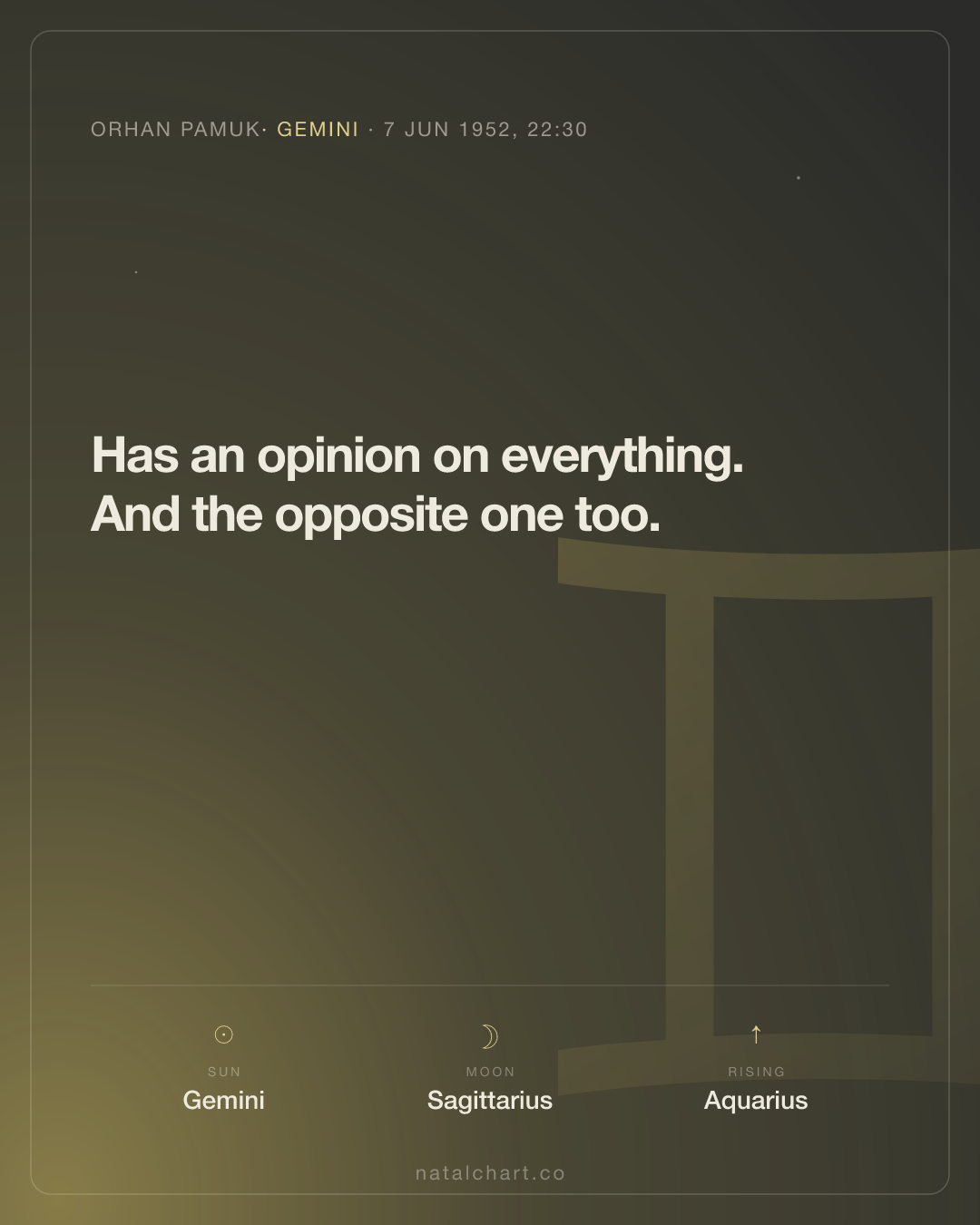
Orhan Pamuk's Sun sign is Gemini — the Sun was in Gemini at birth (1952).
What is Orhan Pamuk's moon sign?
Orhan Pamuk has the Moon in Sagittarius. The Moon sign describes the emotional and instinctive layer of the chart.
What is Orhan Pamuk's rising sign?
Orhan Pamuk's rising sign (ascendant) is Aquarius — the sign on the eastern horizon at the moment of birth.
When and where was Orhan Pamuk born?
Orhan Pamuk was born in 1952 in Istanbul, Turkey.