Bülent Ecevit — natal chart
What does Bülent Ecevit’s natal chart reveal?
Bülent Ecevit, born on 28 May 1925 in Istanbul, was a Turkish politician, poet, journalist and translator who served four times as Prime Minister of Turkey. He led the centre-left Republican People's Party (CHP) from 1972 and later founded the Democratic Left Party (DSP) in 1985. As prime minister in 1974, he ordered the Turkish military intervention in Cyprus. His governments alternated with periods of opposition through the turbulent 1970s, and he was imprisoned after the 1980 military coup. He returned to office as prime minister in 1999, leading a coalition during which the financial crisis of 2001 and the capture of PKK leader Abdullah Öcalan occurred, and Turkey was granted European Union candidate status. Beyond politics, Ecevit published poetry and translated works including those of Rabindranath Tagore and T. S. Eliot. He died on 5 November 2006 in Ankara.
 Share
Share
Birth
1925-05-28 · 03:35 · Istanbul, Turkey Reliability: A · reliable data The ascendant is based on the most widely cited birth time for this figure.
The Core: A Gemini Mind in an Aries Frame
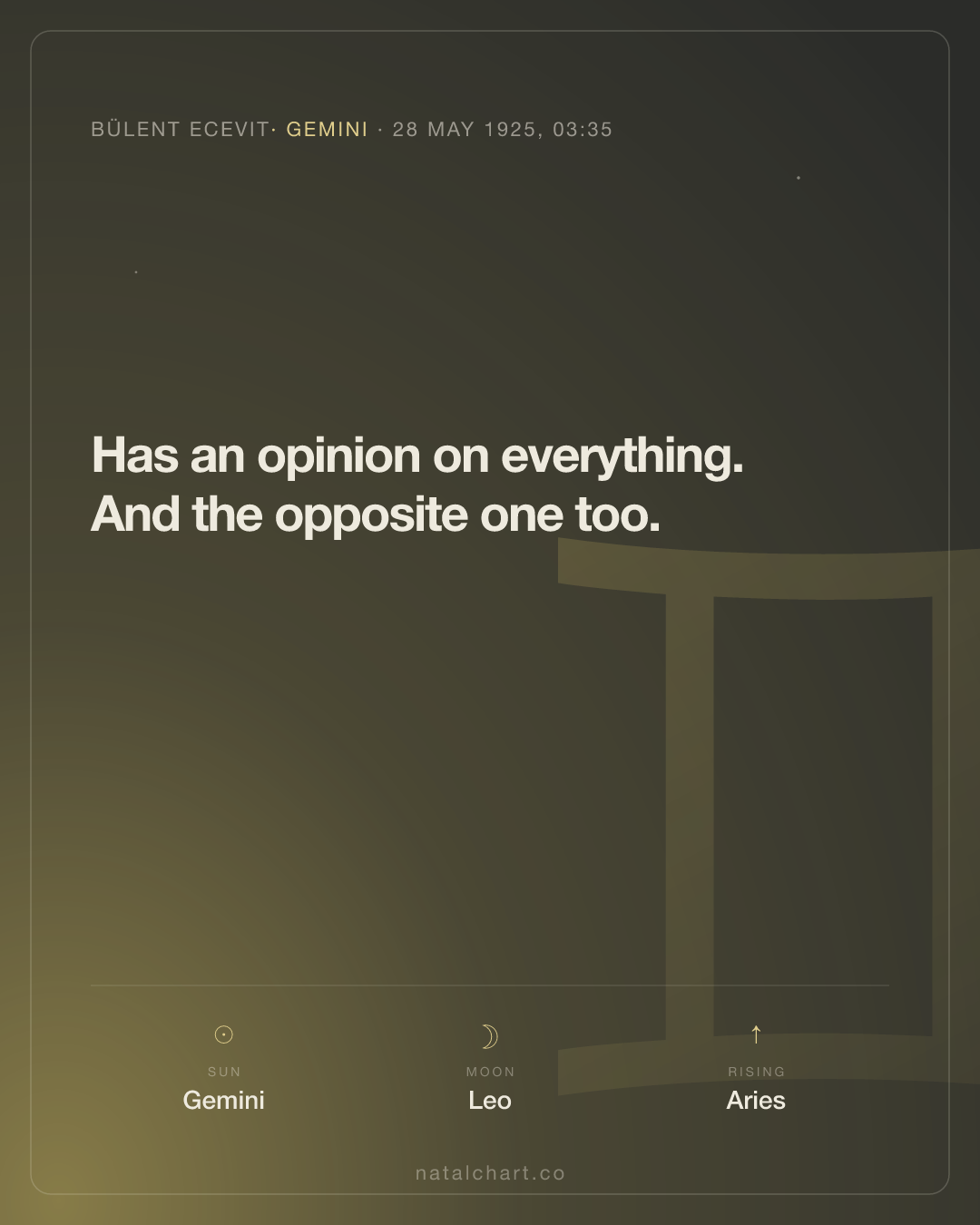
Bülent Ecevit's chart opens with an immediately legible tension. The Sun and Venus both sit in Gemini in the third house — the zone of language, ideas, journalism, and exchange — which means that at the centre of his identity was a genuine love of words and thought. He was not a politician who happened to write poetry as a hobby; the poetry came first, in the same psychic territory as the politics. Yet all this Gemini fluency arrived in an Aries Ascendant — the Ascendant describes the face someone meets the world with. Aries leads with directness, with a certain willingness to act before the full picture is clear, with the physical confidence of someone who trusts their own initiative. The combination is unusual in a statesman: intellectual restlessness and rhetorical richness, delivered with a bluntness that could disarm allies as readily as opponents.
The Aries Ascendant and the Public Presence
An Aries Ascendant is reinforced by Chiron placed in the first house — Chiron is an old vulnerability that slowly becomes a gift. Here it sits right at the doorstep of the public persona. Ecevit entered politics young and took his fair share of battering: the military coup of 1980 landed him in prison, and the turbulent coalition politics of the 1970s wore down every participant. The capacity to absorb those blows and return — to be imprisoned and come back as prime minister nearly two decades later in 1999 — points to exactly the kind of toughened resilience that Chiron in Aries, over time, produces. The wound was exposure, directness, the cost of leading from the front; the gift was an uncommon credibility built precisely because he did not retreat.
The Emotional Interior: Leo Moon
The Moon describes emotional needs and the interior life. Ecevit's Moon is in Leo in the fifth house — the house of creative expression, performance, and the things one does for love rather than obligation. A Leo Moon needs to be seen, genuinely, not merely tolerated; it needs its contributions to matter. His poetry and his translations — of Tagore, of T.S. Eliot — were not a sideline; they were emotional sustenance. The Moon forms an easy angle with the Sun in Gemini, suggesting that the inner life and the outward persona were unusually well coordinated: the public man and the private man pulled in the same direction more often than not. Neptune also sits in Leo in the fifth house, adding a quality of idealism and theatrical imagination to this already expressive placement.
Mercury: Slow Certainty
Mercury describes the thinking and communication style. In Taurus, in the second house, Ecevit's Mercury moved at a different speed than his Gemini Sun might suggest. Taurus Mercury is not verbose; it thinks carefully, arrives at a position, and stays there. Once Ecevit adopted a political conviction — the social democratic centre-left line he held across five decades — he did not abandon it lightly. The translations of Tagore and Eliot fit this Mercury too: translation demands patience, accuracy, respect for the original voice. A Taurus Mercury forms easy angles with both Mars and Pluto in Cancer, which means his careful words had structural depth behind them; they landed with weight because they were backed by conviction and, at times, real force.
Mars and Pluto: The Power Beneath the Poet
Mars and Pluto are joined together in Cancer in the fourth house, a tight pairing that sits at the very foundation of the chart — literally the home, roots, and homeland. This combination is formidable: it speaks of a will that operates through emotional attachment and a sense of protective duty, not through aggression alone. The decision to order the military intervention in Cyprus in 1974 — one of the most consequential and contested acts of his career — has the exact fingerprint of Mars and Pluto in Cancer: action taken in the name of protecting a population, with all the moral complexity that entails. This placement also describes the way ambition is fuelled: not by ego in isolation, but by a felt obligation to a people and a cause. Mars forms an easy flow with Saturn in Scorpio, which gave this drive a structural discipline — it was not impulsive power but power built on a framework.
Jupiter in Capricorn: The Professional Climber
Jupiter, which describes where a person finds growth and good fortune, is in Capricorn in the tenth house — the house of public life, career, and reputation. This is a placement that rewards long work and institutional patience. Ecevit became prime minister four times. He led a party he inherited, rebuilt it after the coup, then founded an entirely new one at the age of sixty. Capricorn Jupiter does not hand over the prize early; it grants what has been earned, incrementally, over time. The European Union candidacy that came through during his final government in 1999 was a diplomatic achievement that required exactly this kind of sustained, institutional patience.
Saturn in Scorpio: The Weight of Hidden Things
Saturn — the planet that describes where a person encounters resistance, duty, and eventual authority — is in Scorpio in the eighth house, the zone of shared resources, power structures, hidden forces, and crisis. Ecevit's governments were repeatedly defined by exactly these themes: the financial crisis of 2001, which struck during his final term, devastated Turkey's economy and ended his political career. Saturn in Scorpio in the eighth house describes a life in which the systemic, the hidden, and the financial repeatedly prove to be the real theatre of events. The pressure is intense but the understanding it produces is hard-won and genuine.
The Outer Planets and Generational Resonance
Uranus in Pisces in the twelfth house speaks of hidden disruption, sudden reversals that arrive from the invisible margins — the 1980 military coup, which dissolved his party and put him in prison, has this quality. It was not something he could fight directly; it came from outside the visible political arena. Pluto in Cancer, joined to Mars, confirms that the deepest transformations in his life ran through questions of homeland and collective belonging. These are generational placements, but they shape the personal story in unmistakable ways.
The Midheaven: Capricorn Vocation
The Midheaven — the public and career point — is in Capricorn, the same sign as Jupiter. This alignment reinforces everything: a vocation tied to institutions, to the long game, to the accumulation of legitimate authority through sustained effort. Prime minister four times, party founder twice, translator of Nobel laureates: the Capricorn Midheaven does not do things quickly, but it does them in a way that lasts.
Chiron and the North Node
Chiron in Aries in the first house has already been discussed: the wound of being exposed and leading from the front, transformed into political durability. The North Node — the direction of growth and development across a lifetime — is in Leo. For someone with the Sun in Gemini, the pull toward Leo asks for something more: not just the exchange of ideas but the full creative and personal expression of them, a willingness to stand behind the work with one's whole name and face. The poetry, the translations, the political memoir — these are all Leo North Node acts. They say: this is not just a position I hold; this is who I am.
Closing the Portrait
Bülent Ecevit's chart describes a man built from contradictions that turned out to be complementary. The Gemini Sun that loved language and ideas sat inside an Aries frame that demanded action. The Leo Moon that needed to matter emotionally was disciplined by Saturn and structured by Pluto. The poet and the politician were not two separate identities kept in separate rooms; they drew from the same source. A life that included imprisonment, multiple governments, translation of Tagore and Eliot, and a country's European candidacy: the chart does not predict the events, but it does trace the character from which they all emerged.
The chart
How to read it →Frequently asked questions
What is Bülent Ecevit's zodiac sign?
Bülent Ecevit's Sun sign is Gemini — the Sun was in Gemini at birth (1925).
What is Bülent Ecevit's moon sign?
Bülent Ecevit has the Moon in Leo. The Moon sign describes the emotional and instinctive layer of the chart.
What is Bülent Ecevit's rising sign?
Bülent Ecevit's rising sign (ascendant) is Aries — the sign on the eastern horizon at the moment of birth.
When and where was Bülent Ecevit born?
Bülent Ecevit was born in 1925 in Istanbul, Turkey.