Clarice Lispector — natal chart
What does Clarice Lispector’s natal chart reveal?
Clarice Lispector was a Brazilian novelist and short-story writer, born on 10 December 1920 in Chechelnyk, Ukraine. Her family fled the post-revolutionary pogroms and emigrated to Brazil when she was an infant, settling first in Recife and later in Rio de Janeiro. While studying law she worked as a journalist, and at twenty-three she startled Brazilian letters with her debut novel, Perto do coração selvagem (Near to the Wild Heart, 1943). Over the following decades she developed an introspective, unconventional prose that probed consciousness and everyday experience, in works such as the story collection Laços de família (Family Ties, 1960), the novel A paixão segundo G.H. (The Passion According to G.H., 1964) and her final masterpiece A hora da estrela (The Hour of the Star, 1977). She died in Rio de Janeiro on 9 December 1977. Today she is regarded as one of the most original voices in twentieth-century Latin American literature.
 Share
Share
Birth
1920-12-10 · 11:15 · Chechelnyk, Ukraine Reliability: DD · conflicting The 11:15 birth time comes from Astrotheme, which labels it rectified from an approximate time. No birth certificate hour is documented, so the time should be treated as unverified.
A mind that could not stop looking inward
Clarice Lispector arrived in the world on the same day she would leave it — born 10 December, dead 9 December, seventy-seven years later, one day shy of completing the circle. That almost-symmetry fits her: a writer who spent her entire career probing what lies just beneath the surface of ordinary experience, circling the same questions without ever quite landing. Her chart is the chart of someone whose inner life is not a refuge from the world but the world itself — relentlessly examined, never resolved.
Sun and Moon in Sagittarius: the double flame
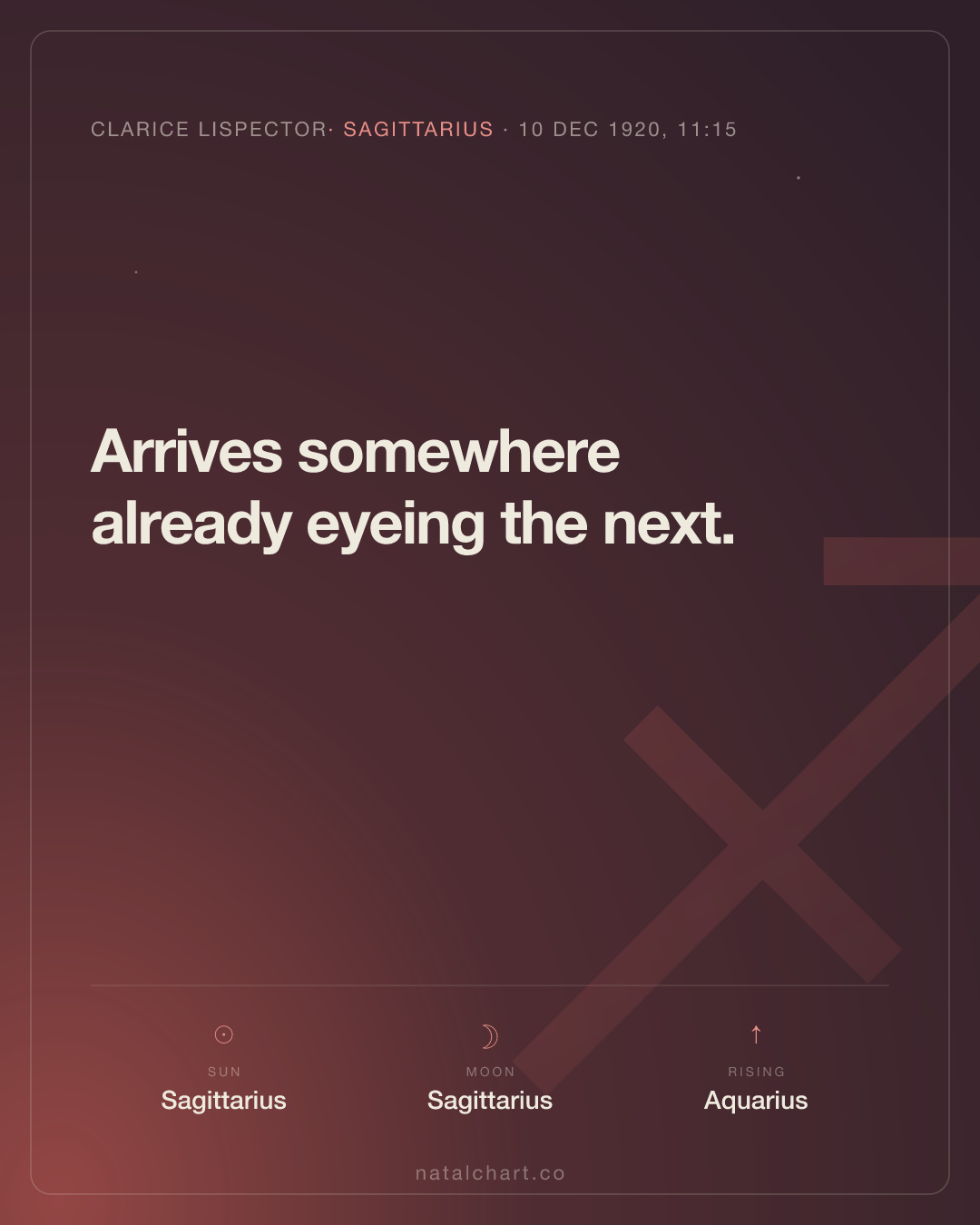
Both the Sun —the conscious drive, how one takes up space— and the Moon —the emotional interior, what one needs to feel whole— sit together in Sagittarius, in the eleventh house of collective life and ideas. A Sun-Moon conjunction this tight (less than half a degree apart) means the public self and the private self are almost the same thing: the same restlessness animates both. Sagittarius brings a philosophical hunger, a need to push beyond whatever boundary is currently visible. In Lispector's case that hunger was directed inward rather than outward — not toward travel or external horizons, but toward the furthest reaches of consciousness. Her debut novel, Near to the Wild Heart (1943), published when she was just twenty-three, opens mid-stream inside a mind thinking about thinking. That double Sagittarius fire is there from the very first page.
Aquarius rising: the outsider who observes
The Ascendant — the face one meets the world with — was Aquarius, and Mars in Aquarius sat right at that rising point. Aquarius rising describes someone who feels slightly outside whatever group they inhabit, watching the scene rather than losing themselves in it. For Lispector this was literal: born in Ukraine, raised in Recife, later in Rio, later abroad (she spent years in Washington DC and Naples as a diplomat's wife), she was always the newcomer, always the one with the slight foreignness that sharpened the gaze. Mars at the Ascendant gave that observer stance real force — she was not passive; the watching had teeth. Her prose is both intimate and cold at the same moment, which is exactly what an Aquarius Ascendant with Mars looks like on the page.
Mercury in Scorpio: language as surgery
Mercury — how one thinks and communicates — was in Scorpio, in the tenth house of public reputation. Scorpio Mercury does not describe things; it dissects them. It goes past the surface of language to the tissue beneath, looking for what is true even when the truth is uncomfortable. In Lispector, this shows up as sentences that seem simple but detonate slowly — "She had been aware for some time that life was just a layer, and beneath it lay nothing. But that nothing she had discovered in herself was a rich, pulsing darkness." That is Mercury in Scorpio doing its work. The tenth house placement means this way of using language became the public face of her career: her literary reputation rested precisely on how far she was willing to take the probe.
Venus in Capricorn and Saturn in Virgo: a private architecture of love
Venus — how one loves and what one values — was in Capricorn, tucked into the twelfth house: the house of what remains hidden, of what one does not easily show. Venus and Capricorn together describe love that is serious, loyal, and slow to open. The twelfth house adds a quality of privacy, even isolation — affection that does not broadcast itself. In her correspondence and in what those close to her wrote, Lispector emerges as intensely warm in private and almost inaccessible in public. Her Venus in Capricorn was also in easy flow with Saturn in Virgo in the eighth house — a link between her values and a precise, enduring inner discipline. She revised obsessively. The Passion According to G.H. (1964) was reworked over years; its final form has the spare, architectural precision of someone who valued getting it exactly right above all else.
Mars in Aquarius: the unconventional force
Mars — the drive to act, to push, to make things happen — was in Aquarius at the Ascendant. This placement breaks with convention instinctively, not as a programmatic statement but because any other way of proceeding feels simply wrong. When Lispector submitted Near to the Wild Heart in 1943, Brazilian prose fiction looked nothing like what she had written. The book had no real plot in the traditional sense; its interior monologue technique was jarring by the standards of the day. She did not soften it. Mars in Aquarius does not sand down the edges to fit. Its tension with Neptune in Leo in the seventh house — the pull between radical individuality and the need for relationship, between the solitary probe and the desire to be received — runs as a quiet undercurrent through everything she wrote, including The Hour of the Star (1977), whose narrator Rodrigo is both utterly alone and desperately seeking connection.
Jupiter and Saturn in Virgo: the gift of exact detail
Jupiter and Saturn — the two great organizing principles, one of expansion and one of structure — were both in Virgo, in the eighth house of depth, inheritance, and transformation. Virgo does not generalize; it notices the particular. Jupiter in Virgo expands through precision: the more exact the observation, the larger the meaning it carries. Saturn in Virgo disciplines through attention to detail. Together in the eighth house, they describe a mind that finds its largest questions in the smallest things — a cockroach in The Passion According to G.H., a hand on a table, a woman peeling an orange. The eighth house adds the undertow of what lies beneath: Lispector's Virgo precision was always in service of something deeper, something that could not be said directly and therefore had to be approached through the particular.
The Sagittarius Midheaven and the vocation that found her
The Midheaven — the public and career point in the chart — was also in Sagittarius, amplifying the double Sun-Moon energy in that sign. A Sagittarius Midheaven builds a reputation through ideas, through reaching for what is philosophically true, through work that crosses boundaries. Lispector's literary career is unusual in the history of Brazilian letters precisely because it accumulated its authority slowly, through the force of the work itself rather than through literary politics or association with movements. She is now taught in universities across Latin America, Europe, and North America. That slow, wide diffusion — Sagittarius, not Scorpio — is how she became canonical.
The tightest aspects: the pressure that made the work
The Sun and Moon joined Jupiter to within a fraction of a degree — and both were in tension with it. Sun square Jupiter (less than one tenth of a degree) and Moon square Jupiter (less than one third of a degree) describe the exact same friction: an impulse toward expansion and philosophical largeness that runs up against practical limits, against what is actually achievable in a single book, a single sentence. This was not a flaw in Lispector's work; it was the engine of it. The Hour of the Star, her last novel, was written in the final year of her life, terminally ill, and it is a ninety-page meditation on whether it is possible to write about someone else's suffering without appropriating it — that is Jupiter square Sun/Moon made into literature. The Moon was also in easy flow with Neptune in Leo: a natural porous connection between the emotional interior and the capacity to dissolve the self into something larger. In practice, that meant the ability to write from inside states of consciousness without losing narrative coherence.
Chiron in Aries and the North Node in Scorpio
Chiron — the old wound that in time becomes the source of one's deepest skill — was in Aries in the third house: the house of language, early learning, and the siblings and community of origin. Aries Chiron points to a hurt around the right to assert oneself, to be heard, to exist fully in one's own voice. For Lispector, who arrived as a refugee infant in a country where her native language meant nothing, who spent years writing in a Portuguese that was explicitly not quite native, the wound around voice was real. The North Node — the direction of growth across a lifetime — was in Scorpio, pushing toward exactly the depth and unsparing honesty that became her signature. The direction of growth was toward the thing she was already doing, which is the most exhausting and precise kind of calling.
What the chart says in full
Lispector's chart is not a comfortable one. The double Sagittarian fire demanding philosophical truth, the Scorpio Mercury unwilling to stop at the surface, the Venus hidden in the twelfth house, the Aquarian outsider gaze — none of these make for ease. What they make for is the kind of writing that does not let the reader rest, that keeps returning to the question of what consciousness is and what it owes the world. She died the day before her fifty-seventh birthday, with The Hour of the Star published. The circle was not quite complete. In her work, it never was — and that incompleteness is precisely what made it true.
The chart
How to read it →Frequently asked questions
What is Clarice Lispector's zodiac sign?
Clarice Lispector's Sun sign is Sagittarius — the Sun was in Sagittarius at birth (1920).
What is Clarice Lispector's moon sign?
Clarice Lispector has the Moon in Sagittarius. The Moon sign describes the emotional and instinctive layer of the chart.
What is Clarice Lispector's rising sign?
Clarice Lispector's rising sign (ascendant) is Aquarius — the sign on the eastern horizon at the moment of birth.
When and where was Clarice Lispector born?
Clarice Lispector was born in 1920 in Chechelnyk, Ukraine.