Clint Eastwood — natal chart
What does Clint Eastwood’s natal chart reveal?
American actor and director. Four Oscars as director and producer: Unforgiven (1992) and Million Dollar Baby (2004). Inspector Harry Callahan in the Dirty Harry franchise. Man with No Name in Sergio Leone's Dollars Trilogy.
 Share
Share
Birth
1930-05-31 · 17:35 · San Francisco, California Reliability: AA · vetted record
The core: still water, enormous depth
Clint Eastwood has made a long career out of saying very little and meaning a great deal, and his natal chart explains why that isn't an act. The Sun in Gemini sits in the eighth house — the zone of depth, transformation, and what lies beneath the surface. Gemini is the sign of duality, of the quick mind and the quick switch; but the eighth house slows all of that down, presses it inward, asks what the facade is protecting. The result is a man who is genuinely two things at once: the fast-draw intelligence of Gemini and the unflinching interest in mortality, power, and consequence that the eighth house demands. His most characteristic films — the Dollars Trilogy, Unforgiven, Million Dollar Baby — are all eighth-house meditations disguised as genre pictures. The Scorpio Ascendant (the face he meets the world with) reinforces everything: controlled, watchful, projecting a force that makes others think twice. There's nothing accidental about the Eastwood stare. It's the outer presentation of someone who sees a great deal and chooses, very carefully, what to show.
The Moon in Leo: performing emotion in public
Eastwood's Moon — the part of the chart that shows how someone processes emotion and where they feel most at home — is in Leo and in the tenth house, the most publicly visible position in the whole chart. The tenth house is the zone of reputation, vocation, and legacy. Leo is the sign that performs. This Moon needs an audience not out of vanity but because creative expression is how emotional experience gets processed and made real. The characters Eastwood has most fully inhabited — Harry Callahan's barely controlled fury, William Munny's exhausted grief, Frankie Dunn's conflicted love — are all emotionally complex roles played with an economy that makes the feeling land harder. Leo Moon in the tenth house: the emotional life becomes the public work, and the public work carries the emotional life.
Mercury in Taurus: the laconic style as deliberate craft
Mercury governs how a person thinks and communicates, and Eastwood's Mercury in Taurus in the seventh house explains nearly everything about his legendary spareness of dialogue and direction. Taurus thinks carefully and commits; it is not interested in revision for its own sake. The seventh house places this communication style in the context of others — how one negotiates, directs, and works with collaborators. Chiron, the old wound that slowly becomes a gift, is also in Taurus and in the seventh house: there is something in Eastwood's creative history about learning to be heard on his own terms, about the cost of not being taken seriously as a craftsman before Unforgiven (1992) made the argument impossible to ignore. Taurus Mercury does not beg for recognition; it waits, builds, and delivers something so solid that the argument becomes unnecessary.
Venus in Cancer: landscape as love language
Venus shows what someone gravitates toward aesthetically and emotionally, and Venus in Cancer in the ninth house points toward two things that run all the way through Eastwood's body of work: a deep feeling for place, and an emotional directness that tends to surface in his films only when it can't be held back any longer. The ninth house is associated with expansive territory — literal landscape, philosophical breadth, the longing for horizons. The American West, which Eastwood has returned to again and again, is Venus in Cancer in the ninth house made visible: emotionally resonant space, home felt as a moral landscape, not just a backdrop. The opposition between Venus and Saturn (just over two degrees, the tightest aspect in the chart) introduces a characteristic restraint: what is valued most tends to be guarded, expressed at a cost, held until the moment is right.
Mars in Aries: the craftsman who demands the best take
Mars in Aries in the sixth house is Mars at its most direct — Aries is the sign Mars rules, and the sixth house governs the daily work, the craft, the discipline of the ordinary. Eastwood is famously one of the most efficient directors in Hollywood: he rarely does more than a few takes, moves quickly, respects the spontaneous moment. That is exactly what this Mars looks like in practice. But Mars in Aries is also uncompromising; it has a standard and will not settle below it. Uranus is also in Aries and in the sixth house, joined closely to Mars (in easy flow, just over three degrees): the spontaneity isn't recklessness, it's a principled commitment to the unrepeatable. The scene either has it or it doesn't, and Eastwood's Mars in Aries knows the difference on the first take.
Jupiter and Saturn: the patience to build something that lasts
Jupiter in Gemini sits with the Sun in the eighth house — expansiveness applied to depth, to the territory where most people prefer not to look too long. This is what makes Eastwood's work resist easy genre classification: even the most apparently commercial films have a philosophical undertow. Saturn in Capricorn in the third house — Saturn in its own sign, in the house of communication and craft — is one of the most striking placements in the chart. Saturn here imposes a discipline on language itself: words cost something; ideas must be earned before they're expressed; what gets said carries the weight of what could have been said instead. The tension between Saturn and Uranus (about three and a half degrees apart, both square) generates the productive friction between discipline and disruption that runs through his directing career: strict formal control (Saturn) made interesting by the willingness to break pattern at exactly the right moment (Uranus).
The outer planets: depth beneath the genre surface
Neptune in Virgo in the eleventh house gives Eastwood a quiet relationship to collective ideals — the eleventh house concerns groups, audiences, the shape of one's public significance — and Neptune in Virgo approaches that through practical craft rather than grand abstraction. His films don't preach; they put you in a situation and let the moral weight settle on its own. Pluto in Cancer in the ninth house echoes what Venus already suggested: a deep, transformative relationship to place, to rootedness, to the way physical landscape carries meaning. The square between Uranus and Pluto (not quite four degrees) pulses quietly through the chart, a generational aspect that in Eastwood's case expressed itself as the willingness to dismantle genre conventions from the inside — to take the Western and the cop thriller seriously enough to let them become something else entirely.
The Midheaven: star power as vocation
The Midheaven — the public and career point of the chart — is in Leo, the same sign as the Moon. When the Moon and the Midheaven share a sign, the emotional register and the professional calling become very hard to separate. The Leo Midheaven needs the work to matter, to carry presence, to land with weight. It also needs the legacy — Leo is the sign most aware of how it will be remembered. Four Academy Awards (two for directing Unforgiven, two for producing and directing Million Dollar Baby) are the official record of that Leo Midheaven; the unofficial record is the continued relevance into his nineties, the ongoing conversation about which Eastwood film gets to be called the essential one. A Leo Midheaven does not accept retirement as a category.
The tightest aspects: the productive tensions
The Venus–Saturn opposition is the tightest aspect in the chart, and it leaves a very clear mark: what Eastwood values most — relationships, the emotional world, creative partnership — tends to be held at some distance, expressed through work more readily than through directness, and protected from casual exposure. It is not coldness; it is the cost of caring about something enough to protect it. The Moon in tension with Mars (just over three degrees) generates drive and productive restlessness: the emotional need and the action impulse pull against each other, which is exactly what keeps someone working at a serious level past ninety. Saturn in tension with Uranus adds the signature creative dynamic: structure and disruption, tradition and the impulse to break it, always negotiating.
Chiron and the North Node: the craft that heals and the direction of growth
Chiron in Taurus in the seventh house (the old wound that becomes a gift) and the North Node also in Taurus point in the same direction: toward the mastery of material craft, toward building something that outlasts the moment, toward the slow accumulation of a body of work that speaks for itself. The Taurus North Node — the direction the chart is pointing for growth and contribution — is the antithesis of the quick career move. It requires patience, consistency, and the willingness to let quality be the argument. Eastwood's career, in retrospect, is exactly that: a long, methodical construction of a body of work that took twenty years to be taken seriously as art, and which has proven more durable than most of the critical frameworks used to evaluate it at the time.
The close: what silence actually says
Eastwood's chart is built around the productive tension between concealment and revelation — the Scorpio Ascendant and the eighth house Sun hold a great deal back, while the Leo Moon and Midheaven need that withheld feeling to eventually find form in the work. The result is an artist who communicates most precisely through what is left out: the long pause before the line, the scene that ends before the explanation, the film that refuses to tell the audience what to feel. That restraint is not absence. It is, as the Mercury in Taurus in the seventh house and the Venus–Saturn opposition together suggest, the only way someone like this knows how to offer something real — by refusing to offer it cheaply.
The chart
How to read it →Frequently asked questions
What is Clint Eastwood's zodiac sign?
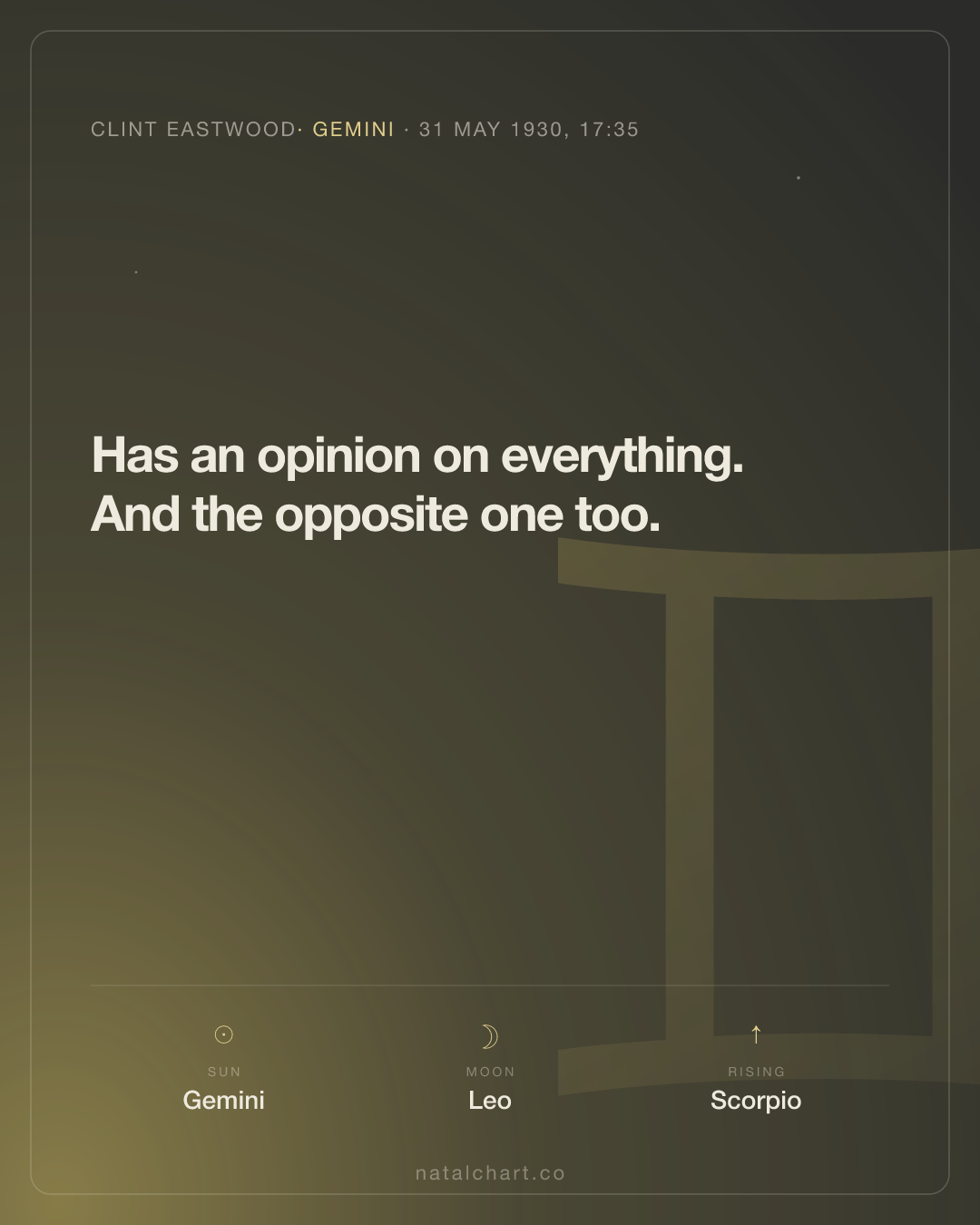
Clint Eastwood's Sun sign is Gemini — the Sun was in Gemini at birth (1930).
What is Clint Eastwood's moon sign?
Clint Eastwood has the Moon in Leo. The Moon sign describes the emotional and instinctive layer of the chart.
What is Clint Eastwood's rising sign?
Clint Eastwood's rising sign (ascendant) is Scorpio — the sign on the eastern horizon at the moment of birth.
When and where was Clint Eastwood born?
Clint Eastwood was born in 1930 in San Francisco, California.