Edouard Manet — natal chart
What does Edouard Manet’s natal chart reveal?
Edouard Manet (1832-1883) was a French painter born in Paris, a pivotal figure in the transition from Realism to Impressionism. His provocative works 'Le Dejeuner sur l'herbe' and 'Olympia' (both 1863) challenged academic conventions and helped launch modern art.
 Share
Share
Birth
1832-01-23 · 19:00 · Paris, France Reliability: AA · vetted record
The Provocateur Who Needed the Crowd
Manet spent his career doing something almost impossible: breaking every rule of the Paris art world while desperately wanting its approval. He was the son of a magistrate, educated to enter the naval service, a man who dressed immaculately, dined at the best cafés, and craved election to the Académie — and yet he painted Le Déjeuner sur l'herbe (1863), a naked woman staring directly and unapologetically out of a picnic scene, and Olympia, a reclining nude who looks the viewer in the eye with a composure that the Salon critics called obscene. He was a radical who could not stop seeking the institution's embrace. That tension is the whole story, and it runs through every placement in his chart.
Sun in Aquarius: The Reformer in the Room
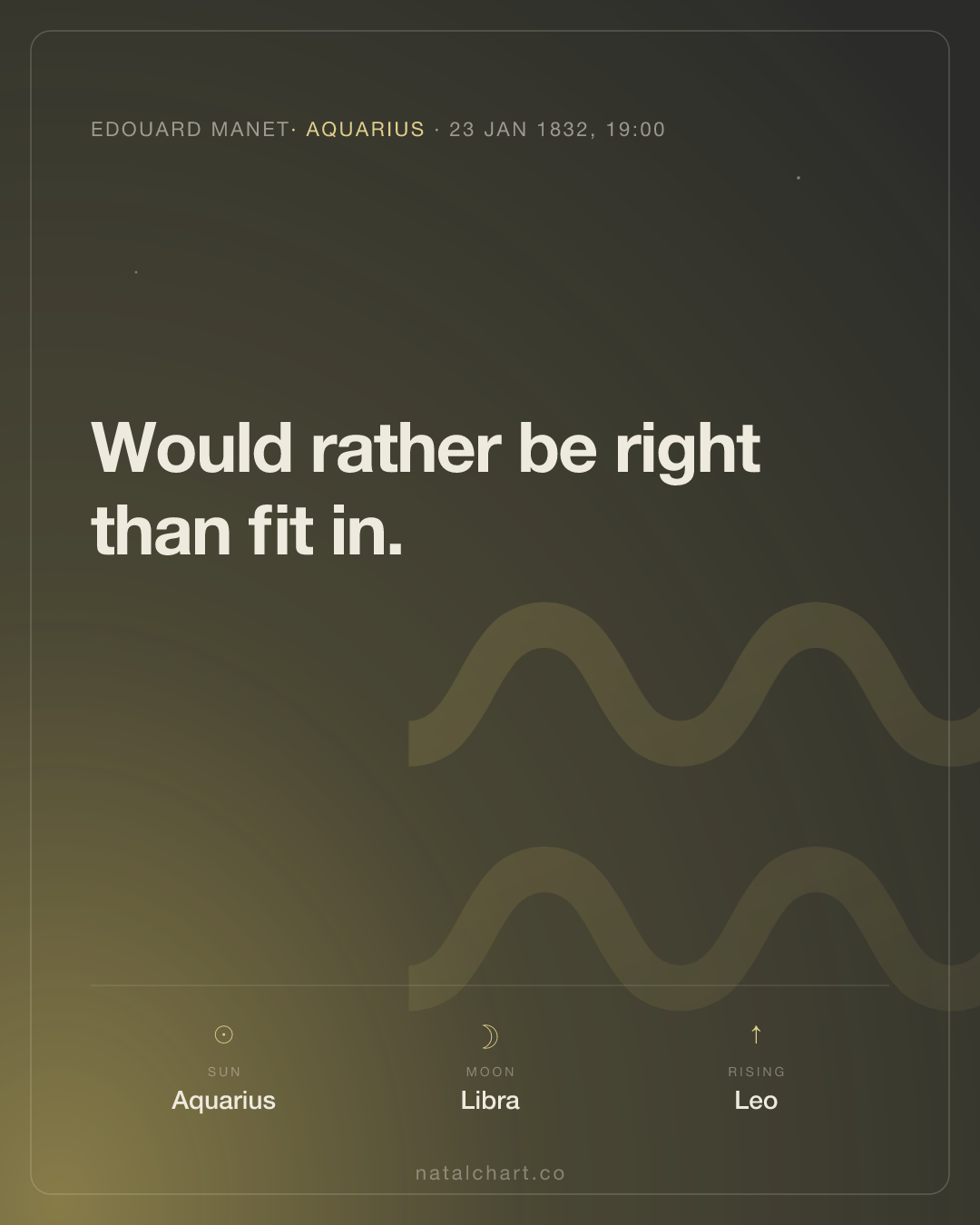
Sun in Aquarius in the 7th house — the house of others, audience, and direct confrontation — is the clearest signal in Manet's chart. Aquarius is the sign of the system-breaker, the person who sees what everyone is pretending not to see and says it plainly. The 7th house means that entire identity was performed in relationship to others: not alone in the studio, but in constant dialogue with the public, with critics, with the tradition he was simultaneously absorbing and dismantling.
Jupiter and Uranus also sit in Aquarius in that same 7th house — three celestial bodies in the sign of iconoclasm, all oriented toward the world. This is not a painter who retreats into solitude. The work required witnesses.
Ascendant in Leo: The Public Face
The Ascendant is the face a person meets the world with, the mask worn in public, the first impression they make. Manet's Ascendant in Leo explains everything about his physical presence: the photographs show a handsome man in elegant clothes, carefully posed, conscious of how he appeared. Leo at the Ascendant needs to be seen and respected; it seeks the limelight not out of vanity but because visibility feels like validation.
Chiron — an old wound that, over time, becomes a gift — sits directly on that Leo Ascendant in the 1st house, alongside the North Node in Leo. The wound was pride: the need for recognition that the Salon kept withholding. His 1863 works were rejected or displayed with contempt, his Olympia was attacked in the press. But that very refusal to be dismissed — Leo's wounded dignity insisting on being taken seriously — pushed him to keep showing, keep provoking, keep asking the question that would eventually reshape French painting.
Moon in Libra: The Social Animal
Moon in Libra in the 3rd house speaks to Manet's legendary social life — the daily gatherings at the Café de Bade and later the Café Guerbois, where he held court among Zola, Monet, Bazille, Renoir, and Berthe Morisot. The 3rd house rules local environment, exchange, conversation; Libra rules harmony, aesthetics, and the need to balance opposing positions. His Moon there made him the natural centre of the circle — charming, articulate, genuinely interested in other people's ideas.
That Moon was in tension with Neptune, adding a quality of longing, an idealism that never fully resolved into certainty. Manet genuinely believed he could reconcile modernity with the museum; he spent his career on that bridge. He admired Velázquez, Goya, Titian — and he admired the gaslit boulevards of Haussmann's Paris. He wanted both. The Libra Moon insisted that both could coexist.
Mercury and Saturn: The Deliberate Mind
Mercury in Capricorn in the 6th house, in easy flow with Saturn in Virgo in the 2nd: Manet's thinking was methodical and disciplined beneath the surface provocations. Capricorn gives Mercury a long view — the concern is not with the immediate reaction but with whether the work will stand. Saturn in Virgo in the 2nd house (the house of material value and craft) in easy flow with that Mercury means the aesthetic judgments were rigorous. He was not reckless; he calculated.
But Mercury in Capricorn was also in tension with Pluto in Aries in the 9th house, the house of philosophy and the wider worldview. This is the aspect of the thinker who provokes not out of mischief but out of a deep conviction that received wisdom needs to be overturned. Olympia was not an accident. Manet knew exactly what he was doing when he posed his model in the position of Titian's Venus of Urbino and replaced the sleeping goddess with a woman who is very much awake and looking back.
Venus and Mars in Sagittarius: The Appetite for Life
Venus and Mars joined in Sagittarius in the 5th house — the house of creative pleasure, play, and self-expression — is the warmest placement in his chart. Sagittarius adds a love of the wide canvas: not intimate domestic scenes but the broad scope of modern life, the races at Longchamp, the boating parties on the Seine, the music concerts, the café singers. Venus and Mars joined in the same degree means the desire and the drive operated as one engine: he wanted what he also pursued with full physical commitment.
Lilith also sits in Sagittarius in that 5th house, adding a quality of refusal — specifically the refusal to domesticate pleasure, to make art respectable by making it safe. Le Déjeuner sur l'herbe is this placement made literal: leisure, bodies, the open air, and the completely unabashed confrontation with the viewer's discomfort.
Venus and Mars squared by Saturn in Virgo adds friction: the expansive appetite was always checked by the craftsman's judgement. He worked in flat, summary planes rather than academic sfumato not because he was careless but because he decided that approach was truer. Saturn in Virgo insisted on the discipline, even when it looked like deliberate crudeness to his critics.
Jupiter and Saturn: Expansion Checked by Form
Jupiter in Aquarius in the 7th house (joined to the Sun) expands everything the Sun stands for — the reforming impulse, the engagement with the public, the conviction that the audience matters. Jupiter and the Sun in Aquarius together are the reason Manet's work reads as broadly democratic: the subjects are not mythological heroes but barmaids, boatmen, and naked women at picnics who look straight back at you.
Saturn in Virgo in the 2nd house applies the corrective: the craft must justify the concept. Every radical choice had to be earned by the quality of the brushwork. This is why Manet could not simply be dismissed as a vandal. The flat tones in Olympia, the Japanese-influenced compression of space, the deliberate refusal of chiaroscuro — these were not failures of technique but decisions of it.
Midheaven in Taurus: The Enduring Object
The Midheaven — the point in the chart marking public vocation and lasting reputation — in Taurus speaks of a legacy built in tangible, permanent objects. Taurus values the material, the beautiful, the thing that lasts. For all the scandal, what remained were the paintings: physical surfaces of oil on canvas, objects that could be owned and hung, that would eventually migrate from the contested Salon walls to the Musée d'Orsay.
Taurus at the Midheaven also implies that the reputation would arrive slowly, solidify, and prove hard to dislodge. Manet died in 1883, at fifty-one, from locomotor ataxia, without ever winning the prize he most wanted — the Salon gold medal. He was finally awarded the Légion d'honneur the year before he died, largely through the lobbying of his friend Antonin Proust. The Taurus Midheaven promises: it comes, but it comes on its own schedule.
The Tightest Aspects: Social Grace and Private Conflict
The Moon in easy flow with both Venus and Mars gives Manet the quality that everyone who met him noted: warmth, social ease, genuine pleasure in company. He was not the prickly outsider. Berthe Morisot, who became his sister-in-law, wrote of the wit and the lightness he brought to every gathering. The emotional instinct (Moon in Libra) and the desire (Venus-Mars in Sagittarius) pulled in the same direction — toward people, toward engagement, toward life.
The Moon in tension with Neptune adds the shadow: the idealism that could tip into disillusionment, the sensitivity to how badly the official world received him. The tension between Mercury and Pluto (the deliberate mind against the force that unmakes certainties) kept him from ever fully settling — each painting was another attempt to say the thing he had not quite said yet.
Chiron in Leo and the North Node: The Gift Inside the Wound
Chiron in Leo in the 1st house, on the same axis as the North Node: the deepest growth came through the very wound that most hurt — the wound to pride, to the dignity of a man who knew his work was serious and watched the institution treat it as a joke. The path through was not to stop caring, but to stop needing the institution to validate what he already knew. Late in his career, as his legs began to fail him, Manet turned to small pastel portraits — intimate, tender, technically ravishing — as if the project had always been about looking closely at individuals, not about conquering the Salon. The Leo wound, metabolised, produced one of the most acute sets of eyes in nineteenth-century French art.
The Portrait as a Whole
The word that best describes Manet's chart — and his life — is voltage: a current running between poles that never fully discharged. The Aquarian reformer and the Leo audience-seeker. The Libra diplomat and the Sagittarian provocateur. The methodical Capricorn craftsman and the restless Plutonian rebel. He never resolved these tensions; he painted them. The great works are pictures of exactly that charge — the ordinary world, met with a gaze so direct it becomes extraordinary. That is what still stops people in front of Olympia: not the scandal, not the art-history footnote, but the feeling of being looked at by someone who has decided that looking clearly, without flinching, is the only form of respect worth offering.
The chart
How to read it →Frequently asked questions
What is Edouard Manet's zodiac sign?
Edouard Manet's Sun sign is Aquarius — the Sun was in Aquarius at birth (1832).
What is Edouard Manet's moon sign?
Edouard Manet has the Moon in Libra. The Moon sign describes the emotional and instinctive layer of the chart.
What is Edouard Manet's rising sign?
Edouard Manet's rising sign (ascendant) is Leo — the sign on the eastern horizon at the moment of birth.
When and where was Edouard Manet born?
Edouard Manet was born in 1832 in Paris, France.