Ernest Hemingway — natal chart
What does Ernest Hemingway’s natal chart reveal?
Ernest Hemingway (1899-1961) was an American novelist and short-story writer whose spare, understated prose shaped 20th-century literature. Author of The Old Man and the Sea, A Farewell to Arms, and For Whom the Bell Tolls, he won the Pulitzer Prize and the 1954 Nobel Prize in Literature.
 Share
Share
Birth
1899-07-21 · 08:00 · Oak Park, Illinois, United States Reliability: AA · vetted record
The Writer Who Said Everything by Saying Almost Nothing
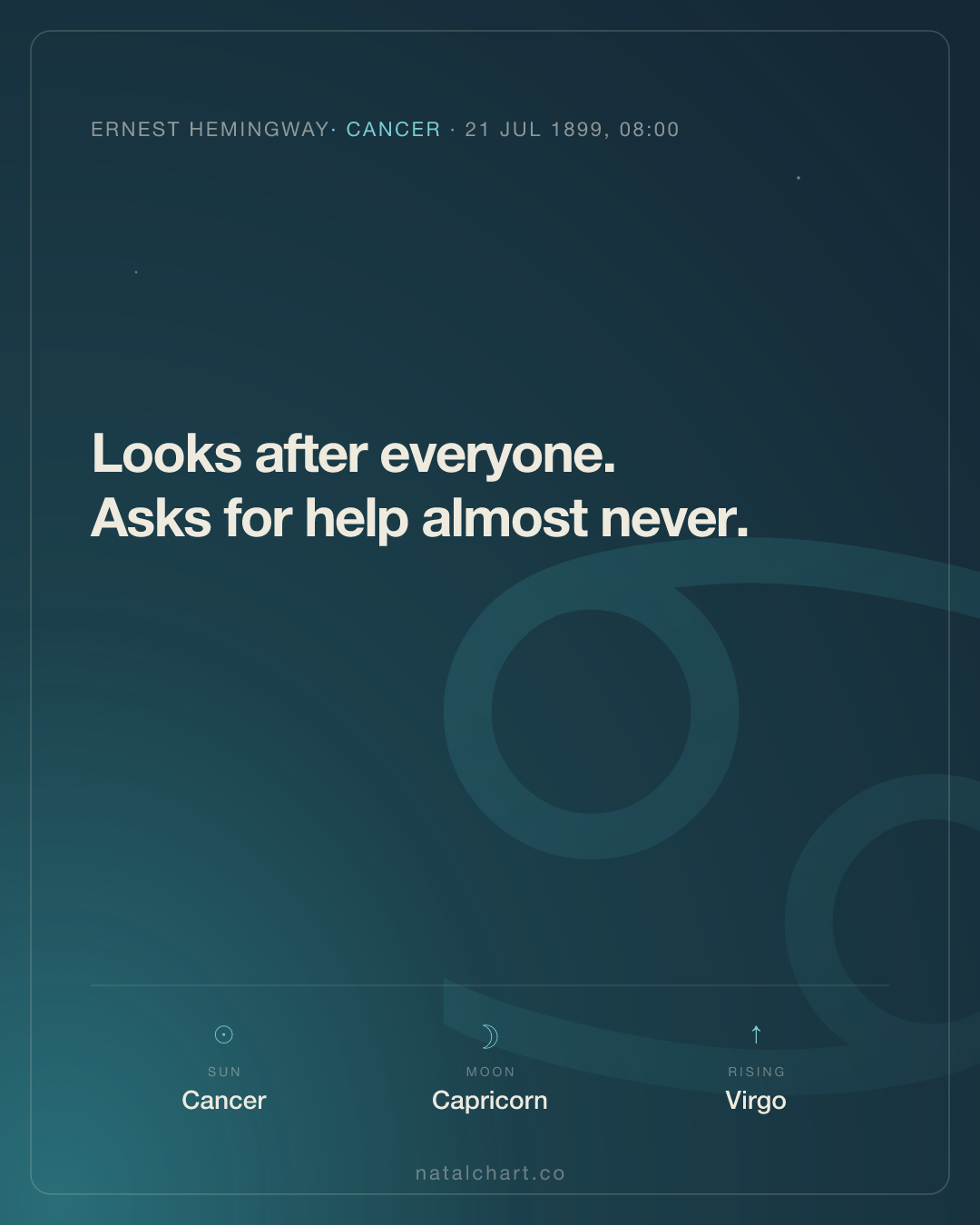
Ernest Hemingway was born with the Sun and Venus together in Cancer in the eleventh house — the sign of protective feeling, the house of collective purpose and chosen tribe. The conjunction created a man whose deepest tenderness was not expressed in private rooms but in work meant to outlast him, in dedication to a community of readers he would never meet. The feelings were real and fierce; what changed was the address. He wrote for humanity as a proxy for the intimacy that otherwise terrified him.
His Ascendant — the face he met the world with — was Virgo, and Mars, the planet of drive and action, sat directly on that rising point in the first house. This is the iceberg in plain view. Virgo Ascendant produces a man who edits before speaking, who distrusts ornament, who believes that precision is a form of respect. Mars here is not a brawler — it is a craftsman who works with visible economy and enormous hidden effort. The legendary spare prose, the sentences stripped to bone, were not a pose. They were the man. Every adjective he cut cost him something.
The Moon Behind the Stoic Mask
The Moon — a person's emotional weather, the private self beneath the public face — sat in Capricorn in the fifth house, the house of creative work and expression. Capricorn Moon is one of the most disciplined emotional signatures in the chart: it does not display grief, it transmutes it. It does not ask for comfort, it produces something durable instead. In the fifth house, that transmutation happened directly on the page. A Farewell to Arms, written in the aftermath of his wounding in Italy and a devastating love affair, is almost unbearably restrained at its most painful moments — because the Capricorn Moon was in charge of the pen.
This placement also describes a man who found play serious, who treated creative work with the gravity others reserve for duty. The famous competitive rituals — the word counts tracked each day, the standing desk, the drive to outwrite himself — are Capricorn Moon at work in the fifth house. Tenderness existed; it simply came packaged in craft rather than confession.
The Hidden Grand Voice
Mercury, the planet governing thought and expression, occupied Leo in the twelfth house — the house of what is concealed, worked through in solitude, offered to the world only once it has been fully transformed. Leo Mercury is a naturally theatrical intelligence, one that craves an audience and possesses an instinct for the memorable phrase. In the twelfth house, that voice did not perform in public — it was refined in the dark of a private process before emerging on the page. This is the writer who said he wrote alone, in the morning, before the world could get at him.
The tightest aspect in Hemingway's chart — within a fraction of a degree — is Mercury in a gentle, productive relationship with Neptune, the planet of imagination and the dissolving of boundaries. This is the astrological signature for prose that transcends its literal content, language that carries more weight than its words. When a Hemingway sentence ends, there is a silence that continues. The subtext does not lurk — it reverberates. That effect was not technique alone; it was wired into the fundamental relationship between his mind and his imagination.
Love, Beauty, and the Tribe
Venus in Cancer in the eleventh house gave Hemingway a deep need for loyalty in friendship — the chosen family mattered enormously, and the Paris years, the literary circle around Shakespeare and Company, the big friendships with Fitzgerald and Dos Passos, were not social strategy but genuine emotional sustenance. Cancer Venus nurtures through acts: the round of drinks bought, the manuscript read, the introduction made. The eleventh house channels personal affection into something larger than the couple, which is partly why his romantic life was so turbulent: intimate partnership was not where Cancer Venus in the eleventh finds its fullest expression.
The Moon in Capricorn pulling against Venus in Cancer — the chart's emotional axis — describes the tension every close witness reported: a man capable of great warmth who would also go cold without warning, who could be extravagantly generous and then suddenly withdrawn. Neither side was false. They were the poles of a genuine internal argument that never quite resolved.
Writing as the Wound's Answer
Chiron — an old wound that, when worked with, becomes a hard-won gift — sat in Capricorn in the fifth house, very close to the Moon. The wound here involves creative expression and emotional exposure: a deep fear that to show feeling directly is to invite judgment, or worse, to look weak. The response was a discipline of omission. Hemingway did not hide emotion; he encoded it so precisely that a reader who finds the signal is moved more deeply than any direct declaration could achieve. The wound produced the technique. The fifth house Chiron in Capricorn is why The Old Man and the Sea can make a grown person cry without a single sentimental sentence.
The North Node — the direction of growth, the point that pulls the life forward — fell in Sagittarius. Sagittarius is the sign of the wide horizon, the honest witness, the truth told without flinching. Every real story Hemingway chased — the Italian front, the Spanish Civil War, the African plains, the Gulf Stream — was the Node pulling him toward direct experience as the only valid source of knowledge. He had to be there. Second-hand would not do.
Mars, Saturn, and the Cost of the Work
Mars in Virgo on the Ascendant pulling against Saturn in Sagittarius — two planets in tension, at almost exactly the same degree — is one of the most demanding aspects a chart can carry. It describes an enormous drive that meets an equally enormous internal check, a will that constantly encounters its own ceiling. The effort required to produce anything felt disproportionate. The discipline was real, but so was the resistance. What looked from outside like effortless masculine ease was paid for in private anguish, in the compulsive daily rituals that kept the resistance at bay.
Saturn in Sagittarius also sits in the fourth house — the house of home, roots, and the private inner world. Saturn here brings a restlessness about belonging, a difficulty finding a fixed home that satisfies, a relationship with one's origins that is loaded and never simple. The constant relocations — Oak Park, Paris, Key West, Cuba, Ketchum — were not merely biography. They were Saturn in Sagittarius in the fourth house playing out across a lifetime.
Neptune, Pluto, and the Literary Era
Neptune and Pluto together in Gemini in the tenth house — the public/career point — are generational planets, but their placement on the Midheaven makes them personally significant. The Gemini Midheaven is a vocation built on language, duality, the movement of ideas. Hemingway's two careers — novelist and journalist — fit Gemini's double nature perfectly. The tenth house Neptune describes a public image that carries something mythic, larger than the actual man, a quality of the legendary that accumulates faster than fact can manage. By the time Hemingway won the Nobel Prize in 1954, the legend had overgrown the writer; the real work nearly disappeared beneath the image.
Pluto here, pulling against Saturn — a powerful, slow-grinding tension — describes a life shaped by radical transformation and destruction: the wars he witnessed and reported, the crashes, the physical deterioration, the losses. Each version of Hemingway was built in part on the ruins of the previous one.
Jupiter and the Deep Waters of Language
Jupiter in Scorpio in the third house — the house of writing, communication, and short journeys — is an exceptional placement for a writer. Scorpio goes beneath the surface; it is not satisfied with the polite version of any story. Jupiter amplifies this into a genuine gift: the ability to sit with what is most uncomfortable in human experience and render it comprehensible, even beautiful. The Scorpio third house is why Hemingway's war scenes do not look away, why death in his fiction has weight rather than sentiment, why the violence in the corrida passages of The Sun Also Rises is both horrifying and honest.
Jupiter also forms an easy, reinforcing relationship with Neptune — the planet of imagination already linked so tightly to Mercury. This triple connection between mind, imagination, and expansive emotional depth is the skeleton of the literary achievement. The craft was Virgo, the method was Capricorn, but the depth that made the work last was Scorpio and Neptune speaking to each other through Jupiter.
The Long View
Hemingway's chart describes a man built for a particular kind of greatness: disciplined, precise, deeply feeling but armored against sentiment, capable of sitting inside the worst of human experience long enough to render it honestly. The Virgo Ascendant and Mars kept the instrument sharp. The Cancer Sun and Venus ensured that underneath the economy of expression was genuine love — for the people, for the places, for the work itself. The Capricorn Moon made certain the love became form rather than raw feeling.
He is a chart that pays with difficulty for everything it creates. The Mars square Saturn, the Saturn opposition Pluto, the Moon pulling against Venus — these are not comfortable configurations. They describe a man who worked hard in pain and did not say so. What he said instead is still being read.
The chart
How to read it →Frequently asked questions
What is Ernest Hemingway's zodiac sign?
Ernest Hemingway's Sun sign is Cancer — the Sun was in Cancer at birth (1899).
What is Ernest Hemingway's moon sign?
Ernest Hemingway has the Moon in Capricorn. The Moon sign describes the emotional and instinctive layer of the chart.
What is Ernest Hemingway's rising sign?
Ernest Hemingway's rising sign (ascendant) is Virgo — the sign on the eastern horizon at the moment of birth.
When and where was Ernest Hemingway born?
Ernest Hemingway was born in 1899 in Oak Park, Illinois, United States.