Fabrizio De André — natal chart
What does Fabrizio De André’s natal chart reveal?
Fabrizio De André was an Italian singer-songwriter, born on 18 February 1940 in Genoa. Often called the greatest of the Italian cantautori, he wrote literate, compassionate songs centred on outcasts, rebels and the marginalised. Early works such as La canzone di Marinella (1964) and the concept album Tutti morimmo a stento (1968) showed his poetic ambition. He adapted poetry and folk traditions in albums like Non al denaro non all'amore né al cielo (1971), based on the Spoon River Anthology, and explored regional language and culture in the Sardinian-tinged Creuza de mä (1984). His lyrics gave voice to the dignity of society's overlooked. He died in Milan in 1999, remembered as a poet of Italian popular music whose influence endures.
 Share
Share
Birth
1940-02-18 · 12:00 · Genoa, Italy Reliability: A · reliable data The noon time comes from the Genoa registry via Astro.com but carries a moderate (A) reliability.
The Poet of the Overlooked
Fabrizio De André spent his life giving voice to people that Italian culture preferred not to see: prostitutes, thieves, the executed, the mad, the poor, the conquered. He did this not from sentiment but from conviction — a principled, philosophically grounded refusal to accept that anyone's humanity was conditional. The chart behind this life is one of genuine moral authority: an Aquarius Sun in the house of ideas and distant horizons, a Gemini Moon that could inhabit any voice, and a Mars-Pluto tension so tight that the confrontation with power was not a stance he chose but something structurally woven into who he was.
Sun in Aquarius, ninth house: the thinker who stands at a distance
The Sun was in Aquarius, in the ninth house — the section of the chart associated with philosophy, with the long view, with ideas that move across borders. Aquarius is the sign of independence, of the mind that refuses the given answer, of the person who sees the social arrangement from the outside and wonders why it was built this way. The ninth house adds the dimension of the search: this is not just someone who disagrees, but someone who has thought it through, who has read widely, who has a framework.
De André grew up in a wealthy Genoese family with a library full of Croce, Montale, and Pavese. He taught himself guitar, translated Brassens, and approached songwriting the way a poet approaches a text — with a clear sense of what he believed and why. La canzone di Marinella (1964), his early masterpiece, turned a newspaper account of a murdered young woman into a lyric of extraordinary tenderness. The Sun in Aquarius does not sentimentalize the overlooked; it insists on their full humanity.
The Midheaven — the career point, the public vocation — was also in Aquarius, directly reinforcing the Sun. His public identity and his deepest convictions were the same thing. He did not perform a political position; he lived from one.
Gemini Ascendant, Moon in Gemini: the storyteller with a thousand voices
The Ascendant — the face one meets the world with — was Gemini, and the Moon — the emotional interior — was also in Gemini, in the first house, sitting right on the rising sign. This is a remarkable concentration: the way De André appeared to others and the way he felt inside were both governed by the sign of multiplicity, of language, of the ability to be more than one thing at once.
Gemini is the great ventriloquist of the zodiac. It does not have a single story; it has many. De André's albums are populated with characters: the dying man in La guerra di Piero, the thief in Il gorilla, the prostitute in La città vecchia, the heretic in Processo a Gesù. He wrote from inside these figures, not at them. A Moon in Gemini in the first house is constitutionally unable to dismiss any perspective as irrelevant — every voice deserves to be heard, every life contains something worth understanding.
This also explains the ease with which he moved across traditions: French chanson (Brassens, Brel), American folk (the Spoon River Anthology adaptation), Sardinian oral culture, Ligurian dialect, Neapolitan song. Each was a different voice to inhabit.
Mercury in Pisces, tenth house: the lyrical word as vocation
Mercury — the mind, the literary intelligence — was in Pisces, in the tenth house. The tenth house is the public career and reputation; Pisces is the sign of the boundless, the permeable, the poetic register that cannot be paraphrased. Mercury in Pisces thinks in images rather than propositions; it moves by intuition and resonance rather than by argument.
De André's lyrics are not rhetorical. They do not explain their position; they show it, through a scene, a face, a particular gesture. Creuza de mä (1984), the album written almost entirely in Ligurian dialect, is the fullest expression of this Mercury: language so embedded in a specific place and history that it carries meaning untranslatable into any other tongue. The tenth-house placement means this was not a private experiment — it became his most celebrated work, influencing a generation of Italian musicians and writers.
Lilith, the point associated with the rejected and the outcast, also sat in the tenth house, in Pisces. The public face he built — the spokesman for the marginalized — had its roots in something he felt personally, not just politically.
Venus conjunct Jupiter in Aries, eleventh house: the generous rebel
Venus — beauty, artistic values, what one loves — was joined with Jupiter — expansion, generosity, the quality that one gives freely — in Aries, in the eleventh house. Aries is direct and uncompromising; the eleventh house is the house of the collective, of the group one chooses, of the community one builds.
De André was not a solitary recluse. He had deep friendships, collaborative partnerships, a long creative engagement with the composer Nicola Piovani, and a genuine delight in the company of musicians, writers, and thinkers. Venus-Jupiter in Aries in the eleventh house is warm and generous in community — it gives without calculating return. His album Non al denaro non all'amore né al cielo (1971), based on Edgar Lee Masters' Spoon River Anthology, was a communal act: he gave Italian voices to American characters, and in doing so created a new tradition.
The sextile (an easy, cooperative relationship) between the Sun in Aquarius and Mars in Taurus reinforced this: the intellectual conviction of Aquarius and the physical, stubborn endurance of Taurus worked together rather than in tension.
Mars square Pluto: the confrontation that could not be avoided
The tightest aspect in the entire chart — Mars in tension with Pluto, less than a third of a degree apart — is the one that explains the most. Mars is will, force, and the confrontation with power; Pluto is power itself, deep, structural, and not easily moved. When the two are in tension this close, the person is constitutionally unable to accept domination, whether political, social, or personal.
This was not something De André performed. It was something he lived. He was a conscientious objector when military service was mandatory in Italy. He was kidnapped by Sardinian bandits in 1979 and held for four months — an experience that, characteristically, he did not respond to with recrimination but with a deepened understanding of the social conditions that produced violence. His final album, Anime salve (1996), is a meditation on solitude and refusal — on the dignified freedom of those who will not be assimilated.
Mars-Pluto also produces an immovable stubbornness, and De André had it. He refused for years to perform in public; when he finally did, he performed on his own terms. He refused the commercial machinery that surrounded Italian popular music; when he engaged with it, he forced it to accommodate his work.
Saturn was also conjunct Mars, at just over four degrees — the discipline and the confrontational force worked together. Saturn in Aries in the eleventh house: someone who imposes structure on their own rebellious energy, who does not simply destroy but builds an alternative.
Moon in tension with Neptune: the melancholy beneath the tenderness
The Moon in Gemini formed a tense relationship with Neptune in Virgo — the planet of the intangible, of dissolution, of the grief that has no single object. A Moon-Neptune tension describes an emotional life that is sensitive to the full weight of human suffering, that cannot maintain distance from it, that sometimes does not know where its own feelings end and the world's begin.
The melancholy in De André's music is not performed or decorative. It comes from somewhere real. La guerra di Piero (1964) does not make war exciting; it makes it simply, irrefutably, sad. The young soldier who dies in the spring beside a stream — the specific, unheroic, private death — is the Moon-Neptune truth: the grief is for the particular person, not for an abstraction.
Chiron in Cancer, second house: the wound of belonging
Chiron — the old wound that, once accepted, becomes a source of genuine strength — was in Cancer, in the second house. Cancer is the sign of home, of roots, of the family one comes from and the one one builds; the second house governs what one values, what one owns, what one is not willing to lose.
De André was the son of a wealthy establishment family who chose a life entirely at odds with that background — a musician, a dropout, a political dissenter. The tension between origin and chosen identity, between the world he came from and the one he inhabited, was a live current throughout his life. Cancer Chiron in the second house suggests that the wound was precisely this: the question of where one truly belongs, of what heritage to claim and what to leave behind. The gift it produced was an art that belonged to everyone who had ever felt outside the place they were supposed to fit.
North Node in Libra: the movement toward the other
The North Node — the direction of growth — was in Libra, the sign of the other, of relation, of justice understood as balance. De André's movement across a life was from the solitary, interior world of the self (the Gemini and Aquarius emphases) toward genuine encounter with the other — not as a political abstraction but as a specific person with a specific story.
Creuza de mä and Anime salve, his two final masterpieces, are both albums about encounter: with a culture, with a tradition, with people who live outside the mainstream of Italian experience. The North Node was pointing toward exactly this: not solidarity from a distance, but listening from up close.
The voice that did not simplify
Fabrizio De André died in Milan in January 1999, at fifty-eight, from lung cancer. He left behind a body of work that does not simplify. The characters in his songs are not noble victims; they are fully human, which means they are complicated, sometimes complicit, sometimes mistaken, always worth understanding. That refusal to simplify — to make suffering picturesque, to make rebellion heroic, to make the outcast merely pitiable — is the moral core of everything he wrote.
The chart gave him the tools: the Aquarius distance to see the social structure clearly, the Gemini multiplicity to inhabit any voice, the Pisces lyricism to find the words that moved people without instructing them, and the Mars-Pluto force to refuse every compromise that would have made the work less true.
What remains is songs. They are still being sung.
The chart
How to read it →Frequently asked questions
What is Fabrizio De André's zodiac sign?
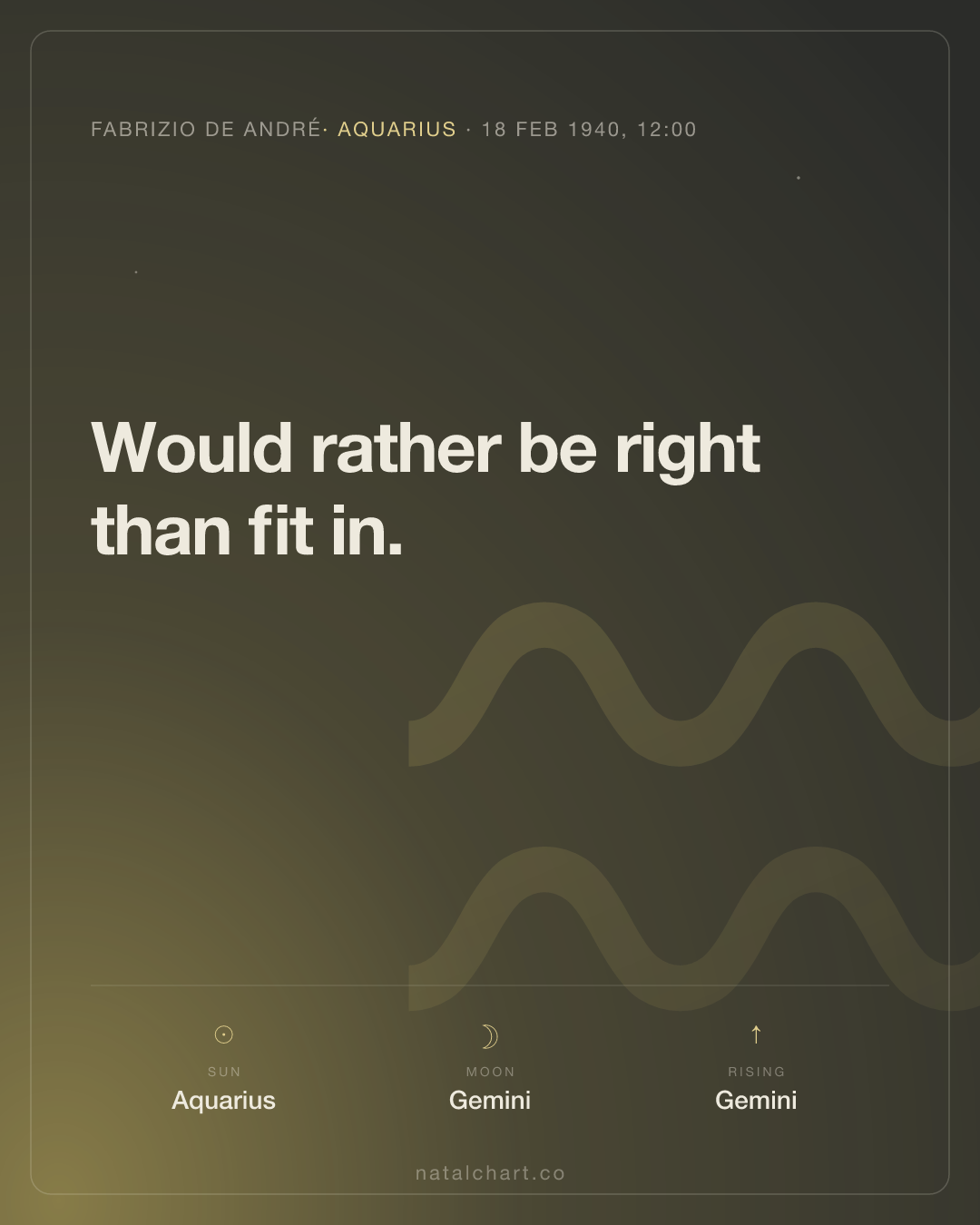
Fabrizio De André's Sun sign is Aquarius — the Sun was in Aquarius at birth (1940).
What is Fabrizio De André's moon sign?
Fabrizio De André has the Moon in Gemini. The Moon sign describes the emotional and instinctive layer of the chart.
What is Fabrizio De André's rising sign?
Fabrizio De André's rising sign (ascendant) is Gemini — the sign on the eastern horizon at the moment of birth.
When and where was Fabrizio De André born?
Fabrizio De André was born in 1940 in Genoa, Italy.