Federico Fellini — natal chart
What does Federico Fellini’s natal chart reveal?
Federico Fellini, born in Rimini on 20 January 1920, was an Italian film director and screenwriter, one of the most influential figures in world cinema. After early work as a journalist and cartoonist, he wrote neorealist screenplays before turning to directing. He made masterpieces such as "La Strada" (1954), "Nights of Cabiria" (1957), "La Dolce Vita" (1960), "8½" (1963) and "Amarcord" (1973). He won four Academy Awards for Best Foreign Language Film and received an honorary Oscar in 1993. His dreamlike, baroque style gave rise to the adjective "Felliniesque." He died in Rome in 1993.
 Share
Share
Birth
1920-01-20 · 21:00 · Rimini, Emilia-Romagna, Italy Reliability: DD · conflicting Sources give conflicting times (21:00, 21:30, 11:30 from the certificate, 00:15 recalled by Fellini himself); the time is not established.
A Capricorn who dreamed in Baroque
The standard story about Federico Fellini begins with his films and arrives at some word like "dreamlike." The better starting point is the man himself: someone who spent a lifetime turning the mundane material of small-town Italian life — carnivals, churches, women on bicycles, the provincial cinema — into something vast and strange. His birth chart shows why that transformation was, for him, unavoidable. The Sun, Moon, and Mercury are all in Capricorn in the fifth house, the house of creative expression and artistic production. Three personal planets, all in the same sign, all gathered in the zone of the chart most directly associated with making things. The ambition was there from the start. So was the discipline.
Ascendant in Virgo: the craftsman's face
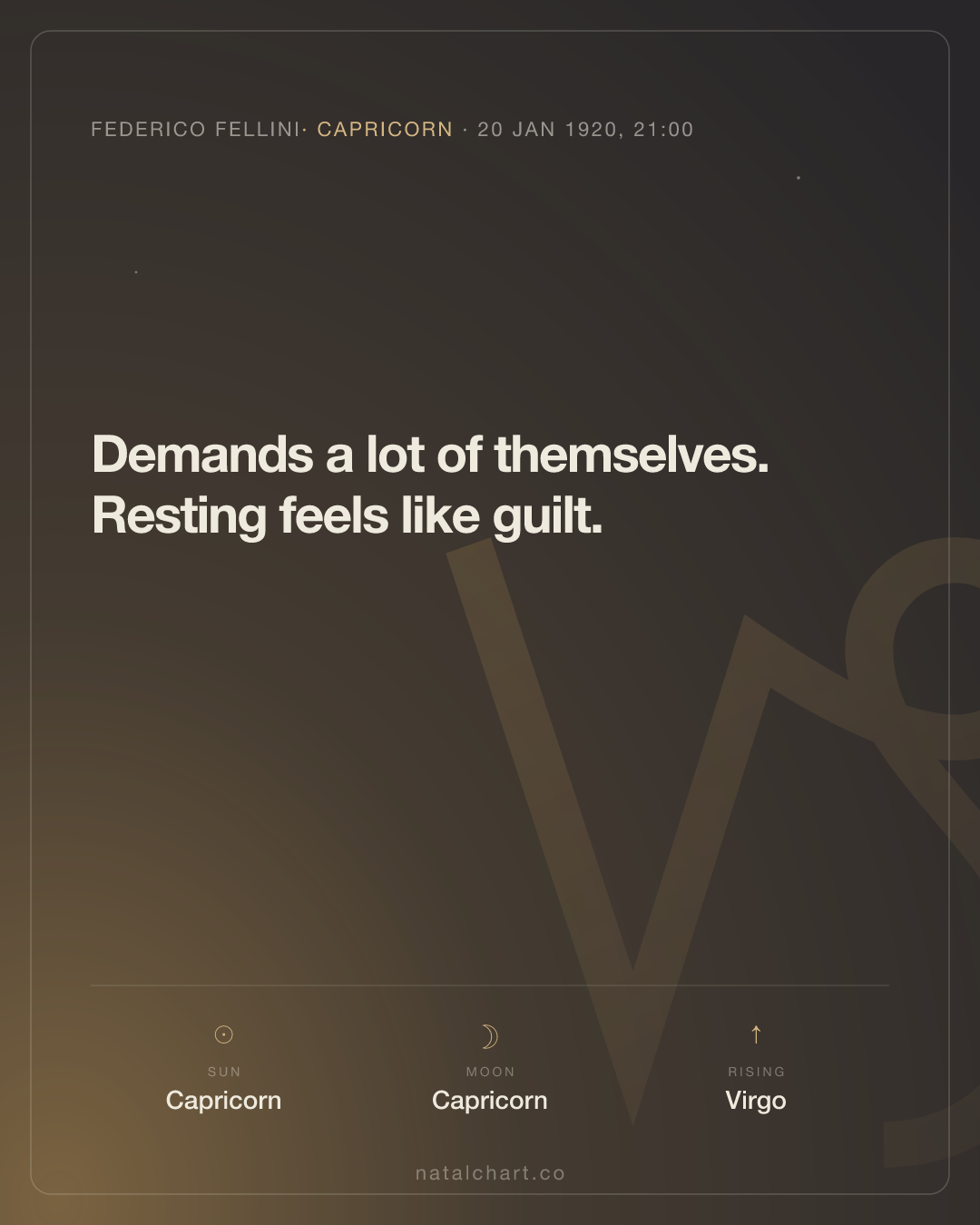
The Ascendant (the face one meets the world with, determined by the sign rising on the eastern horizon at the moment of birth) is Virgo. This is the sign of the meticulous craftsman, of precision, of an eye for the flaw that nobody else has noticed yet. Where Capricorn accumulates and builds, Virgo refines and edits. Fellini came up as a journalist and cartoonist before he directed anything — both vocations that reward observation and economy — and even his most baroque, apparently formless films were the product of obsessive preparation. The notebooks he kept throughout his career, full of sketches, character notes, and dream records, are very Virgo: the visible form of an invisible discipline. Saturn, the traditional ruler of Capricorn, sits in Virgo in the first house, reinforcing the Ascendant. The impression he gave the world was one of craft and seriousness.
Sun and Moon in Capricorn: built to last
The Sun and Moon are joined together in Capricorn, in the fifth house. Two luminaries in the same sign is a significant concentration of energy: there is less internal division than in charts where the Sun and Moon pull in opposite directions. In Capricorn, this unified self is patient, prepared to work for decades toward a goal, and most fully alive when it has something concrete to show for the effort. Fellini's filmography is the record of a man who kept working at a very high level for nearly forty years — from his neorealist screenwriting contributions in the late 1940s through to his final films in the early 1990s. He didn't make one masterpiece and burn out. He made four Academy Award-winning films, kept evolving, and went on. Mercury in Capricorn in the same fifth house completes this cluster: the mind works methodically, stores information patiently, and communicates through structure rather than improvisation. His screenplays, which he co-wrote on virtually every film, were frameworks that could absorb enormous amounts of improvisational material — but they were frameworks.
Moon square Mars: the friction that drove everything
The tightest aspect in the chart — just 0.6 degrees of separation, meaning it operated at very high intensity — is the Moon in tension with Mars in Libra in the second house. The Moon rules the inner emotional life; Mars is the planet of drive, assertion, and action. When these two pull against each other at 90 degrees, the result is a person in whom emotional need and active drive are perpetually in friction. The calm that the Capricorn concentration promised was not easily available. What it produced, in practice, was an enormous restlessness: an inability to leave well enough alone, a compulsion to keep pushing a film further, to keep adding, to keep testing. The women in Fellini's films — one of the most discussed subjects in the critical literature on him — are in part the product of this aspect. The Moon represents the emotional, the feminine, the inner world; Mars represents the drive that can't leave it alone, that keeps circling and probing. That tension was never resolved, and the films are more interesting for it.
Jupiter and Neptune in Leo in the twelfth house: the hidden dreamer
Jupiter and Neptune are joined together in Leo in the twelfth house. The twelfth house is the zone of the chart associated with what is hidden, unconscious, or withdrawn from public view — the backstage of a life. Jupiter is the planet of expansion, belief, and generosity; Neptune governs imagination, illusion, and the blurring of boundaries between what is real and what is constructed. Their joining in Leo, the sign of theatrical self-expression and spectacle, in the most hidden house in the chart, is a remarkable placement for a filmmaker. It describes an imagination that is naturally cinematic — that thinks in images, in sequences, in scenes — but that draws its material from the unconscious rather than from observable reality. Fellini was famously uninterested in documentary realism even when working within a neorealist tradition. He was always after something more interior. Venus in Sagittarius in the fourth house is in easy flow with this Jupiter-Neptune conjunction, adding warmth and an instinctive generosity with the material of his own past. The entire fourth house (home, origins, childhood) in Sagittarius suggests a mythologizing relationship with the place where he came from. Rimini, his hometown, became Amarcord's unnamed town. It didn't need to be named.
Mercury joins the Moon: the mind that remembered everything
Mercury in Capricorn is close to the Moon — the two travel together in the fifth house. This connection means the intellect and the emotional memory operate in tandem: what one feels, one also notices and files. Fellini was a famously observant man. His early career as a caricaturist required exactly this — the quick identification of a defining trait, the ability to isolate what was essential — and that skill carried forward into his casting choices, his direction of actors, his treatment of faces. He worked again and again with the same performers not out of sentimentality but because he knew what they could do. The memory of what had worked, stored in that Capricorn fifth house, was an active resource.
Midheaven in Gemini: the public image of duality
The Midheaven (the public and career point, the highest point of the chart at the moment of birth) is in Gemini. Gemini is the sign of doubleness, of the ability to hold two things at once, of the space between one thing and another. For someone who built a career on the tension between autobiography and invention, between neorealism and fantasy, between the sacred and the carnivalesque, Gemini at the career peak is fitting. He was always regarded as two things simultaneously: a serious European art filmmaker and a supremely entertaining maker of spectacle. The adjective "Felliniesque" entered the language because it described something that couldn't be reduced to either category alone. The Midheaven in Gemini suggests a public identity built on productive contradiction.
Mars trine Uranus: the radical within the institution
Mars in Libra is in easy flow with Uranus in Aquarius in the sixth house. Mars represents action; Uranus is the planet of disruption, originality, and the refusal of convention. When these two work together easily (120 degrees, a current of mutual support), the result is someone who can act in unconventional ways without appearing confrontational — who can introduce radical changes in method or style in a way that feels natural rather than aggressive. Fellini won the Oscar four times working within the Hollywood awards system while making films that had almost nothing to do with Hollywood conventions. He was a permanent insider-outsider, respected by an establishment whose rules he routinely ignored. Mars trine Uranus describes exactly that position.
Chiron in Aries in the eighth house: the wound that opened inward
Chiron (the point marking an old wound that eventually becomes a singular gift) is in Aries in the eighth house. Aries is the sign of the individual self, of assertion and direct action; the eighth house is associated with depth, with transformation, with everything that lies below the surface of ordinary life — including the unconscious. Chiron here suggests a wound involving the capacity to assert oneself directly, to act on pure personal impulse without mediation. The compensation — the gift that develops from the wound — was the turn inward: rather than acting on the world directly, Fellini created interior worlds. The films are populated with projections and doubles, with characters who seem to be simultaneously observed from the outside and experienced from within. That is Chiron in Aries in the eighth house doing its work.
North Node in Scorpio: the deeper waters
The North Node (the point indicating the direction of growth, what a life moves toward integrating) is in Scorpio. Scorpio is the sign of depth, of transformation through confrontation with what one would rather avoid, of the willingness to go beneath the agreeable surface. As a filmmaker, Fellini's trajectory moved consistently in this direction: from the relatively social and external early films toward the more interior, more psychologically extreme work of the 1960s and beyond. 8½ is the definitive portrait of a director in psychological crisis, examining his own failures of will and imagination with unflinching honesty. That kind of self-confrontation is Scorpio at work, pulled forward by the North Node.
The portrait complete
Federico Fellini was a Capricorn who worked like a craftsman, dreamed like a mystic, and never quite resolved the friction between those two things — and his films are alive because he didn't. The Virgo Ascendant gave him the discipline that Capricorn demanded. The Sagittarius Venus gave him the warmth and the mythologizing fondness for his own origins. Jupiter and Neptune in Leo in the twelfth house gave him the cinema of the interior. And Mars square the Moon gave him the restlessness that prevented any of it from becoming comfortable. He received his honorary Oscar in 1993, a few months before he died. In his acceptance speech he asked the audience to stop applauding because it was making him want to cry. That is a very Capricorn thing to say.
The chart
How to read it →Frequently asked questions
What is Federico Fellini's zodiac sign?
Federico Fellini's Sun sign is Capricorn — the Sun was in Capricorn at birth (1920).
What is Federico Fellini's moon sign?
Federico Fellini has the Moon in Capricorn. The Moon sign describes the emotional and instinctive layer of the chart.
What is Federico Fellini's rising sign?
Federico Fellini's rising sign (ascendant) is Virgo — the sign on the eastern horizon at the moment of birth.
When and where was Federico Fellini born?
Federico Fellini was born in 1920 in Rimini, Emilia-Romagna, Italy.