Federico García Lorca — natal chart
What does Federico García Lorca’s natal chart reveal?
Federico García Lorca was born on 5 June 1898 in Fuente Vaqueros, a village near Granada, Spain. A poet and playwright, he became the central figure of the Generation of '27. His verse collection Romancero gitano (1928) made him famous, while the searing Poeta en Nueva York (written 1929–30, published 1940) marked his most experimental work. For the stage he wrote the rural tragedies Bodas de sangre (1933), Yerma (1934) and La casa de Bernarda Alba (1936), which fused folk tradition with stark modern drama. He also co-founded the travelling theatre company La Barraca. In August 1936, weeks into the Spanish Civil War, he was arrested and executed by Nationalist forces near Granada; his body was never found. Lorca remains one of the most widely read and performed Spanish-language writers, a symbol of artistic freedom silenced by violence.
 Share
Share
Birth
1898-06-05 · 23:59 · Fuente Vaqueros, Granada, Spain Reliability: A · reliable data Biographers record that Lorca was born around midnight on 5 June 1898; astrology sites cite 11:59 PM (23:59). The minute is approximate, with some sources placing the moment at the cusp of 6 June.
A voice born at the crossing of worlds
Federico García Lorca arrived in the world at midnight on 5 June 1898, and the moment already held a kind of paradox: the last seconds of one day spilling into another, light and dark balanced at the threshold. That threshold quality runs through everything he made. His Ascendant — the face he presented to the world — was Pisces, the sign most attuned to what lies beneath the surface, to images that float up from deeper water. Piscean rising people rarely announce themselves in straight lines; they arrive obliquely, through feeling, through atmosphere, through the sense that something is about to be said that cannot be said any other way. Anyone who has read Romancero gitano or sat through the first act of Bodas de sangre knows exactly what that feels like in practice.
The 4th house stellium: the past that becomes the work
The most unusual concentration in the chart is the gathering of Sun, Neptune, and Pluto all in Gemini in the 4th house — the part of the chart that governs origins, roots, and the inner life one carries from childhood. This is not a casual cluster. The 4th house stellium in Gemini speaks of someone for whom language itself was the founding inheritance, who grew up breathing folklore, song, and spoken tradition as naturally as air. Lorca grew up in the Granada countryside, surrounded by the cante jondo tradition, by itinerant musicians, by a rural Andalusia that already felt haunted by its own memory of Al-Andalus and the Reconquista. His Sun — his essential identity — is not separate from that world; it is fused with it. Neptune in this position describes an imagination that never fully distinguished between what happened and what was felt to have happened, between historical fact and mythic truth. His best poetry does the same: the bullfighter Ignacio Sánchez Mejías does not merely die in Llanto por Ignacio Sánchez Mejías — he dies into a legend that the poem makes real. Pluto in the same house and sign adds an awareness of what is buried, of the cycles of suppression and eruption in collective life that the Andalusian landscape carried in its soil.
Sun joined to Pluto: the poet who cannot look away
The Sun sits within 1 degree of Pluto in Lorca's chart — one of the tightest and most defining alignments of the whole map. When these two bodies work together so closely, the individual's sense of self becomes inseparable from a preoccupation with power, with death, with what societies forbid and what they refuse to name. The word Lorca himself used was duende — that irrational, shiver-inducing quality that separates living art from competent art, the thing that makes an audience hold its breath. He didn't invent the concept; he theorised it in a famous 1933 lecture because he understood it from the inside. Sun-Pluto people rarely choose light subjects; they are drawn to the places where the bright surface cracks and something older and truer shows through. The rural tragedies — Bodas de sangre, Yerma, La casa de Bernarda Alba — are all, in different registers, about the violence that inhabits repressed desire, about what happens to life that is not allowed to live. That is Pluto's territory, and Lorca mapped it more precisely than almost anyone.
Ascendant Pisces, Neptune in the 4th: the imagination as motherland
Neptune in Gemini is also part of the 4th house stellium, and it is the planet most naturally affiliated with the Pisces Ascendant. This double Neptune emphasis explains the surreal, dream-logic quality of Poeta en Nueva York, the collection written during Lorca's time at Columbia University in 1929 and 1930. New York shocked him — its industrial scale, its racial segregation (he identified deeply with the Harlem community he encountered), its mechanical indifference to individual suffering — and the poems that resulted are not realist observations but images filtered through a mind that processed the world through symbol and distortion. The work feels visionary because it was: Neptune does not report; it transforms perception. The collection was too strange, too raw to publish in his lifetime. It appeared in 1940, four years after his death, and reads now like a prophecy as much as a document.
Moon in Capricorn, 11th house: the social architect
The Moon — which describes the emotional interior and what a person needs to feel grounded — is in Capricorn, and in the 11th house, the zone of collective life, friendship, and one's relationship to the broader community. Capricorn Moon people feel their responsibilities acutely; they are not easily given to emotional display, even when the inner life is very active. The Moon in Capricorn square Jupiter (5 degrees apart, a tense angle that pushes and strains) describes a generosity that sometimes overreaches its own resources, a desire to build and to gather people together that occasionally collides with the limits of what one person can sustain. Lorca co-founded La Barraca in 1931, the travelling theatre company subsidised by the Spanish Republic that brought classical drama to rural communities across Spain. That project — taking Lope de Vega and Calderón to villages that had never seen a professional production — is a Moon-in-Capricorn-11th enterprise if there ever was one: emotional investment disciplined into institutional form, placed in service of the collective. He directed, designed costumes, acted, and raised the money. The Moon square Jupiter explains both the ambition of the project and the exhausting range of what he personally carried.
Mercury in Taurus, 3rd house: the craftsman of language
Mercury governs thought and expression, and in Taurus — the sign most associated with the physical world, with slowness, with the pleasure of material things — it produces a writer who crafts language the way a sculptor works stone. Taurus Mercury does not reach for the abstract when a concrete image will do; it trusts the specific weight of a word. Lorca's Romancero gitano is full of this: the green of the gypsy ballads is not a metaphor explained — it is simply green, and the reader feels it in the body before understanding it in the mind. The 3rd house placement reinforces the connection to oral tradition, to the spoken word, to the exchange between neighbours and communities. Chiron — a point of old tenderness that becomes a gift — is also in Taurus in the 3rd house. His wound and his mastery are the same thing: the ability to hold a word until it is exactly right.
Venus in Cancer, 5th house: love as a country that could not be named
Venus in Cancer describes affection that runs deep and quiet, that attaches to people and places with the tenacity of roots, that grieves hard when those roots are severed. In the 5th house — the zone of creative expression, pleasure, and romantic life — Venus in Cancer makes an artist whose creative work is not separate from the life of feeling: the poems are love letters; the plays are shaped by ungovernable desire. Lorca was gay at a time and in a country where that fact carried mortal risk; his private life required concealment in a way that must have sat in permanent tension with a Sun-Pluto nature that was temperamentally incapable of staying on the surface. Lilith is also in Cancer in the 5th house — a point that speaks of the dimension of the personality that refuses to conform, that exists outside the permitted story. His capacity to write female desire — in Yerma, in La casa de Bernarda Alba — with the accuracy and fury that he did comes partly from this position: he understood, from the inside, what it means to want something society has decided you are not allowed to want.
Midheaven in Sagittarius: the vocation of crossing borders
The Midheaven is the public and career point of the chart — the highest point, the aspiration that becomes a public reputation. Lorca's Midheaven in Sagittarius is apt to the point of being almost too neat: Sagittarius is the sign of the explorer, the teacher, the one who brings things home from foreign territory. He brought cante jondo into the concert hall. He brought folk ballad into the literary canon. He brought the Spanish rural world to Buenos Aires (where Bodas de sangre premiered to ecstatic audiences in 1934) and then to New York. He made La Barraca travel the roads of a republic that was tearing itself apart, bringing theatre to places that had never had it. Saturn and Uranus are both in Sagittarius in the 10th house, conjunct the Midheaven, and both opposing Pluto in the 4th. The opposition (a pulling tension between opposite points of the chart) between the public ambition and the 4th-house roots describes the fundamental creative engine: Lorca drew constantly on the intimate and the local to speak to the universal and the public, and the strain between those poles produced the electricity. Jupiter sextile Uranus at just 0.5 degrees — the tightest aspect in the chart — is a gift for inspired originality that works through established form: not chaos but rupture-within-tradition, which is the exact description of what Romancero gitano accomplished.
The hardest aspect: Saturn opposing Pluto
Saturn in the 10th house opposing Pluto in the 4th — the two ends of the same vertical axis — is the most structurally loaded aspect of the chart. Saturn opposes Pluto at 5.7 degrees: the public sphere and the private roots in direct tension, official power bearing down on what is intimate and buried. In 1936, that tension became literal. The Nationalist uprising that began in July of that year targeted Lorca specifically; he was arrested on 16 or 17 August 1936 at the house of a friend in Granada, executed within days, and buried in an unmarked grave that has never been found. He was 38 years old. Saturn-Pluto oppositions in the charts of people who lived through historical violence often describe, in retrospect, the structural forces that determined the outline of a life — not fate in any supernatural sense, but the way certain configurations of power make certain kinds of lives impossible to protect. His brother-in-law, Manuel Fernández-Montesinos, was the socialist mayor of Granada; in the atmosphere of the early civil war, Lorca's art, his politics, and his sexuality made him, in Nationalist eyes, a target. The chart does not explain the murder. But the Saturn-Pluto axis names the landscape in which it happened.
North Node in Capricorn: building the work that outlasts the life
The North Node — the direction of the most meaningful development across a life — is in Capricorn, the sign of what endures, of the structure that outlives its maker. Lorca was killed before he was 40. La casa de Bernarda Alba, perhaps his greatest play, was completed just months before his death; it was not performed until 1945. Poeta en Nueva York was published posthumously. The work he left behind is not the work of a man who expected to have more time — it is concentrated, pressurised, complete in itself. The North Node in Capricorn speaks of someone who learned, or was learning, to build for permanence rather than for the moment. The paradox is that the prematurely ended life produced the most permanent thing: a body of work still performed on every continent, still taught, still alive in ways that outlast the governments and forces that killed him.
What the chart leaves
There is something in Lorca's chart that refuses a tidy close, as his life refuses it. The Sun joined to Neptune speaks of a person who lived, in his own words, in a state of permanent astonishment at the world; the Pisces Ascendant means he arrived in every room already attuned to what the room was feeling; the Jupiter-Uranus gift made the ruptures look effortless even when they weren't. What the chart makes plain is that the work was not a performance of feeling but its direct transmission — that the duende he described in his 1933 lecture was not a theory but a report from experience. The warmth in the chart is real: Venus in Cancer, the Moon in service of community, the 4th house full of inherited love for a landscape and a tradition. The violence in the chart — Pluto threaded through the Sun, Saturn pressing on the public axis — is also real. He held both. His poems still do.
The chart
How to read it →Frequently asked questions
What is Federico García Lorca's zodiac sign?
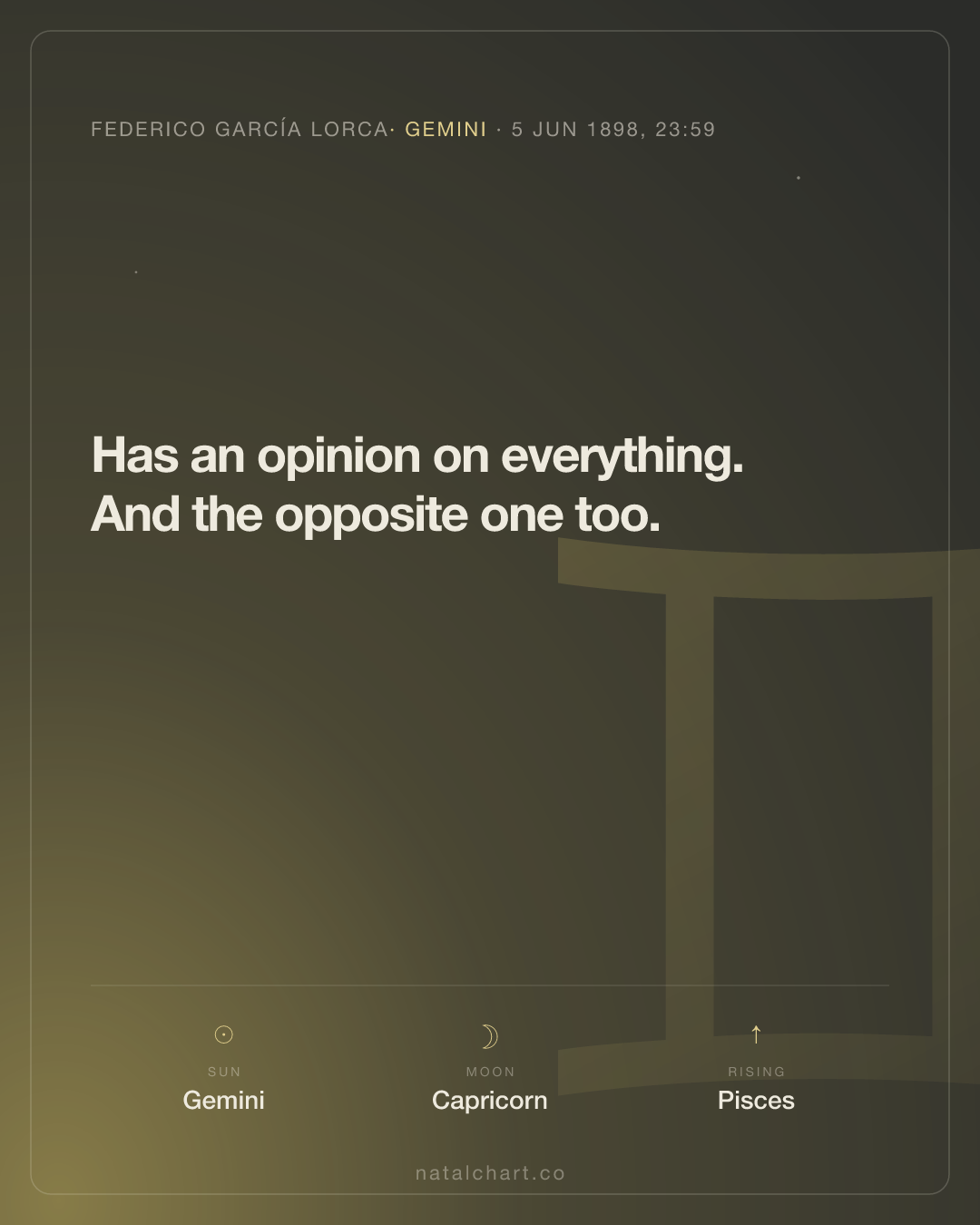
Federico García Lorca's Sun sign is Gemini — the Sun was in Gemini at birth (1898).
What is Federico García Lorca's moon sign?
Federico García Lorca has the Moon in Capricorn. The Moon sign describes the emotional and instinctive layer of the chart.
What is Federico García Lorca's rising sign?
Federico García Lorca's rising sign (ascendant) is Pisces — the sign on the eastern horizon at the moment of birth.
When and where was Federico García Lorca born?
Federico García Lorca was born in 1898 in Fuente Vaqueros, Granada, Spain.