François Truffaut — natal chart
What does François Truffaut’s natal chart reveal?
Francois Truffaut, born 6 February 1932 in Paris, was a French filmmaker and critic and a founder of the French New Wave. Writing for Cahiers du Cinema, he championed an auteur approach to cinema before directing his autobiographical debut The 400 Blows (1959), which won best director at Cannes. He went on to make Jules and Jim (1962), the Antoine Doinel cycle, Fahrenheit 451 (1966), The Wild Child (1970) and Day for Night (1973), which won the Academy Award for Best Foreign Language Film. He also acted, notably in Spielberg's Close Encounters of the Third Kind (1977), and co-wrote an influential book-length interview with Alfred Hitchcock. He died on 21 October 1984.
 Share
Share
Birth
1932-02-06 · 06:00 · Paris (17th arrondissement), France Reliability: AA · vetted record
A portrait shaped by an unusual beginning
François Truffaut arrived in the world in February 1932 under a strikingly concentrated sky: the Sun, Moon, Mercury, and Mars all gathered in Aquarius in the second house. That kind of density in a single sign and house is rare, and it leaves a mark — a person whose thinking, feeling, and acting all run through the same channel, simultaneously intellectual and private, driven by values that are deeply personal even when the cause appears collective. Aquarius at that intensity produces someone who observes humanity with genuine warmth but from a slight distance, as though through a pane of glass; the Capricorn Ascendant (the face one meets the world with) adds another layer of reserve, of a composure that can read as cool to people who don't know how much is happening underneath.
Truffaut's early life was genuinely difficult — an illegitimate child mostly unwanted by his parents, a teenager who ran away, who was sent to a reformatory, who discovered cinema as a refuge rather than a career plan. That story is what became The 400 Blows. And there is a direct line from that biography to the chart.
The Capricorn Ascendant and Saturn's discipline
Saturn — the planet associated with structure, discipline, and what one builds through sustained effort — sits in Capricorn in the first house, the house of the self, right alongside the Ascendant. When Saturn occupies this position, it tends to produce people who appear more contained and formal than they feel inside, who take work extremely seriously, and who come to authority gradually, through earned mastery rather than overnight arrival. Truffaut was twenty-seven when The 400 Blows won the Best Director prize at Cannes. His career was not a lucky break — it was the result of years of obsessive watching, writing, and arguing for a cinema of personal vision in the pages of Cahiers du Cinéma. Saturn in the first house often builds slowly, then stands for a long time.
The Aquarius stellium: a mind that kept moving
Four planets in Aquarius — Sun, Moon, Mercury, and Mars — in the second house (the house associated with resources, values, and what one holds as worth protecting) describe a person whose most precious resource is ideas themselves. Aquarius thinks in systems, in alternatives to how things are usually done; it is the sign most interested in what cinema could be, not just what it currently is. Truffaut's auteur theory, developed in his combative critical essays, was a framework — a way of reordering the entire history of film around the question of personal voice. The four-planet cluster also means that his emotional life (the Moon), his intellect (Mercury), and his drive (Mars) all worked through the same Aquarian frequency: restless, idealistic, committed to originality, uncomfortable with repetition for its own sake.
The Moon in Aquarius: warmth at a remove
The Moon in Aquarius in the second house speaks to an emotional interior that understands feelings through concepts, that can be enormously caring about humanity in the abstract while finding the direct expression of vulnerability harder to locate. Truffaut's films return obsessively to childhood — to Antoine Doinel across five films spanning nearly two decades, to the feral child Victor in The Wild Child, to the children in Small Change — with a tenderness that is clearly autobiographical and just as clearly filtered through craft. He felt most when he was making something. That is the Moon in Aquarius at work: emotion transformed into form.
Venus in Pisces and the pull toward depth
Venus — how one loves, and what one finds beautiful — moves into Pisces in the third house, shifting the register entirely from Aquarian clarity into Piscean dissolution and longing. Venus in Pisces is drawn to what is fragile, fleeting, romantic in the old sense of the word: to love as something larger than the people involved. Truffaut's Jules and Jim (1962) is perhaps the purest expression of this: a film about love that cannot contain itself within conventional arrangements, that spills into a triangle, into ambivalence, into catastrophe — and remains, somehow, beautiful. Venus forms a flowing aspect with Pluto (the planet of depth and transformation), intensifying this pull toward love as revelation, as something that changes the people it passes through.
Mercury and the interviewer's patience
Mercury in Aquarius in the second house, part of the main stellium, describes a mind that collects and categorizes — not pedantically, but as a way of building a private system of the things that matter. Truffaut's book-length interview with Alfred Hitchcock, published in 1966 and still in print, is one of the most exhaustive and illuminating conversations ever published about cinema. It is not a journalist's interview — it is a fellow craftsman asking the questions no one else thought to ask, listening long enough to get the real answers. Mercury in Aquarius has that quality: patient, systematic, genuinely curious about how something works.
Sun opposed Jupiter: ambition and its costs
The Sun — the core identity — sits in almost exact opposition to Jupiter in Leo in the eighth house. An opposition in a chart means two forces that pull in different directions and must be held in productive tension. Jupiter in Leo in the eighth house (a house associated with depth, transformation, and what is shared with others) suggests an expansive, generous impulse toward grand expression, toward largeness of vision. The opposition with the Sun says that this largeness sometimes pulled against the intimate, precise, personal register where Truffaut's best work lived. He made Fahrenheit 451 (1966) as an international co-production with a budget and a star (Julie Christie) — and it remains, by most accounts including his own, the film that felt least like himself. Jupiter-Sun oppositions often involve learning how much scale serves the work and how much overwhelms it.
Jupiter and Uranus: the sudden opening
Jupiter in Leo forms an easy, supporting aspect with Uranus in Aries in the fourth house (the house of roots, home, and private foundations). Uranus is the planet associated with rupture, with the sudden change that rewrites what came before. In the fourth house, it speaks to a domestic and psychological foundation that was unstable — Truffaut's childhood was genuinely uprooted in multiple ways. But the supporting aspect to Jupiter suggests that this instability ultimately freed something: a person who has no fixed origin has to construct one through work. The auteur theory, the Antoine Doinel cycle, the Hitchcock book — these are all acts of making a home out of cinema.
Chiron in the fifth house: the wound and the gift
Chiron — often described as an old wound that eventually becomes a gift — sits in Taurus in the fifth house, the house most associated with creative expression, play, and children. Truffaut's complicated relationship with his own childhood (a subject he returned to in film after film) points directly at this placement. The wound and the art are inseparable: the creative gift grew precisely out of what was painful and unresolved. His work with child actors — the improvised warmth he drew from Jean-Pierre Léaud across decades, the extraordinary scenes in Small Change — carries the quality of someone who understands children from the inside, who hasn't forgotten what it costs to be one.
The North Node in Pisces: toward surrender
The North Node (an astronomical point that often indicates the direction a life is developing toward) is in Pisces in the third house. Pisces is the sign most oriented toward dissolving boundaries — between self and other, between the real and the imagined. For someone with four planets in Aquarius, the move toward Piscean openness is not easy but is precisely what the chart suggests is the most fertile direction. Truffaut's later work — The Story of Adele H., The Green Room, his performance in Close Encounters of the Third Kind — has a quality of greater emotional exposure, of someone willing to let the carefully maintained distance drop a little.
A warm and precise legacy
There is something characteristic of this chart in the shape of Truffaut's entire career: the four planets in Aquarius building a framework, a theory, a system — and then Venus in Pisces doing the actual work of love on screen, in the details, in the faces of the children and the women and the men who carried his films. The reserve was real; so was the tenderness. He died in 1984 at fifty-two, leaving a body of work that still feels, half a century later, like being understood by someone who has thought very carefully about what it means to be a person.
The chart
How to read it →Frequently asked questions
What is François Truffaut's zodiac sign?
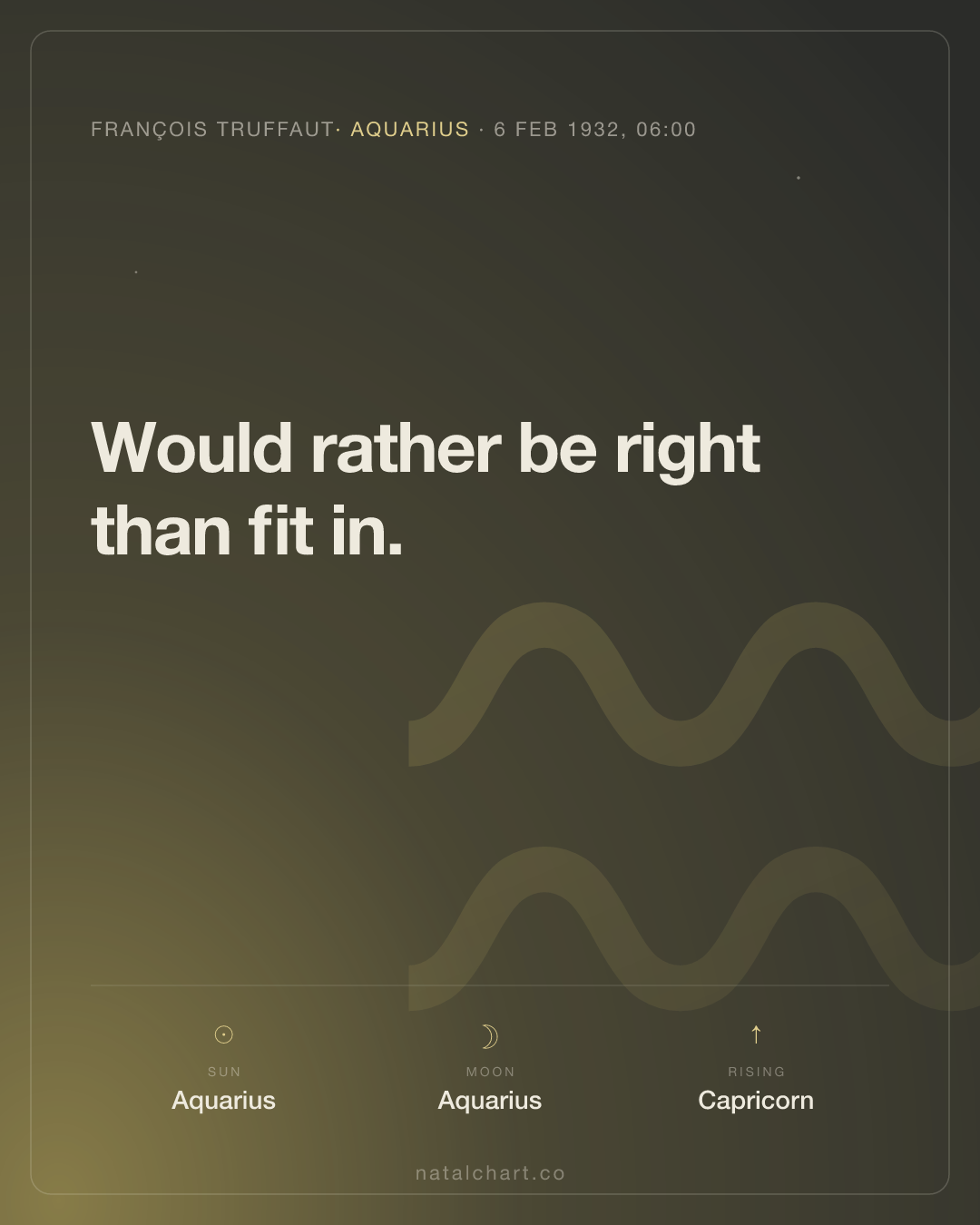
François Truffaut's Sun sign is Aquarius — the Sun was in Aquarius at birth (1932).
What is François Truffaut's moon sign?
François Truffaut has the Moon in Aquarius. The Moon sign describes the emotional and instinctive layer of the chart.
What is François Truffaut's rising sign?
François Truffaut's rising sign (ascendant) is Capricorn — the sign on the eastern horizon at the moment of birth.
When and where was François Truffaut born?
François Truffaut was born in 1932 in Paris (17th arrondissement), France.