Gilberto Gil — natal chart
What does Gilberto Gil’s natal chart reveal?
Gilberto Gil (born Gilberto Passos Gil Moreira on 26 June 1942 in Salvador, Bahia) is a Brazilian singer-songwriter, guitarist and politician. He grew up in the interior town of Ituaçu before returning to Salvador, where he studied business administration. In the mid-1960s he became, alongside Caetano Veloso, a central figure of the Tropicália movement, which fused Brazilian popular music with rock, psychedelia and avant-garde poetry. The 1968 collective album 'Tropicália ou Panis et Circensis' marked the movement. During the military dictatorship he was imprisoned in 1969 and lived in exile in London until 1972. His extensive discography includes 'Expresso 2222' (1972), 'Refazenda' (1975) and 'Refavela' (1977). He won several Grammy and Latin Grammy awards. From 2003 to 2008 he served as Minister of Culture of Brazil under President Luiz Inácio Lula da Silva, and in 2024 he was elected to the Brazilian Academy of Music.
 Share
Share
Birth
1942-06-26 · 11:50 · Salvador, Brazil Reliability: A · reliable data
The core: a public man with a private compass
Gilberto Gil is, above almost everything else, a man who belongs to the world without losing himself in it. The Sun in Cancer joined closely with Jupiter in Cancer — both sitting at the very top of the chart, in the house of public life and career — creates a gravitational pull toward public expression that is simultaneously generous and deeply personal. Cancer is not a flamboyant sign; it is protective, sensitive, attuned to belonging. But placed at the career peak and amplified by Jupiter, it becomes a kind of open-door warmth: the person who brings everyone in, who makes a stage feel like a kitchen table. Gil's music has always carried that quality — the albums Refazenda (1975) and Refavela (1977) were not crossover attempts; they were homecomings, root-touchings that then opened outward.
The Ascendant in Libra — the sign rising on the horizon at birth, the face Gil meets the world with — adds elegance and a diplomat's instinct to all of this. Libra looks for balance, hears multiple sides, and tends to be disarming rather than confrontational. For someone who led a cultural revolution (Tropicália) and then served as a government minister, that capacity to charm, to build bridges, and to be genuinely liked across very different audiences was not incidental — it was structural.
The Moon: a restless emotional life
The Moon — the interior world, what one needs to feel at home — is in Sagittarius, in the third house of communication and ideas. A Sagittarian Moon doesn't settle easily. It needs room to move, to explore, to change its mind. Put it in the third house and that restlessness becomes intellectual: an endless appetite for new ideas, conversations, sounds, philosophies. The Moon in tension with Saturn (at barely a degree's distance — one of the tightest aspects in the chart) gives that restless Sagittarian need a harder edge: a pull between the urge for freedom and a demand for seriousness, between the desire to roam and the obligation to build something that lasts. The years of exile in London (1969–1972), imposed rather than chosen, held that tension in sharp relief — freedom denied, form imposed, and a musician who came back with something richer for having been forced to go still.
Mercury: the mind that speaks in many tongues
Mercury in Gemini in the ninth house — the house of philosophy, foreign cultures, and the big picture — is an exceptionally curious mind. Gemini Mercury is fast, associative, interested in everything at once; in the ninth house it reaches toward the conceptual, the cross-cultural, the wide-frame question. Gil's ability to weave Candomblé with psychedelic rock, Bahian rhythms with Beatles-era arrangements, politics with joy, was not a gimmick or a genre exercise — it came from a mind that genuinely needed to hold all of it together. Saturn and Uranus also sit in Gemini in the ninth house, giving this intellectual space a paradoxical quality: a love of tradition alongside an impulse to break it, a need for philosophical grounding alongside genuine iconoclasm.
Venus: beauty in the concrete
Venus in Taurus in the eighth house has a direct, almost physical relationship with beauty and value. Taurus is the sign where Venus is most at ease — sensory, patient, committed to quality that endures rather than dazzles briefly. In the eighth house, those values deepen into something more private, more concerned with what is shared most intimately. Venus in easy flow with Neptune (at barely a degree's distance) softens this further into a quality of musical idealism: the belief that beauty is real, not constructed, and that the right chord progression can reach something that argument cannot. That quality shows up in recordings like Expresso 2222 (1972), where the political and the pastoral coexist without irony.
Mars: Leo fire in a collaborative house
Mars in Leo in the eleventh house — the house of groups, movements, and collective projects — is combative in the most theatrical and principled sense. Leo wants to do things with pride, wants its contribution to be seen and to matter. In the eleventh house that fire goes into movements rather than solo glory: Tropicália was not a brand built by one person, and Gil's role in it was always collegial, argumentative, genuine. Mars in Leo here also resists humiliation, and the experience of the military dictatorship — arrest, forced exile — was an attack on the pride and autonomy that Mars in Leo defends most fiercely. He came back from London not subdued but recharged.
The Moon very nearly exactly in flowing harmony with Mars — less than half a degree — means the emotional life and the drive are unusually well-integrated. What Gil feels, he acts on; what he acts on, he feels. There is very little gap between impulse and commitment, which is both the source of his creative productivity and the reason the music rarely feels calculated.
Jupiter and Saturn: the slow architecture of a life
Jupiter joined closely with the Sun at the career peak has already been described — it is the single most prominent feature of the chart, a mark of someone for whom public life is genuinely a form of fulfillment rather than a burden. The scale of that public life is remarkable: not just a musician celebrated across generations, but a minister of culture for five years (2003–2008) under President Lula, reshaping Brazil's cultural policy, embracing open-source technology in the arts, and in 2024 elected to the Brazilian Academy of Music. Jupiter at the Midheaven means the public role expands over time.
Saturn in Gemini in the ninth house — in easy flow with both Mars and Pluto — provides the structural foundation beneath all that expansion. The philosophical range is not undisciplined; it is organized, cumulative. The decades of recording and touring built a body of work with genuine internal coherence, not a scattered catalogue. Saturn's discipline shows up in the craft.
The outer planets and the generation
Neptune in Virgo in the twelfth house works quietly. The twelfth house is the space beneath the public surface — dreams, retreats, what one absorbs unconsciously. Neptune in Virgo in this house suggests a spirituality that is precise rather than diffuse, a relationship with Afro-Brazilian religious tradition (Candomblé has always been present in Gil's work and worldview) that is particular and embodied rather than vague. Pluto in Leo in the eleventh house, shared with a whole generation, speaks to the transformative potential of collective cultural projects — and Tropicália was exactly that, a movement that attempted to change what Brazilians understood about their own culture.
The Midheaven: vocation as a public trust
The Midheaven — the career point, the public legacy — falls in Cancer. Cancer at the career peak is not an obvious placement for a cultural politician, but it is a deeply coherent one for Gil. Cancer leads with belonging, with roots, with the question of who people are and where they come from. Every major phase of his public life has circled back to that: the Tropicália movement was ultimately about Brazilian identity; the ministry of culture work was about who gets access to Brazilian culture; the music itself keeps returning to Bahia, to the northeast, to the specific textures of a particular place. The career is not a performance of public life — it is an extended argument for the value of roots.
The tightest aspects: what shapes the character most
The Moon barely a degree from exact in flowing harmony with Mars is the tightest aspect in the chart, and it does what was described above: integrates feeling and action into something seamless. The Sun joined with Jupiter at less than a degree sets the scale of ambition and public life. Moon in tension with Saturn at barely more than a degree provides the productive friction — the discipline that keeps restlessness from scattering.
Venus in flowing harmony with Neptune at barely more than a degree is worth staying with: it is the quality of musical idealism, the conviction that sound can carry something true about how people feel and who they are. This aspect appears in musicians who treat the craft as a form of listening rather than performance — Gil's guitar playing has that quality of attention, of waiting for the note rather than imposing it.
Chiron and the North Node: the wound and the direction
Chiron — the old wound that over time becomes a gift — is in Leo in the eleventh house, close to Mars and Pluto. The Leo wound is typically about being seen, about whether what one expresses is received and valued. For Gil, the long arc of that wound moving toward a gift played out publicly: the imprisonment, the exile, the years of building a career in a foreign country while Brazil went on without him, and then the long return — not a triumphant comeback but a patient, rooted re-engagement that ended up shaping Brazilian culture far more durably than many who never left.
The North Node in Virgo — the direction of growth, what the chart is oriented toward — points toward precision, discernment, service, the willingness to get into the details of how things actually work. The five-year ministerial term was a Virgo task in a Cancer framework: the care for people's cultural roots expressed through the painstaking work of policy.
A portrait in full
Gilberto Gil's chart tells the story of someone for whom the personal and the public were never separate compartments. The Sun and Jupiter together at the career peak mean that being known, being a public figure, serving something larger than himself — these were genuine satisfactions, not compromises. The Cancer quality running through Sun, Jupiter, and Midheaven means that what he gave the world he drew from the most personal place: the body's memory of a place, a rhythm, a belonging. And Libra rising gave him the grace to offer that without imposing it, to make the encounter feel like a conversation rather than a lecture. More than eighty years of life, more than five decades of recorded music, one term as a government minister, and the Brazilian Academy of Music: a life spent in public that never stopped being about something deeply private.
The chart
How to read it →Frequently asked questions
What is Gilberto Gil's zodiac sign?
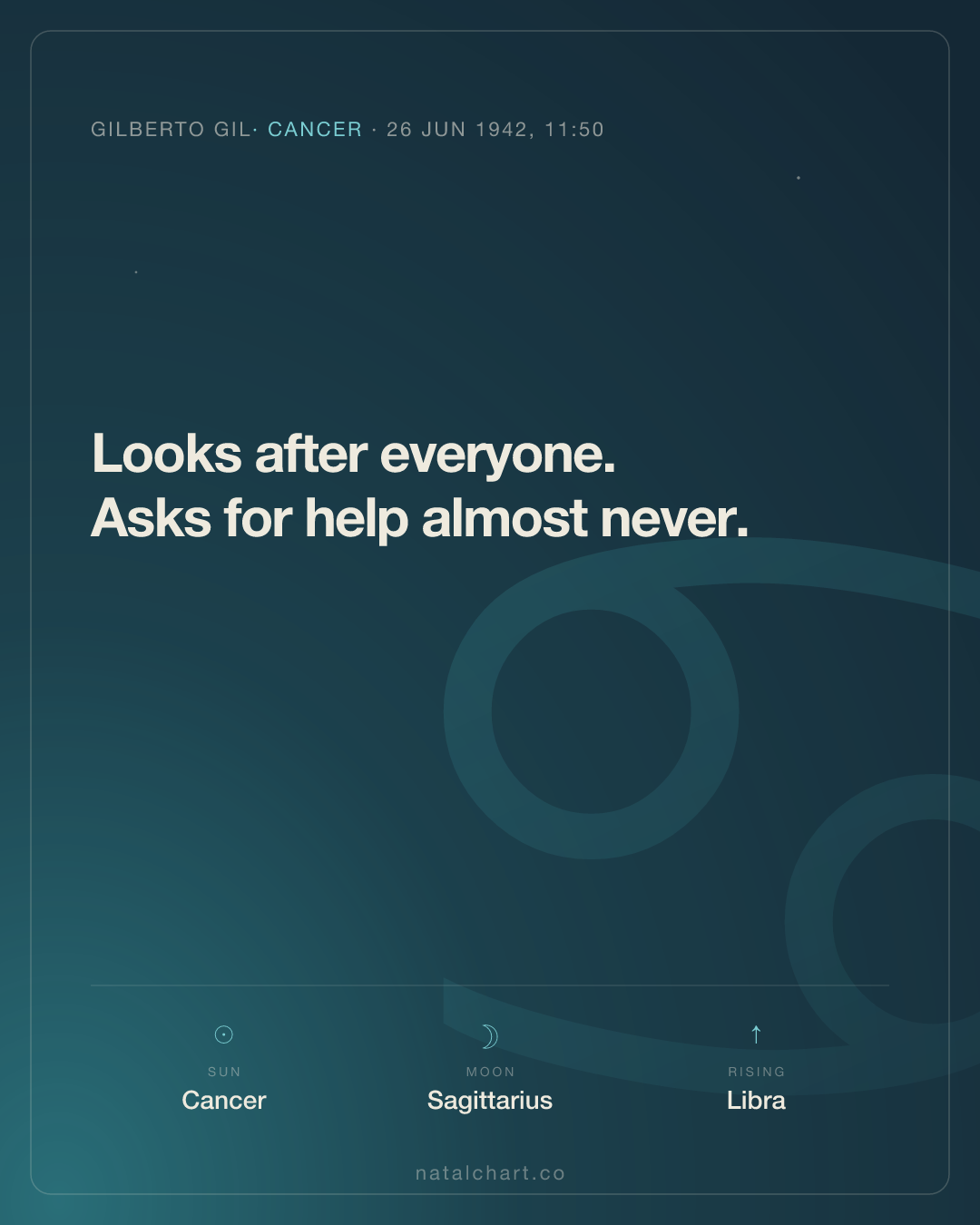
Gilberto Gil's Sun sign is Cancer — the Sun was in Cancer at birth (1942).
What is Gilberto Gil's moon sign?
Gilberto Gil has the Moon in Sagittarius. The Moon sign describes the emotional and instinctive layer of the chart.
What is Gilberto Gil's rising sign?
Gilberto Gil's rising sign (ascendant) is Libra — the sign on the eastern horizon at the moment of birth.
When and where was Gilberto Gil born?
Gilberto Gil was born in 1942 in Salvador, Brazil.