Gilles Deleuze — natal chart
What does Gilles Deleuze’s natal chart reveal?
Gilles Deleuze (1925-1995) was a French philosopher born in Paris, among the most important thinkers of the late 20th century. Known for 'Difference and Repetition' and, with Felix Guattari, 'Anti-Oedipus' and 'A Thousand Plateaus', his work influenced philosophy, literary theory and the arts.
 Share
Share
Birth
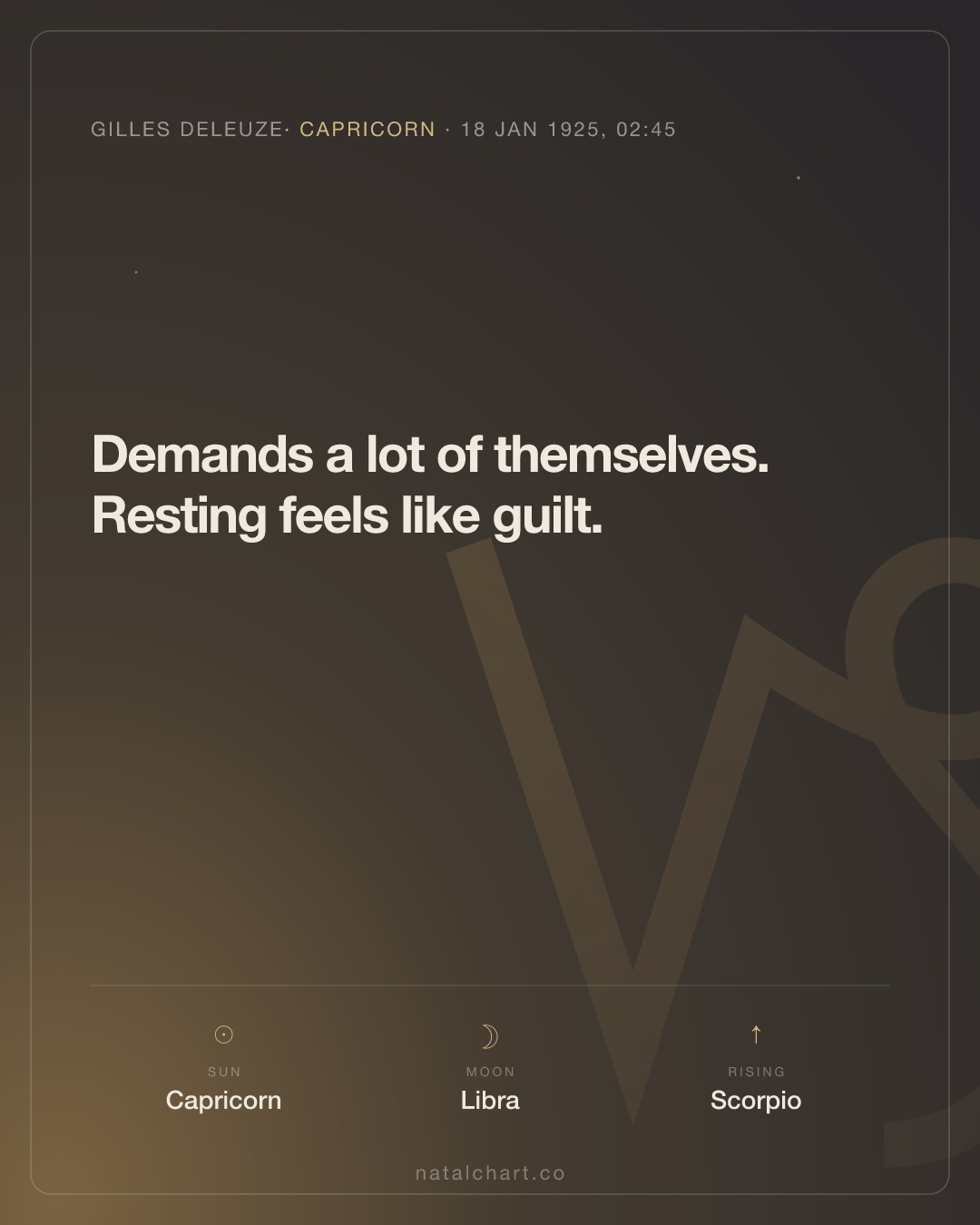
1925-01-18 · 02:45 · Paris, France Reliability: AA · vetted record
The core: thinking as a way of living
Gilles Deleuze did not fit the mold of the French academic philosopher — the kind who argues from a secure institutional position and writes for other specialists. He thought in movement, built systems only to destabilize them, formed unlikely partnerships, and produced a body of work that kept escaping classification. The natal chart explains much of this restlessness. The Sun in Capricorn sits in the third house — the sector of language, writing, and intellectual exchange — alongside Mercury, Venus, and Jupiter, all in the same sign. That concentration is rare: it describes someone for whom thought and expression are not separate activities but a single, continuous practice. The Ascendant in Scorpio (the point in a chart that describes how a person meets the world) adds the intensity: Deleuze did not approach ideas lightly. He went deep, looked for what was hidden underneath the obvious reading, and held his positions with the kind of quiet conviction that makes a thinker unsettling rather than comfortable.
The emotional interior: Moon in Libra
The Moon — the planet that governs the inner life, the emotional register, what moves a person from the inside — sits in Libra in the twelfth house, the most private sector of the chart. Libra weighs and balances; the twelfth house keeps things hidden. This is not the Moon of public display. Deleuze was famously private about his personal life, but his philosophical writing is full of attention to aesthetic experience, to the way a painting or a piece of music reaches the nervous system before it reaches the mind. His collaboration with Félix Guattari — one of the most generative intellectual partnerships of the twentieth century — has the quality of Libra Moon in the hidden house: built on a deep mutual recognition that was never fully explained to the outside world. The square between Sun and Moon (a tension between the structured Capricorn drive and the relational Libra emotional need) runs quietly through all of his major work: the tension between system-building and the ethical demand that systems remain open, incomplete, livable.
The mind and the word: Mercury and Jupiter in Capricorn
Mercury joined with Venus in Capricorn, with only half a degree between them, is the tightest aspect in the chart. The mind and the sense of beauty operate as one thing. Deleuze's prose — notoriously demanding in French, but with a distinct aesthetic pleasure in it — is the direct expression of this: writing was not a vehicle for thought but inseparable from it. The concept-creation he described in What Is Philosophy? was also a literary act. Jupiter lands very close to Mercury and Venus in the same sign, expanding and systematizing that intellectual-aesthetic drive. Difference and Repetition (1968) is a large-scale philosophical architecture built from what are essentially conceptual images — the kind of writing only Mercury-Venus-Jupiter in Capricorn, a sign that builds structures meant to last, could produce.
Love and values: Venus in Capricorn
Venus in Capricorn is not demonstrative. It values what has been tested, what endures, what was built with patience. Deleuze's intellectual loyalties were famously long — his engagement with Spinoza, Hume, Bergson, Nietzsche, and Kant spanned decades, returning to the same thinkers to find new angles rather than moving on to the next fashionable name. That fidelity is Capricorn Venus: it does not abandon what it has genuinely valued. His personal life was kept almost entirely private; what was made public was the work, and the work was devoted with the same constancy.
Drive and action: Mars in Aries
Mars — the planet that governs action, physical force, and the manner of pursuing what one wants — is in Aries in the sixth house, the sector of daily work and practice. Mars in Aries moves on instinct, with directness. In the sixth house, that directness gets channelled into a daily discipline of sustained production. Deleuze was a remarkably consistent writer across four decades. The sixth house is also the house of health — Mars in Aries here points to a tense, taut physical energy, and Deleuze suffered from serious respiratory illness throughout much of his adult life. The Mars trine Neptune (the outer planet of dissolution and imagination, in the tenth house of public life) is one of the most revealing aspects: it links the direct, disciplined daily practice with an extraordinary imaginative capacity, the ability to think fluidly across philosophy, literature, cinema, and painting — the interdisciplinary range that made A Thousand Plateaus possible.
Vocation: Neptune in Leo, tenth house, and Midheaven in Virgo
The Midheaven — the career and public identity point in a chart — is in Virgo, a sign associated with precision, analysis, and the meticulous construction of argument. This describes a thinker whose public reputation rests not on broad strokes but on the exactness of conceptual distinction, the care with which a term is defined before it is used. Neptune in Leo sits in the tenth house of public life, adding something larger: the philosopher as a figure who reshapes how imagination itself is understood, whose influence goes beyond the discipline and into art, film, and cultural theory. The combination of Virgo Midheaven and tenth-house Neptune is unusual — it produces rigor in service of a vision that is, ultimately, expansive and even lyrical.
The outer planets and the philosophical generation
Saturn in Scorpio in the first house — touching the Ascendant — is a defining placement for Deleuze's manner of intellectual engagement. Saturn in Scorpio digs. It does not accept surface readings. It is patient with complexity and treats difficulty as the beginning of real thought, not an obstacle to be cleared away. The trine between Saturn and Pluto (the planet of radical transformation, in the ninth house of knowledge and foreign intellectual worlds) in easy flow describes a thinker who saw transformation — the overturning of fixed identities, categories, and structures — not as a threat but as the very condition for thought. Uranus in Pisces in the fifth house of creative production, in easy flow with Saturn, brought a quality of inspired unconventionality to a fundamentally disciplined approach.
Chiron and the North Node: the gift of difference
Chiron — the point in a chart that marks an old wound that, over time, becomes a gift — is in Aries in the sixth house, close to Mars. For Deleuze, the wound is in the register of action and bodily existence: the persistent respiratory illness that shadowed his adult life, the gap between a mind of extraordinary range and a body that did not cooperate. What emerged from that tension was a philosophy acutely alive to the question of what bodies can do — Spinoza: Practical Philosophy, the sections of A Thousand Plateaus on affect, on intensity, on the body without organs. The philosophical preoccupation grew directly from the lived constraint. The North Node in Leo (the point that describes the direction of growth) points toward a trajectory that was fully realized: becoming a public intellectual of genuine cultural reach, not just an academic specialist.
The tightest aspects: what the chart cannot avoid
Mercury joined with Venus at 0.5° is the signature of a mind where thought and aesthetic pleasure are genuinely inseparable. Saturn in easy flow with Pluto at 1.1° is the capacity to hold radical ideas within a rigorous, durable framework — not to let the subversive become formless. The Sun in tension with the Moon at 1.7° is the central personal friction: between the structured, driven, building Capricorn will and the relational, equilibrium-seeking Libra emotional need. That friction produced philosophy rather than resolution; it is what kept the thought open. Jupiter opposite Pluto at 5.2° is the pull between philosophical systematizing and the insistence on transformation — the very tension Anti-Oedipus was written to address.
The complete portrait
Deleuze once described philosophy as the creation of concepts — not the discovery of pre-existing truths but the making of new tools for thinking. The natal chart is the portrait of someone who was built for exactly that: the Capricorn stellium that builds and endures, the Scorpio Ascendant that goes underneath, the Libra Moon that keeps the ethical axis in play, the Virgo Midheaven that insists on precision, and the Mars-Neptune flow that allows the disciplined practitioner to think, without losing rigor, like an artist. He died in 1995, but the concepts he made are still in active use — which is, for Capricorn, the only measure that counts.
The chart
How to read it →Frequently asked questions
What is Gilles Deleuze's zodiac sign?
Gilles Deleuze's Sun sign is Capricorn — the Sun was in Capricorn at birth (1925).
What is Gilles Deleuze's moon sign?
Gilles Deleuze has the Moon in Libra. The Moon sign describes the emotional and instinctive layer of the chart.
What is Gilles Deleuze's rising sign?
Gilles Deleuze's rising sign (ascendant) is Scorpio — the sign on the eastern horizon at the moment of birth.
When and where was Gilles Deleuze born?
Gilles Deleuze was born in 1925 in Paris, France.