Giulio Andreotti — natal chart
What does Giulio Andreotti’s natal chart reveal?
Giulio Andreotti (1919-2013) was an Italian Christian Democrat politician, one of the most prominent figures of the postwar Republic. He served seven times as Prime Minister and held numerous ministerial posts across decades, becoming a central and controversial figure in Italian political life.
 Share
Share
Birth
1919-01-14 · 07:00 · Rome, Italy Reliability: AA · vetted record
The Core: Power Worn Like a Second Skin
Few politicians have made power look so effortless — or so permanent. Giulio Andreotti served as Prime Minister of Italy seven times across five decades, held virtually every major cabinet portfolio at least once, and remained a central force in Italian public life from the birth of the Republic in 1948 until the early 1990s collapse of the postwar political order. The chart of a man like this does not announce itself with fire and drama; it shows a colder, more patient architecture.
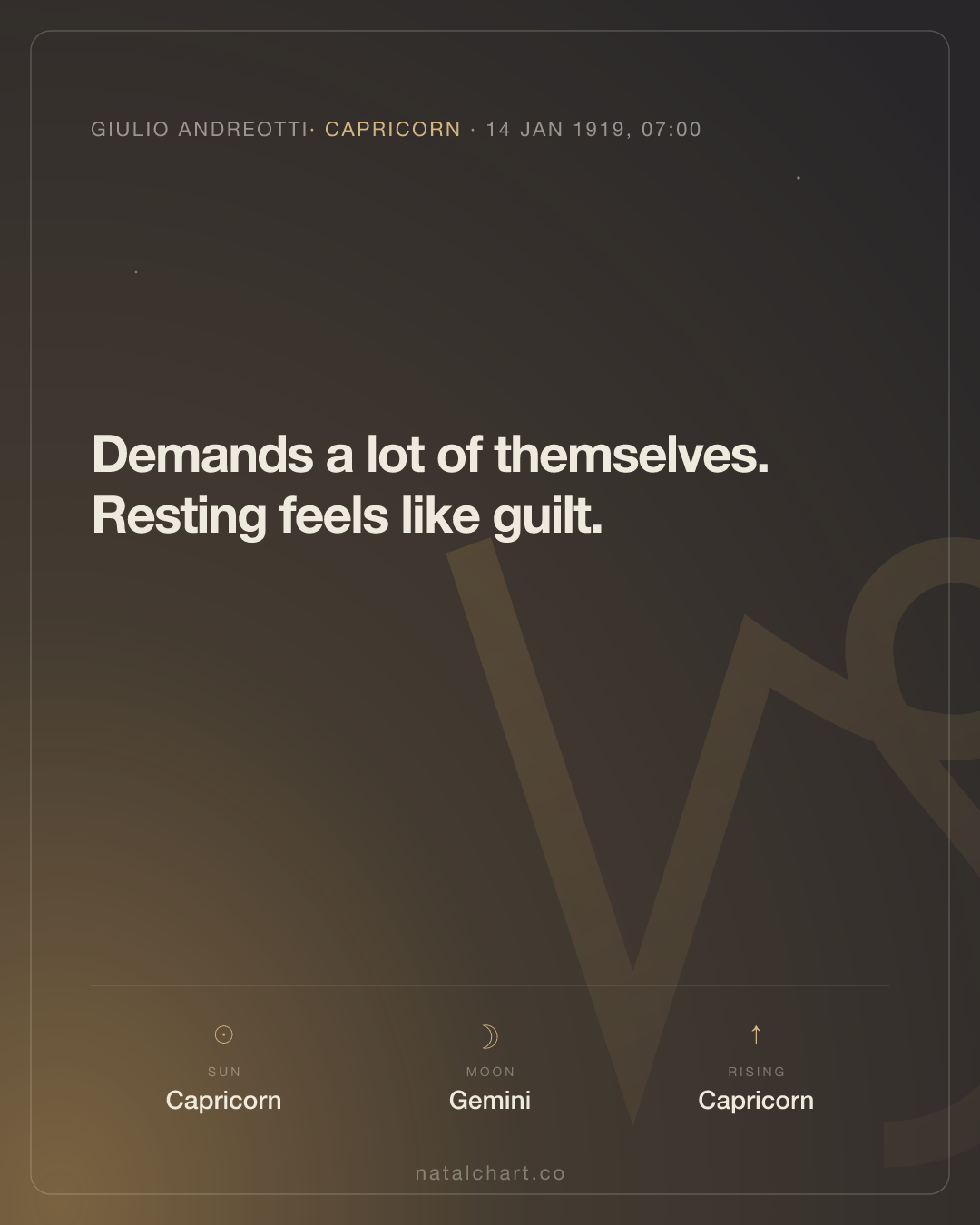
The Sun in Capricorn sits in the first house — the house of the self, of how a person moves through the world — and Capricorn is the Ascendant as well. Sun and rising sign coincide almost exactly: what Andreotti showed the world was very close to what he actually was. Capricorn builds slowly, holds its cards, prefers the long game over the quick win. The image the world received — the small, unassuming man in dark suits who somehow always ended up at the table — was not a performance. It was the truth of a nature that finds its fullest expression in the accumulation of institutional weight.
The Moon: Information as Emotional Currency
Inside the composed exterior lived a mind that never stopped moving. The Moon in Gemini in the sixth house — the house of daily work, routine, and the unglamorous machinery of getting things done — describes someone who processed the world through information. Gemini gathers, sorts, and retains; in the sixth house, this becomes a working method: the desk covered in files, the famous capacity to hold in memory the details of hundreds of cases simultaneously, the dry wit that dispatched opponents with a line rather than a blow.
Andreotti's aphorisms became legendary in Italian political culture — "Power wears out those who don't have it" is the most quoted, but there were dozens more, each precise as a scalpel. That is the Moon in Gemini speaking: language as instrument, the well-placed phrase as a tool of governance.
This Moon forms an almost exact flowing connection with Uranus, also in Aquarius, in the second house. The flow between the two suggests a mind that not only gathered information but made sudden, unexpected connections from it — arriving at conclusions that others found surprising, often before the evidence was fully assembled. It also signals an emotional detachment unusual even by Capricorn standards: Andreotti was genuinely difficult to read, which in Italian politics is an extraordinary asset.
Mercury and the Mind of the State
Mercury — the planet governing how a person thinks and speaks — also sits in Capricorn in the first house. The pattern is consistent: Capricorn through and through, from the self outward. Mercury in Capricorn thinks in structures, in precedents, in the weight of what has been established. It is not a mind that improvises or plays with ideas for the joy of it; it identifies the load-bearing walls of an argument and builds there.
Mercury connects in easy flow with Saturn in Leo — and Saturn here sits in the eighth house, the house of power held in common, of institutional secrets, of what is inherited and what is owed. That connection between the thinking mind and the planet of institutional gravity — drawn tight across those two houses — produced one of the most consequential strategic intellects in postwar European politics. Andreotti didn't just understand power; he understood the system that power runs through, the invisible plumbing of the Italian state, in a way very few people ever have.
Venus, Mars, and the Aquarian Cluster
Venus, Mars, and Uranus cluster together in Aquarius in the second house — the house of resources, material security, and what a person considers genuinely valuable. Aquarius here is telling: the resources that mattered were systemic, not personal. Andreotti was famously uninterested in personal wealth or luxury; the currency he accumulated was influence, connection, and institutional position — the Aquarian abstraction of value.
Venus sits in tension with Neptune in the eighth house, Neptune being the planet associated with what remains hidden, with what dissolves clear boundaries. That tension — between the stated values (Aquarius: rationalism, institutions, the collective good) and something more shadowed and unclear — captures the central ambiguity of Andreotti's legacy. He was tried, at various points in the 1990s, for association with the Mafia and for complicity in a political murder. He was ultimately acquitted or had charges extinguished by statute of limitations. The tension between the Aquarian idealist and the eighth-house Neptune remains unresolved in his chart and in history.
Jupiter and Saturn: The Architecture of the Long Game
Jupiter in Cancer in the seventh house — the house of alliances, partnerships, and open dealings with the world — joined to Pluto in the same house: this is the signature of a man who made his greatest gains through alliances rather than through solo power. The Democrazia Cristiana was, for Andreotti, not just a party but an ecosystem; he cultivated relationships across its factions with the patience of a gardener who expects the harvest to come decades later.
Saturn in Leo in the eighth house adds the cold side of the ledger. Leo's theatre, Saturn's discipline: the public persona managed with extraordinary care, the private machinery of power kept invisible. Saturn opposing Uranus across the eighth-to-second-house axis is one of the tightest tensions in the chart — the friction between the established order (Saturn in Leo, the institutional performance of power) and the disruptive, reforming impulse (Uranus in Aquarius, the systemic rethink). Andreotti navigated that tension for fifty years by always controlling which side of it was visible.
The Midheaven: Scorpio's Vocation
The Midheaven — the career and public-reputation point of the chart — lands in Scorpio. Scorpio is the sign of what lies beneath the surface: the investigation, the hidden file, the question that polite conversation never asks. For a career that was inseparable from Italian intelligence services, from the shadowed corners of Cold War geopolitics, and from the enduring mysteries of the Aldo Moro kidnapping and other affairs of state, Scorpio is the fitting seal.
Lilith in Libra in the tenth house — just below the Midheaven — adds a note of raw ambiguity to the public role: the shadow side of balance, the place where diplomacy and manipulation become indistinguishable. Andreotti himself once said he preferred not to have enemies, but the way he managed not to was never entirely transparent.
The Tightest Tension: Saturn Opposing Uranus
The most structurally important aspect in the chart is Saturn in Leo opposing Uranus in Aquarius across the second and eighth houses — separated by just over a degree. This opposition describes a man perpetually caught between two irreconcilable imperatives: the need to maintain and embody institutional order (Saturn in Leo, the dignified performance of the established state) and the awareness that systems must be forced to change, that working inside a structure can mean helping it rot from within or helping it renew itself, sometimes simultaneously.
The Italian First Republic, which Andreotti helped build and which ended in the Tangentopoli corruption investigations of the early 1990s, lived out that opposition on a national scale. He survived it; most of his contemporaries did not. Whether that survival reflected extraordinary integrity, extraordinary cunning, or something in between, the chart declines to adjudicate.
Chiron and the North Node: The Wound and the Direction
Chiron — the old wound that, worked with over time, becomes a point of hard-won wisdom — sits in Pisces in the third house, the house of communication, close reading, and the connections between things. Pisces dissolves boundaries; the third house is where language lives. Chiron here suggests that the wound ran through how Andreotti was read and misread — the decades of ambiguity about what he actually stood for, the quality of elusiveness that protected him and isolated him simultaneously.
The North Node — the chart's indicator of where genuine growth and long-term reward lie — is in Sagittarius. Sagittarius seeks the larger truth, the wider frame, the meaning above and beyond the transaction. It is, in some sense, the opposite of everything that made Andreotti's career: the transactional, the particular, the close-held. That distance between where he operated and where his chart pointed as the direction of deepest reward is perhaps the most poignant note in the whole reading.
The Full Portrait
Andreotti's chart is a study in the patient accumulation of institutional weight — Sun, Mercury, and Ascendant all in Capricorn in the first house, making him one of the most thoroughly Capricornian public figures of the twentieth century. The Moon in Gemini gave him the intelligence to move through information the way other men move through rooms: quickly, leaving no trace, retaining everything. The Aquarian cluster in the second house meant he genuinely did not accumulate wealth, which made him, paradoxically, harder to touch.
The tensions — Saturn opposing Uranus, Venus opposing Neptune, Mercury opposing Pluto — describe a man who spent his entire career navigating irreconcilable forces: tradition and disruption, the declared and the hidden, the institutional and the personal. He navigated them with a precision that history may never fully explain. What the chart does show is that the navigation was not accidental. The architecture of this map was built for the long game — and the long game, Andreotti played longer than almost anyone.
The chart
How to read it →Frequently asked questions
What is Giulio Andreotti's zodiac sign?
Giulio Andreotti's Sun sign is Capricorn — the Sun was in Capricorn at birth (1919).
What is Giulio Andreotti's moon sign?
Giulio Andreotti has the Moon in Gemini. The Moon sign describes the emotional and instinctive layer of the chart.
What is Giulio Andreotti's rising sign?
Giulio Andreotti's rising sign (ascendant) is Capricorn — the sign on the eastern horizon at the moment of birth.
When and where was Giulio Andreotti born?
Giulio Andreotti was born in 1919 in Rome, Italy.