Greta Garbo — natal chart
What does Greta Garbo’s natal chart reveal?
Greta Garbo (1905-1990) was a Swedish-born American film actress and one of the defining stars of Hollywood's silent and early sound eras. Celebrated for her elusive screen presence in films such as Grand Hotel, Anna Karenina, and Ninotchka, she received an honorary Academy Award and retired famously young.
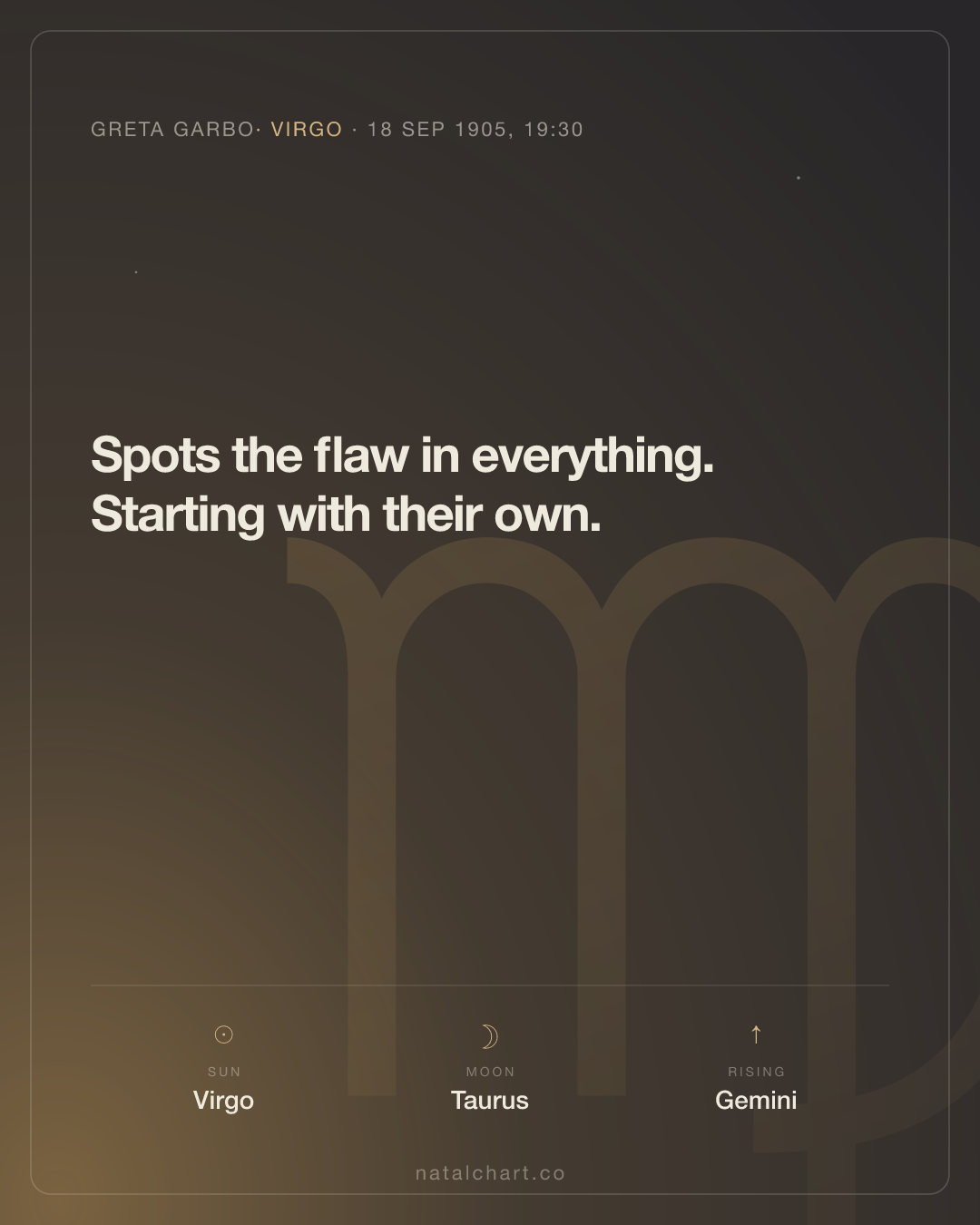 Share
Share
Birth
1905-09-18 · 19:30 · Stockholm, Sweden Reliability: AA · vetted record
The woman who withdrew
Greta Garbo retired from films at 36, at the peak of her fame, and then lived another fifty years in deliberate obscurity on the Upper East Side of Manhattan — refusing interviews, declining awards ceremonies, rarely photographed. The world called it mystery. The natal chart calls it something more precise: a Gemini Ascendant (the face the world meets first) carrying Jupiter and Pluto in the first house, paired with a Sun in Virgo buried deep in the fourth house, the most private sector of the chart. The tension between those two forces — a presence that fills any room it enters, and an interior that wanted nothing more than to be left alone — shaped every film she made and every decision she made after.
The face that lit screens
The Ascendant in Gemini, with Jupiter and Pluto both sitting in the first house, made Garbo's screen presence something larger than a human being could ordinarily produce. Jupiter expands everything it touches; Pluto magnetises it. The result was a quality that directors from Clarence Brown to Ernst Lubitsch struggled to describe in words — an aliveness in stillness, a sense that everything happening in a scene was somehow concentrated in the way she held her head. Louis B. Mayer's MGM signed her for a reason that had nothing to do with conventional beauty: she created a force field. That Gemini quality — the capacity for multiplicity, for playing a face that could be anything — meant she was equally convincing as a Russian spy (Ninotchka), a Swedish peasant (Anna Christie), and an eighteenth-century Swedish queen (Queen Christina). She didn't play characters; she inhabited possibilities.
The inner life that stayed hidden
The Sun in Virgo in the fourth house, with Mercury also in Virgo in the fourth, tells a different story entirely. Virgo attends to what is real and concrete; the fourth house is the foundation, the private realm, the part of oneself that exists only away from the world's attention. Garbo genuinely could not separate the public gaze from an experience of violation. The famous line — "I want to be alone" — was not a pose or a publicity strategy; it was a precise description of a psychological need that the chart confirms in multiple places. The Sun here preferred to exist in depth rather than breadth, in quality rather than quantity, in the privacy of genuine experience rather than the glare of celebrity machinery.
Emotional ground
The Moon — the emotional interior, the felt sense of home — was in Taurus in the twelfth house. The twelfth house is the most withdrawn territory in the chart, the place where experience becomes solitary and interior. Taurus gives the Moon stability and sensory richness, a need for physical comfort and beauty, and a reluctance to be moved from what feels safe and familiar. Together these describe someone whose emotional life was enormously rich and entirely private — someone who needed beauty around her (her New York apartment was immaculately curated), who formed intense attachments but rarely allowed them public expression, and who found the constant emotional demand of fame genuinely draining. The Moon in the twelfth house often describes a private grief that runs underneath the surface of a life. Garbo's long relationship with the actress and socialite Mercedes de Acosta, her deep friendship with Leopold Stokowski, her grief after the death of John Gilbert — none of these were performed for an audience. They happened in the twelfth house.
Venus and the art of attraction
Venus in Leo in the third house, in easy flow with both Pluto and Mars, produced one of the most striking combinations in the chart. Leo gives Venus an instinct for theatre, for radiance, for the pleasure of being genuinely seen — but at a distance of her own choosing, on her own terms. The third house is the domain of expression and communication, of how one speaks and what one says. Venus here was not sentimental or conventionally romantic; it was dramatic, precise in language, capable of both extraordinary charm and equally extraordinary withdrawal. The easy relationship between Venus and Pluto accounts for the quality that studio photographers described as impossible to capture in a single shot: a face that changed its charge depending on the angle, the light, the moment. Venus trine Mars added a directness to the charm — she was not passive or coy, and in interviews she gave before her retirement she was notably frank about what she wanted and did not want.
Mercury, the mind that saw clearly
Mercury in Virgo in the fourth house in tension with Jupiter in Gemini reveals the analytical quality that everyone who worked with Garbo noted: she read scripts with exceptional care, pushed back on dialogue she found false, and refused to play scenes she judged theatrically dishonest. Virgo's Mercury is a discriminating instrument, precise and critical; the tension with Jupiter in Gemini meant there was always a pull between that precision and a larger appetite — for ideas, for language, for the variety that Gemini craves. She was reportedly a voracious reader, fluent in several languages, and genuinely curious about the people she met. The Mercury-Neptune sextile (in easy flow, just over two degrees) added a permeability to language and image — she could feel the emotional undertow of a phrase, a visual, a piece of music, which partly explains her legendary responsiveness to the work of directors who operated in that register.
Jupiter, Saturn, and the long arc
Jupiter in Gemini in the first house, in tension with Mercury, gave Garbo's public image an intellectual dimension that Hollywood found useful and confusing in equal measure. She was not the dumb blonde or the pure ingénue; she projected intelligence as part of the allure. Saturn in Aquarius in the ninth house — in easy flow with both Uranus and Pluto — describes the discipline and architectural quality of her approach to her own image: deliberate, structured, ahead of its time. Saturn in Aquarius builds frameworks that outlast the moment, and Garbo's decision to retire young rather than slowly diminish is one of the most Saturn-in-Aquarius choices in the history of fame. The ninth house deals with reputation across cultures and continents; the sextile to Uranus in Capricorn explains why her image did not age the way other Golden Age stars' images aged — there was always something structurally modern about it.
The outer planets and the threshold
Uranus in Capricorn in the eighth house — concerned with transformation, with what crosses thresholds, with what cannot be taken back — describes a particular quality of finality in Garbo's most important decisions. The retirement was absolute; there was no comeback, no television interview, no memoir. Capricorn's Uranus does not make dramatic gestures; it makes permanent ones. Neptune in Cancer in the second house — the house of material security and self-worth — suggests that her relationship with money, security, and her own value was more fluid and uncertain than the public image suggested. Despite earning enormous sums at MGM, Garbo reportedly worried about financial security throughout her life, a Neptune-in-the-second-house anxiety that can make solid ground feel illusory.
The Midheaven and the legacy she chose
The Midheaven — the public and career point at the top of the chart — was in Capricorn. Garbo's professional identity was governed by Capricorn's principles: restraint, longevity, refusal of the cheap effect. Capricorn climbs selectively and builds for the long term. The fact that her reputation is, if anything, larger a century after her peak years than it was in her lifetime is a Capricorn-Midheaven outcome — slow, structural, and lasting. Chiron — an old wound that gradually becomes a form of mastery — was in Aquarius in the ninth house, which deals with one's place in the larger world, in history, in the culture. The wound of never quite belonging — to Hollywood, to America, to any fixed social identity — became the very thing that made her iconic. She was always slightly exterior to whatever world she inhabited, and that quality of permanent outsider-ness was, paradoxically, what made her image so universally available.
The tightest aspects and the portrait they make
The most precise aspect in the entire chart is the Moon in exact tension with Venus — zero degrees, no orb at all. This describes the central dilemma of Garbo's life with unusual clarity: the need for private emotional security (Moon in Taurus in the twelfth) pulling directly against the need for beauty, radiance, and genuine expression (Venus in Leo in the third). She could not fully have both at once. Every relationship she formed was caught between these two forces: the pull toward warmth and genuine contact on one side, and the equally strong pull toward retreat on the other. The Sun in tension with Pluto — just over two degrees — adds the quality of intensity to her inner life: not a person who experienced things lightly, who moved easily between emotional registers, but someone for whom love, loss, and work all had the weight of irreversible events.
The North Node and the direction of growth
The North Node — the chart's indication of a direction for genuine development — was in Leo. For someone with so much of her chart in the private, withdrawn, analytical register of Virgo and the twelfth house, Leo asks for the one thing that did not come easily: the willingness to be fully seen, to take up space, to perform not just in front of a camera but in the full presence of other human beings. Garbo's films are the evidence that she could access this Leo quality when the conditions were right — when the camera replaced the crowd, when the director replaced the public. The extraordinary power of her presence on screen may be, in part, the voltage generated by the gap between what Leo asked of her and how difficult it genuinely was to give.
The enduring portrait
Greta Garbo's chart reads as the map of a person who was given extraordinary gifts of presence and made extraordinary choices about when and how to use them. The Gemini Ascendant with Jupiter in the first house gave her the capacity to hold a world's attention; the Sun and Moon buried in the most private sectors of the chart meant she could never make peace with what that attention cost. The retirement was not a mystery and not a failure of nerve — it was the chart's logic made visible: a Capricorn Midheaven building for permanence, a twelfth-house Moon that needed silence to survive, and a first-house Jupiter that had already done more than enough. What she left behind — a handful of films, a face, an image that has resisted interpretation for a century — is exactly what a Virgo Sun in the fourth house would have wanted: a record without explanation, a presence without a price.
The chart
How to read it →Frequently asked questions
What is Greta Garbo's zodiac sign?
Greta Garbo's Sun sign is Virgo — the Sun was in Virgo at birth (1905).
What is Greta Garbo's moon sign?
Greta Garbo has the Moon in Taurus. The Moon sign describes the emotional and instinctive layer of the chart.
What is Greta Garbo's rising sign?
Greta Garbo's rising sign (ascendant) is Gemini — the sign on the eastern horizon at the moment of birth.
When and where was Greta Garbo born?
Greta Garbo was born in 1905 in Stockholm, Sweden.