Henri Matisse — natal chart
What does Henri Matisse’s natal chart reveal?
Henri Matisse (1869-1954) was a French painter, sculptor, and printmaker, a leader of the Fauvist movement and one of the foremost artists of the 20th century. Celebrated for his expressive use of color and fluid draughtsmanship, his late cut-out collages remain widely influential.
 Share
Share
Birth
1869-12-31 · 20:00 · Le Cateau-Cambrésis, France Reliability: AA · vetted record
The Man Who Made Joy Rigorous
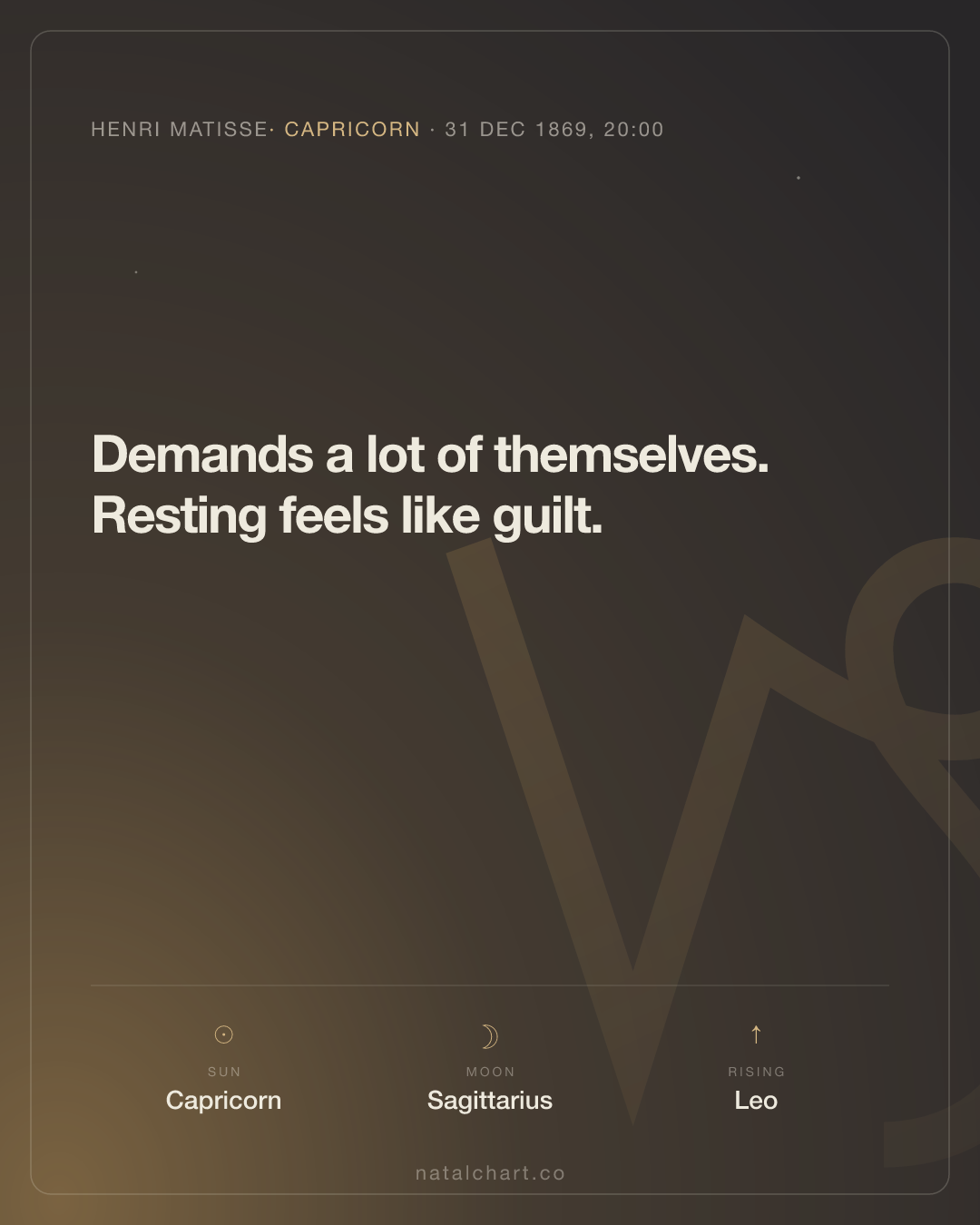
Henri Matisse's birth chart opens on a striking paradox: the Sun, Mercury, and Mars are all in Capricorn in the sixth house — the sector of work, craft, and daily labor — while his Ascendant falls in Leo, the sign most associated with display, radiance, and the theatrical gesture. The painter who declared that he wanted his art to be like a good armchair, a place of ease and pleasure for the weary viewer, was in fact a compulsive worker who remade canvases dozens of times, revised compositions obsessively, and continued producing major work into his late eighties, largely from his bed. The Leo face was genuine — he loved color, adored the south, had a showman's instinct for what would dazzle — but the Capricorn interior was equally real: the pleasure came only after the labor was done, and the labor was never quite done.
Capricorn Stellium in the Sixth House: Work as a Way of Being
When three planets occupy the same sign and house — as Sun, Mercury, and Mars do here in Capricorn and the sixth — that house's themes become almost the entire texture of daily life. The sixth house covers craft, service, health, and the routines that give a life its structure. Matisse's practice bore this out completely: he kept studio hours with near-monastic regularity, he insisted on drawing from the model even when his handling of color had grown entirely free, and in the last decade of his life, when his health failed and he could no longer stand at an easel, he developed his cut-paper technique — the Jazz series, the Vence chapel — rather than stop making. Capricorn adds the dimension of long-term mastery: this is not a placement that produces meteoric early fame, but one that builds on itself across decades. Matisse's most influential period began after fifty.
Leo Ascendant: The Theater of Light
The Ascendant — the face a person meets the world with — is Leo, and it shaped everything about how Matisse presented his art. He was a brilliant self-promoter by temperament, not by calculation: he loved beautiful spaces, dressed carefully, arranged his studios so that visitors would feel their impact as a total environment. The great flat canvases of his Nice period — the odalisques in patterned interiors, the windows opening onto light — have a frontal, declarative quality that is unmistakably Leo. They do not ask to be analyzed; they ask to be seen. Jupiter and Pluto are both in Taurus in the tenth house (the Midheaven, the public summit of the chart), directly above this Leo Ascendant, amplifying the sense of a career built on visible, lasting beauty.
Moon in Sagittarius: The Roving Emotional Compass
The Moon in Sagittarius in the fifth house — the house of creative play — points to an emotional life organized around movement, discovery, and the hunger to absorb new material. Matisse was restless in a specifically productive way: his trips to Morocco in 1912 and 1913 unlocked a new palette and a new relationship to light that transformed his approach to color for a decade. His interest in textiles, in Islamic art, in the patterns of North Africa was not academic; it was felt, almost physical — a Moon in Sagittarius collecting the world's surfaces and bringing them home. The Moon is also in close easy flow (sextile, 0.8°) with Venus in Aquarius in the seventh house: the emotional appetite and the aesthetic sense worked in alignment, feeding each other rather than competing.
Mercury in Capricorn: The Thinking Hand
Mercury in Capricorn thinks concretely, practically, and with a long view. It is not a placement given to philosophical abstraction for its own sake; it wants ideas that can be tested in the material world. Matisse was unusual among the great modernists in the degree to which he theorized his own practice publicly — his essays and interviews, especially "Notes of a Painter" (1908), show a Mercury that insisted on clarity about what it was doing. He did not mystify his process; he explained it, refined the explanation, and held himself accountable to his stated principles. The tension in Mercury's chart life comes from its nearly exact opposition to Uranus in Cancer in the twelfth house (orb 0.5°): the careful, methodical Capricorn craftsman was in permanent tension with a creative unconscious that kept producing formal surprises he hadn't planned.
Venus in Aquarius: Beauty Serves a Purpose
Venus in Aquarius in the seventh house does not chase conventional prettiness. It finds its aesthetic ideal in what is unexpected, structurally interesting, socially charged — beauty that argues for something. Matisse's Fauvism, which shocked Paris in 1905 with its raw, non-naturalistic color — the green stripe down the nose in Portrait with a Green Stripe — was the purest expression of this: a claim that color could carry emotional and formal weight independent of description. Venus in Aquarius tends toward a certain democratic quality as well; late in life, Matisse said he wanted to make something accessible to everyone, not just to specialists. The Vence chapel, which he designed in its entirety and considered his masterpiece, was built for an actual community of nuns.
Mars in Capricorn: Endurance as Strategy
Mars in Capricorn in the sixth house is one of the most effective placements for sustained, long-range professional effort. Mars here is not quick or flashy; it accumulates, endures, and outlasts. Matisse was a notoriously slow developer — he did not find his mature style until his late thirties, having spent his twenties in financial difficulty and his thirties in painful transition. Once he did find it, however, he kept building, without the crises of direction that undid so many of his contemporaries. At eighty, lying in bed with scissors and colored paper, he was still discovering new formal solutions. Mars in Capricorn simply does not stop.
Jupiter and Pluto in Taurus at the Midheaven: The Legacy Built to Last
The Midheaven (the career and vocation point, the chart's highest degree) falls in Taurus, and both Jupiter and Pluto are clustered there in the tenth house. Jupiter in Taurus enlarges whatever it touches through material form — beautiful objects, sensuous surfaces, the sheer physical pleasure of paint on canvas. Pluto at the same point suggests a transformative effect on the wider field: Matisse did not simply add to the art world, he changed what art was allowed to be. The Jupiter–Pluto conjunction in the tenth also describes an artist whose reputation has only grown with time: both planets in Taurus resist obsolescence, and Matisse's cut-outs, once considered merely the work of a bedridden invalid, are now recognized as among the most radical formal innovations of the twentieth century.
The Mercury–Uranus Opposition: Discipline and Rupture
The tightest aspect in the chart — Mercury opposing Uranus at 0.5° — is the axis that explains Matisse's career-long pattern of methodical work interrupted by sudden formal breakthroughs. Mercury in Capricorn sets the plan; Uranus in Cancer in the twelfth house breaks it open from within. The twelve houses in a chart describe the interior life, including what surfaces from below the threshold of conscious planning. His Fauvist period was triggered not by a theory but by two summers in Saint-Tropez and Collioure, painting with Signac and Derain, where the light simply overwhelmed his previous habits. The cut-paper technique emerged from illness, not intention. Both ruptures look, in retrospect, like Uranus: unexpected, liberating, impossible to plan for.
Chiron in Capricorn: The Wound that Built the Practice
Chiron — an asteroid associated with an old wound that eventually becomes the source of one's gift — falls in Capricorn in the sixth house, precisely atop the stellium that defines his working life. Matisse began his working life as a law clerk, paralyzed by an illness at twenty-one that confined him to bed during recovery. It was during that convalescence that his mother gave him a paint box; he began to paint and never stopped. The wound in the sixth house — illness interrupting work — became the originating impulse of the entire practice. Decades later, when arthritis and cancer again took away his ability to stand and paint in the conventional sense, the same pattern recurred: the wound generated the solution. The cut-outs are Chiron in Capricorn finding its final expression.
North Node in Cancer: Toward Intimacy and Rootedness
The North Node (the chart's growth direction, where the soul pushes toward) is in Cancer — the sign of home, tenderness, and belonging. Against the hardworking, ambitious, outward-facing Capricorn stellium, this node suggests that what most needed developing was precisely what Capricorn resists: softness, receptivity, the willingness to be nourished and to nourish. In Matisse's late work — the enormous tender interiors of the 1940s, the Vence chapel where he oversaw every detail from the stained glass to the priest's vestments — there is something genuinely domestic and protective, almost maternal. The work that came to define him was not the aggressive shock of Fauvism but the warmth of inhabited space.
A Portrait in Closing
Matisse's chart is a portrait of how rigor and pleasure are not opposites but partners. The Capricorn worker and the Leo presenter, the Mercury planner and the Uranus breaker, the Sagittarius wanderer and the Cancer nester — all these polarities found resolution in a practice that insisted, above all, on the serious business of joy. The cut-outs made in the last years of his life remain some of the most exuberant works in all of modern art, made by a man who could barely move, who refused to stop.
The chart
How to read it →Frequently asked questions
What is Henri Matisse's zodiac sign?
Henri Matisse's Sun sign is Capricorn — the Sun was in Capricorn at birth (1869).
What is Henri Matisse's moon sign?
Henri Matisse has the Moon in Sagittarius. The Moon sign describes the emotional and instinctive layer of the chart.
What is Henri Matisse's rising sign?
Henri Matisse's rising sign (ascendant) is Leo — the sign on the eastern horizon at the moment of birth.
When and where was Henri Matisse born?
Henri Matisse was born in 1869 in Le Cateau-Cambrésis, France.