Juan Manuel Fangio — natal chart
What does Juan Manuel Fangio’s natal chart reveal?
Juan Manuel Fangio, born on June 24, 1911, in Balcarce, Argentina, was a racing driver who won the Formula 1 World Drivers' Championship five times, in 1951 and from 1954 to 1957, a record that stood for forty-six years. He competed for four different constructors—Alfa Romeo, Mercedes-Benz, Ferrari, and Maserati—winning championships with all four, a feat never repeated. During his F1 career he won 24 of the 52 races he entered, achieving a winning percentage of 46.15%. His driving style was known for its precision and economy of movement. Fangio retired from racing in 1958 and died in Buenos Aires on July 17, 1995.
 Share
Share
Birth
1911-06-24 · 00:10 · Balcarce, Argentina Reliability: A · reliable data
The Portrait
Juan Manuel Fangio won the Formula 1 World Drivers' Championship five times, for four different constructors — Alfa Romeo, Mercedes-Benz, Ferrari, Maserati — a feat nobody has repeated. He won nearly half the races he entered. His driving style was described by rivals and engineers alike as almost unnaturally precise: no wasted movement, no showboating, just the shortest, cleanest line from start to finish. That quality — disciplined effectiveness in conditions of extreme pressure, the ability to do exactly what needs to be done and nothing more — runs as a clear thread through his natal chart.
The Core: Sun in Cancer, Ascendant in Aries
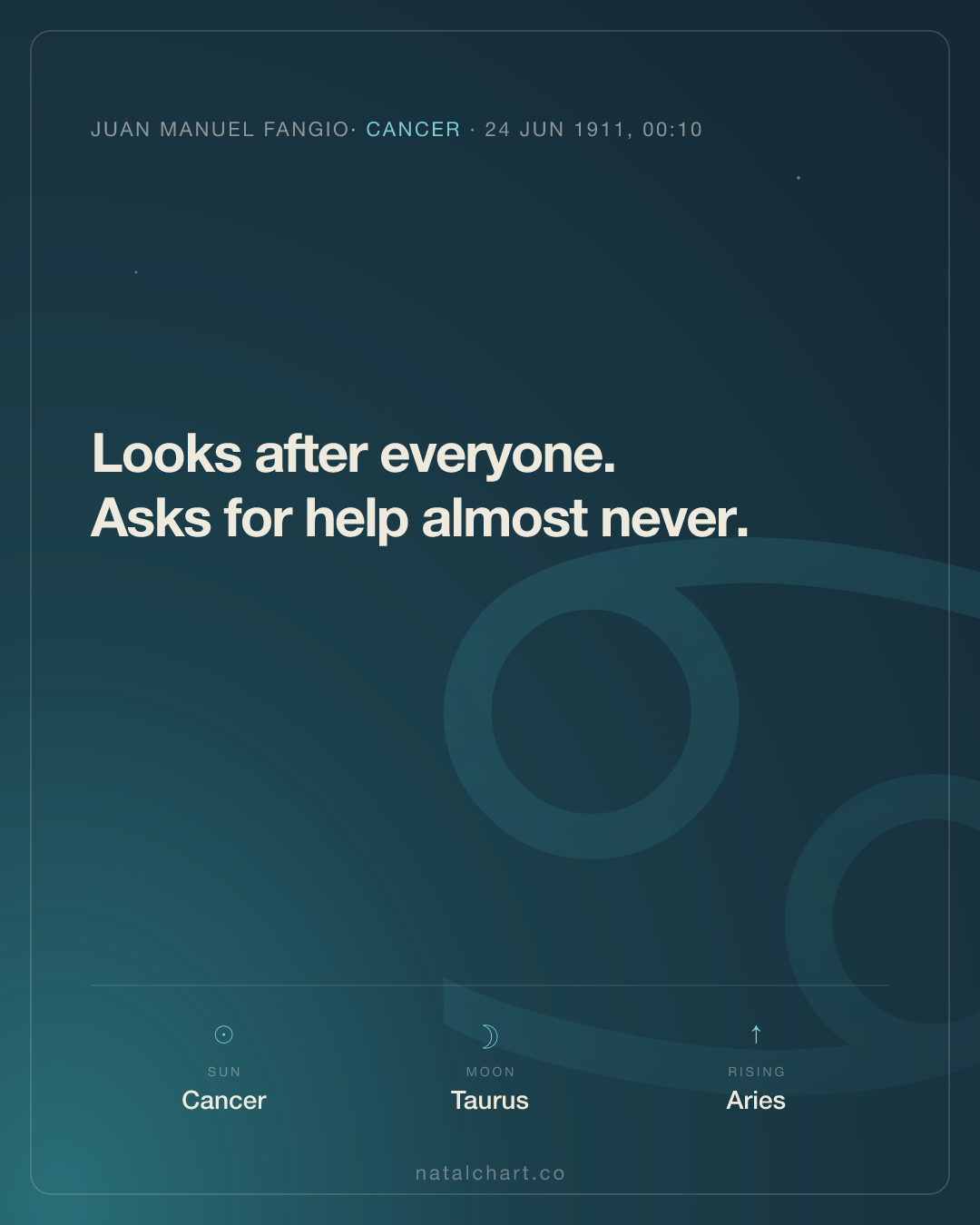
Fangio was born at the very first minutes of the day with an Ascendant in Aries (the Ascendant is the sign rising on the eastern horizon at birth — it describes the face a person meets the world with, their first instinct in any situation). Aries rising is immediate, instinct-driven, and self-reliant. In a racing car, that quality is not optional: the driver who hesitates at 250 km/h loses. Fangio's reflexes and directness were legendary; teammates and opponents described him as someone who simply did not seem rattled.
The Sun — the central organising principle of a chart — is in Cancer in the fourth house. Cancer is an interior sign, more private than its public behaviour would suggest: it runs on feeling and intuition, and it is anchored by loyalty and memory. Fangio grew up in Balcarce, a small town in the Argentine pampas, the son of Italian immigrants. He returned there throughout his life, stayed close to his roots and the people he started with, and retired there. The Cancer Sun describes a man whose ambition was never abstracted from where he came from — not a restless wanderer but someone whose drive to excel was always paired with a pull back to home.
The Emotional Life: Moon in Taurus
The Moon (the planet that describes the emotional interior, what a person needs to feel steady) is in Taurus in the second house. Taurus is steady, patient, and physical — it endures, and it does not hurry. In the second house, that Moon connects the emotional life directly to material security and to the value of what one has actually built. Fangio began racing with very limited resources in Argentina, running long-distance road races through the late 1940s before making it to Europe and Formula 1. That Taurus Moon describes the patience that sustained a decade of working his way up through difficult conditions before the championship years arrived. The Moon forms a very easy flow with Uranus in Capricorn (gap of only 0.5°), which — as discussed below — speaks to the steadiness that allowed him to thrive precisely when conditions turned unpredictable.
Love and Values: Venus in Leo
Venus (values, aesthetics, the way a person relates to what they love) is in Leo in the fifth house — the house of creative expression, pleasure, and the joy of doing something well for its own sake. Venus in Leo takes genuine pride in craftsmanship; it wants to do things with a kind of flair that is recognisable as distinctly one's own. In Fangio, this shows in the aesthetic dimension of his driving: even people who had no interest in motorsport could see that something exceptional was happening when he was at the wheel. His victories were not grinding attrition wins; they had a quality of elegance. Venus here is in tension with Saturn in Taurus (gap of only 0.2° — the tightest aspect in the chart): what Venus wants to do with style, Saturn demands be earned through effort and proved through consistency. That friction is one of the engines of sustained excellence. The flamboyance never became indulgence because the discipline kept it honest.
Mercury and Venus flow easily together (gap of 3.5°), placing the mind and the values in natural alignment: the way Fangio thought about racing reflected the same values as the way he raced.
The Mind: Mercury in Gemini
Mercury (the mind, the way a person processes information and communicates) is in Gemini in the third house — quick, adaptive, at home with complexity, reading multiple signals at once. In a racing car this is exactly what is needed: the driver is integrating information from the road surface, the car's behaviour, the tyre state, the positions of other cars, and the team's signals simultaneously, all at high speed. Fangio's famous ability to read a race as it developed — to know when to push and when to conserve, when to make the move — was repeatedly described as almost intuitive. Mercury in Gemini in the third house names that capacity in the chart: a mind that is not fazed by fast-moving, multi-variable situations.
Mars and Drive: Aries in the First House
Mars (energy, drive, the appetite for action) is in Aries in the first house. This is as direct an expression of physical courage and competitive instinct as a chart can offer: Mars rules Aries, and the first house is the house of the self, the body, the immediate presence. It describes raw physical confidence — not recklessness, because Mars in Aries is also intelligent about risk, but a genuine ease with high-stakes situations that most people would find overwhelmingly stressful. Combined with the Aries Ascendant, this double Aries emphasis at the chart's most personal point paints a portrait of someone whose first instinct was always to go — to act, to compete, to be in the middle of things rather than watching from the side.
Mars flows easily with Venus in Leo (gap of 1.2°): the competitive drive and the love of craft were not in conflict in Fangio. Winning and driving beautifully were the same thing.
Jupiter and Saturn: The Architecture of a Long Career
Jupiter (the planet of expansion, opportunity, and good fortune) is in Scorpio in the eighth house. The eighth house is associated with depth, transformation, and the kind of tests that reveal what a person is actually made of. Fangio's career had more than its share of severity: he was already 39 years old when he won his first championship in 1951, started late by any measure, and drove through an era when racing was genuinely dangerous and the loss of fellow drivers was a regular reality. Jupiter in the eighth house describes the capacity to find opportunity in situations others experience as terminal — to go deeper rather than retreat when conditions are at their hardest. He was kidnapped by Cuban revolutionaries in 1958 just before the Cuban Grand Prix and released unharmed, an incident he later recalled with surprising equanimity. That quality of navigating extremity without losing composure is this Jupiter.
The Sun is in easy flow with Jupiter (gap of 3.2°): the core identity and the capacity for growth reinforced each other. Fangio was not someone whose success hollowed him out; he seemed to become more himself as his career progressed.
Saturn in Taurus in the second house places the planet of discipline and long-term structure directly alongside the Moon, reinforcing that quality of patience and steadiness in building something real. The tension between Venus and Saturn (discussed above) keeps the whole system honest.
The Outer Planets: Uranus and Neptune
Uranus (the planet associated with sudden change, the unexpected, and the ability to respond to it) is in Capricorn in the tenth house — the house of public reputation, career, and the mark left on the world. Uranus here describes a career whose public shape was repeatedly defined by moments of dramatic adaptation. The Moon and Uranus flow together (gap of 0.5°), the tightest of the easy aspects in the chart: the emotional stability and the responsiveness to sudden change worked as a unit. The 1957 German Grand Prix at the Nürburgring is perhaps the most cited example — Fangio stopped for an unplanned tyre and fuel change and then drove the final laps at a pace that seemed impossible, overtaking the two cars ahead of him with a lap to spare and setting the fastest lap of the race. The ability to reset completely after a setback and then exceed what anyone thought possible is Uranus in Capricorn, Moon-supported.
Neptune in Cancer in the fourth house joins the Sun in the same sector, adding a quality of intuition and attunement — the sense of feeling the car rather than simply thinking it — that went alongside the technical precision described elsewhere.
The Career Point: Midheaven in Capricorn
The Midheaven (the highest point of the chart; the public calling, the direction of a life's work in the world) is in Capricorn. Capricorn is the sign of mastery achieved through sustained effort, of authority that comes from time and proven competence, of the kind of respect that cannot be hurried. Fangio's career is the portrait of exactly that: slow-burning, late-blooming, absolutely undeviating. He did not win early and burn out; he built, competed, and arrived at a level of mastery that stood as a record for forty-six years. Uranus in the tenth house, as described above, adds the dimension of historic disruption — someone whose career did not merely reflect the standards of their era but changed them.
Chiron: The Old Wound
Chiron (a point in the chart associated with a recurring wound that, when worked with honestly, becomes a particular kind of competence) is in Pisces in the twelfth house — the most withdrawn sector of the chart, the house of what operates below the surface and outside ordinary visibility. Fangio lost a close friend and co-driver, Daniel Urrutia, in a road race accident in Argentina in 1948 before his European career began. He carried the weight of those losses throughout his racing years — an era when fatalities among fellow drivers were not rare. Chiron in the twelfth house in Pisces describes a grief that does not loudly announce itself, one that is processed internally rather than performed. What it appears to have produced in Fangio was not recklessness — the opposite: an extraordinary care, a technical discipline that took nothing for granted, and a quality of appreciation for what he was doing that seemed to deepen rather than fade with success.
The Sun Joined with Pluto
The Sun is close to Pluto in Gemini (gap of 4.0° — just within orb). Pluto describes the capacity for deep transformation and for the kind of effort that does not stop at surface results. Joined to the Sun, it gives the core identity a quality of intensity and thoroughness that is not always visible from the outside but is consistent underneath: the willingness to go all the way in, to not leave anything unexplored. Combined with Mars in Aries in the first house and Jupiter in Scorpio in the eighth, this is a chart that describes a person for whom depth of engagement is not optional. Fangio did not race for recreation or celebrity. He raced because the complete commitment demanded was, for him, the point.
A Closing Note
A chart with an Aries Ascendant and Mars in the first house, a Cancer Sun paired with a Taurus Moon, a tight Venus–Saturn tension kept honest by a Mars–Venus ease, and a Capricorn Midheaven describes someone who acts from instinct but builds for duration, who competes with style but proves it through consistency, and who is, underneath the public precision, more private and more feeling than the performance of mastery tends to reveal. The forty-six years that Fangio's five championships stood as a record are not a curiosity of a less competitive era — they are the measure of a character that combined things rarely found together: the Aries instinct to go and the Cancer root to come back from, the Taurus patience to wait for the right moment and the Pluto will to seize it completely.
The chart
How to read it →Frequently asked questions
What is Juan Manuel Fangio's zodiac sign?
Juan Manuel Fangio's Sun sign is Cancer — the Sun was in Cancer at birth (1911).
What is Juan Manuel Fangio's moon sign?
Juan Manuel Fangio has the Moon in Taurus. The Moon sign describes the emotional and instinctive layer of the chart.
What is Juan Manuel Fangio's rising sign?
Juan Manuel Fangio's rising sign (ascendant) is Aries — the sign on the eastern horizon at the moment of birth.
When and where was Juan Manuel Fangio born?
Juan Manuel Fangio was born in 1911 in Balcarce, Argentina.