Justin Timberlake — natal chart
What does Justin Timberlake’s natal chart reveal?
Justin Timberlake (born 1981) is an American singer, songwriter and actor. Rising to fame with the boy band NSYNC, he launched an acclaimed solo career with albums such as Justified and FutureSex/LoveSounds, earning multiple Grammy Awards while also building a parallel film career.
 Share
Share
Birth
1981-01-31 · 18:30 · Memphis, Tennessee, United States Reliability: AA · vetted record
The core: an Aquarian with Leo written all over him
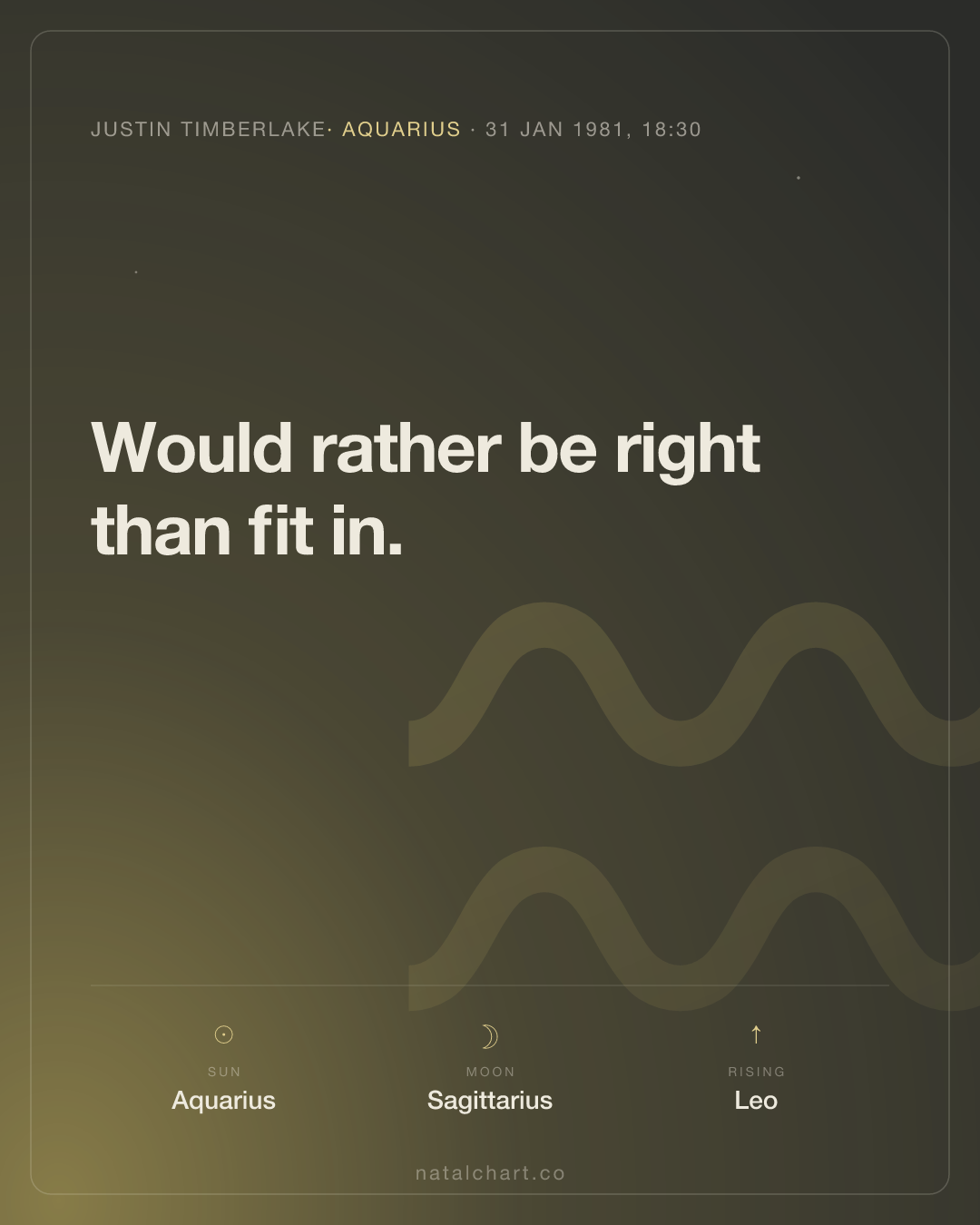
There is an immediate paradox at the centre of Justin Timberlake's chart — and it maps precisely onto the contradiction that has defined his career. The Sun sits in Aquarius in the seventh house, pointing toward someone who thinks in collective terms, who wants to dissolve the boundary between self and audience, who is genuinely interested in what makes culture move. But the Ascendant — the face he meets the world with — is Leo. And Leo rising is impossible to miss: there is a natural magnetism, a quality of command in the room, a performer's presence that arrives before he does. The two are not at war; they create a useful tension. The Aquarian mind gives him the distance to observe popular culture and manoeuvre within it; the Leo Ascendant gives him the warmth and theatricality to own a stage.
His rise from boy-band member to genre-shifting solo artist — from NSYNC teen idol to the mature voice behind FutureSex/LoveSounds — is exactly this dynamic in motion: the Aquarian cool recalibrating, the Leo performer demanding the spotlight back.
The Moon: where feeling lives
The Moon in Sagittarius in the fifth house — conjunct Neptune, and the two inseparable — is one of the defining placements of this chart. The Moon describes the emotional interior, the register a person lives in privately. In Sagittarius it needs movement, breadth, creative restlessness; it is bored by the familiar and energised by the new. In the fifth house, the house of creative expression and performance, this restlessness has a natural outlet: making things, performing them, collaborating with people who push the work forward.
The Moon joined to Neptune (the two almost exactly together) blurs the line between personal feeling and imagination in a way that is both a gift and a source of confusion. Neptunian emotion does not always follow clear logic; it tends toward absorption, toward inhabiting a role or a sound completely. The emotional intelligence that makes Mirrors or Cry Me a River land with such precision — the sense that the emotion is real, not performed — comes from exactly this Moon-Neptune signature. It also means the inner life is rich, impressionable, and sometimes difficult to pin down even from the inside.
Mercury: where the mind surprises
Mercury in Pisces in the eighth house — in tension with Uranus, the two pulling against each other — describes a mind that does not work in straight lines. Pisces Mercury absorbs information through feeling and atmosphere rather than through analysis; it makes intuitive leaps that are sometimes brilliant and sometimes impossible to explain after the fact. The eighth house adds depth and a pull toward what is hidden — toward the subtext in a lyric, the psychological undercurrent in a song.
The tension with Uranus brings sudden flashes of originality that can feel disruptive even to the person having them. In practice, this combination has shown up in Timberlake's willingness to make unexpected choices: the sonic restlessness of Justified, the funk deconstruction of FutureSex/LoveSounds, the reach toward Americana in Man of the Woods. The ideas come from somewhere oblique; the challenge has always been trusting them long enough to see them through.
Venus: the work of discipline
Venus in Capricorn in the sixth house is one of the quieter but more telling placements in this chart. Venus in Capricorn places value on craft, on long-term structure, on the kind of quality that accumulates through consistent effort rather than inspiration. The sixth house is the house of daily work — of practice, of the unglamorous part of a creative career. This placement describes someone for whom the rehearsal, the production process, the precision of the recorded performance, matter at least as much as the feeling of the moment.
This is the Venus behind the long studio sessions, the choreography that looks effortless because it has been worked to exhaustion, the collaborations with producers where the brief was to get it exactly right rather than fast. It is not a glamorous placement — but it is the one that separates talent from durability.
Mars and the Sun: built for the stage and for others
Mars in Aquarius in the seventh house sits alongside the Sun, and the two amplify the same theme: this is someone whose drive activates most powerfully in relationship to others. The seventh house is the house of significant partnership — creative collaborators, the audience as an entity, the public dynamic. Mars here means the competitive and creative instincts are sharpest when there is someone on the other side — a collaborator to push against, a crowd to convince, a cultural moment to respond to.
Mars in easy flow with Pluto and with the Moon adds depth and staying power to that drive: this is not surface-level ambition but something more persistent, capable of regenerating after setbacks. The early career pressure of competing with NSYNC bandmates, the re-emergence after years of mixed critical reception, the willingness to pivot genres — these are Plutonian qualities, the drive to go underneath and come back transformed.
Jupiter and Saturn: the third house, words and ideas
Jupiter and Saturn both in Libra in the third house — the house of communication, language, and short-form ideas — with the two almost exactly together, is a significant configuration. Jupiter in Libra brings a natural feel for what is balanced and aesthetically pleasing; it favours elegant expression, collaboration, charm in communication. Saturn in the same position demands that the charm be earned — that the work backing the expression be solid.
In the third house, this pairing describes someone who takes the craft of the lyric seriously, who is not satisfied with a line that almost works, and who has the patience to revise until it does. The prolific nature of Timberlake's songwriting credits — including work he has produced for other artists — reflects this combination: an expansive creative appetite held honest by structural discipline.
The Midheaven in Taurus: what he is known for
The Midheaven — the career and public reputation point of the chart — is in Taurus. Taurus at the Midheaven describes a public identity built around tangible, lasting work: things that can be held, replayed, and kept. Where Aquarius often points toward the ephemeral or experimental, Taurus roots the career in the sensory and the enduring — in the hook that persists, the production that still sounds good fifteen years later, the album that earns its place on a shelf.
Chiron — the old wound, the place where something tender was exposed early — sits right at the Midheaven, in Taurus, in the tenth house. Chiron at the career point suggests that the public dimension of his life has been the arena where the most formative vulnerability was played out. Early-career scrutiny, the loss of control over the NSYNC narrative, the years of critical doubt about whether he was more image than substance — these were not just professional setbacks; they pressed on something real. The gift Chiron eventually offers is hard-won authority: the credibility that comes from having been challenged publicly, having been found wanting by some, and having continued anyway.
Outer planets and the generational signature
Uranus in Scorpio in the fourth house belongs to a generational cohort born in the early 1980s. In the fourth house — the house of foundation, roots, private life — it describes a domestic or early-life environment that had qualities of instability or disruption, an upbringing that required adaptability. It does not specify how; it suggests the capacity to rebuild from an unstable foundation became part of the emotional toolkit.
Neptune in Sagittarius in the fifth house, joined to the Moon as noted above, and Pluto in Libra in the third house (generation of those born to challenge how culture communicates and frames beauty) round out the outer-planet picture. These are shared generational signatures; what is personal is how they are focused through the tighter, faster planets.
The North Node in Leo: growing into the spotlight
The North Node — understood as the direction of meaningful growth, the developmental frontier — is in Leo, and it sits with the Ascendant. In Leo, the Node points toward full, unguarded self-expression: toward performing not as an exercise in meeting expectation but as an act of genuine presence. The Leo North Node in someone who has spent a career navigating the tension between collective pop-culture positioning (Aquarian Sun) and individual artistic ambition suggests that the most fruitful path runs through full commitment to the personal, idiosyncratic, unedited self — not the brand, not the calculated reinvention, but the actual person.
This is often the tension in his most discussed work: the albums where he let the production be strange, where the emotional register was less controlled, land differently than the ones where the craftsmanship is impeccable but the risk feels managed.
The tightest aspects: where the energies concentrate
The Moon and Neptune joined together, almost exactly, with both also closely connected to Mars and Pluto — this cluster in the fifth house is the emotional and creative core of the chart. It generates the capacity for deep imaginative absorption that marks his best work, alongside the sensitivity to atmosphere and emotional nuance that makes his performances register beyond the technical.
Mercury in tension with Uranus keeps the mind alert and slightly ahead of itself: ideas arrive in bursts, not sequences. Jupiter and Saturn joined together in the third house anchors the communication instinct in a tension between expansion and precision — the impulse to reach wider held in check by a standards-driven internal editor.
What the chart holds together
Justin Timberlake's chart describes someone in a sustained negotiation between two real forces: the desire to dissolve into the collective, to be the sound of a moment, and the need to be seen as a distinct person with a particular artistic point of view. The Leo Ascendant and Leo North Node pull toward full self-expression; the Aquarian Sun and Aquarian Mars pull toward the group, toward cultural service, toward being a conductor of something larger than one individual.
The chart does not resolve this tension — it provides the creative fuel for it. The most interesting moments in his discography are the ones where neither force won cleanly, where the pop instinct and the stranger idea were both present at once. That friction, the slight discomfort of the in-between, is where the most durable work has lived.
The chart
How to read it →Frequently asked questions
What is Justin Timberlake's zodiac sign?
Justin Timberlake's Sun sign is Aquarius — the Sun was in Aquarius at birth (1981).
What is Justin Timberlake's moon sign?
Justin Timberlake has the Moon in Sagittarius. The Moon sign describes the emotional and instinctive layer of the chart.
What is Justin Timberlake's rising sign?
Justin Timberlake's rising sign (ascendant) is Leo — the sign on the eastern horizon at the moment of birth.
When and where was Justin Timberlake born?
Justin Timberlake was born in 1981 in Memphis, Tennessee, United States.