Louis Pasteur — natal chart
What does Louis Pasteur’s natal chart reveal?
Louis Pasteur (1822-1895) was a French chemist and microbiologist born in Dole, a founder of microbiology. He developed pasteurization and vaccines for rabies and anthrax, and his germ theory of disease transformed medicine and public health. The Pasteur Institute carries his name.
 Share
Share
Birth
1822-12-27 · 02:00 · Dole, France Reliability: AA · vetted record
The Core
The dominant note in Louis Pasteur's chart is unmistakable: six planets gathered in Capricorn, all sitting in the fourth house (the area governing private foundations, early roots, and the inner life). Capricorn is the sign of methodical building — patient, disciplined, unwilling to accept anything on trust. When that concentration falls in the house of private foundations, what looks like a public career is in fact driven by an almost domestic compulsion: the need to make things solid, verifiable, safe. Pasteur did not chase fame; he built certainties, one painstaking experiment at a time, as if the integrity of the world depended on the rigor of his methods.
The Ascendant — the face one meets the world with — is Libra, a sign of balance, proportion, and the desire to be fair. Visitors to Pasteur's laboratory described a man who listened carefully, weighed evidence scrupulously, and was willing to change his mind when the data demanded it. The Libra rising softened the Capricorn severity into something approachable, even collegial — until someone challenged a finding he had proved rigorously, at which point the Capricorn core reasserted itself with force.
Sun Joined to Neptune
The most striking feature of the chart is the Sun sitting virtually on top of Neptune — an overlap so tight it approaches zero degrees. The Sun describes who a person fundamentally is; Neptune dissolves the boundaries between self and something larger, giving an instinct for the invisible, the microscopic, the world below direct perception. For a nineteenth-century scientist, this combination is remarkable. Pasteur built his entire career on things no one could see with the naked eye: bacteria, fermentation organisms, attenuated viruses. The germ theory of disease was, in its moment, almost incomprehensible — the idea that invisible creatures were causing suffering and death ran against everything educated people believed. The Sun-Neptune conjunction gave Pasteur both the sensitivity to intuit the unseen world and the Capricorn steel to prove it empirically.
This same conjunction shapes his relationship to his own image. Neptune blurs and diffuses; Pasteur's personal life remained largely private, his deepest grief — the death of three of his five children to typhoid — rarely surfacing in public. The pain was folded inward, fuel for work that might save others from the same loss.
The Moon: A Mind Always Moving
The Moon sits in Gemini in the ninth house (the area of knowledge, inquiry, and long-range understanding). Gemini's Moon is restless and insatiably curious — it processes the world through language, comparison, and the urge to connect disparate facts. In the ninth house, that curiosity turns toward large questions: not just how things work, but what they mean. Pasteur's scientific correspondence was famously voluminous; he wrote constantly, connecting findings across chemistry, biology, and medicine in letters to colleagues across Europe. His Moon made him a communicator as much as a discoverer — the germ theory required not only experiments but arguments, publications, and public demonstrations, and he pursued all of them with equal intensity.
Chiron — an old wound that becomes a lifelong gift — sits alongside the Moon in this same zone, also in Gemini, ninth house. The wound attached to communication and wide-ranging inquiry had its echo in Pasteur's life: he suffered a severe stroke at 46 that partially paralyzed him. He had to continue his research dictating to assistants, unable to handle equipment himself. The limitation became its own form of teaching — learning to transmit knowledge through others, to articulate findings with clarity, to trust collaborators with the work his own hands could no longer carry out.
Venus and the Inner Life
Venus in Capricorn, joined to both the Sun and Neptune, describes a person whose affections are serious, long-term, and held with great privacy. There was nothing casual about Pasteur's emotional life. He married Marie Laurent in 1849 and the union lasted forty-six years until his death; she was his collaborator in correspondence and his shield against the world. Capricorn Venus does not scatter warmth widely — it concentrates it on those few it has chosen and holds them with a quiet, steady constancy.
The Neptune layer on this Venus adds a dimension of idealism — a love that reaches toward something beyond the ordinary. Pasteur's dedication to science had the quality of a vocation, and his love for his wife and children carried the same depth. When those children died, the grief was vast and unspoken. The Venus-Neptune conjunction does not mourn publicly; it absorbs the loss and redirects it — in Pasteur's case, into the very research that would one day make typhoid preventable.
Mercury and Mars: The Precision and the Drive
Mercury in Capricorn is the mind of an engineer: structured, skeptical, demanding proof before accepting a claim. It builds arguments the way Capricorn builds structures — from the foundation up, with no shortcuts. Pasteur's experimental protocols were legendary for their rigor; he designed controls, reproduced results, and refused to publish until he was certain. Mercury pulling against Pluto (Pluto in Pisces, sixth house — the area of health, daily labor, and service) adds intensity and an almost compulsive desire to get to the bottom of things. That friction drove Pasteur into the uncomfortable corners of biology where accepted views dissolved under scrutiny.
Mars in Capricorn is determined, strategic, and very hard to stop once committed to a direction. It is not the Mars of quick explosions; it is the Mars that stays up late, returns the next morning, and does not declare defeat. The rabies vaccine trials of 1885 — testing an unproven treatment on a nine-year-old boy who had been bitten fourteen times — took a particular kind of controlled courage that Mars in Capricorn describes exactly: calculated, deliberate, clear-eyed about the risk, and committed to the outcome.
Jupiter, Saturn, and the Architecture of Endurance
Jupiter and Saturn both sit in Taurus in the eighth house (the area of transformation, what persists after death, and other people's resources). Taurus deals in the material and the durable; the eighth house deals in what outlasts a single life. Jupiter here expands the reach of what one leaves behind; Saturn consolidates and structures it. The Pasteur Institute, founded in 1887 during his lifetime and still operating today, is a precise expression of this placement: a material institution (Taurus) built to carry work beyond his own death (eighth house), organized for permanence (Saturn), and eventually growing into an international network (Jupiter).
Saturno in Taurus is also a planet of patience with physical limits. Pasteur worked after his stroke for another twenty-seven years, building from a body that no longer served him as it once had. That eighth-house Saturn does not yield to physical limitation; it reorganizes around it, steadily and without complaint.
The Outer Planets and the Invisible World
Uranus in Capricorn, placed alongside the rest of the Capricorn cluster, brought a streak of radical disruption to the methodical Capricorn project. Pasteur's germ theory was not an incremental adjustment — it was a rupture with everything that had come before. Uranus breaks what is established; in Capricorn, in the fourth house, the disruption came from within the most fundamental structures, from the inside of the laboratory rather than from any public revolt. The scientific establishment resisted him fiercely, and he challenged it from the inside with data alone.
Pluto in Pisces in the sixth house is a quiet but relentless signature for transformation through daily service, particularly in health and the body. The sixth house governs health and methodical labor; Pisces dissolves barriers; Pluto transforms irreversibly. The combination captures the arc of a life spent in laboratories working on disease prevention — transforming, slowly and completely, what it meant to be ill in the modern world.
The Midheaven: A Public Stage Built for Leo
The Midheaven — the public face, the career summit — is in Leo. Leo seeks to be recognized, to leave a mark, to shine. The Midheaven describes not what one privately wants but how the world eventually comes to see the work. Pasteur became one of the most celebrated scientists of his century; the name became a verb (to pasteurize), a monument (the Pasteur Institute), a standard (Pasteurian rigor). Leo on the Midheaven is not vanity; in Pasteur's case it is the legitimate recognition that accrued to decades of methodical, disruptive, world-changing work.
The private Capricorn stellium — concentrated in the fourth house, the house of roots — powers this Leo Midheaven from a hidden place. The public figure was built on foundations that were almost entirely inward: discipline, grief, obsession, and a refusal to leave anything unproven.
The North Node and the Direction of Growth
The North Node — astrology's marker for the direction in which growth is called — sits in Aquarius. Aquarius governs the collective, the humanitarian, the long view across community rather than individual achievement. Pasteur's individual Capricorn concentration could have settled into private distinction; the Aquarian node kept pulling the work toward its larger application: public health systems, vaccination campaigns, sanitary reform. The discoveries were personal achievements made by a private, driven man; their meaning was entirely collective. Pasteur himself seemed to understand this — his later lectures and public communications were addressed to humanity, not to specialists.
A Life in the Evidence
Pasteur died in 1895, partially paralyzed, surrounded by collaborators, having lived long enough to see the germ theory become the foundation of modern medicine. The chart describes a man who found his purpose in the invisible — the Sun dissolved into Neptune at birth, drawn to the world no one could yet see — and who anchored that intuition in the most rigorous Capricorn discipline available to him. The Libra Ascendant kept him fair and open; the Gemini Moon kept him curious and communicating; the Leo Midheaven gave the work a stage it richly earned.
What endures about Pasteur is exactly what the eighth-house Taurus planets promised: material permanence, institutions that outlast the person. The pasteurization process runs in every dairy on earth. The Pasteur Institute still produces vaccines. The name that became a verb is still in daily use. A chart concentrated so heavily in Capricorn — hidden, foundational, private — left an imprint that is entirely impossible to overlook.
The chart
How to read it →Frequently asked questions
What is Louis Pasteur's zodiac sign?
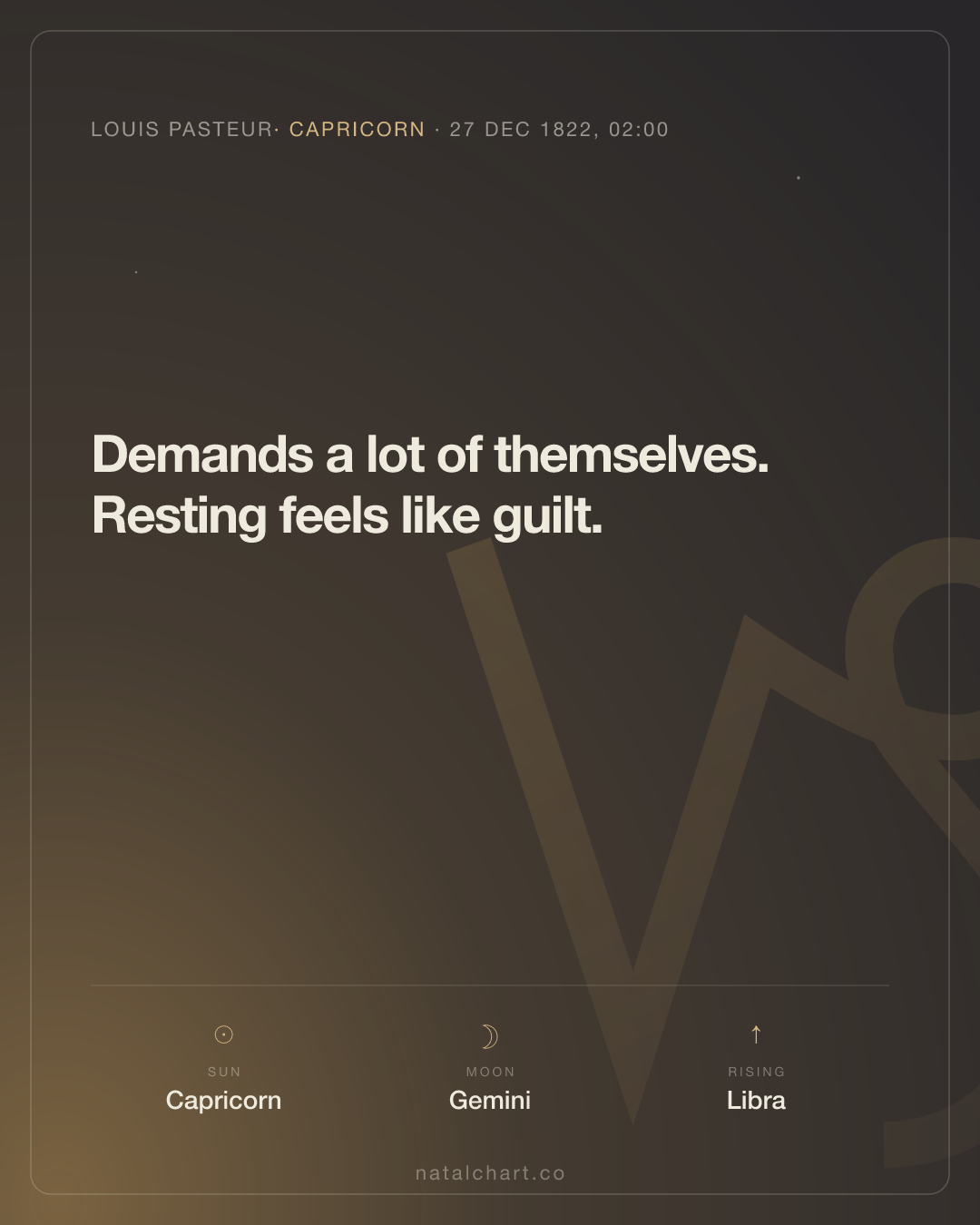
Louis Pasteur's Sun sign is Capricorn — the Sun was in Capricorn at birth (1822).
What is Louis Pasteur's moon sign?
Louis Pasteur has the Moon in Gemini. The Moon sign describes the emotional and instinctive layer of the chart.
What is Louis Pasteur's rising sign?
Louis Pasteur's rising sign (ascendant) is Libra — the sign on the eastern horizon at the moment of birth.
When and where was Louis Pasteur born?
Louis Pasteur was born in 1822 in Dole, France.