Marcel Proust — natal chart
What does Marcel Proust’s natal chart reveal?
Marcel Proust (1871-1922) was a French novelist and essayist best known for In Search of Lost Time, a monumental seven-volume work exploring memory, time, and society. His introspective style and concept of involuntary memory made him one of the most influential authors of modern literature.
 Share
Share
Birth
1871-07-10 · 23:30 · Paris, France Reliability: AA · vetted record
A Mind Built for Remembrance
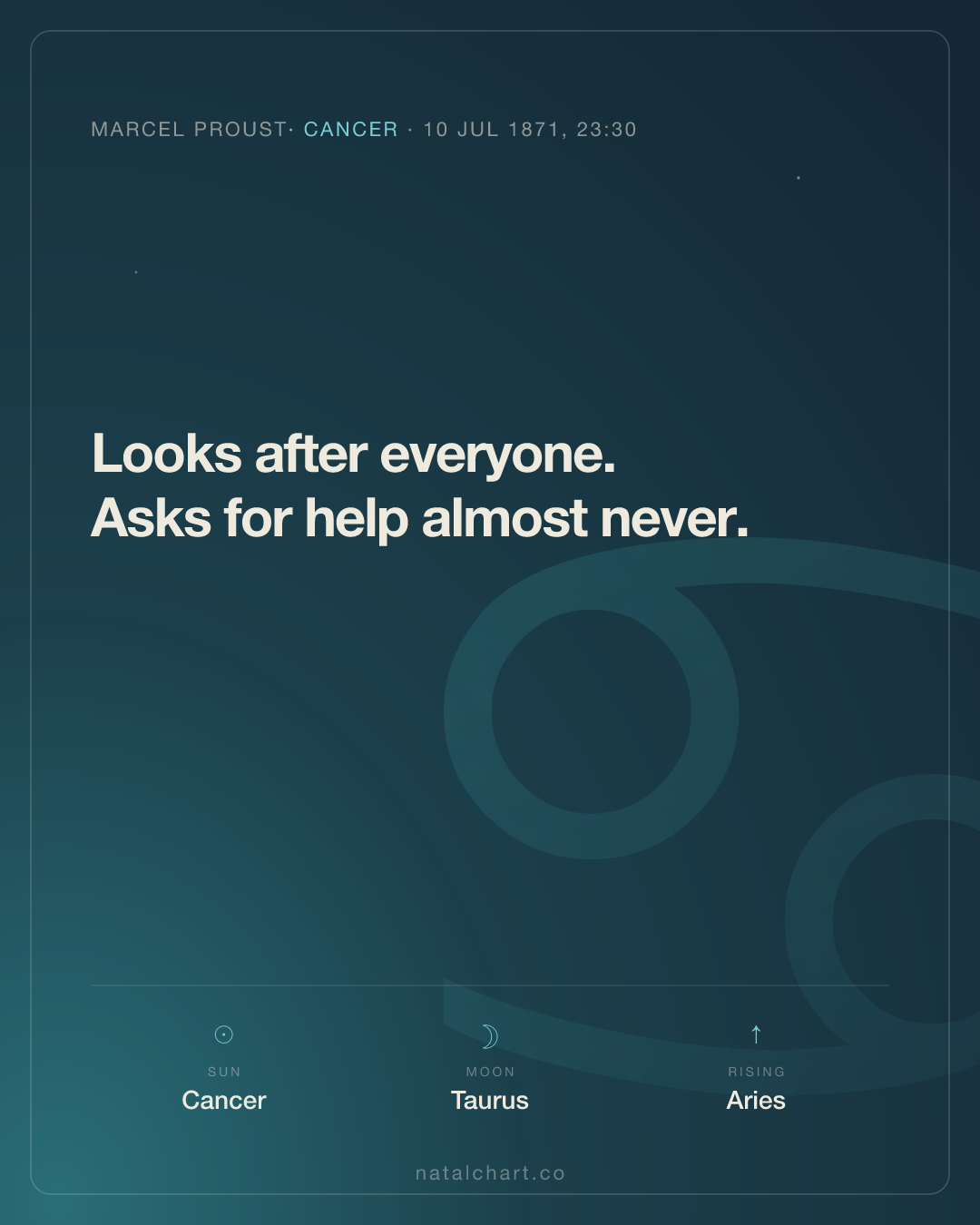
Marcel Proust was born on 10 July 1871 at half past eleven at night, with the Sun in Cancer in the fourth house — one of the most precise alignments of person and chart one could imagine. The fourth house is the domain of interior life, family memory, and everything that took root in childhood; Cancer is the sign that holds the past with extraordinary care, that circles back to first impressions and tastes them again. Proust built his entire literary life around that exact instinct. In Search of Lost Time — all seven volumes, over a million and a quarter words — is fundamentally an act of fourth-house Cancer: the retrieval of time past through the interior world, layer by layer, sensation by sensation. The Aries Ascendant (the sign rising on the eastern horizon at birth, the face one shows the world) adds an arrow of directness and urgency to that brooding interior. Proust was not shy; he was socially omnivorous. He moved through the salons of Paris with a Martian boldness while simultaneously cataloguing everything in the private archive of his Cancer Sun.
The Moon in Taurus: Pleasure as Foundation
The Moon in Taurus in the second house describes an emotional life anchored in the physical and the sensory. The second house is the domain of what one owns, what one values, what nourishes; Taurus insists on pleasure taken slowly, texture felt carefully, taste remembered precisely. The famous madeleine dipped in lime-blossom tea — the involuntary memory at the heart of In Search of Lost Time — is an almost perfect symbol for this placement. The taste of a small sponge cake does not merely recall a memory; it reconstitutes an entire lost world through sensory experience. That is exactly what Moon in Taurus in the second house does: it banks pleasures and holds them, without diminishment, until they are needed. The Moon formed an easy flow with both Venus in Virgo and Saturn in Capricorn (within 0.7 and 1.4 degrees respectively), creating a rare coherence between emotion, aesthetic judgment, and structural discipline. Proust did not merely feel; he analysed what he felt, then built it into architecture.
Mercury: The Fused Instrument
Mercury in Cancer was joined to the Sun within 0.6 of a degree — a tight, almost seamless fusion of identity and expression. When thought and self are this close, the writing voice and the person become indistinguishable. Proust's prose does exactly that: the narrator of In Search of Lost Time is not quite Proust and not quite fiction — he inhabits a space in between, where biography and invention are perpetually intertwined. Mercury's easy flow with Pluto in Taurus (within 2.1 degrees) confers a depth and transformative power to the language: these are not sentences that describe experience, they are sentences that excavate it. The famous Proustian sentence — sprawling, subordinate clause upon subordinate clause, digressing and doubling back — performs, in its very structure, the way the mind circles around a memory rather than stating it directly.
Venus in Virgo: The Analyst of Beauty
Venus in Virgo in the sixth house is an unusual placement for a writer associated with the most refined aesthetic sensibility of the French literary tradition. Virgo does not love carelessly; it discriminates, classifies, identifies the precise fault in an otherwise perfect surface. In the sixth house (the house of daily practice and craft), this Venus is less about romantic rapture than about the labour of art — the unending revision, the insistence on getting the sentence exactly right. Proust was famously consumed by the process of correction: he covered galley proofs with added passages longer than the original text. Venus in easy flow with the Moon (0.7 degrees) and with Saturn (2.1 degrees) makes this aesthetic perfectionism emotionally sustaining rather than merely anxious. It pleased him to get it right.
Mars in Libra and the Social Battlefield
Mars in Libra in the seventh house creates an immediate paradox: Mars is the planet of direct action; Libra deliberates, weighs, and seeks equilibrium. In the seventh house — the domain of partnerships and open confrontations — this Mars is drawn into social arenas and interpersonal frictions. Proust was a famously keen observer of social warfare: the elaborate status games, the slights and retreats, the fates of the Guermantes, the Verdurins, the Swann circle. Mars pulled in tension with Jupiter in Cancer (within 0.8 of a degree, the tightest aspect in the chart) intensifies this: Jupiter expands everything it touches, and here it amplifies the social battlefield into a whole landscape of human ambition and frailty — the entire Faubourg Saint-Germain, meticulously observed.
Jupiter and Saturn: Memory and Mortality
Jupiter in Cancer in the fourth house brings amplification to the domain of home, inheritance, and emotional memory — exactly the territory where Proust's genius operated. Jupiter here enlarges the personal past until it becomes a universal subject. The childhood summers in Combray (Illiers-Combray in life, Combray in the novel) are not merely a private record; through Jupiter's expansive touch, they become an entire civilisation of experience. Saturn in Capricorn in the tenth house — the house of public standing and lasting legacy — is Saturn in its own sign, dignified and powerful. It describes a public achievement built with extraordinary patience and structural mastery. Proust did not publish the first volume of In Search of Lost Time until 1913, when he was 42; the project, which he had begun years earlier, expanded continuously until his death in 1922. Saturn in the tenth house made him a monument.
The Outer Planets and the Age of Transformation
Uranus in Cancer joined a fourth-house stellium of Sun, Mercury, and Jupiter — the entire cluster of personal planets in the house of memory, childhood, and the past received the influence of the planet of radical disruption and sudden revelation. This is the astrological description of involuntary memory itself: a sudden, unannounced rupture in ordinary consciousness through which the past irrupts completely, without warning. Proust did not theorise the madeleine experience from the outside; he had Uranus in Cancer in the fourth house. Neptune in Aries in the first house — the house of the self and the body — is an unusual placement: Neptune dissolves boundaries, and in the first house it dissolves the firm edge between self and world, between subject and what is perceived. Proust's asthma — which confined him more and more to his cork-lined bedroom in the boulevard Haussmann — was, in a very literal sense, a dissolution of the boundary between interior and exterior world. But it also created the conditions for total concentration.
The Midheaven in Capricorn: A Monument Built to Last
The Midheaven (the highest point of the chart, the indicator of vocation and public legacy) in Capricorn points toward a reputation built through sustained effort and formal mastery, recognised fully only over time. Proust received the Prix Goncourt in 1919 for Within a Budding Grove, the second volume; international recognition followed. But the full measure of his achievement was not visible in his lifetime. The posthumous volumes — published between 1922 and 1927 — completed the work. Saturn in Capricorn in the tenth house governs this Midheaven by ruler: the legacy was architecturally constructed, piece by piece, and was designed to outlast its maker. It did.
Chiron in Scorpio and the Wound of Loss
Chiron (an asteroid associated with an old wound that, when confronted, becomes a source of insight) in Scorpio in the eighth house places the central hurt at the level of death, loss, and what disappears without warning. Proust lost his mother Jeanne Weil in 1905; her death was catastrophic and destabilising, and it is widely understood to have accelerated the writing of the great novel — as if loss itself became the engine. The eighth house is the house of what cannot be recovered except through transformation. Chiron here is the instrument by which the death of the beloved is converted into art.
The North Node in Gemini: The Obligation to Tell
The North Node (the direction of growth and integration across a lifetime) in Gemini points toward articulation, communication, the making of connections between disparate things. Gemini finds meaning by linking, by comparing, by generating language out of experience. For Proust — whose South Node in Sagittarius might have kept him wandering between impressions — the challenge was to convert the diffuse flux of memory into specific, written language. The novel is that conversion: the entire length of In Search of Lost Time is the North Node in Gemini doing its work.
The Portrait of Time Itself
Marcel Proust lived fifty-one years and spent the last fourteen largely in a bedroom. But that bedroom — cork-lined against the noise of Paris, manuscripts covering every surface — was the most productive space in twentieth-century European letters. A Sun–Mercury fusion in Cancer in the fourth house, amplified by Jupiter, channelled through Venus in Virgo's perfectionism and given durability by Saturn in Capricorn: the chart is the explanation. The writing of In Search of Lost Time was not a retreat from life; it was the fullest form of living this particular chart could take. Time, for Proust, was never truly lost. It was waiting in the body, in the taste of a madeleine, in a sentence long enough to hold it all.
The chart
How to read it →Frequently asked questions
What is Marcel Proust's zodiac sign?
Marcel Proust's Sun sign is Cancer — the Sun was in Cancer at birth (1871).
What is Marcel Proust's moon sign?
Marcel Proust has the Moon in Taurus. The Moon sign describes the emotional and instinctive layer of the chart.
What is Marcel Proust's rising sign?
Marcel Proust's rising sign (ascendant) is Aries — the sign on the eastern horizon at the moment of birth.
When and where was Marcel Proust born?
Marcel Proust was born in 1871 in Paris, France.