Maria Bethânia — natal chart
What does Maria Bethânia’s natal chart reveal?
Maria Bethânia Viana Telles Veloso, known as Maria Bethânia, is a Brazilian singer born on 18 June 1946 in Santo Amaro da Purificação, Bahia. The younger sister of musician Caetano Veloso, she moved to Rio de Janeiro in 1965 and gained national attention performing the song 'Carcará' in the show 'Opinião'. Her self-titled debut album appeared in 1965. Over the following decades she became one of the central figures of Música Popular Brasileira (MPB), recording dozens of albums and selling millions of copies, which makes her one of the best-selling Brazilian recording artists. Notable works include the live album 'Álibi' (1978), one of the first by a Brazilian woman to surpass one million copies sold, as well as 'Maricotinha' (2001). She is closely associated with the Tropicália generation that emerged in the late 1960s, alongside Caetano Veloso, Gal Costa and Gilberto Gil. Her interpretive style blends song with spoken poetry and theatrical staging.
 Share
Share
Birth
1946-06-18 · 16:40 · Santo Amaro, Brazil Reliability: A · reliable data The ascendant is based on the most widely cited birth time for this figure.
The core: a Sagittarian who carries the world inside
Maria Bethânia walks into a room — any room, any stage — as though she is arriving from somewhere larger than the immediate moment. The Sagittarius Ascendant (the sign rising at the horizon at the moment of birth, the first impression she makes on the world) gives her presence a quality of breadth, of someone who speaks from accumulated experience rather than from the narrowness of the present. It is an Ascendant well-suited to a performer who has spent sixty years treating the stage not as entertainment but as a site of witness.
The Sun in Gemini in the seventh house — the house of encounters with other people, of visible relationship — means her identity has always been forged in dialogue. Gemini is the sign of duality, of the need to hold multiple voices, and for Bethânia this has been literal: her interpretive style has never been about asserting a single voice over the material but about making space for the complexity already present in a poem, a lyric, a political moment. She did not so much sing "Carcará" in 1965 as inhabit it, and the song became inseparable from the political urgency of the Brazil that received it.
The Moon: an interior that spans centuries
The Moon in Aquarius in the third house describes an emotional life that thinks in large categories — movements, generations, currents of culture rather than only personal feeling. Aquarius is the sign of the collective, of what connects people across difference, and the Moon there gives Bethânia an emotional intelligence that is fundamentally oriented toward the broader human story. The third house is the sector of communication, of language, of the exchange of ideas: her feeling-life finds its truest expression through words and voice.
The opposition between the Moon and Pluto (Pluto in Leo in the ninth house, the house of distant horizons and philosophical reach) is one of the most significant tensions in her chart. Moon in opposition to Pluto describes a person who has lived through the full weight of emotional transformation — not once, but repeatedly — and who carries that depth in every phrase they sing. It is not performance; it is testimony. The Moon in flowing relationship with Jupiter (in the eleventh house, the house of collective and community) softens this: the weight finds a home in the broader human community she has always served.
Mercury: feeling made into language
Mercury in Cancer in the eighth house brings a mode of thought and communication that moves through emotional depth rather than around it. Cancer thinks by attachment, by what is felt and remembered; the eighth house is the sector of what is hidden, shared, transformed. For a performer who has built her interpretive style on fusing song with spoken poetry and theatrical staging, this Mercury is an exact description: words are not vehicles for information but instruments for reaching something beneath the surface.
The tension between Mercury and Jupiter (a square, meaning the two pull against each other — less than two degrees separating them) creates productive friction between depth and range. Jupiter in Libra wants equilibrium, wants the larger view; Mercury in Cancer wants to stay with the particular, the felt, the intimate. The result is an interpretive breadth that never loses its warmth — she can move from a popular samba to a poem by Drummond to a political statement without any of them feeling out of place.
Venus and Mars: beauty that demands to be taken seriously
Venus and Mars are both in Leo in the ninth house, and they are closely joined — two forces working together toward the same end. Leo is the sign of creative expression, of the performer who knows that beauty is a form of truth. The ninth house, the sector of distant horizons and philosophical understanding, places these two drives not in the personal and intimate but in the expansive and searching. For Bethânia, beauty has never been decorative; it has been inseparable from meaning.
Venus in Leo working in easy flow with the Sun (a sextile, meaning the two support each other naturally) connects her aesthetic sensibility directly to her identity: she is not someone who performs feeling, she is someone for whom the expression of beauty is a fundamental mode of being. Mars in Leo reinforces the will behind this — a Mars that is willing to hold the stage, to demand that the audience stay with difficulty, to refuse to make things easier than they are.
The conjunction between Venus and Saturn (about six degrees apart, a looser but still real connection) adds a quality of seriousness, of craft, of commitment over time to the Leonine warmth. She has recorded for six decades; the stamina is built into the placement.
Jupiter and Neptune: the community of culture
Jupiter in Libra in the eleventh house — the house of collective life, of the circles and movements we belong to — is the placement of someone whose growth happens in relationship to others, whose understanding deepens through encounter. The Tropicália generation that gathered around Caetano Veloso and Gilberto Gil in the late 1960s was exactly this kind of collective: a group of artists who thought together, who pushed each other, who produced something together that none of them would have produced alone. Bethânia was at the centre of that.
Neptune in Libra in the eleventh house, directly alongside Jupiter, adds the quality of dissolution between self and collective — a permeability to the cultural moment, an ability to absorb and reflect the times. Jupiter in flowing relationship with Uranus (the tightest aspect in her chart, less than a degree separating them, working in easy trine) brings an element of surprise, of rupture, of the unexpected turn: her career has been marked by interpretive choices that no one saw coming, readings of material that reframed what the material was capable of.
The Midheaven: precision in the service of feeling
The Midheaven — the highest point in the chart, the public point that shapes professional reputation — is in Virgo. Virgo is the sign of precision, of craft, of attention to the detail that makes the whole cohere. For a performer whose interpretive work is known for its exactitude — the placement of a pause, the weight of a syllable — this is a direct description. The reputation is built on care, on the willingness to serve the material rather than the self.
Lilith in Sagittarius in the first house adds a note that complicates the Virgo Midheaven in productive ways: a refusal to be entirely contained by expectation, a wildness that operates at the level of presence and identity rather than craft alone.
Chiron and the North Node: the gift hidden in the wound
Chiron in Libra in the eleventh house — Chiron is the asteroid associated with an old wound that, in time, becomes the gift one offers to others — places the wound in the territory of relationships, community, and belonging. Libra seeks harmony, balance, the connection between people; a Chiron there suggests an early fragility around belonging, around the question of how to be part of something while remaining oneself. The eleventh house is the sector of collective life: the wound and its transformation have played out most fully in community, in the cultural movements she has been part of.
The North Node in Gemini points toward the direction of growth: toward multiplicity, toward the willingness to hold two things at once, toward communication as a practice of meeting rather than assertion. The career trajectory from a young woman singing protest songs in 1965 to one of the most widely recorded voices in Brazilian popular music is, among other things, a journey toward exactly this.
A portrait in full
Maria Bethânia's chart is the chart of an interpreter rather than an originator — not in any diminished sense, but in the deepest sense: someone whose gift is to find what is already in the material and make it legible, felt, present. The Gemini Sun that holds multiple voices, the Cancer Mercury that thinks through depth and attachment, the Aquarian Moon that connects personal feeling to collective meaning — these are the qualities of a performer who has spent sixty years asking not "what can I make this song say?" but "what does this song already know?" The warmth of that question, and the seriousness with which she has asked it, is what "Álibi" sold a million copies of. It is what the stage in "Opinião" was for.
The chart
How to read it →Frequently asked questions
What is Maria Bethânia's zodiac sign?
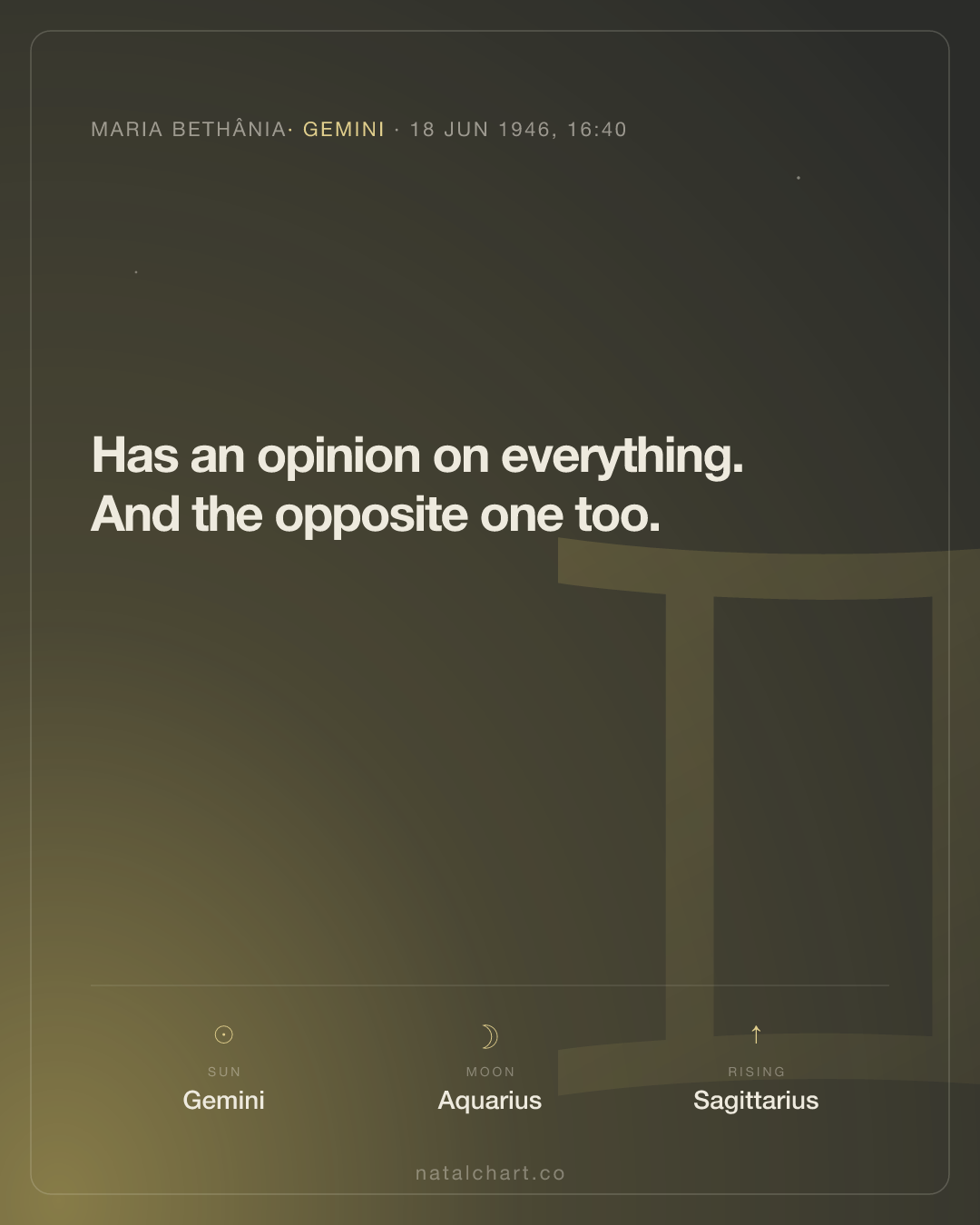
Maria Bethânia's Sun sign is Gemini — the Sun was in Gemini at birth (1946).
What is Maria Bethânia's moon sign?
Maria Bethânia has the Moon in Aquarius. The Moon sign describes the emotional and instinctive layer of the chart.
What is Maria Bethânia's rising sign?
Maria Bethânia's rising sign (ascendant) is Sagittarius — the sign on the eastern horizon at the moment of birth.
When and where was Maria Bethânia born?
Maria Bethânia was born in 1946 in Santo Amaro, Brazil.