Marlene Dietrich — natal chart
What does Marlene Dietrich’s natal chart reveal?
Marlene Dietrich (1901-1992) was a German-American actress and singer who became an international icon of glamour and androgyny. Rising to fame in The Blue Angel, she starred in Hollywood classics, defied the Nazi regime by becoming a US citizen, and entertained Allied troops during World War II.
 Share
Share
Birth
1901-12-27 · 21:15 · Berlin-Schöneberg, Germany Reliability: AA · vetted record
The Architecture of Reinvention
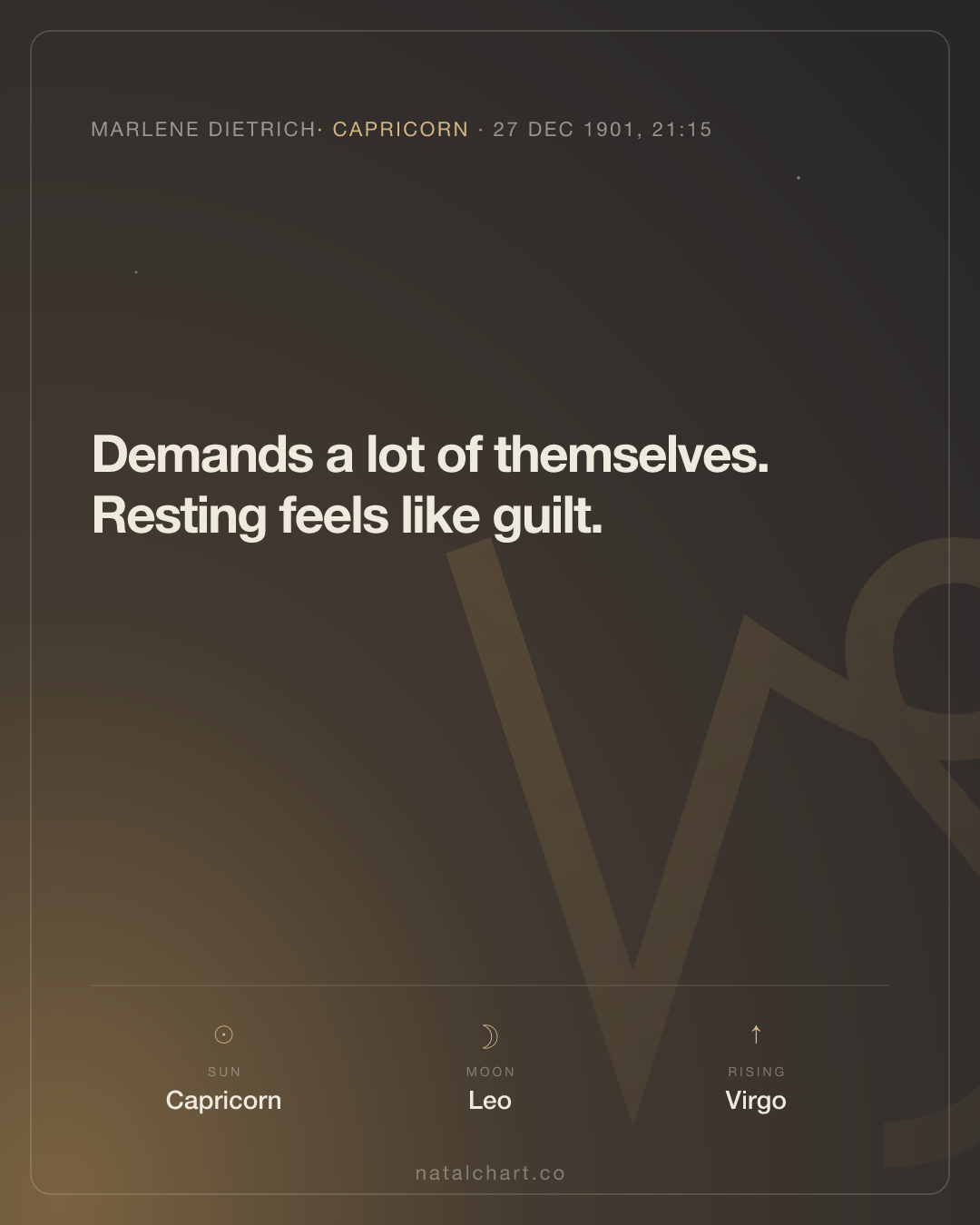
Marlene Dietrich arrives in the world as a craftsperson — Virgo rising, the Ascendant that meets everything with a careful, discerning eye. The face she presents is composed, exact, a little self-contained. Nothing lands on that surface by accident. But the Virgo Ascendant is only the doorway. Behind it sits one of the most concentrated stelliums in any famous chart: Sun, Mercury, Mars, Jupiter, Saturn, and Chiron all gathered in Capricorn in the fifth house — the house of performance, creative expression, and public spectacle. Capricorn here is not cold; it is structural, patient, built to last. Dietrich does not flash and fade. She builds. And what she builds, she builds to outlast the century.
The Sun and the Stage
The Sun in Capricorn in the fifth house describes a woman whose identity is inseparable from what she creates and performs. Capricorn Suns do not seek attention impulsively — they earn it, maintain it, and treat their public image as a lifelong project requiring continuous work. The fifth house puts all of that in the theatre, on the screen, in the spotlight. The Blue Angel in 1930 was not Dietrich stumbling into fame — it was a calculated, disciplined ascent. She negotiated her own terms with Josef von Sternberg and Paramount Pictures from nearly the beginning, understanding instinctively that her image was an asset to be managed, not a gift to be received.
The Sun sits in exact conjunction with Mercury — thought and identity fused, a mind that is inseparable from the person's public face. Dietrich spoke openly about the mechanics of her own glamour, the lighting, the angles, the costume choices. She knew the architecture of her own image from the inside.
The Moon Behind the Curtain
The Moon in Leo in the twelfth house — the interior life (the Moon) in the sign of radiance and performance (Leo), but hidden away in the twelfth house, which governs what happens offstage, behind closed doors, in exile. This placement describes someone who feels most herself when performing, yet keeps the emotional cost of that performance entirely private. The public Leo light is real, but what fuels it — the longing, the tenderness, the need to be seen as truly beautiful rather than merely spectacular — lives out of sight.
Dietrich's friendships with figures like Ernest Hemingway, Edith Piaf, and Noël Coward pointed to a deep need for intimate connection that the celebrity machinery could not satisfy. The Moon in Leo in the twelfth house loves fiercely and quietly, away from the audience.
Mind, Voice, and the Myth
Mercury in Capricorn in the fifth house, joined to the Sun, makes Dietrich's communication inseparable from her persona. She was notoriously precise about words — about how interviews were conducted, how she was described, what she would and would not say on record. Mercury in Capricorn does not speak carelessly. Every utterance is measured, deliberate, chosen for its structural effect.
But Mercury is pulled in tension with Neptune in the tenth house (the career and public image point) at 2.4°. Neptune here introduces a quality of myth, of unreality, of deliberate blurring. Dietrich did not merely have a career — she presided over a constructed legend. Dates, biographical details, the exact circumstances of her early life in Berlin were all subject to revision. The tension between Mercury's precision and Neptune's mist is the tension between the woman who knew exactly what she was doing and the persona that deliberately obscured it.
Love on Her Own Terms
Venus in Aquarius in the sixth house — love shaped by independence, by a refusal of conventional categories. The sixth house connects Venus to work, to daily life, to the practical texture of how a person actually spends their time. For Dietrich, love was never separate from collaboration, from creative partnership, from the people she worked alongside. Her bisexuality, her long string of affairs with both men and women, her famous relationships with actors, writers, and musicians — all of this reflects a Venus that does not recognise ownership or restriction.
Venus forms a strong connection with Uranus (in easy flow at 2.2°) and with Pluto (in easy flow at 3.1°). These two aspects together describe a woman for whom love carries an unmistakable charge of the unexpected, of transformation, of intensity managed with lightness. She breaks conventions not through rebellion but through the quiet assumption that they simply do not apply to her.
Mars and the Will That Does Not Yield
Mars in Capricorn in the fifth house — and here the stellium reveals its engine. Mars joined to Jupiter (at 5.5°) in the same sign and house describes ambition that does not merely want success but needs to act, to make, to produce. Jupiter amplifies Mars's drive; Capricorn gives both the patience to play the long game. Jupiter joined to Saturn in the same house adds discipline to expansion — the ability to know when to press and when to hold, when to take the risk and when to wait.
This Mars-Jupiter-Saturn concentration in the fifth house explains the wartime Dietrich as much as the Hollywood Dietrich. When she renounced German citizenship, refused Goebbels's personal offers to return to Germany, became a US citizen in 1939, and spent years performing for Allied troops at the front lines — sometimes under active fire — that was not sentiment. That was Mars in Capricorn: a decision made once, held absolutely, executed with full commitment regardless of personal cost.
The Outer Planets and the Age She Carried
Uranus in Sagittarius in the fourth house pulls against Pluto in Gemini in the tenth house — these two are in opposition at 0.8°, the tightest aspect in the entire chart. The fourth house is roots, home, origin, private foundation; the tenth is career, reputation, public standing. Uranus in the fourth describes a deeply disrupted, unconventional home life — Dietrich left Berlin for Hollywood and never truly returned, exiling herself from the country that had defined her. Pluto in the tenth describes a career marked by absolute transformation, by reinvention so complete it crosses into mythology.
The opposition between these two tells a coherent story: the rupture of her private roots (Germany, the language, the landscape she was born into) was the price of, and perhaps the fuel for, the public metamorphosis. She could not have become the icon she became without the exile.
The Midheaven: Art as Endurance
The Midheaven (the chart's career and public vocation point) in Taurus describes a public identity built around beauty, sensory artistry, and lasting material creation. Taurus endures. It does not change for the season, does not pivot with fashion, does not apologise for its particular aesthetic. Dietrich's voice — unmistakable, low, perfectly placed — is a Taurus Midheaven sound: warm, corporeal, built to outlast trends. Her cabaret performances in the 1950s, 60s, and 70s were not nostalgia acts. They were a Capricorn-Taurus project of long-term artistic identity, maintained with professional rigour into her eighties.
Neptune and Pluto in the tenth house alongside the Midheaven add the mythic register: she does not just work in the arts, she becomes part of the cultural unconscious of the twentieth century.
Chiron and the Wound That Shaped the Work
Chiron (an old wound that, over time, becomes the source of a distinctive gift) sits in Capricorn in the fifth house, inside the stellium. Dietrich's wound is entwined with performance itself — the cost of making public spectacle the core of one's existence, the price of building an identity so thoroughly around being seen. Her later years were marked by increasing withdrawal: she refused to be photographed after a certain point, spent her final decade in her Paris apartment almost entirely unseen. The North Node in Scorpio points toward depth, toward the hidden and the true, as the direction of genuine growth — away from the structured performance of the stellium, toward something rawer and less managed.
That final withdrawal may have been the deepest act of the whole life: the woman who had built an entire existence around being looked at, choosing, at last, not to be.
The Lasting Impression
Dietrich's chart is not the chart of someone who simply had talent and got lucky. It is the chart of a person who approached her own existence as a long, patient construction project — Capricorn's method applied to the fifth house's materials, with Virgo's precision shaping the surface and the hidden Moon in Leo fuelling the fire. She outlived the regime that tried to claim her, outlived most of the collaborators she loved, outlived the fashion cycles that declared her dated and then rediscovered her. What remains is not glamour as decoration but glamour as argument — proof that a person can build something with their image, their voice, and their choices that does not wash away.
The chart
How to read it →Frequently asked questions
What is Marlene Dietrich's zodiac sign?
Marlene Dietrich's Sun sign is Capricorn — the Sun was in Capricorn at birth (1901).
What is Marlene Dietrich's moon sign?
Marlene Dietrich has the Moon in Leo. The Moon sign describes the emotional and instinctive layer of the chart.
What is Marlene Dietrich's rising sign?
Marlene Dietrich's rising sign (ascendant) is Virgo — the sign on the eastern horizon at the moment of birth.
When and where was Marlene Dietrich born?
Marlene Dietrich was born in 1901 in Berlin-Schöneberg, Germany.