Nâzım Hikmet — natal chart
What does Nâzım Hikmet’s natal chart reveal?
Nâzım Hikmet, born on 15 January 1902 in Thessaloniki (then Selânik, in the Ottoman Empire), was a Turkish poet and playwright widely regarded as the founder of modern Turkish verse. Influenced by the Russian Futurists during years in Moscow, he broke with traditional syllabic metre and wrote in a free, direct, openly political voice. His major works include the epic 'The Epic of Shaykh Bedreddin' (1936) and the vast verse novel 'Human Landscapes from My Country' ('Memleketimden İnsan Manzaraları'), written largely during imprisonment, alongside poems such as 'Some Advice to Those Who Will Serve Time in Prison'. A committed communist, he spent much of his life in jail or exile and left Turkey for good in 1951, settling in the Soviet Union. He died in Moscow in 1963. Translated into dozens of languages, he remains one of the most influential international poets of the twentieth century.
 Share
Share
Birth
1902-01-15 · Thessaloniki (Selânik), Ottoman Empire Reliability: X · no time No verified birth time: ascendant and houses are omitted. No reliable birth time is recorded. Astrology databases such as Astrotheme list no time and calculate the chart for noon by default, so any time-dependent placement is unverified.
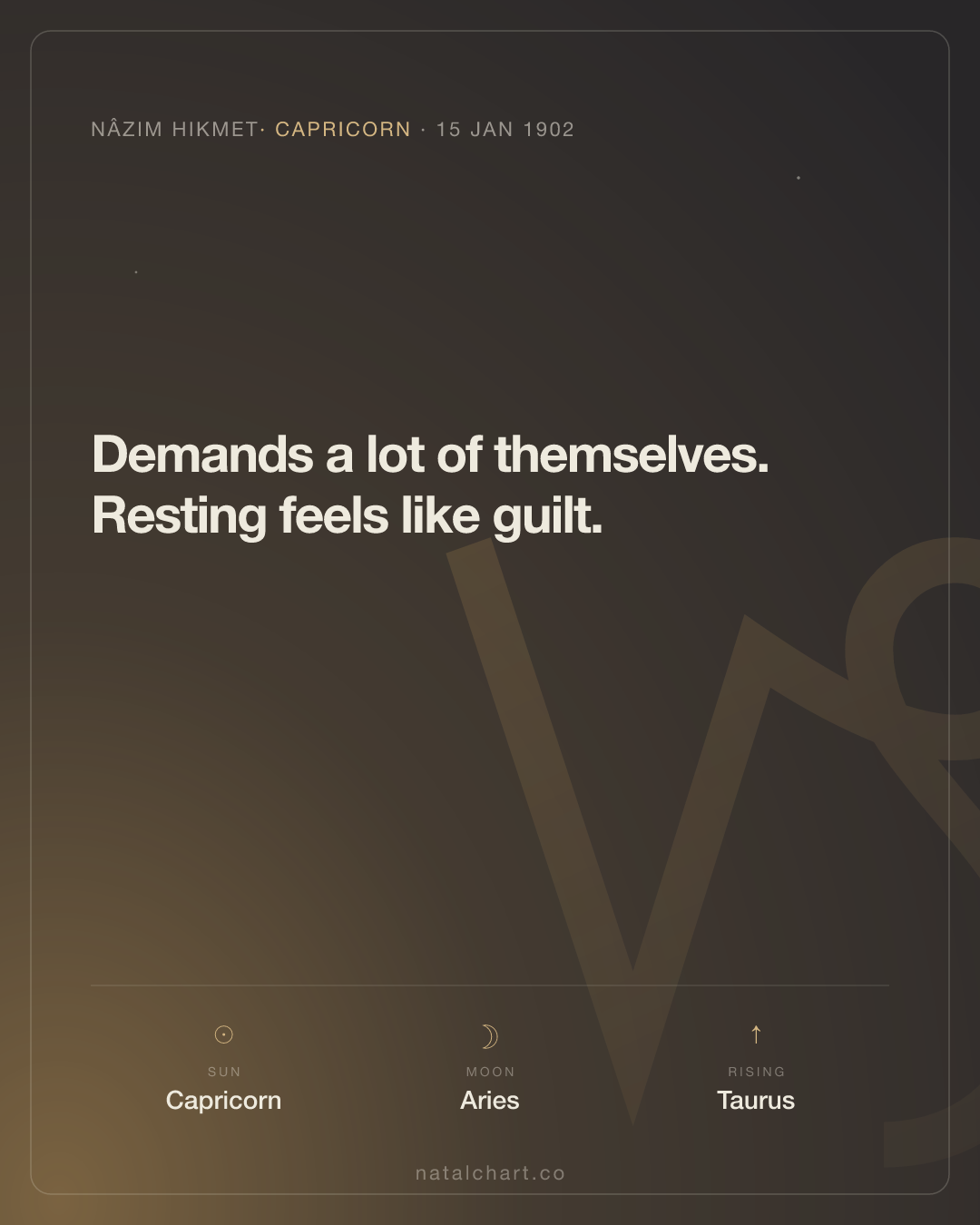
Sun in Capricorn, Joined to Jupiter and Saturn: the long-haul builder
Nâzım Hikmet was born on 15 January 1902, and the Sun that day stood in Capricorn — the sign of the long-distance runner, the person who understands that the most enduring things are built through time, difficulty, and sustained commitment. Two of the chart's heaviest planets sat beside it: Jupiter (at 0.4 degrees away, the closest aspect in the whole chart) and Saturn (at 5.0 degrees). Jupiter expands what it touches and brings confidence and scope; Saturn insists on structure, cost, and the weight of reality. Having all three — Sun, Jupiter, Saturn — compressed together in Capricorn describes a writer who was constitutionally incapable of working small. "Human Landscapes from My Country," the verse novel Hikmet wrote largely while in prison, runs to more than 17,000 lines. It is not the work of someone who thought in short bursts; it is the work of a Capricorn Sun in full development: ambitious in architecture, patient in execution, and fully aware that the subject — the whole texture of Turkish life in the twentieth century — was worth the time it would take.
Moon in Aries, in tension with Neptune: fire that dreams
The Moon in a chart reflects emotional instinct, the quick, unreasoned self. In Aries — the most impulsive and direct of signs — the Moon reaches for immediacy: it feels before it thinks, it acts before it explains. Hikmet's poetry has that quality. The famous lines from "Some Advice to Those Who Will Serve Time in Prison" — "The best of all goods is hope, my friend" — land with the bluntness and directness of Aries, not the elaborate indirection of a more calculating sign. But this Moon sits in tension with Neptune (1.5 degrees away), and Neptune in the chart represents the imaginary, the ideal, and the realm of pure poetry. The friction between a hot, present-tense emotional response (Aries Moon) and the pull of idealized vision (Neptune) is the engine of lyric poetry: the concrete and the yearned-for, held in the same breath. It also describes the gap between the world as he felt it should be and the world as he actually found it — which cost him seventeen years in prison.
Mercury in Aquarius with Mars: the argumentative intellectual
Mercury rules the mind and the way ideas are shaped into language. In Aquarius — the sign associated with collective thought, social systems, and the future rather than the past — Mercury carries a naturally political charge: it thinks in terms of humanity rather than individuals, in terms of structures rather than feelings. Mars occupied the same sign, and the two sat in close enough proximity that the combination describes a mind that argues. Hikmet had studied in Moscow in the early 1920s among the Russian Futurists, and the influence shows: his verse broke decisively with the syllabic metre of traditional Ottoman poetry in favor of a direct, unmistakably political voice. Mercury in Aquarius does not soften its ideas to make them more palatable; it states them with the confidence of someone who believes they have seen the shape of the future. That cost him. He was first imprisoned in 1933, charged with inciting military and naval officers to revolt through his poems.
Venus in Pisces, in easy flow with Neptune: the language of longing
Venus in the chart describes what the heart reaches for — in art, in love, in the aesthetic choices that make a piece of work feel alive. In Pisces, Venus moves toward beauty that is boundless, empathic, and not easily contained. The trine — an easy, mutually reinforcing angle — between this Venus and Neptune (2.1 degrees) deepens that quality: Neptune in Gemini here amplifies the musical and verbal dimension of the imagination. It is a combination that produces lyric poetry of a particular kind — not merely clever or structural, but suffused with an ache for connection that travels across languages. Hikmet has been translated into more than fifty languages, and part of why his poems survive translation is that the longing in them is not culture-specific: it is the longing of Venus in Pisces, which is universal.
Uranus opposite Pluto: the generation that broke the world apart
Both Uranus and Pluto are slow-moving outer planets whose positions define entire generations rather than individuals. But when they form an opposition — a pulling-apart, face-to-face tension — the people born under it often carry within them the full force of a historical fracture. Hikmet was born in 1902, when Uranus in Sagittarius stood in opposition to Pluto in Gemini (2.2 degrees apart). This is the axis of revolutionary thought versus the transformation of collective language and culture: Sagittarius pushes toward freedom and new horizons; Gemini remakes the codes through which a culture understands itself. Hikmet lived both sides of that opposition. The Ottoman Empire dissolved. Turkey was reinvented. He reinvented Turkish poetry. And he was stateless for the last twelve years of his life — a man literally caught between two worlds, belonging fully to neither.
Chiron in Capricorn: the wound of institutional exclusion
Chiron marks a place of old, often unearned pain that gradually becomes the source of one's deepest contribution. In Capricorn — the sign of institutions, official recognition, and the structures through which society confers legitimacy — that wound sits precisely where Hikmet was most repeatedly hurt. He was stripped of his Turkish citizenship in 1951 while in exile in the Soviet Union. He was never awarded the Nobel Prize he almost certainly would otherwise have received. He was not formally rehabilitated by the Turkish state until decades after his death — his citizenship was restored posthumously in 2009. And yet the work he did during the seventeen years he spent in prison — "Human Landscapes," the advice poems, the letters to his wife Piraye — is exactly what endures. Chiron in Capricorn: the wound of not being recognized by the institution eventually becomes the gift that the institution cannot contain.
North Node in Scorpio: the calling toward depth and transformation
The North Node marks the direction in which a life most fully comes into its own — not the easy or habitual direction, but the one that demands growth. In Scorpio — the sign of depth, of what is hidden, of the transformative power of fully reckoning with darkness — the call was toward writing that did not flinch. Hikmet did not write pretty poems from a comfortable distance. He wrote from inside the experience: from the cell at Bursa Prison, from the ship crossing the Black Sea into permanent exile, from the body of a man who knew he might never see Turkey again. The Scorpio North Node, reinforced by Lilith also in Scorpio, points toward a willingness to go where it genuinely costs something — to make the hidden visible, to alchemize the worst of what happens into language that illuminates rather than merely records.
Moon sextile Mercury: the poem that talks
A sextile is an easy, cooperative angle — two placements that help each other without strain. Here, the Moon in Aries (direct, emotionally immediate) and Mercury in Aquarius (politically charged, structurally minded) work in tandem. The result is a voice that is simultaneously felt and thought: poems that are intellectually clear but not cold, emotionally direct but not naive. This is one of the rarer gifts in a poet's chart — the head and the heart not in competition but in conversation. It shows in lines like those from "Since I Was Thrown Inside": the argument of a political mind, the heat of a man writing from a cell, both present at once and neither overwhelming the other.
A warm close
Nâzım Hikmet died in Moscow on 3 June 1963, in exile, far from the country whose language he had transformed. He had not seen Turkey for twelve years. But the poems had already crossed every border he could not: translated into dozens of languages, recited in living rooms and university halls and prison cells around the world, passed hand to hand in photocopied pages in countries where they were banned. A Capricorn Sun builds for time. A Venus in Pisces builds for the heart. This chart built both.
The chart
How to read it →Frequently asked questions
What is Nâzım Hikmet's zodiac sign?
Nâzım Hikmet's Sun sign is Capricorn — the Sun was in Capricorn at birth (1902).
What is Nâzım Hikmet's moon sign?
Nâzım Hikmet has the Moon in Aries. The Moon sign describes the emotional and instinctive layer of the chart.
When and where was Nâzım Hikmet born?
Nâzım Hikmet was born in 1902 in Thessaloniki (Selânik), Ottoman Empire.