Pablo Casals — natal chart
What does Pablo Casals’s natal chart reveal?
Catalan cellist and conductor born in 1876. He rediscovered and recorded Bach's Cello Suites. Exiled after the Spanish Civil War, he conducted his oratorio 'El Pessebre' at the UN in 1971. Died in Puerto Rico in 1973.
 Share
Share
Birth
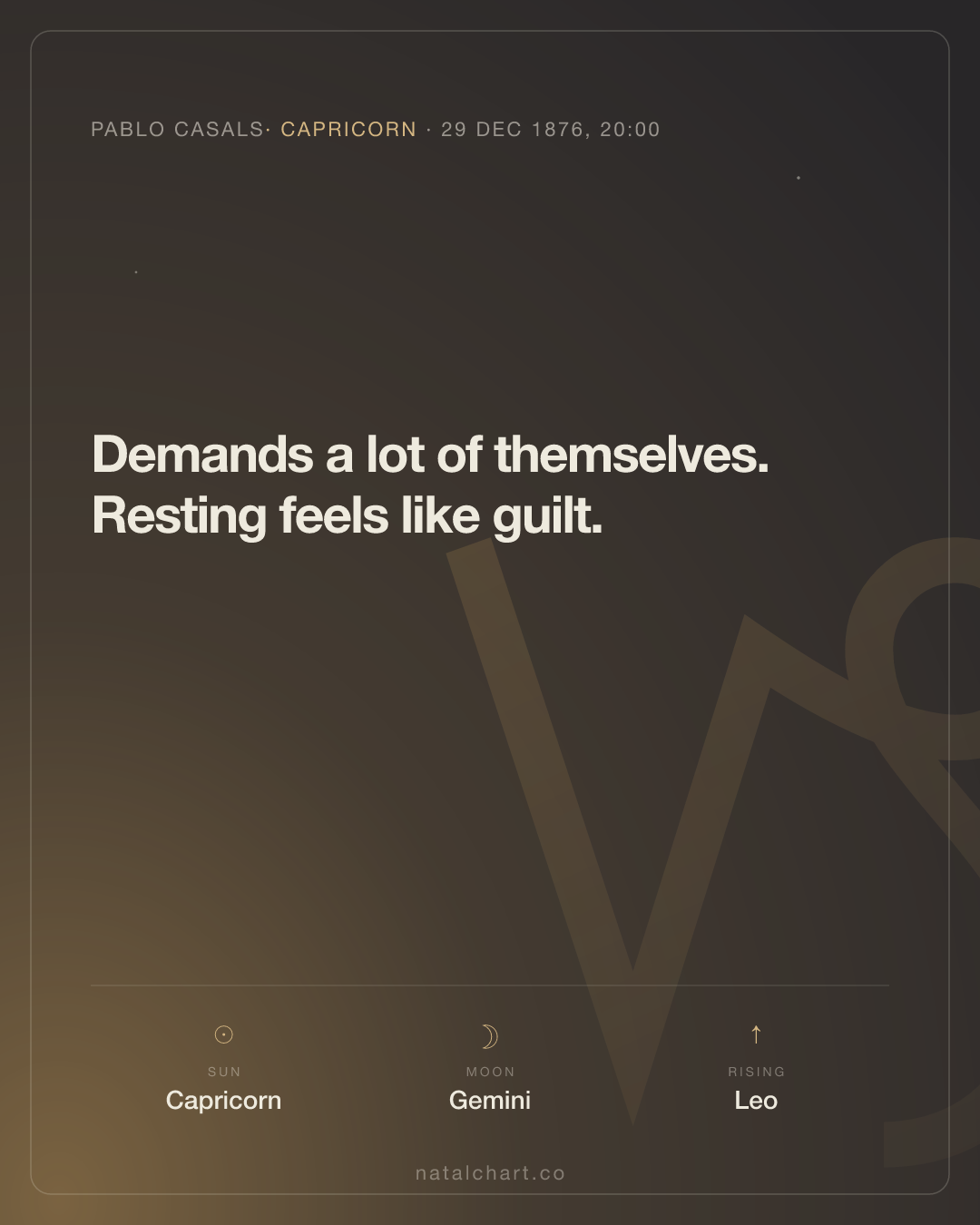
1876-12-29 · 20:00 · El Vendrell, Spain Reliability: A · reliable data
The Core: A Capricorn Who Played Until the World Listened
Pablo Casals did not become one of the twentieth century's most important musicians by talent alone. He became one by discipline, by refusal, and by an almost geological patience — the patience of someone who could spend years in rural exile and still trust that the work itself would outlast the injustice. The Sun in Capricorn in the sixth house (the house of daily practice and craft) describes that orientation precisely: meaning found not in recognition but in the act of playing, preparing, committing. Capricorn does not wait for the right moment; it builds until the moment arrives.
The Leo Ascendant — the point in the chart that describes how a person meets the world — gives that patient interior a warm and unmistakable public presence. There was nothing small or provisional about Casals on stage. The broad torso, the way he seemed to inhabit the cello as a physical extension of himself, the authority that made audiences still without effort: this was a Leo Ascendant in full expression. And with Uranus sitting right on that Ascendant, the presence carried an edge of the original, even the startling. Uranus on the Ascendant marks someone who arrives slightly ahead of where the world is ready to follow.
The Moon: Ideas in Constant Circulation
The Moon in Gemini in the eleventh house describes an emotional life that moves through connection and conversation, through belonging to a community of minds. The eleventh house is the house of collectives, causes, and the future one wants to help build. Casals's great public acts — his refusal to perform in countries that recognised Franco, the decades of self-imposed exile in Prades and later Marlboro, the eventual appearance at the United Nations in 1971 to conduct his own oratorio El Pessebre — were not separate from his music: they were the same statement in a different medium. The Moon in Gemini says that belonging and exchange of ideas mattered deeply; the eleventh house says that belonging was always to something larger than any one friendship.
The Moon forms an easy, flowing connection with Uranus, which was right on his Ascendant. The emotional life and the public self pointed in the same direction: toward what was new, what broke with convention, what challenged what had been taken for granted.
Mercury: The Instrument as Argument
Mercury in Capricorn in the sixth house sits within a hair's breadth of an exact flowing connection with Pluto in Taurus in the tenth house (the career and public legacy point). This is perhaps the single most telling alignment in the chart. Mercury in the sixth speaks to a mind that communicates through the discipline of practice; the connection to Pluto in the tenth transforms that discipline into something that reshapes how an entire field understands itself.
What Casals did with the Bach Cello Suites was precisely this. The six suites had existed since the early eighteenth century, known to cellists primarily as technical exercises. Casals found a copy in a Barcelona music shop as a teenager, practised them privately for twelve years before performing them publicly, and then — through his recordings in the 1930s — established them as among the greatest works in the entire repertoire. That is not just musicianship: it is a reframing, a transformation of perception. Mercury trine Pluto, exact to zero degrees, is the signature of someone who thinks in ways that permanently alter the conversation.
Venus: Beauty With Structure
Venus in Sagittarius in the fifth house (the house of creative work) describes an aesthetic sensibility that aims large, that reaches for the philosophical and the universal in what it makes. The fifth house is where creative identity lives, and Sagittarius brings to it an interest in meaning, in the overarching idea. Casals never played a piece without an interpretation — an argument about what the music was saying. His tempos were often controversial precisely because they followed a musical logic rather than convention.
Venus in Sagittarius is also warm, generous, given to expressing affection openly. Casals was known throughout his life for the directness of his relationships — with students, with fellow musicians, with political causes. He did not maintain careful distances.
Venus sits in tension with Saturn in Pisces in the eighth house. The two pull against each other, a degree and a half apart. The capacity for warmth and the weight of discipline, the desire for expansive expression and the restraint that Saturn always imposes: this tension runs through his whole biography. The self-imposed exile from performance — no concerts in Spain, no performances in countries that recognised Franco's regime, decade after decade — was Venus submitting to Saturn's strictness in the service of a principle. It cost him, materially and in terms of the audiences he never played for. He did not appear to regret it.
Mars: The Conviction Behind the Craft
Mars in Scorpio in the fourth house describes a drive rooted in something private and foundational. The fourth house is the house of origins, of the ground one stands on; Mars in Scorpio brings to it intensity, staying power, the refusal to be moved. Casals's identification with Catalonia — with the language, the traditions, the political identity that Franco tried to extinguish — was not sentimental: it was load-bearing. It was the thing from which the long exile and the long refusals drew their strength.
Mars stands in opposition to Pluto in the tenth house — the two pulling hard against each other across the chart, about three degrees apart. Mars opposition Pluto tends to describe a person whose private convictions and public presence eventually collide with transforming force. For Casals, the collision was the Spanish Civil War. Before 1936, he was primarily a musician. After it, he became something more complex: a musician who understood that the stage was also a position, and that using or refusing it was a political act with weight.
Jupiter, Saturn, and the Long Game
Jupiter in Sagittarius in the fifth house — sitting right beside Venus — amplifies the creative ambition and the instinct to find the widest possible meaning in artistic work. Casals composed throughout his life, though composition sat below performance in his public identity. El Pessebre, the oratorio he began in the 1940s and conducted at the UN in 1971 when he was ninety-four years old, carries the full Jupiter-in-Sagittarius signature: a work about a universal theme (the nativity as an emblem of peace), performed on the most international of stages, still in service of a political vision held for thirty-five years.
Saturn in Pisces in the eighth house, flowing easily with Neptune in Taurus in the tenth, describes a career built at the intersection of rigorous structure and something harder to name — a quality that Casals himself might have called the spiritual responsibility of the musician, even without using that word. Neptune in the tenth house gives a public legacy a quality of elegy, of something that means more over time than it did when it first appeared. His Bach recordings are a clear example: recorded in the 1930s on equipment that now sounds limited, they were still being cited fifty years later as the standard interpretation.
Neptune and Pluto: The Generation That Changed Everything
Neptune and Pluto are both in Taurus in the tenth house — they belong to the same generation and mark a collective moment rather than purely individual qualities. But their position on the Midheaven (the public career point) makes them personal for Casals in a way they are not for everyone born in the same years. Neptune here suggests that the public legacy carries something lasting and hard to reduce to a simple account. Pluto here suggests that the career involved transformation — not just building a reputation but changing the field.
Both are accurate. The cello's place in the concert repertoire before and after Casals is measurably different. This is rare: most performers, however fine, work within a tradition. Casals altered the tradition.
Chiron and the North Node: The Wound That Became a Gift
Chiron — the point that marks an old wound that becomes a person's most distinctive contribution — is in Gemini in the eleventh house, near the Moon. Chiron in the eleventh describes someone for whom the pain of exclusion, of not being heard, of being shut out of a community, eventually becomes the ground from which their deepest work grows. Casals spent roughly three decades in exile from the country where he had learned music and built his first reputation. The exclusion was real and long. What came out of it was not diminishment but an intensification: the years in Prades and Marlboro generated the Casals Festivals, the teaching relationships, the masterclasses that shaped the next generation of cellists.
The North Node in Pisces — the direction in which his life was always moving, without it always being visible — speaks to dissolution of boundaries, to the music that surpasses the musician's own biography and becomes available to everyone. The Bach Suites, after Casals, belonged to the world in a way they had not before. That is North Node in Pisces at full arrival.
A Life That Kept Playing
Casals's chart is the portrait of someone who trusted the long arc even when the immediate picture was bleak. He lived to ninety-six, conducted at the United Nations at ninety-four, and is reported to have practised the Bach Suites every morning until near the end of his life — not to perform them, but because, as he said, the day began better that way. The Capricorn Sun in the sixth house is a precise description of that fact: meaning in the discipline, not only in its outcome. The Leo Ascendant gave him the stage and the warmth to fill it; the Gemini Moon kept him curious and connected; the Mercury–Pluto alignment made the work he did permanently audible. What he left behind — the recordings, the pedagogy, the example of what a musician could refuse without losing the music — is the kind of legacy Pluto on the Midheaven tends to produce: not easily categorised, not easily forgotten.
The chart
How to read it →Frequently asked questions
What is Pablo Casals's zodiac sign?
Pablo Casals's Sun sign is Capricorn — the Sun was in Capricorn at birth (1876).
What is Pablo Casals's moon sign?
Pablo Casals has the Moon in Gemini. The Moon sign describes the emotional and instinctive layer of the chart.
What is Pablo Casals's rising sign?
Pablo Casals's rising sign (ascendant) is Leo — the sign on the eastern horizon at the moment of birth.
When and where was Pablo Casals born?
Pablo Casals was born in 1876 in El Vendrell, Spain.