Paolo Maldini — natal chart
What does Paolo Maldini’s natal chart reveal?
Paolo Maldini (born 1968) is an Italian former footballer regarded as one of the greatest defenders in history. A one-club legend, he spent his entire 25-year career at AC Milan, winning multiple Serie A titles and Champions League trophies, and captained Italy in over 120 international appearances.
 Share
Share
Birth
1968-06-26 · 21:35 · Milan, Italy Reliability: AA · vetted record
The Core: Loyalty, Protection and the Cancer Stellium
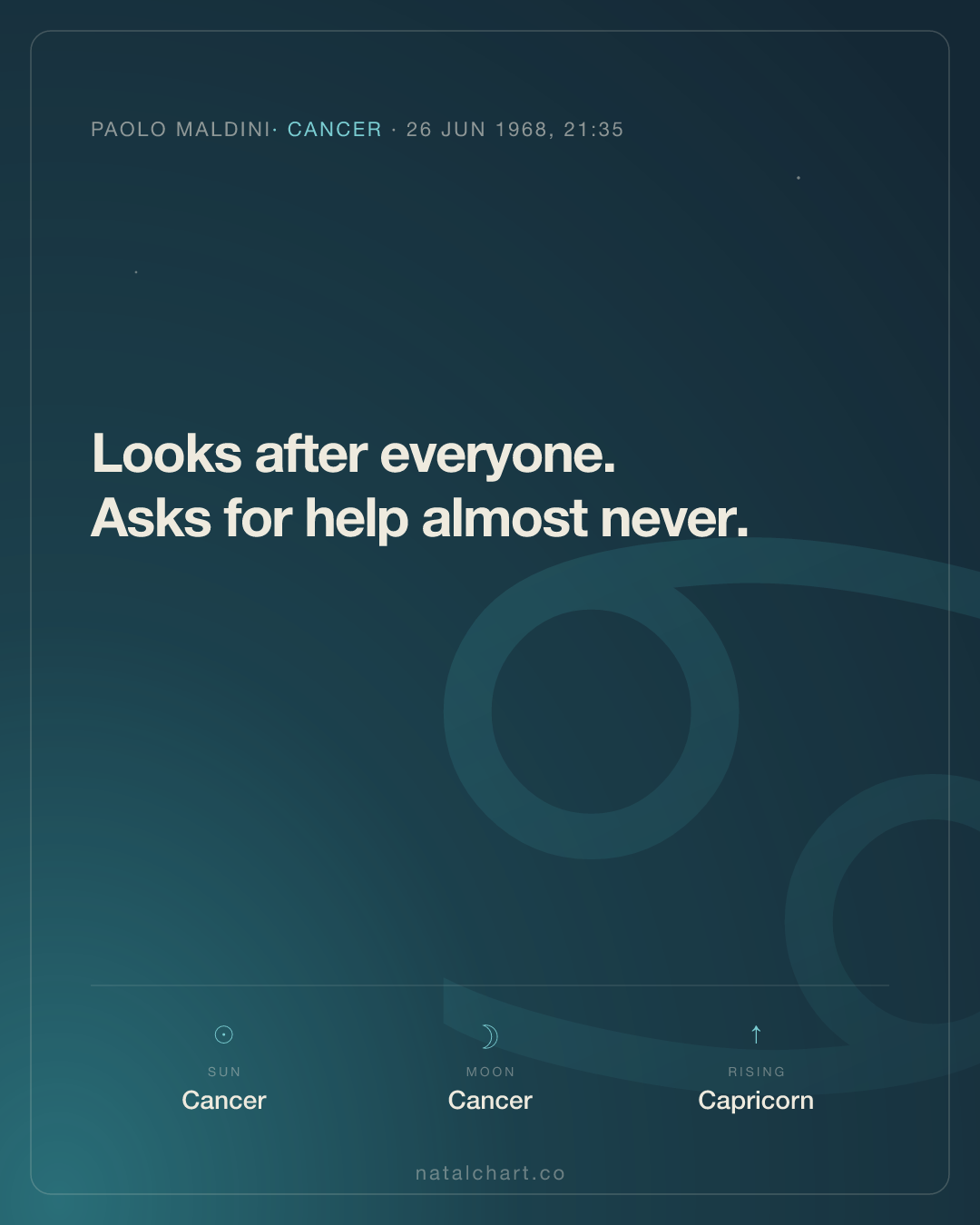
Some footballers play for clubs. Paolo Maldini was AC Milan. The word that recurs in every account of his career — in teammates' memoirs, in opponents' interviews, in the statistics of a man who made 900 appearances for a single club across 25 years — is not speed or skill, though he had both. It is reliability. And that word maps almost too perfectly onto the tightest cluster in his birth chart: Sun, Moon, Venus and Mars, all in Cancer, all in the seventh house. Four personal planets, one sign, one house — a concentration that turns protection, loyalty and emotional investment into the defining mode of existence rather than merely a professional style.
Capricorn Ascendant: The Face That Never Cracked
The Ascendant (the point of the zodiac rising on the horizon at birth — the face a person presents to the world) in Capricorn describes the exterior that every opponent encountered: composed, controlled, impossible to read, radiating a kind of institutional authority. Maldini did not talk much on the pitch. He did not need to. The Capricorn Ascendant is the figure who conveys dominance through stillness and economy of movement — the defender who seems to be barely trying while making it look effortless.
There is a productive contrast here. Capricorn on the outside, Cancer on the inside. All that controlled, measured exterior contained a deeply emotional interior; a person for whom connection to his club, to his family, to Italian football was not professional loyalty but something closer to identity. His father Cesare played for Milan before him; his sons played for Milan after him. This is not coincidence — it is a Cancerian pattern made visible across generations.
The Moon in Cancer: Feeling as Architecture
The Moon in Cancer in the seventh house — the sector of partnerships, face-to-face relationships and what one builds through the other — describes an emotional life structured around bonding and continuity. When Maldini said in interviews that he could not imagine wearing another shirt, it was not marketing speak. The Moon here feels things through loyalty, through the repetition of shared rituals, through the security of an established relationship. Arriving at training every morning for 25 years at the same club is not routine — it is how this Moon organises the world.
The Moon sits joined to the Sun (a gap of just one and a half degrees), meaning his inner emotional world and his outer identity were drawing from the same source. There was no gap between the private Maldini and the public Maldini. What you saw was what was there.
Mercury in Gemini: The Quick Mind in the Quiet Leader
Mercury — the planet governing thinking and communication — sat in Gemini, the sign that processes information in real time, switching between multiple inputs without losing the thread. In the sixth house (the house of work, daily craft and technique), this describes a football intelligence that was less about physical dominance and more about reading the game ahead of the moment, anticipating where the ball would be before it got there. Maldini himself said more than once that by his mid-thirties he relied less on his legs and more on his understanding. Mercury in Gemini in the sixth house is that intelligence made planetary: fast pattern-recognition, applied to daily professional craft.
Mercury sits in a tight easy flow with Saturn — a gap of less than half a degree — meaning that quick, adaptable thinking was held in place by rigorous structure. The improvisation was real, but it operated within discipline. The mind was fast; the framework was precise.
Venus, Sun and Mars in Cancer: One-Club Love
Venus joined to the Sun, and Venus joined to Mars, all in Cancer, all in the seventh house — this is a signature of someone whose deepest values (Venus) are inseparable from their identity (Sun) and their drive (Mars), and for whom all three are filtered through the Cancerian lens of loyalty, protection and belonging. In professional terms: Maldini did not play football to win titles, though he won many. He played football to protect something he loved — the club, the shirt, the tradition. The five Champions League titles and seven Serie A championships were the product of that love, not the reason for it.
Venus and Mars in the same sign and house also produce a person of considerable emotional intensity in close relationships, though Cancer keeps that intensity private. Maldini was famously reserved in public; the intensity belonged to his family and to the game itself.
Jupiter, Uranus and Pluto in Virgo: The Technical Era
Jupiter, Uranus and Pluto all gathered in Virgo in the ninth house — the house of knowledge, mastery and the broader world. Virgo's precision combined with the ninth house's reach describes someone who brought a technical, analytical dimension to their craft that transcended the merely athletic. Maldini was part of a generation of Italian defenders who turned defending into a distinct discipline — not merely stopping attackers but constructing a system, reading angles, understanding space. Mars in easy flow with Jupiter (just over two degrees) links that physical drive to an expansive, intelligent approach: the defender who studied the game as seriously as he played it.
Saturn in Aries in the fourth house — the house of foundations, roots and family — reflects what was simultaneously the most personal and most public dimension of his life: the weight of being a second-generation Milan player, of carrying his father's name and number as well as his own. Saturn in Aries here describes a foundation that was built on challenge and on the imperative to prove that the inheritance was earned, not simply received.
The Midheaven in Scorpio: The Vocation of Transformation
The Midheaven (the career and public-vocation point at the top of the chart) in Scorpio describes a professional identity that operates through depth, intensity and a kind of quiet power that does not announce itself. Scorpio does not need to shout. In football terms: Maldini did not celebrate in opponents' faces, did not seek controversy, rarely engaged with provocation. His public persona was as controlled as it was compelling — the Scorpio Midheaven at its most functional. The vocation was not to be famous, but to be formidable.
Neptune in Scorpio in the eleventh house connects that professional depth to something wider — the collective, the cultural, the sense of standing for something beyond personal achievement. Maldini became, in time, an icon less of a player and more of what football could mean: that it was possible to be technically excellent, personally dignified and loyal to a single institution without it becoming a limiting story.
Chiron, the North Node and the Wound of Captaincy
Chiron (an asteroid associated with the old wound that eventually becomes a gift) sits in Aries in the fourth house alongside Saturn. An Aries wound in the house of foundations and family: the pressure of a name, of an expectation set before one was old enough to choose it. Maldini's father Cesare captained Milan and later managed the Italian national team; Paolo grew up inside that shadow as much as in that tradition. The gift that emerges from a Chiron-Aries wound is leadership — not the leadership that demands attention, but the kind that others organise around without quite knowing why. The North Node (the chart's direction of growth) in Aries in the fourth house reinforces this: the deepest growth lay in becoming his own foundation, not merely his father's continuation.
The Tightest Aspects: Speed, Precision, and the Weight of Depth
Mercury and Saturn almost exactly in easy flow (less than half a degree) is the aspect that made his football intelligence sustainable over a quarter-century: the quick Gemini mind held tightly to Aries Saturn's structural discipline. Sun joined to Mars (one and a half degrees) in Cancer means drive and identity were indistinguishable — he was not someone who played intensely; he was someone for whom intensity was simply the mode of being. Mercury in tension with Uranus (under two degrees) added the unpredictability: a defender who could think faster than the standard playbook, who responded to sudden changes rather than being undone by them.
A Portrait in Blue and Black
The birth chart of Paolo Maldini describes a man who made loyalty an art form. The Cancer stellium gave him the emotional architecture; the Capricorn Ascendant gave him the composure to make it look controlled; and the Mercury-Saturn line gave him the intelligence to sustain it across a career that lasted until he was forty years old. He retired in 2009. By then he had played more games for one club than almost any other outfield player in the history of the sport — not because there were no other options, but because the question of another option was, in some fundamental sense, not a question he recognised.
The chart
How to read it →Frequently asked questions
What is Paolo Maldini's zodiac sign?
Paolo Maldini's Sun sign is Cancer — the Sun was in Cancer at birth (1968).
What is Paolo Maldini's moon sign?
Paolo Maldini has the Moon in Cancer. The Moon sign describes the emotional and instinctive layer of the chart.
What is Paolo Maldini's rising sign?
Paolo Maldini's rising sign (ascendant) is Capricorn — the sign on the eastern horizon at the moment of birth.
When and where was Paolo Maldini born?
Paolo Maldini was born in 1968 in Milan, Italy.