Paul McCartney — natal chart
What does Paul McCartney’s natal chart reveal?
British singer-songwriter, founding member of The Beatles alongside Lennon, Harrison and Starr. Later led Wings in the 1970s. Wrote Yesterday, Hey Jude, Let It Be. Knighted in 1997. Most commercially successful songwriter in history.
 Share
Share
Birth
1942-06-18 · 14:00 · Liverpool, United Kingdom Reliability: A · reliable data
The Core: A Gemini Chart Built for the Public Stage
Paul McCartney's chart opens on a striking concentration: Sun, Mercury, Saturn, Uranus and his Midheaven — the career and public identity point — all cluster in Gemini in the tenth house, the house of vocation and visibility. What that says plainly is that his work, his mind, and his public life are not separate departments. The way he thinks, the way he communicates, and the person the world sees are one continuous project. There is no "private McCartney who writes" and "public McCartney who performs" — those roles are structurally fused.
His Ascendant — the face he meets the world with, the first impression he creates — is Virgo. Virgo rising is precise, observant, quietly self-critical in a way that is not visible from the outside. It is the quality that made McCartney the Beatle who showed up to sessions with parts already worked out, who cared about the exact tempo, who pressed for the orchestral arrangement on Eleanor Rigby and the baroque piano loop on In My Life. The Virgo Ascendant also keeps the chart anchored: beneath the enormous Leo Moon and the Gemini sparkle is someone who checks his work.
The Emotional Interior: Moon in Leo, Twelfth House
McCartney's Moon is in Leo in the twelfth house — a combination that holds a real tension at its centre. The Moon describes the emotional interior, what a person needs to feel secure. Leo wants recognition, warmth, applause; the twelfth house is the most private, withdrawn sector of the chart, the place where things operate quietly, out of sight.
The result is a man whose emotional need for recognition is genuinely enormous — and who has carried much of it privately, or channelled it so thoroughly into his work that the work itself became the container. The Beatles years, especially the years after John Lennon's death in 1980, speak to the twelfth house side of this: grief processed through music (Here Today, the relentless touring of his later decades) rather than through public display. Mars and Pluto are also here in Leo, reinforcing the theme of intensity kept beneath the surface, released through creative effort rather than direct confrontation.
Vocation: When the Career IS the Person
The Midheaven in Gemini — directly joined to the Sun and Mercury — means that McCartney's vocation and his identity are the same thing. He is not a person who happens to write songs: he is a songwriter in the way that some people are left-handed. The North Node, his chart's pointer toward growth and calling, is in Virgo at the Ascendant, reinforcing the Virgo theme of craft, service, and attention to detail as the through-line of his contribution.
What is remarkable in the chart is the sheer number of planets in the tenth house: Sun, Mercury, Saturn, Uranus, and Lilith all in Gemini, all in the house of public life. This density explains why retirement has never quite taken. The chart does not separate "Paul McCartney the person" from "Paul McCartney the public figure" — they are the same column.
The Mind: Gemini Sharpness and the Neptune Complication
Mercury in Gemini in the tenth house, sitting directly alongside the Sun, describes a mind that is fast, verbal, idea-generating, always moving between registers. Yesterday famously arrived fully formed in a dream — McCartney spent days asking friends if they had heard it before, convinced he must have taken it from somewhere. That story is a Mercury-in-Gemini story: the speed at which an idea arrives is so great that its source becomes unclear.
The tightest aspect in the chart — and one of the most defining — is the Sun in tension with Neptune (the two pull against each other with less than half a degree between them, which in chart terms is as close as it gets). Neptune dissolves boundaries, introduces fog, makes ideals feel like reality. The tension between a Sun that wants to be clear, communicative, and present, and a Neptune that softens all outlines is written into McCartney's creative output in ways that are audible to anyone who listens: Yesterday, The Long and Winding Road, Blackbird are not songs that resolve cleanly. They end in a kind of beautiful uncertainty. That half-degree tension is in the music.
Love and Values: Venus in Taurus, Ninth House
Venus — the planet describing what a person values and how they approach love — is in Taurus in the ninth house, the house of beliefs, long journeys, and what expands a person's world. Venus in Taurus is steadfast, sensual, loyal in a way that does not change its mind quickly. It describes someone for whom love, once given, is not easily withdrawn — the long marriage to Linda Eastman, who died of cancer in 1998, and the grief that publicly followed, speaks directly to this placement. The ninth house adds a dimension of idealism: love that broadens the horizon, that feels like a form of philosophy.
The Moon in tension with Venus — the two planets pull against each other at under two degrees — describes a longstanding pull between the need for recognition and admiration (Leo Moon) and the quieter, steadier, more private quality of what Venus in Taurus actually values. In practice: the inner life wants warmth and applause, but what endures in a relationship is loyalty and physical presence.
Mars and Drive: Leo Fire in the Twelfth
Mars in Leo in the twelfth house, working in easy flow with both Uranus and Saturn, describes a creative drive that is enormous but characteristically indirect. Mars in the twelfth does not fight in the open — it works behind the scenes, in the studio, in the private sessions that generate the public results. The easy connection between Mars and Uranus produces the creative velocity that characterised the Beatles years: Help!, Rubber Soul, Revolver, Sgt. Pepper's and The White Album in four years, without repeating a formula. That pace is not normal. Mars, Uranus and Saturn working together generates sustained, structural innovation — the kind that does not just break rules but replaces them with something that works better.
Mars joined to Pluto in the twelfth reinforces the sense of enormous reserves held beneath a composed surface. The intensity is real; it simply does not perform itself.
Jupiter and Saturn: The Long Arc
Jupiter is in Cancer in the eleventh house, the house of communities, audiences, and the wider world. Jupiter in Cancer is generous, protective, orientated toward collective belonging. It is the placement that helps explain why McCartney's music has functioned as a kind of emotional infrastructure for millions of people — not just entertainment, but something people reach for at funerals, at weddings, in private grief. Let It Be is not a pop song for most people who love it. Jupiter in the eleventh describes a musician whose reach becomes genuinely communal.
Saturn in Gemini in the tenth — in easy flow with Pluto — is the counterbalance: the discipline that makes the reach sustainable. Saturn in the tenth house builds slowly and durably. The most commercially successful songwriter in history is also, by any measure, one of the most consistent: Band on the Run, the collaborations with Michael Jackson in the 1980s, the classical works, Chaos and Creation in the Backyard in 2005 — the chart's Saturn does not allow coasting.
The Outer Planets: Neptune Rising and the Boundary Question
Neptune sits at the Ascendant in Virgo — the planet of dissolving edges right at the point that describes how McCartney presents himself to the world. This is the placement that gives him the quality of being somehow present and slightly out of focus at the same time. In interviews, McCartney is notoriously hard to pin down: he tells stories, pivots, deflects with charm. The Virgo Ascendant wants to be precise; Neptune at the Ascendant softens every edge before it reaches the outside world. The result is a public persona that feels warm and accessible but rarely fully legible.
Combined with the Sun-Neptune tension described above, this suggests a person for whom clarity about identity has required active effort — not a natural condition but something worked toward.
Chiron: The Wound in the Private Space
Chiron — the point in the chart that often marks an old wound that, over time, becomes a specific kind of competence — is in Leo in the twelfth house, alongside the Moon, Mars, and Pluto. A Chiron in Leo in the twelfth speaks of a deep private question about worth and recognition: am I enough on my own terms, without the applause? The wounds of the Beatles' dissolution in 1970 — the legal battles, the public acrimony with Lennon, the years during which critical consensus dismissed McCartney as the safe Beatle — fed directly into this Chiron placement. The response, characteristically twelfth-house, was to return to work: Ram, Band on the Run, Venus and Mars, the Wings years, then the long solo arc. The wound became the engine.
A Chart That Does Not Retire
There is a version of McCartney's story that looks like a man who should have stopped — a Beatle, which is enough for any ten careers. But the chart is not built for that stop. The Sun-Mercury-Saturn concentration in Gemini in the tenth house describes a vocation that does not have a natural off-switch. The North Node in Virgo at the Ascendant points toward contribution through craft as the ongoing direction of growth, not a phase. McCartney is in his eighties and still recording, still touring, still iterating. The chart does not explain this as stubbornness or ego — it explains it as structure. For some people, the work is not what they do. It is who they are.
The chart
How to read it →Frequently asked questions
What is Paul McCartney's zodiac sign?
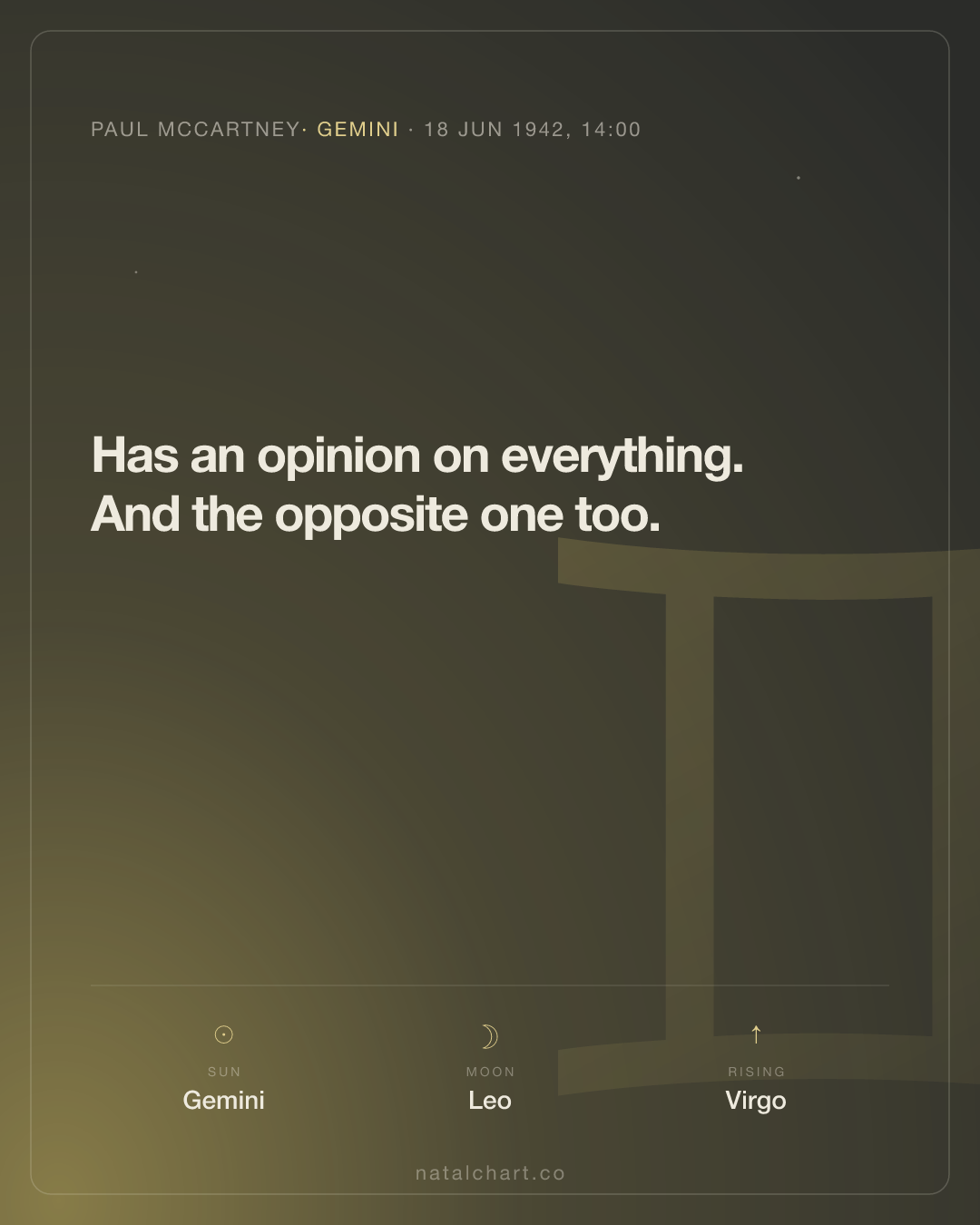
Paul McCartney's Sun sign is Gemini — the Sun was in Gemini at birth (1942).
What is Paul McCartney's moon sign?
Paul McCartney has the Moon in Leo. The Moon sign describes the emotional and instinctive layer of the chart.
What is Paul McCartney's rising sign?
Paul McCartney's rising sign (ascendant) is Virgo — the sign on the eastern horizon at the moment of birth.
When and where was Paul McCartney born?
Paul McCartney was born in 1942 in Liverpool, United Kingdom.