Rudolph Valentino — natal chart
What does Rudolph Valentino’s natal chart reveal?
Rudolph Valentino (1895-1926) was an Italian-American actor and one of the first great sex symbols of silent cinema. Known as the Latin Lover, he starred in The Sheik and The Four Horsemen of the Apocalypse. His sudden death at 31 triggered mass public mourning.
 Share
Share
Birth
1895-05-06 · 15:00 · Castellaneta, Italy Reliability: AA · vetted record
The Core: A Face That Made the World Go Quiet
Rudolph Valentino met the world through a Libra Ascendant — the face he gave audiences was beautiful, harmonious, magnetic. Libra rising (the Ascendant is the face one meets the world with) describes the person who becomes what the room needs them to be, who moves through social space with an instinctive grace. What made Valentino extraordinary was the Moon sitting almost exactly at that rising degree, and forming a perfect trine (an easy, amplifying flow) to Neptune — the planet of glamour, illusion, and the cinema screen itself — at a zero-degree orb so tight it is almost unrepeatable in a natal chart. He did not merely perform for the camera. He dissolved into it.
His Sun sits in Taurus in the eighth house — the house of depth, transformation, taboo, and the hidden. This is not the Sun of spectacle; it is the Sun of concentrated, interior intensity. What the world saw (Libra, Moon, Neptune) and what he actually was (Taurus, eighth house) were two different registers. The public fell in love with the reflection; the man behind it was quieter, more careful, more anchored in the physical and private.
The Moon: Dissolving into the Image
The Moon in Libra in the first house is already a striking placement — emotional life worn on the surface, a need to be in relationship as a basic psychological condition. But the trine to Neptune at 0.0 degrees transforms this entirely. Neptune governs dreams, film, enchantment, and the dissolution of boundaries between self and other. A Moon-Neptune trine this tight means that Valentino's emotional life and his on-screen presence were not separate things; the screen was where he felt most himself and most dissolved at once. When women wept at his films, they were responding to something genuinely felt in the image — it came through because it came from inside.
The Moon also flows easily with Pluto (3.7°), adding a layer of depth and transformation to this emotional current. Nothing in his inner life was light or passing. He felt in full, and audiences felt it back.
Mercury: The Thinker Behind the Pose
Mercury in Taurus in the eighth house sits within two degrees of the Sun, amplifying the Taurean focus on form, beauty, and material reality. But Mercury is also pulling against Uranus at 0.4 degrees — an opposition, meaning the tightest hard tension in his whole chart. Uranus disrupts, accelerates, and breaks with the conventional. Mercury pulling against Uranus in the eighth house describes a mind that could not stay still on received ideas — someone who thought in sudden leaps, whose private intellectual life was very different from the public image of sensuous simplicity. His early years in New York before cinema found him doing odd jobs, dancing in cabarets, navigating immigration as an outsider: a restless mind looking for the right frame.
Venus: The Traveling Romantic
Venus in Gemini in the ninth house — long-distance affection, partnerships that begin across a cultural or intellectual distance, fascination with the different and the foreign. Valentino crossed the Atlantic from Italy to America; his most significant personal relationships involved women from very different worlds than his own. Gemini Venus is adaptable and curious in love, but also capable of holding two things at once — he married twice in quick succession, and both relationships were complicated and publicly contested. Neptune and Pluto in the same ninth house amplify this: the ninth becomes a place of extraordinary atmosphere, romantic imagination, and projections as large as a cinema screen.
Mars and Jupiter: The Career Built on Feeling
Mars and Jupiter are joined together in Cancer in the tenth house — the public/career point of the chart. Cancer is the sign of nurturing, of emotional attunement, of the protective instinct. Jupiter expands whatever it touches, and Mars provides drive and action. Together they describe someone whose professional power came from his ability to make an audience feel cared for, desired, wanted. The "Latin Lover" was not simply sexual charisma; it was tenderness. In The Four Horsemen of the Apocalypse and The Sheik, what audiences responded to was not aggression but an emotionally present intensity — Mars in Cancer rather than Mars in Aries or Leo.
Jupiter in easy flow with Saturn (1.2°) is a gift of structural discipline: the capacity to build something that lasts, to combine vision with durability. His career trajectory from immigrant with no English to the highest-paid film star in Hollywood showed exactly this quality — expansive ambition kept steady by a patient capacity to work.
Saturn and the Second House: Value Built Slowly
Saturn in Scorpio in the second house is a complex placement. The second house governs money, resources, and one's sense of self-worth; Scorpio takes these questions deep and turns them into matters of power and survival. Saturn here suggests that financial security was hard-won and never taken for granted — and that questions of worth, monetary and personal, carried unusual psychological weight. Valentino's disputes with his studio over contracts and salary were legendary; he went on strike against Paramount in 1922, a public stand that was very much a Saturn-Scorpio second-house declaration of self-worth. Uranus sits beside Saturn in Scorpio, adding volatility and the unexpected to this arena.
The Outer Planets: Neptune, Pluto, and the Generation of Cinema
Neptune and Pluto are joined together in Gemini in the ninth house. These are generational placements, but their house position makes them personally significant. The ninth house governs foreign countries, higher meaning, and publishing. For Valentino's generation, Neptune in Gemini colored a collective fascination with narrative, image, and the newly invented art of moving pictures. He was born in 1895, the year the Lumière brothers showed their first films. That conjunction in the ninth house meant that his generation's mythmakers would be storytellers who crossed borders — and Valentino became the most visible proof.
The Midheaven: The Tender Caretaker at the Top
The Midheaven (the chart's public/career point) falls in Cancer — the same sign as his Mars-Jupiter joining. A Cancer Midheaven describes the public role as something nurturing, emotionally resonant, and tied to memory and feeling. His fame was never merely aesthetic; audiences needed him. The mass public mourning when he died at thirty-one in 1926 — tens of thousands filling the streets of New York — was not simply the death of a handsome man. It was grief for something he had given them that they could not quite name: the feeling, for two hours in a dark cinema, of being seen and desired.
Chiron and the North Node: The Wound Behind the Curtain
Chiron (an old wound that, worked through, becomes a form of wisdom and teaching) sits in Virgo in the twelfth house — the house of hidden things, of solitude, of what is kept out of sight. Chiron in Virgo speaks to a wound around imperfection, inadequacy, or criticism — a private self-scrutiny that never quite went to sleep. The twelfth house keeps this hidden from public view; the audience never saw the self-doubt. The North Node in Pisces (the direction the life chart was pointing toward) points toward surrender and dissolution of boundaries — which is exactly what the Moon-Neptune trine delivered. The chart was pointed toward the screen all along.
A Portrait, Whole
Rudolph Valentino's chart holds together a real paradox: a Taurus Sun that wanted depth, privacy, and material rootedness, carried inside a Libra-rising, Moon-Neptune glamour that the world could not stop watching. He did not engineer a persona — the Moon-Neptune connection did not allow for that kind of deliberate calculation. He simply was, fully, in front of the camera, and that fullness hit the screen unfiltered. That is what made audiences grieve as if they had lost someone they personally knew. In a sense, they had.
The chart
How to read it →Frequently asked questions
What is Rudolph Valentino's zodiac sign?
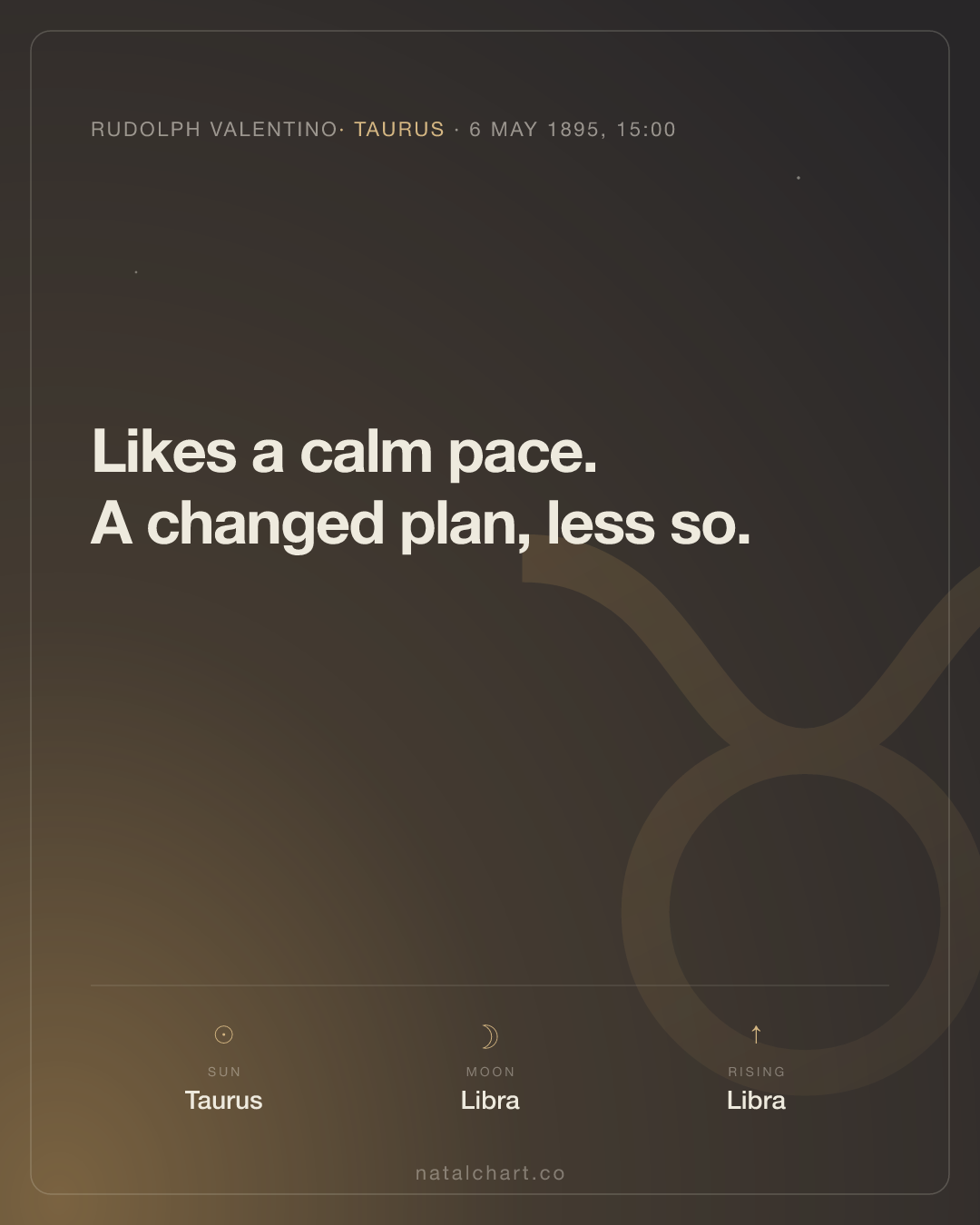
Rudolph Valentino's Sun sign is Taurus — the Sun was in Taurus at birth (1895).
What is Rudolph Valentino's moon sign?
Rudolph Valentino has the Moon in Libra. The Moon sign describes the emotional and instinctive layer of the chart.
What is Rudolph Valentino's rising sign?
Rudolph Valentino's rising sign (ascendant) is Libra — the sign on the eastern horizon at the moment of birth.
When and where was Rudolph Valentino born?
Rudolph Valentino was born in 1895 in Castellaneta, Italy.