Sigmund Freud — natal chart
What does Sigmund Freud’s natal chart reveal?
Sigmund Freud (1856-1939) was an Austrian neurologist and the founder of psychoanalysis, a method for treating mental illness through dialogue between patient and analyst. His theories of the unconscious mind, repression, and dream interpretation reshaped psychology, psychiatry, and Western culture. Key works include The Interpretation of Dreams.
 Share
Share
Birth
1856-05-06 · 18:30 · Příbor (Freiberg), Czech Republic Reliability: AA · vetted record
The core: a mind built to look underneath
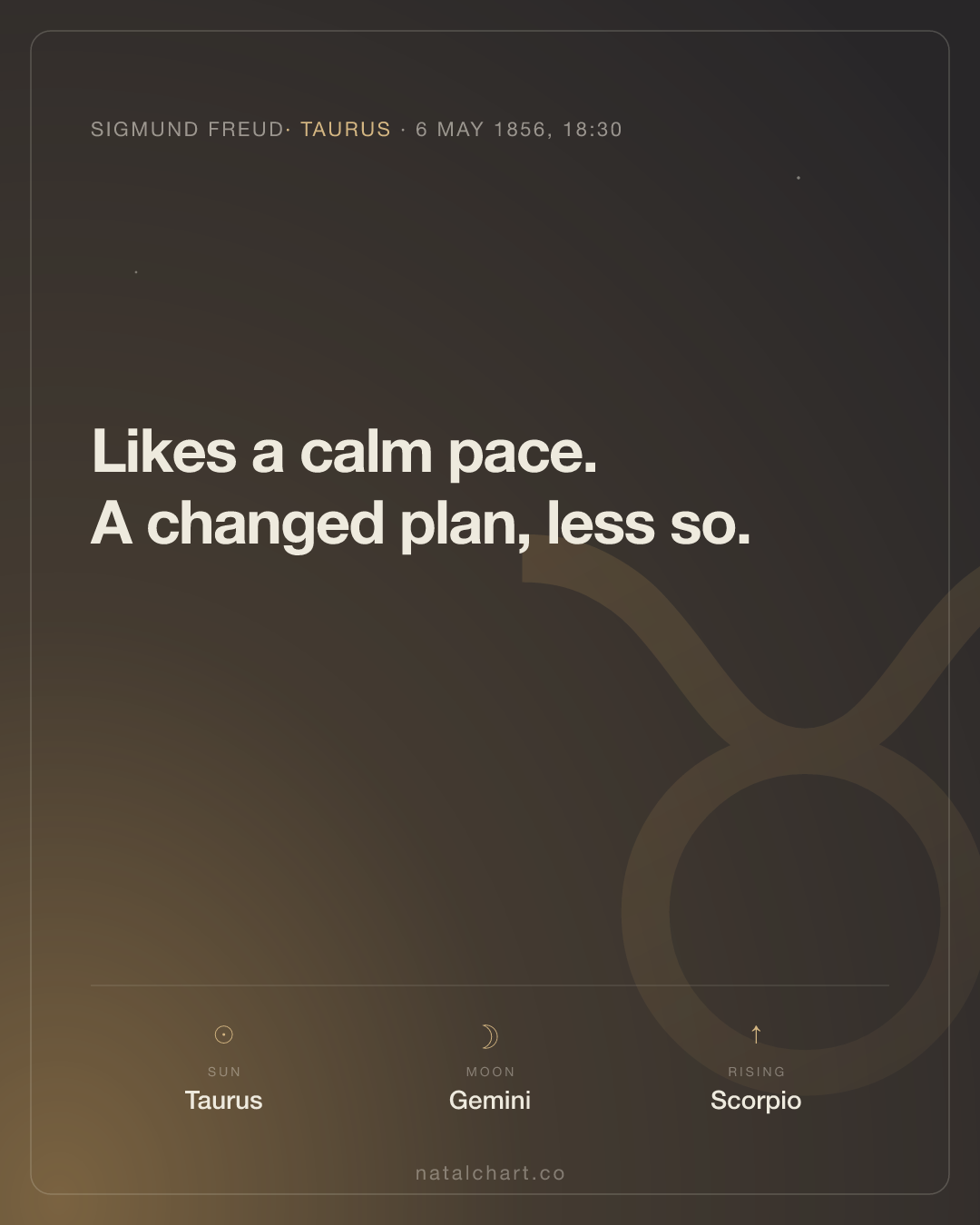
Sigmund Freud's chart opens with a remarkable concentration: the Sun, Mercury, Uranus, and Pluto all sit in Taurus in the seventh house, while the Ascendant is Scorpio. These two signs sit directly across the zodiac from each other, and together they describe the central tension of his life and work. Scorpio rising — the face the world met — carries the sign most associated with what is buried, forbidden, and psychologically dangerous. It brings penetrating perception, comfort with darkness, and a quality that unnerves as much as it draws in. Across from it, the Taurus stellium grounds that Scorpionic instinct in something material, patient, and methodical: the slow accumulation of evidence, the insistence on building a theory that stands.
Freud did not theorise from a distance. He watched, he listened, he sat in the room with patients for years before he made claims. That Taurus quality — unhurried, thorough, focused on what can be demonstrated — is what kept the Scorpionic depths from becoming mere speculation. The result was psychoanalysis: an entire method built on the premise that what matters most is precisely what no one talks about.
The Moon: the restless cataloguer
The Moon in Gemini in the eighth house is a striking placement for the man who invented free association. The eighth house governs what is hidden — secrets, sexuality, death, the unconscious. Gemini there adds a particular quality to this territory: it is not explored in silence or in mystical communion, but through words, through questions, through the restless need to name and classify what is found. Freud's famous talking cure was not incidental to his Moon placement — it was its exact expression.
Gemini Moon also carries a certain duality, an ability to hold contradictory ideas simultaneously without collapsing the tension between them. The structural contradiction at the heart of psychoanalysis — that rational science can study irrational processes — required exactly this quality of mind.
Saturn is also in Gemini in the eighth house, close to the Moon. Saturn in the eighth house brings a sustained, almost punishing seriousness to the investigation of what others prefer to leave alone. Saturn here does not let the analyst look away: it demands the full reckoning, the complete theory, the published account. The Interpretation of Dreams, Three Essays on the Theory of Sexuality, The Ego and the Id — each represents Saturn's insistence that the work be completed and recorded.
Mercury: the patient architect
Mercury in Taurus in the seventh house describes a thinker who builds slowly and does not move until he is sure. Taurus Mercury does not generate ideas in flashes — it turns a problem over and over, adds one brick at a time, and arrives at formulations that have weight and density. The prose of Freud's major works reflects this: methodical, cumulative, written as though each sentence is load-bearing.
Mercury forms an easy flow with Jupiter (sextile, 1.8° orb): the patient Taurus mind has access to a Piscean expansiveness, an ability to extrapolate from the individual case to the universal claim. Freud moved from a single patient's dream to a theory of all human dreaming; from a handful of clinical observations to a map of the entire psyche. That leap — from particular to general — is the Mercury-Jupiter flow operating.
Venus: the disciplined desire
Venus in Aries in the sixth house sits in what is sometimes called its weakest sign — Aries is direct and impulsive, and Venus in Aries wants what it wants without much ceremony. The sixth house moderates this: it is the domain of daily work, craft, and the discipline that transforms raw capacity into professional excellence. The picture that emerges is of desire that finds its proper channel in the consulting room, in the hours of careful listening, in the construction of a clinical method precise enough to be taught and transmitted.
Venus forms an easy flow with Saturn (sextile, 1.4° orb): the Aries directness is steadied by structure. Freud's personal relationships were famously complicated — the long, intense friendship with Wilhelm Fliess, the ambivalent ties with his disciples — but his professional relationships were organised with Saturnian precision: the Wednesday Psychological Society, the International Psychoanalytic Association, the careful management of who was admitted to the inner circle.
Mars: the invisible battle
Mars in Libra in the twelfth house is perhaps the most psychologically revealing placement in Freud's chart. The twelfth house — the hidden sector — is where what we cannot consciously claim lives. Mars there does not fight in the open: it acts through institutions, through proxies, through the careful diplomacy that conceals the aggression beneath. Freud was famously warm with his allies and devastating with those he perceived as threats. The treatment of Adler, Jung, and others who diverged from his thinking showed a Mars that acted decisively without ever quite showing its hand.
Mars pulls against Jupiter (opposition, 3.8°): the aggression in the twelfth house is in constant tension with the expansive idealism of Pisces in the fifth. This is the tension between the man who controlled his inner circle with considerable firmness and the theorist who proclaimed a universal science of the human mind. He needed both — the authority to protect the method and the ambition to extend it beyond any particular case.
Jupiter and Neptune: the oceanic in the fifth house
Jupiter and Neptune both occupy Pisces in the fifth house — the sector of creativity, play, and the imagination. This conjunction brings an unusual quality to Freud's intellectual creativity: a sense that the theories generated there touch on something vast and oceanic, something that concerns all of human experience, not just the patients in front of him. The concept of the oceanic feeling — which Freud discussed and then deliberately distanced himself from in Civilization and Its Discontents — was not foreign to him. The distancing was itself a Taurus-Scorpio act: naming the depth, then insisting on the analytic frame.
Jupiter and Saturn pull against each other (square, 2.0°): the expansive, almost mystical quality of the fifth-house Pisces is in constant friction with the eighth-house demand for systematic proof. Freud both theorised wildly and insisted on clinical evidence. The lifelong debate about whether psychoanalysis was a science or an interpretive art runs directly along this fault line.
The outer planets: the era in the body
Uranus in Taurus in the seventh house, nearly joined to the Sun (4.3° orb), means that Freud's public identity was constitutionally disruptive. The Sun-Uranus conjunction does not fit comfortably into existing structures — it carries an electric charge that makes the settled and institutional uncomfortable. In the seventh house, this disruption plays out through encounters with others: colleagues who collaborated with him became targets for his revolutionary thinking, and the psychoanalytic movement itself became an institution whose rules he alone could override.
The Sun forms an easy flow with Neptune (sextile, 3.5°) across to the Pisces fifth house: the rational Sun in Taurus has a genuine, if carefully managed, access to the irrational. Freud was not a mystic — he went to considerable lengths to say so — but the porousness to the unconscious that his theoretical work required was built into his chart.
The Midheaven: the wound that becomes public
The Midheaven — the public vocation point — is in Leo. Leo Midheaven wants recognition, wants the work to carry an author's name, wants a certain grandeur in how the life is recorded. Freud spent considerable energy protecting the primacy of his ideas and was alert to any attempt to diminish or misattribute his contributions. The Nobel Prize, which he never received despite nominations, was a source of real frustration.
Chiron in Leo in the tenth house — Chiron being the old wound that gradually becomes a gift — sits directly on this vocational axis. The particular wound here involves recognition and authority: the experience of being dismissed, of having one's work treated as dangerous or absurd. The Jewish community in Vienna, the medical establishment's rejection of his early theories on sexuality, the forced exile to London in 1938 — each was a Chiron blow delivered on the Leo Midheaven. The response was always the same: double down, build the record, ensure that the name and the work survive.
The North Node and the close aspects
The North Node in Aries points toward directness, toward individual courage, toward the willingness to make claims without the support of consensus. The default South Node in Libra would be to seek approval, to build coalitions, to soften the argument. Freud moved against his own Libra comfort: where Libra seeks agreement, Freud published The Interpretation of Dreams knowing it would be rejected, named sexuality as central to neurosis when medicine found it unspeakable, and built an institution around ideas that had no establishment support.
The tightest aspect in the chart is the Uranus-Neptune sextile at 0.7° — a generational aspect, but one that in Freud's chart is personalised by Uranus's conjunction with the Sun. The personal Uranian charge flows easily alongside the Neptunian depth. These two planets in easy flow describe someone for whom the radical and the oceanic are not in opposition: the most disruptive idea and the most profound one are often the same.
A closing note
Sigmund Freud's chart is, in its way, a portrait of the project he gave his life to. The Scorpio Ascendant and the Taurus depth bring the courage to go where others will not; the Gemini Moon in the eighth house provides the vocabulary to name what it finds; the Taurus patience ensures that the discoveries are recorded and transmitted with enough weight to last. The wound on the Leo Midheaven — the dismissal, the exile, the argument with history — did not silence the work. It ensured it. What began as the private curiosity of a neurologist in Vienna has since passed through every department of human knowledge, and the chart suggests a man who, in some sense, knew it would.
The chart
How to read it →Frequently asked questions
What is Sigmund Freud's zodiac sign?
Sigmund Freud's Sun sign is Taurus — the Sun was in Taurus at birth (1856).
What is Sigmund Freud's moon sign?
Sigmund Freud has the Moon in Gemini. The Moon sign describes the emotional and instinctive layer of the chart.
What is Sigmund Freud's rising sign?
Sigmund Freud's rising sign (ascendant) is Scorpio — the sign on the eastern horizon at the moment of birth.
When and where was Sigmund Freud born?
Sigmund Freud was born in 1856 in Příbor (Freiberg), Czech Republic.