Umberto Eco — natal chart
What does Umberto Eco’s natal chart reveal?
Umberto Eco (1932-2016) was an Italian writer, semiotician and academic. He achieved worldwide fame with his 1980 medieval mystery novel 'The Name of the Rose', followed by 'Foucault's Pendulum', combining erudite scholarship with popular storytelling and becoming one of Italy's most renowned modern intellectuals.
 Share
Share
Birth
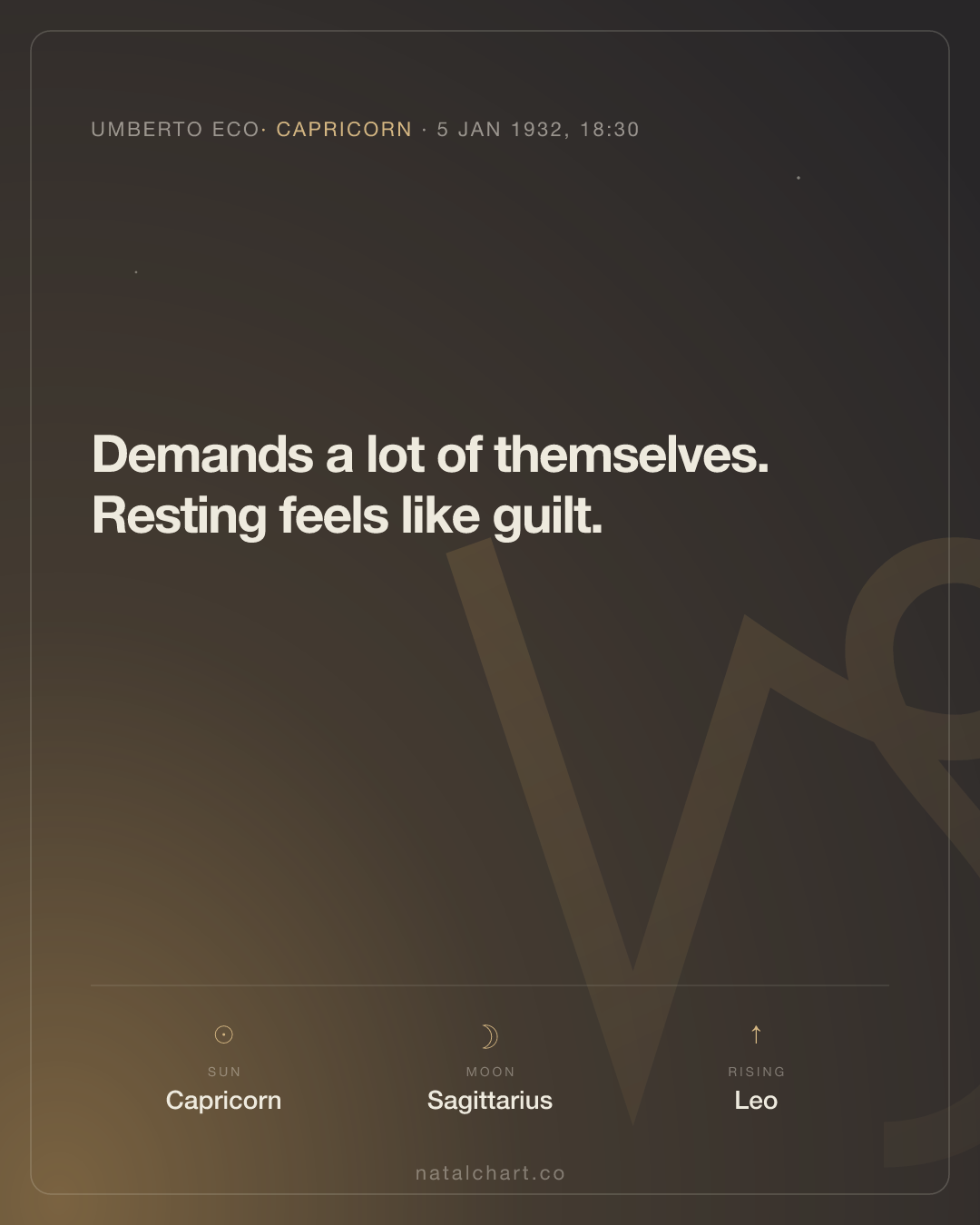
1932-01-05 · 18:30 · Alessandria, Italy Reliability: AA · vetted record
The Core: Three Capricorns and a Leo Stage
The most immediate fact about Umberto Eco's chart is a triple gathering in Capricorn — Sun, Mars, and Saturn all in the same sign, all in the sixth house, the house of daily craft, methodology, and discipline. Three of the most demanding forces in astrology converging in the sign of structure and long-term build, in the house of work done without an audience. This is the scholar underneath: the man who maintained elaborate filing-card systems for his research, who wrote newspaper essays every week for decades, who taught semiotics at the University of Bologna for thirty years and considered it a serious obligation. The work itself — not the fame surrounding it — was the primary fact of his intellectual life.
But the Ascendant, the face Eco showed the world, was Leo, and its traditional ruling planet Jupiter sat directly in the first house, also in Leo. Leo rising gives a presence that fills the room; Jupiter in Leo amplifies it into something theatrical and generous. Eco was famous for his laughter, his vast beard, his capacity to hold a dinner table or a lecture hall with equal authority. The scholar and the showman occupied the same body, and neither was a performance.
Moon and Mercury: The Sagittarian Imagination
Both the Moon, the emotional register, and Mercury, the way the mind moves, were in Sagittarius, placed in the fifth house — the house of play, creative expression, and storytelling. Sagittarius reaches for the wide picture, the philosophical synthesis, the map that connects everything. Eco's mind worked this way structurally: a medieval mystery novel was never just a mystery novel but a vehicle for exploring the history of knowledge, the politics of religious institutions, and the semiotics of the labyrinth. The fifth house places this imagination in the territory of genuine pleasure — he was not an ascetic intellectual. He collected comic books. He wrote pieces on football and James Bond alongside essays on Thomas Aquinas and the poetics of narrative.
Mercury and Jupiter: The Tightest Intellectual Thread
The most precise connection in the chart was a 0.3-degree alignment between Mercury in Sagittarius and Jupiter in Leo, working together in easy flow. This is the aspect that made The Name of the Rose possible: the encyclopedic reach of Sagittarius Mercury — the philosopher, the cataloguer, the lover of cross-references — joined to the narrative gift of Jupiter in Leo, the storyteller who makes the abstract vivid. Eco could explain William of Ockham's nominalism inside a detective plot without either element feeling out of place. That precision of fit between erudition and readability was not a laborious achievement; it was this alignment working naturally, the way a bilingual person switches registers without noticing.
Moon and Uranus: The Unconventional Leap
The tightest aspect in the entire chart was the Moon in easy flow with Uranus, just 0.1 degrees apart. Uranus carries the impulse toward the unconventional, the lateral move, the unexpected synthesis. When it links this easily to the Moon, it builds emotional restlessness and intellectual independence into the instinctive register — Eco felt things differently, associated differently, arrived at connections no one else would make in quite the same order. His 1995 essay naming fourteen properties of eternal fascism, drawing directly on his childhood memory of Mussolini, is Moon-Uranus work: the emotional intelligence joined to the structural leap that defamiliarizes what everyone thought they already knew.
Mars Pulling Against Pluto: What the Darkness Was For
Three of the most resonant texts in Eco's career — The Name of the Rose, Foucault's Pendulum, The Prague Cemetery — take institutional violence, conspiracy thinking, and historical cruelty as their central subject. Mars in the sixth house pulled against Pluto in the twelfth, the house of what is hidden beneath structures and what institutions bury, with only 0.8 degrees between them. This configuration does not suggest personal violence — it suggests a structural compulsion to excavate what power conceals. The Inquisition's forbidden library in The Name of the Rose is a precise twelfth-house image: the labyrinthine archive, the knowledge that the institution decides must not circulate. The opposition between drive and buried power ran through his fiction as a consistent thread.
Saturn and the Capricorn Work Ethic
Having the Sun, Mars, and Saturn all in Capricorn and all in the sixth house creates a pattern in which the doing is not separable from the being. Eco was not famous for talking about writing; he was famous for the output. The novels. The academic monographs on semiotics. The newspaper columns. The university courses. The conference papers. Saturn in this position often produces the scholar who finds genuine satisfaction in the accumulation of method: Eco completed A Theory of Semiotics at forty-three and The Role of the Reader at forty-seven before the novels appeared. The discipline came first. Fame arrived as a consequence, not a goal — and he seemed temperamentally better suited to that sequence than the reverse.
Jupiter and Saturn: The Architecture of a Career
Jupiter in Leo in the first house brought natural authority and a talent for making complex ideas enjoyable. Saturn in Capricorn in the sixth brought the rigor that kept those ideas honest. The combination explains why Eco could write bestselling fiction without ever simplifying the scholarship, and why his academic peers took the novels seriously rather than dismissing them as popular concessions. Mars and Saturn in Capricorn also reinforce each other through their shared sign: the discipline supports the drive and the drive sustains the discipline. Neither burnt the other out.
The Midheaven and Chiron: Pioneer and Public Friction
The Midheaven — the public and career point, the peak of the chart — was in Aries, the sign of the pioneer, the first-mover, the one who opens territory that others later inhabit. Eco arrived in literary fiction nearly at fifty, with a novel so structurally unusual — medieval whodunit, semiotic treatise, philosophical document — that it defined a genre that hadn't clearly existed before. Aries Midheaven fits: he did it first, definitively, without a model.
Chiron — an old wound that becomes, over time, a form of wisdom — was in Taurus in the tenth house, the same public zone as the Midheaven. Chiron here suggests that the public role itself carried a friction: being simultaneously the rigorous academic and the million-selling novelist was never entirely comfortable. Colleagues sometimes questioned the populism; general readers sometimes found the erudition daunting. The synthesis he pursued was also a lifelong negotiation with that discomfort, and the negotiation itself became part of the work.
North Node in Aries: The Pull Toward Initiative
The North Node, which in astrology marks the direction of growth and forward movement in a life, was in Aries — the same sign as the Midheaven. The pull was consistently toward initiative, independence, and breaking new ground rather than consolidating what already existed. Eco's late-career provocations — the essays on social media giving a global platform to voices previously contained within village limits, the lectures on the dangers of internet misinformation delivered well before the topic became mainstream — show this Aries North Node still active: the first mover, again and again, entering territory others were still deciding whether to approach.
A Portrait
Umberto Eco's chart is the portrait of a mind that could not separate pleasure from rigor. The Sagittarius Moon and Mercury needed the breadth, the story, the delight of connection; the Capricorn Sun, Mars, and Saturn required the discipline, the evidence, the method. Neither side was a concession to the other — they were the same person seen from two angles. The darkness he excavated in the Mars-Pluto opposition gave his fiction its weight; the Mercury-Jupiter connection gave it its readability; the Leo Ascendant with Jupiter in the first house gave it its warmth. He remains, decades after The Name of the Rose, one of the clearest demonstrations that serious thought and genuine pleasure are not opposites, and that the scholar who also makes people laugh is not diluting either thing.
The chart
How to read it →Frequently asked questions
What is Umberto Eco's zodiac sign?
Umberto Eco's Sun sign is Capricorn — the Sun was in Capricorn at birth (1932).
What is Umberto Eco's moon sign?
Umberto Eco has the Moon in Sagittarius. The Moon sign describes the emotional and instinctive layer of the chart.
What is Umberto Eco's rising sign?
Umberto Eco's rising sign (ascendant) is Leo — the sign on the eastern horizon at the moment of birth.
When and where was Umberto Eco born?
Umberto Eco was born in 1932 in Alessandria, Italy.