Albert Camus — natal chart
What does Albert Camus’s natal chart reveal?
Albert Camus (1913-1960) was a French-Algerian writer and philosopher associated with absurdism. Author of The Stranger, The Plague, and the essay The Myth of Sisyphus, he won the 1957 Nobel Prize in Literature for work illuminating the problems of the human conscience.
 Share
Share
Birth
1913-11-07 · 02:00 · Dréan (Mondovi), Algeria Reliability: AA · vetted record
The Core: A Mind That Cannot Look Away
Albert Camus spent his life asking the one question that most thinkers prefer to leave alone: if life has no inherent meaning, what exactly are we doing here? The chart of someone who wrote The Stranger, The Plague, and The Myth of Sisyphus maps precisely onto a person constitutionally unable to avoid that question. The Sun in Scorpio in the third house — the house of writing, language, and the immediate environment — describes someone whose entire sense of self is organized around communication and inquiry, specifically of the kind that does not stop at comfortable answers. Scorpio does not skim the surface; it goes to the root. In the third house, that instinct becomes the instrument of a lifetime's work: the need to put into words exactly what others do not dare think clearly.
The Ascendant in Virgo gives the exterior: the precise craftsman, the careful observer, the person who earns trust through rigor and detail rather than through charisma or sweep. Virgo rising does not perform; it demonstrates. Camus's prose carries that signature — famously stripped back, deliberately unornamented, achieving its emotional weight through what it leaves unsaid. The first line of The Stranger — "Mother died today. Or maybe yesterday, I don't know." — is an Ascendant in Virgo sentence: exact, startling, refusing false comfort.
The Moon: Thought as Emotional Bedrock
The Moon in Aquarius in the sixth house points to a kind of emotional life that might surprise readers who encountered Camus only through the warm Algerian light of his Mediterranean essays. Aquarius keeps its interior cool and somewhat defended; the emotional register functions through the intellect and the collective rather than through personal intimacy. The sixth house — the house of work, daily practice, and service — places that Moon in the domain of what one does rather than what one simply feels. For Camus, thinking was not an intellectual hobby; it was the daily rhythm that made life bearable. The discipline of the desk, the insistence on finishing a thought, the sense of responsibility to readers who needed something honestly said — this is the Moon in Aquarius in the sixth house at work.
The Moon also flows easily with Pluto in a trine aspect, meaning the emotional world has deep contact with transformative forces. This is not someone who writes about death, absurdity, and human suffering from a safe theoretical distance. The writing bears the temperature of genuine encounter.
Mercury: The Philosopher's Engine
Mercury in Sagittarius in the fourth house is one of the most revealing placements in this chart. Sagittarius pushes the mind toward big frameworks — philosophical systems, broad questions about how human beings are supposed to live — while the fourth house roots all that thinking in the private and the foundational. The fourth house is the base, the home, the place of origin. For Camus, born in colonial Algeria to working-class parents, orphaned by war before he turned a year old (his father was killed at the Marne in 1914), and raised in poverty in Belcourt, the philosophical questions were never abstract luxuries. They started from the ground of actual deprivation, actual loss, actual mortality.
Mercury in Sagittarius also flows easily with Uranus — the planet of originality and sudden illumination — giving the mind an unusual capacity for unexpected angles, for finding the exact aperture through which a new idea enters. The absurd was not a standard philosophical category before Camus; it was the concept he needed and therefore made.
Venus: Beauty in the Service of Truth
Venus in Libra in the second house speaks to a writer who understood beauty not as decoration but as a form of ethical responsibility. Libra is the sign most attuned to proportion, harmony, and the just arrangement of things; the second house grounds those values in what one actually produces and holds. Camus believed, explicitly and repeatedly, that literature was only worth its place if it told the truth about human experience — but he equally believed that truth without beauty was a failure of another kind. The prose of The Plague manages to be both accurate and luminous; the essays in The Myth of Sisyphus balance philosophical rigor with something that reads like joy in the act of thinking. That is Venus in Libra: beauty and fairness as twin disciplines.
Venus also moves in easy flow with Saturn in this chart — a trine aspect — which reinforces the sense of elegant discipline: a writer who did not take shortcuts, who revised obsessively, whose apparent simplicity was the result of enormous work rather than facility.
Mars and the Outer Planets: Ideas in Action
Mars in Cancer in the eleventh house describes how Camus converted thought into action — specifically, collective action oriented around communities and solidarity. Cancer makes Mars protective and personal, even in public life; the eleventh house puts that protective impulse in the context of movements, groups, and the broader social body. The French Resistance, which Camus joined and to which he contributed his work at Combat newspaper, was not an abstract political commitment. It was driven by the same Cancer instinct: the refusal to let those around you be destroyed while you reason quietly from a distance.
Mars is joined with Neptune in the eleventh house, and the two move closely together. Neptune softens Mars's direct force but gives it imaginative reach; the combination in the house of collectives describes the idealist who acts — who puts the body and the pen into the cause, not merely the argument. Camus's anti-totalitarianism and his solidarity with the Algerian poor were not philosophical positions that stopped at the page; they were lived commitments that cost him real relationships, real safety, real attacks from former allies.
Saturn and the Midheaven: Discipline as Legacy
Saturn in Gemini in the tenth house — and the Midheaven itself falls in Gemini — confirms what the writing already shows: public identity built entirely through words and the discipline of thought. Gemini is the sign of language, of dual perspectives, of the capacity to hold contradictions without collapsing them prematurely. Saturn here is the slow, serious version of Gemini's range: not the wit who skips across surfaces, but the writer who returns to the same problem for years until it is said clearly. The Myth of Sisyphus and The Rebel are Saturn in Gemini works — decades of thinking compressed into arguments built to last.
The Midheaven in Gemini also fits the biographical shape of Camus's vocation precisely: he was a writer, a journalist, an editor, a playwright, a novelist, and an essayist simultaneously. The legacy is not one form but the discipline across all forms.
The Tightest Aspects: Where the Chart Is Most Alive
The closest aspect in the chart is the Sun in easy flow with Jupiter, a near-exact sextile of only 0.2°. This is not an obvious signature for the philosopher of the absurd — Jupiter is the planet of expansion, meaning, even generosity — but it is precisely right for Camus. The absurd, in his hands, was never nihilism. The whole argument of The Myth of Sisyphus ends with the injunction to imagine Sisyphus happy. Jupiter next to the Sun in easy flow is the capacity to find something worth affirming even inside a framework that has stripped away every comfortable illusion. The rebel who says no to meaninglessness is still a person who says yes to life.
Venus in tension with Mars — a square aspect of 1.2° — describes the creative engine as a genuine friction rather than a smooth flow. The beauty Camus pursued and the action-oriented, politically engaged Mars in Cancer did not always want the same thing. The split between the artist and the engaged intellectual was not merely a media narrative imposed on Camus; it was a real inner tension, and some of the most honest passages in his notebooks are about the cost of trying to hold both.
Chiron and the Nodes: The Wound of the Other
Chiron (the old wound that becomes, over time, a gift to others) falls in Pisces in the seventh house — the house of partnerships, of the Other, of how one relates to what is not oneself. Lilith and the North Node are both here as well. Pisces in the seventh house carries a wound around belonging, exile, and the difficulty of being fully received by another person or community. For Camus — born in Algeria, claiming Frenchness, never fully of France; later claimed by French intellectual life, never fully of it either; estranged from Sartre, misread by the left, unsatisfying to the right — the experience of being on the threshold and never quite inside was fundamental.
The North Node in the seventh house points toward growth through genuine encounter with the other rather than through the solitary interior; it is a chart that does its most important work in dialogue and relationship, not in isolation — even when the working method was a solitary desk.
The Warm Close
The chart of Albert Camus is the chart of someone who took on one of the hardest intellectual jobs available — to look honestly at human mortality and meaninglessness and return from that look with something useful rather than nothing — and who did it with a precision and a warmth that were both genuine and hard-won.
The Virgo Ascendant's rigor, the Scorpio Sun's refusal to stop at the surface, Jupiter's insistence on finding something worth affirming: together they produce a mind that could write, in the middle of the twentieth century's worst cruelties, that one must imagine Sisyphus happy. Not because it is comfortable, but because the alternative — indifference, despair, or bad faith — was a worse answer to a real question. That is the chart: the person who keeps pushing the rock not because the hill has an end, but because the pushing itself is what it means to be fully alive.
The chart
How to read it →Frequently asked questions
What is Albert Camus's zodiac sign?
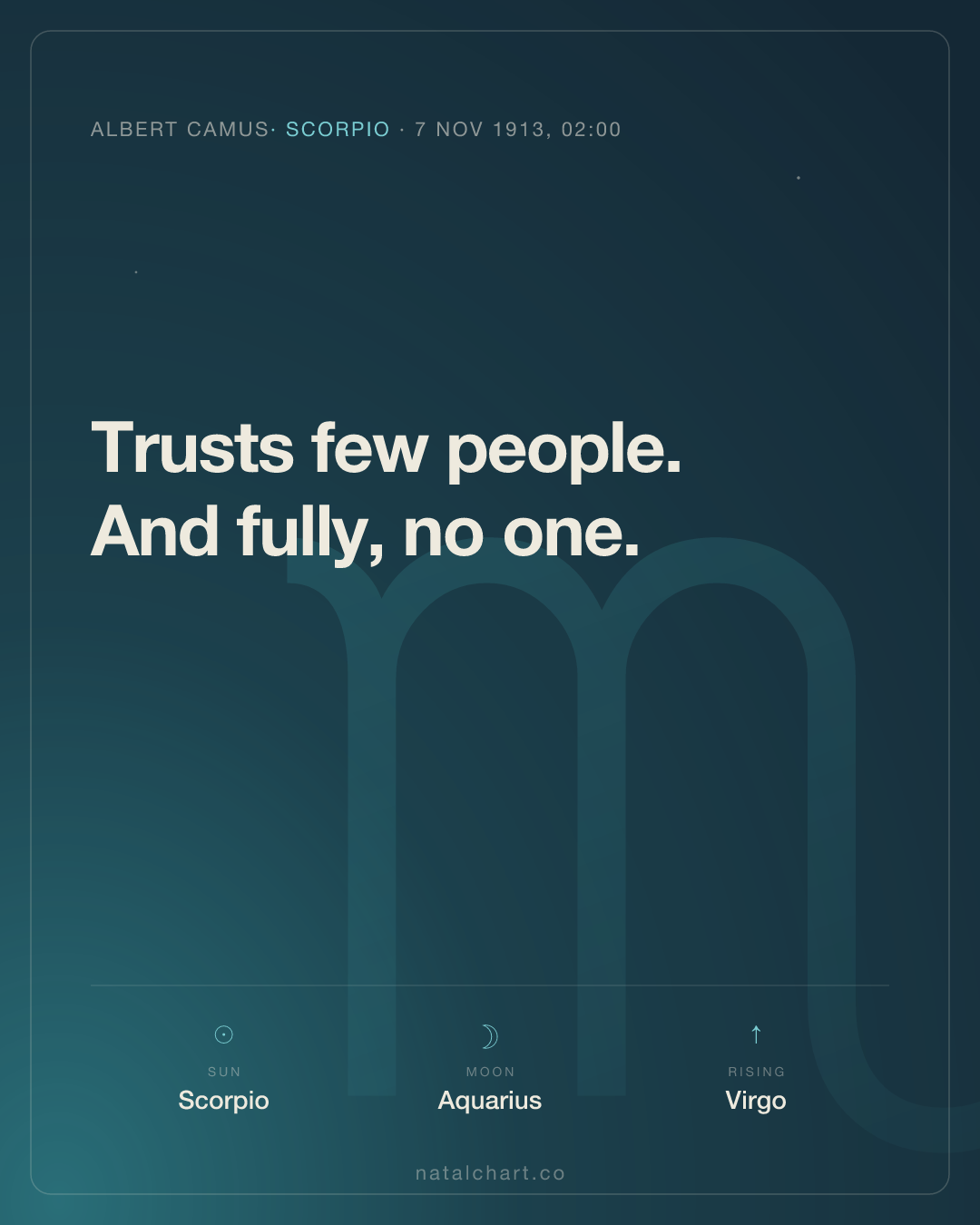
Albert Camus's Sun sign is Scorpio — the Sun was in Scorpio at birth (1913).
What is Albert Camus's moon sign?
Albert Camus has the Moon in Aquarius. The Moon sign describes the emotional and instinctive layer of the chart.
What is Albert Camus's rising sign?
Albert Camus's rising sign (ascendant) is Virgo — the sign on the eastern horizon at the moment of birth.
When and where was Albert Camus born?
Albert Camus was born in 1913 in Dréan (Mondovi), Algeria.