Charles de Gaulle — natal chart
What does Charles de Gaulle’s natal chart reveal?
Charles de Gaulle (1890-1970) was a French general and statesman who led Free France against Nazi Germany during World War II. He founded the French Fifth Republic and served as its first president from 1959 to 1969, profoundly shaping modern French politics and national identity.
 Share
Share
Birth
1890-11-22 · 04:00 · Lille, France Reliability: AA · vetted record
The core: authority from the inside out
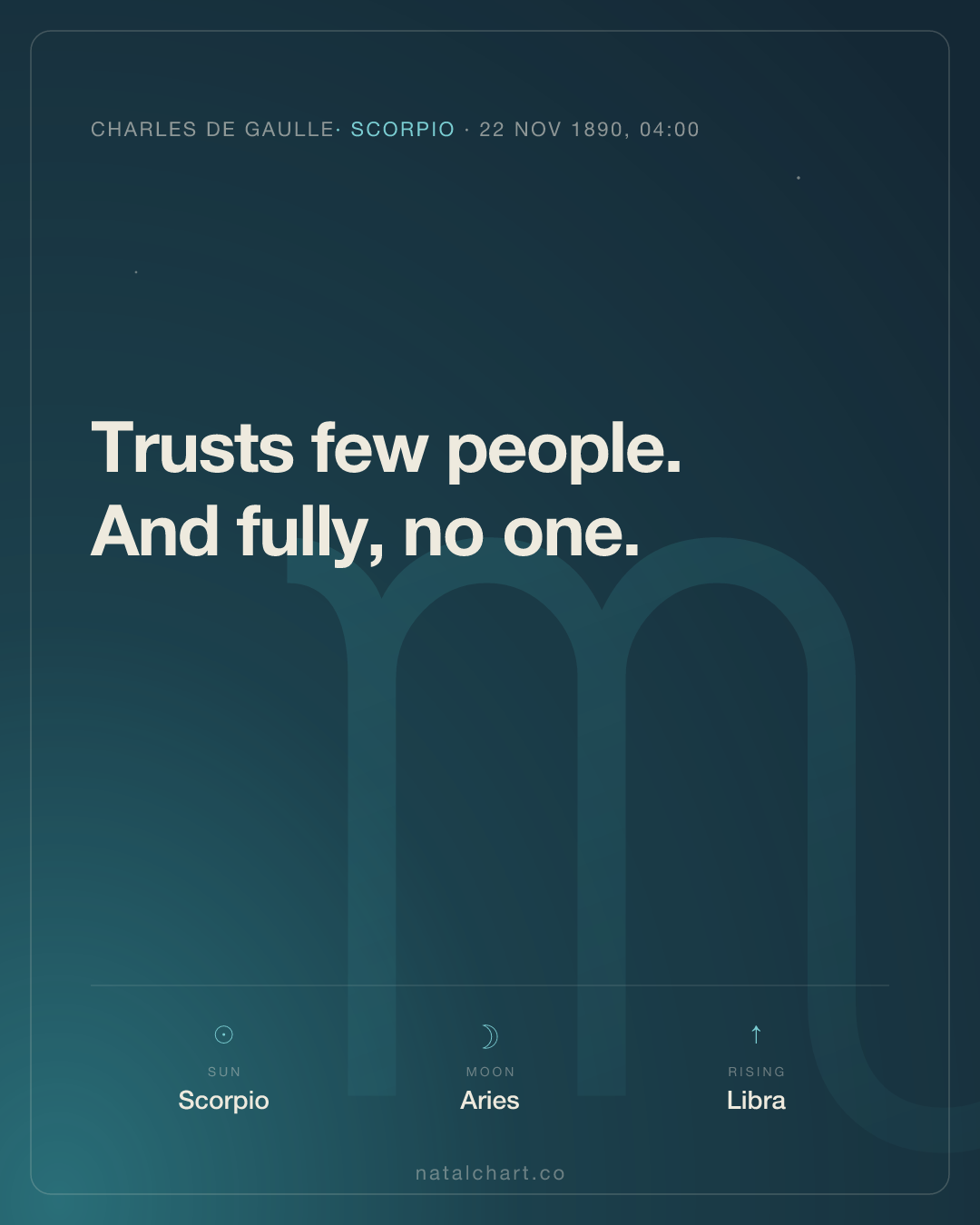
Charles de Gaulle entered the world with a Scorpio Sun in the second house — the house of resources, values, and what one holds as truly one's own — and a Libra Ascendant (the face one meets the world with). On the surface, Libra promises diplomacy, measured judgment, a preference for consensus. But the Scorpio Sun underneath that polished Libran facade was something else entirely: concentrated, immovable, willing to operate in the dark if the mission demanded it. The gap between how de Gaulle appeared — formal, composed, architecturally elegant in speech and bearing — and how he actually worked is precisely this distance between Ascendant and Sun.
Uranus, the planet of rupture and of going one's own way, sits directly on the Ascendant in Libra, tightening the picture considerably. This is someone who arrived at every diplomatic occasion already carrying a charge of pure individuality, a determination to break the expected mold even while maintaining the outward courtliness that Libra demands. The Free France broadcast of June 18, 1940 — an act of institutional disobedience carried out alone in a foreign city, addressed to a country that had already surrendered — is Uranus on the Ascendant made history.
The emotional interior: fire in a diplomatic shell
The Moon in Aries in the seventh house — the house of partners, rivals, and public counterparts — describes an emotional life that was direct, combative, and best understood in relation to opposition. The Moon in Aries does not ruminate; it responds. The emotional temperature rises quickly and the response, when it comes, is decisive. In the seventh house, this means de Gaulle felt most alive — most himself — in confrontation: with Churchill, with Roosevelt, with the Algerian nationalists, with the French political class that he periodically dissolved or bypassed.
The Moon in easy flow with Mercury (less than two degrees) and in easy flow with Jupiter and Neptune (both at less than three degrees) meant that emotional decisiveness and verbal fluency were not separate gears — they were the same engine. When de Gaulle spoke, he was not calculating effects; he was expressing something he genuinely felt, and the architecture of the sentence arrived already formed. The Algerian speech of 1962, with its devastating simplicity — Je vous ai compris — shows this alignment in action.
Mercury and Venus: the orator's instrument
Mercury in Sagittarius in the third house is the configuration of the natural orator: expansive, visionary, concerned with the horizon rather than the footnote. Mercury in Sagittarius does not hedge — it pronounces. The sentence is a declaration, not a negotiation. De Gaulle's public language had this quality in abundance: grandeur was built into the grammar. La France est la lumière du monde was not false modesty.
Venus in Sagittarius shares the third house, giving the same philosophical breadth to what he valued and how he expressed warmth and admiration. The loves of de Gaulle — France as an idea, France as a civilization, France as a moral project — were Sagittarian loves: large, abstract, impossible to fully possess or be disappointed by. His tenderness toward his daughter Anne, who had Down syndrome and who died at twenty, was a Venus in Sagittarius love of a different register: unconditional, unperformative, entirely private.
But Venus pulls against Saturn by about two degrees — a tension between ideals and structural constraint. Every Gaullist vision ran into the friction of what institutions would actually permit, what allies would actually concede, what history would actually allow. The constant struggle to maintain French sovereignty in a world reorganized by two superpowers was this tension lived in geopolitical scale.
Mars and Jupiter: the reformer's will
Mars in Aquarius in the fifth house describes an activist energy directed not toward personal ambition but toward a cause held on principle. Mars in Aquarius fights for ideas, not for territory. The fifth house adds a quality of creative initiative, a willingness to stake everything on a single bold move. Crossing the Channel in June 1940 — unknown, with no mandate, with almost no resources, against a military order — was a Mars in Aquarius in the fifth house gamble of the first order.
Jupiter in Aquarius shares the fifth house, and its connection with Pluto — tighter than a tenth of a degree, the tightest aspect in the entire chart — is the structural signature of a man built for total transformation. Jupiter in easy flow with Pluto at virtually zero distance is rare; it describes an almost unreasonable capacity to expand power through depth, to make strategic bets that seem reckless and prove definitive. The Fifth Republic — a constitution rewritten to concentrate executive authority after the Fourth Republic's paralysis — is the political embodiment of this combination: using the collapse of one order to build a stronger one from scratch.
Saturn: the discipline in the background
Saturn in Virgo in the twelfth house — the house of solitude, hidden work, and what one carries privately — describes the less visible dimension of de Gaulle's discipline. The twelfth house is where what cannot be shown in public is held and processed. Saturn in Virgo here points to a rigorous inner critic, a standard of precision and thoroughness applied without witnesses. The written work — the war memoirs, the political philosophy, the letters — had this quality: meticulous, dense, constructed for permanence, with none of the improvisational looseness that public oratory sometimes permits.
Saturn in the twelfth also carries isolation: the burden of a conscience that cannot always act, the particular loneliness of someone who feels responsible for something very large and cannot share that weight. The years of retreat between 1946 and 1958, at Colombey-les-Deux-Églises, were Saturn in the twelfth Virgo lived at full length: withdrawal into precision, work, and waiting.
The outer planets and the generation's shape
Neptune and Pluto in Gemini in the ninth house — the house of philosophy, foreign nations, and long-range vision — were generational placements shared by millions born in the late nineteenth century. But in de Gaulle's chart, their conjunction (to within one and a half degrees) in the house of international affairs took on personal significance. Neptune in the ninth house gives idealism about what nations can be; Pluto in the same place gives an appetite for structural transformation of those ideals. France-as-civilization, France-as-moral-beacon, France-as-counterweight to the superpowers — these are ninth-house Neptune-Pluto convictions made policy.
The Midheaven: vocation as care for the whole
The Midheaven (the career and public-purpose point in the natal chart) in Cancer speaks directly to the paradox of de Gaulle. Cancer is the sign of home, of protection, of an almost maternal care for what is vulnerable and belongs to one's own. The Midheaven in Cancer describes a vocation that was, at root, about nurturing and defending something fragile: the idea of France, national independence in a world of empires, a republic that kept nearly dying of its own contradictions.
This is not the Midheaven of conquest — it is the Midheaven of custody. The famous opening of the war memoirs — toute ma vie, je me suis fait une certaine idée de la France (all my life I have had a certain idea of France) — is a Cancer Midheaven self-portrait: the career as care, the public life as an act of devotion to something that needs protection.
Chiron and the North Node: the wound that becomes leadership
Chiron (the point in a chart representing an old wound that becomes a source of hard-won understanding) in Aquarius in the fifth house points to a vulnerability around belonging to the group, around being truly received within a collective. De Gaulle was never easy to incorporate: removed from command in 1940, sustained in exile for years, kept at arm's length by Roosevelt, suspected by the left and the right in France in turn. The capacity he developed to act as though the collective endorsement already existed — to proclaim authority before it was granted — was a Chiron in Aquarius response: transforming the wound of non-belonging into an act of will.
The North Node in Gemini points toward the direction of genuine growth: communication, the exchange of ideas, the weaving together of different voices into something legible. The Fifth Republic's institutions, and especially de Gaulle's habit of speaking directly to the French people through television and referendum, bypassing intermediary structures, was a North Node in Gemini at work — reaching for direct dialogue across the distance.
Closing: the man and the idea
Charles de Gaulle's natal chart is the chart of someone for whom the line between person and cause was never fully drawn. The Scorpio Sun in the second house gave him the tenacity to hold a position even when the position was, objectively, extraordinary — one man in London claiming to represent a country that had capitulated. The Libra Ascendant, with Uranus upon it, gave him the bearing to make that claim look like statesmanship rather than delusion. The Moon in Aries gave him the emotional conviction to sustain it.
What the chart reveals, most of all, is coherence: every placement points toward the same thing. The vision was Sagittarian, the discipline Virgoan, the cause Cancerian, the method Scorpionic. He was not an easy man — Saturn in the twelfth, Venus pulling against Saturn, the Moon in confrontational Aries — but the difficulty was, in this case, inseparable from the function. The France he was defending was an idea that required exactly this kind of difficult person to survive.
The chart
How to read it →Frequently asked questions
What is Charles de Gaulle's zodiac sign?
Charles de Gaulle's Sun sign is Scorpio — the Sun was in Scorpio at birth (1890).
What is Charles de Gaulle's moon sign?
Charles de Gaulle has the Moon in Aries. The Moon sign describes the emotional and instinctive layer of the chart.
What is Charles de Gaulle's rising sign?
Charles de Gaulle's rising sign (ascendant) is Libra — the sign on the eastern horizon at the moment of birth.
When and where was Charles de Gaulle born?
Charles de Gaulle was born in 1890 in Lille, France.