Claude Monet — natal chart
What does Claude Monet’s natal chart reveal?
Claude Monet, born 14 November 1840 in Paris, was a French painter and the leading figure of Impressionism, a movement named after his canvas Impression, Sunrise (1872). Working largely en plein air, he pursued the changing effects of light, atmosphere and reflection across repeated views of the same subjects. His celebrated series include the Haystacks, the Poplars, the facades of Rouen Cathedral and the Houses of Parliament in London. From the 1890s he developed the water-lily garden at his home in Giverny, which inspired the vast Water Lilies (Nympheas) panels of his final decades, now displayed at the Musee de l'Orangerie. He died on 5 December 1926.
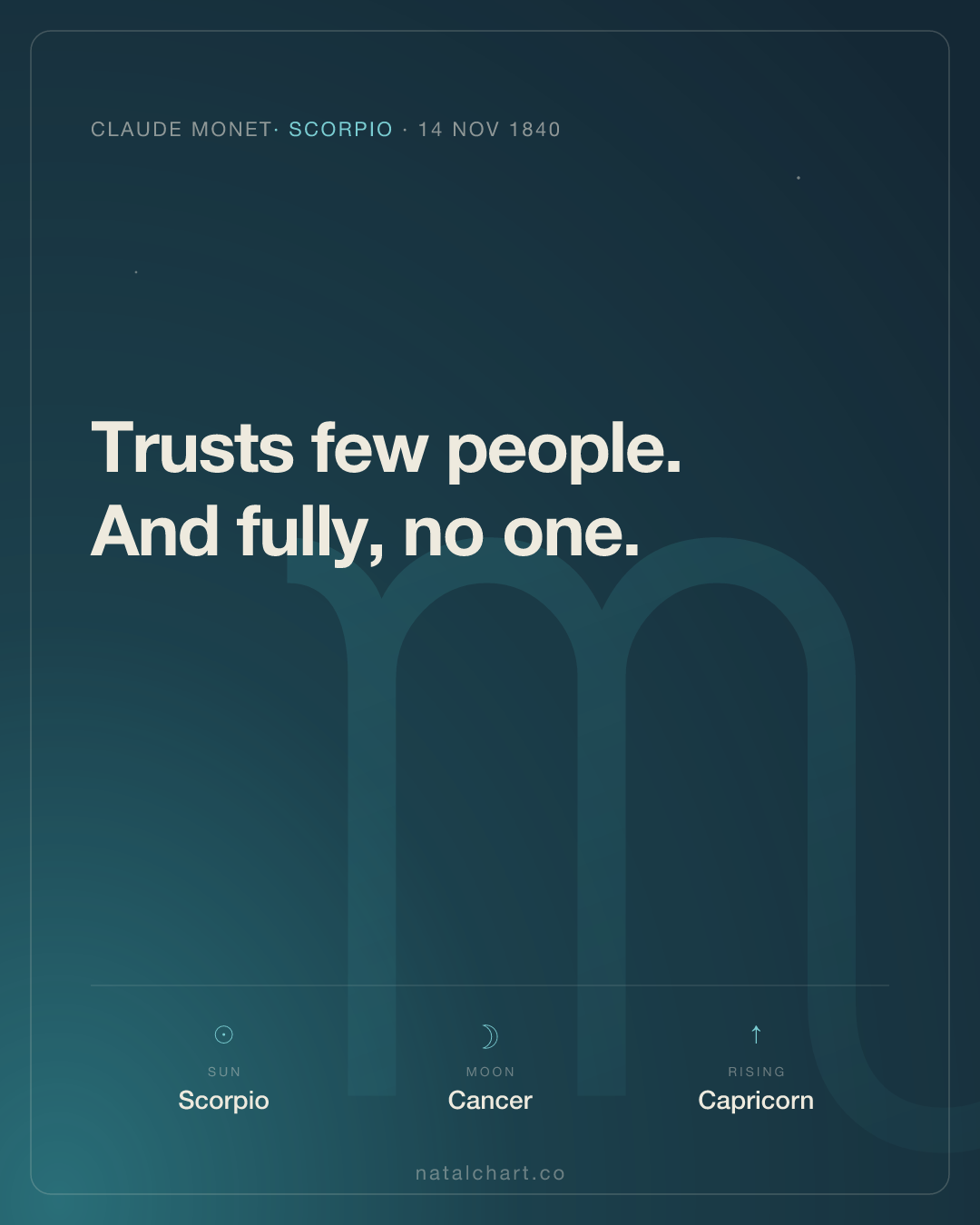 Share
Share
Birth
1840-11-14 · Paris, France Reliability: X · no time No verified birth time: ascendant and houses are omitted. No reliable birth time exists: the Paris records burned in 1870. Times circulating online are astrological rectifications.
The painter who looked longer than anyone else
Some artists work with ideas; Claude Monet worked with looking. He returned to the same haystack, the same cathedral façade, the same curtain of water lilies across the pond at Giverny, not because he had run out of subjects but because one hour of light is not the same as the next, and he wanted to paint the difference. This is the Scorpio Sun at its most characteristic: a depth of concentration that ordinary attention can't sustain, combined with a willingness to follow something all the way down. The Sun in Scorpio, joined in easy flow with Jupiter — also in Scorpio — creates a nature that goes further into things than people around them tend to, that stays longer, that refuses the summary version.
Moon and Jupiter: the cathedral of feeling
The Moon in Cancer and Jupiter in Scorpio stand in almost exact harmony — one of the tightest aspects in this chart, at barely a tenth of a degree. The Moon in Cancer is at home in its own sign: this is emotional responsiveness at full saturation, a sensitivity to atmosphere, to the quality of a moment, to the way afternoon light changes the colour of a stone surface from hour to hour. Jupiter amplifies everything it touches; here it amplifies receptivity itself. Monet described his longing to capture the atmosphere around a subject — l'enveloppe, he called it, the envelope of light and air — and that metaphor is this aspect made concrete. The Water Lilies series, which he worked on for the last thirty years of his life, is what happens when a Cancer Moon directed by Scorpio depth refuses to stop looking.
Mercury and Venus in Sagittarius: the generous eye
Both Mercury and Venus fall in Sagittarius, the sign most oriented toward expansiveness, toward a wide frame rather than a narrow one. Mercury in Sagittarius thinks in categories, in sweeps, in the big picture — and Monet's revolutionary contribution was precisely categorical: not this particular tree but light on all trees at all times of day. He did not paint objects; he painted conditions. Venus in Sagittarius loves what is abundant, outdoor, uncontained — and the whole enterprise of working en plein air, refusing the studio's controlled light, carrying canvases into fields and marshes and onto boats, is Venus in Sagittarius made into method.
Venus and Saturn are joined very close together in Sagittarius, which adds a complicating dimension. Saturn is the planet associated with discipline, limitation, and what one earns through sustained effort. The Venus-Saturn conjunction describes an aesthetic that is rigorous rather than merely pleasing, a beauty that has been worked for over many years. Monet's forty-three canvases of Rouen Cathedral, his forty Haystacks, his eighteen views of Waterloo Bridge — this is not the behaviour of a painter in love with variety. It is Saturn's patience applied to Venus's eye.
Mars in tension with Saturn and Venus
Mars in Virgo sits in tension with both Saturn and Venus in Sagittarius — a tight square on both counts, at barely a degree of orb each. Mars in Virgo is a disciplined, precise, technically exacting force; it wants to get things right at the level of detail. In tension with Saturn (the planet of structure and limitation), this combination produces tremendous frustration with the gap between what is seen and what the hand can render. Monet was frequently dissatisfied — he destroyed canvases, complained that his technique was inadequate to what he was trying to catch. The tension with Venus adds that the aesthetic standard was always slightly ahead of what he could achieve, which meant he kept trying. This productive dissatisfaction drove the series paintings: one canvas per condition of light was never enough.
Mercury and Uranus: the rupture with convention
Mercury in Sagittarius sits in tension with Uranus in Pisces — two planets pulling against each other. Uranus is associated with the sudden break, the refusal of what came before. In Pisces, it has a quality of dissolving distinctions, of blurring the edges between things. The tension between Mercury's tendency to categorize and Uranus's tendency to dissolve categories describes exactly what Impressionism did to academic painting: it refused the sharp, finished outlines of the Salon style in favour of the perceived impression — the blur, the shimmer, the moment before the form fully resolves. The movement was named after Monet's canvas Impression, Sunrise (1872), and the name was initially an insult from a critic who had not understood that the blur was the point.
Mercury also forms a supporting aspect with Neptune — the planet most associated with dissolving boundaries between the self and the perceived world, with what is real and what is reflected. Neptune in Aquarius speaks of a collective transformation in how reality is perceived, and Monet's work was precisely that: it changed not just how people painted but how Western culture learned to see.
Saturn and Pluto: the long arc of commitment
Saturn in Sagittarius forms a supporting aspect with Pluto in Aries — a planet associated with transformation that is total and irreversible. This combination describes someone whose discipline carries a transformative force, who does not just work hard but whose sustained effort eventually changes the medium itself. Monet lived to eighty-six, losing his sight in his last years to cataracts but continuing to paint regardless — the late Water Lilies panels in the Orangerie, immense and almost abstract, are the product of a man who could no longer quite see what he was painting and kept going anyway. That is Saturn-Pluto: the structure that persists even when everything else is taken away.
Chiron and the North Node
Chiron — an old wound that eventually becomes a gift — is in Aquarius, alongside the North Node (a point indicating the direction a life is developing toward). Both in Aquarius, the sign of collective vision and innovation, they point toward a contribution that outlasts the person who made it. Monet did not set out to found a movement; he set out to solve a problem about light. The wound in Aquarius is the experience of being misunderstood by the collective — and Monet spent the early decades of his career being rejected by the official Salon, exhibiting outside its structures, painting subjects the establishment considered unworthy. The gift is that the same drive that came from that exclusion ultimately created an entirely new visual language for European painting.
The garden as the great work
Monet spent the second half of his long life building the garden at Giverny with the same deliberate attention he brought to the canvas. The Japanese bridge, the lily pond, the weeping willows — these were not decorations; they were the subject. He re-engineered a stream to create the water garden he wanted to paint. There is something clarifying about this: a painter who built his own landscape to have something worth looking at long enough. The Sun in Scorpio doesn't stop at the first version of anything. The Moon in Cancer keeps returning to the same beloved place. And Saturn joined with Venus in Sagittarius ensures that the years of returned looking eventually produce something that was worth all that time.
The chart
How to read it →Frequently asked questions
What is Claude Monet's zodiac sign?
Claude Monet's Sun sign is Scorpio — the Sun was in Scorpio at birth (1840).
What is Claude Monet's moon sign?
Claude Monet has the Moon in Cancer. The Moon sign describes the emotional and instinctive layer of the chart.
When and where was Claude Monet born?
Claude Monet was born in 1840 in Paris, France.