Ennio Morricone — natal chart
What does Ennio Morricone’s natal chart reveal?
Ennio Morricone (1928-2020) was an Italian composer who wrote scores for over 400 films. Celebrated for Sergio Leone's spaghetti westerns including 'The Good, the Bad and the Ugly', his innovative, melodic music earned an honorary Oscar in 2007 and a competitive Academy Award for 'The Hateful Eight' in 2016.
 Share
Share
Birth
1928-11-10 · 22:25 · Rome, Italy Reliability: AA · vetted record
A Portrait Written in Sound
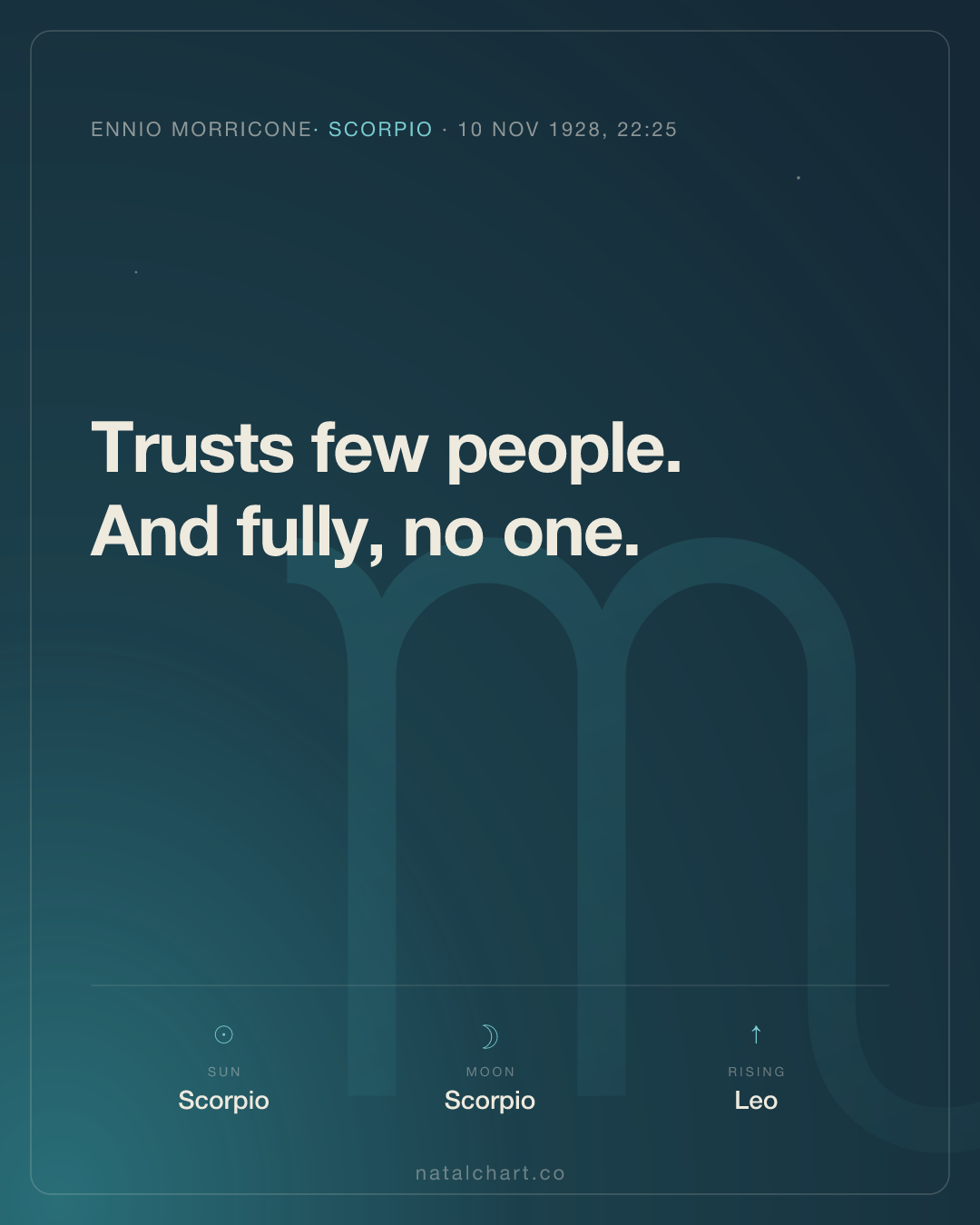
Ennio Morricone composed music the way a surgeon operates: with absolute precision, complete seriousness, and the certainty that what he was doing mattered. That combination of intensity and craft runs through his entire chart. The Sun and Moon sit together in Scorpio — both of them, in the same sign, in the same private house — which means his emotional life and his sense of self were never separate things. He did not dabble. He went to the bottom of whatever he was working on and stayed there until it gave up its secret. The over 400 film scores he left behind are not the output of a prolific machine; they are the record of a man who brought total commitment to every single assignment.
The Leo Face, the Scorpio Interior
The Ascendant — the face a person meets the world with — was Leo: theatrical, commanding, capable of filling a room. On the podium or in a film-music conversation, Morricone projected certainty and presence. He had opinions and he held them. He publicly refused, for years, to be considered a lesser composer simply because he worked in film rather than the concert hall. That Leo confidence was real. But it was armour over a much more private interior. The Sun and Moon in Scorpio in the fourth house (the zone of home, roots, and what remains hidden) tell you that the real work happened alone, in silence, away from audiences. The performances were Leo; the compositions were Scorpio.
Sound as Inner Weather
The Moon in Scorpio links, in very easy flow, to Neptune — the planet associated with imagination, sound, and the dissolution of hard edges. For Morricone, emotion and music were not metaphors for each other; they were the same thing. When he scored The Good, the Bad and the Ugly, the coyote yelp, the jaw harp, the human voice used as an instrument — none of that came from knowing what a western should sound like. It came from going to a feeling first and then finding the exact sound that carried it. Moon joined to Mercury in the same degree confirms that his thinking and his emotional processing operated as a single faculty. He did not think about music and feel separately. He thought-felt in music.
The Career Built on Beauty and Patience
Jupiter in Taurus sits at the very top of the chart — the Midheaven zone (the public and career point), where it becomes the most visible expression of his professional life. Taurus is the sign associated with sound, with the physical properties of resonance, with patience and sensuous craft. Jupiter there speaks to a reputation that grows steadily through accumulated quality rather than a single spectacular debut. Morricone's international recognition arrived slowly — he had been working for decades when the honorary Oscar came in 2007, and he was 87 when he received the competitive one for The Hateful Eight in 2016. The career was not a sprint. It was an edifice built stone by stone, note by note.
Chiron: The Wound That Became the Gift
Chiron (the point in a chart that marks an old wound which slowly becomes a source of strength) sits alongside Jupiter at the Midheaven, also in Taurus. The wound here is one of recognition — specifically, the long refusal by the classical music establishment to take film composition seriously as an art form. Morricone felt this acutely. He kept returning to concert music throughout his career, as if needing to prove his credentials elsewhere. But the tension that wound created — the drive to make film music that was unimpeachably serious — is precisely what produced music no one else was making. The chip on the shoulder became the architecture of the achievement.
Discipline Inside the Adventure
Venus and Saturn travel together in Sagittarius in the house of creative work. This pairing is not a natural fit for easy comfort — Saturn disciplines what Venus would prefer to leave free and expansive. But in a composer's chart, it is exactly what you want: the taste is wide and adventurous (Sagittarius spans cultures, loves the foreign and the epic), but it is contained by a structural severity that refuses indulgence. The famous Morricone sound — the shock of an unexpected instrument, the folk melody set inside a concert texture — comes precisely from this: a cosmopolitan curiosity governed by exacting formal control. He could have settled into a formula after the Leone westerns made him famous. Saturn would not allow it.
The Hidden Engine
Mars — the planet of drive and action — is in Cancer in the twelfth house. The twelfth house is the most private in a chart, associated with work done behind the scenes, with what is given without acknowledgment. Cancer is protective, inward, and emotionally motivated. Morricone's creative drive did not announce itself; it retreated into the work. He was famously prolific and famously private about the process. He composed at night, refused almost all social obligations while on a project, and described composition as a kind of inner necessity that gave him no option but to continue. That is twelfth-house Mars exactly: an engine that runs on its own fuel, invisible from the outside, impossible to switch off.
Mind and Communication
Mercury in Libra in the third house (the natural home of Mercury, the zone of language, ideas, and communication) gave Morricone the capacity to hear music as a kind of balanced argument — each element weighed against the others, nothing left to chance. Libra seeks harmony not in the sense of prettiness but in the sense of rightness, of proportion. He spoke about his compositional method with unusual precision; interviews show a man who could articulate exactly what he was trying to do and why. The Mercury-Neptune link (in easy flow, within two degrees) added the ability to translate what the inner ear heard into concrete written notation — the gift of rendering imagination into form.
Neptune, Livelihood, and the Craft of Imagination
Neptune in Virgo in the second house (the zone of livelihood, material resources, what one earns) is an unusual placement: it suggests someone who makes a living from imagination, but only by subjecting that imagination to meticulous craft. Virgo is analytical, detail-oriented, and intolerant of sloppiness. Neptune there does not produce vague, impressionistic output; it produces music that is richly imagined and precisely realised. The Jupiter-Neptune link across the chart (flowing, within two and a half degrees) amplifies this: the imagination is generous, the craft is exacting, and the two together produce work of a scale that could not have come from either quality alone.
The North Node: Bridge-Maker
The North Node (the direction a chart points toward for growth) falls in Gemini — the sign of connection, of translation, of making the link between one world and another. Morricone's entire career was a form of translation: he took a visual narrative and found the musical language that revealed its emotional logic. He did not illustrate scenes; he translated them. The spaghetti westerns work not because the music tells you what to feel but because it speaks a parallel emotional language — one that neither the image nor any words could access alone. That Gemini North Node describes the gift precisely: the capacity to move between registers and build the bridge that makes the whole greater than the sum of its parts.
The Aries Midheaven: A Career on His Own Terms
The Midheaven in Aries (the career and public reputation point) marks someone who forged a professional path independently, by initiative and personal vision rather than by fitting into an existing institution. Morricone was not appointed, promoted, or admitted to an academy and then given commissions. He built his reputation composition by composition, refusing to be categorized, moving from westerns to political thrillers to horror to chamber concerts with a freedom that institutions rarely grant and that only a singular individual grants himself. The Aries Midheaven is the chart's way of saying: the career was made, not inherited.
The Tightest Thread
The single tightest aspect in the chart — Sun perfectly in easy flow with Pluto, at zero degrees of separation — is the thread that holds everything together. Pluto is associated with depth, with transformation, with the pressure that turns carbon to diamond. A perfect Sun-Pluto link in a composer's chart does not produce surface music. It produces music that makes the listener feel something they did not know they could feel, or something they had felt but never had a name for. The opening notes of Once Upon a Time in the West, the wordless voice of Edda Dell'Orso in The Good, the Bad and the Ugly, the chamber-music severity of the Hateful Eight score — these are not decorations on a film. They are psychic pressure. That is Sun trine Pluto at 0.0°: a life spent using beauty as a means of reaching into the deepest part of a listener and not letting go.
The chart
How to read it →Frequently asked questions
What is Ennio Morricone's zodiac sign?
Ennio Morricone's Sun sign is Scorpio — the Sun was in Scorpio at birth (1928).
What is Ennio Morricone's moon sign?
Ennio Morricone has the Moon in Scorpio. The Moon sign describes the emotional and instinctive layer of the chart.
What is Ennio Morricone's rising sign?
Ennio Morricone's rising sign (ascendant) is Leo — the sign on the eastern horizon at the moment of birth.
When and where was Ennio Morricone born?
Ennio Morricone was born in 1928 in Rome, Italy.