Indira Gandhi — natal chart
What does Indira Gandhi’s natal chart reveal?
Indira Gandhi (1917-1984) was an Indian politician and the first and only woman to serve as Prime Minister of India, holding office across two periods from 1966 until her assassination in 1984. Daughter of Jawaharlal Nehru, she was a dominant and controversial figure in modern Indian politics.
 Share
Share
Birth
1917-11-19 · 23:11 · Allahabad (Prayagraj), India Reliability: A · reliable data
The Armored Interior
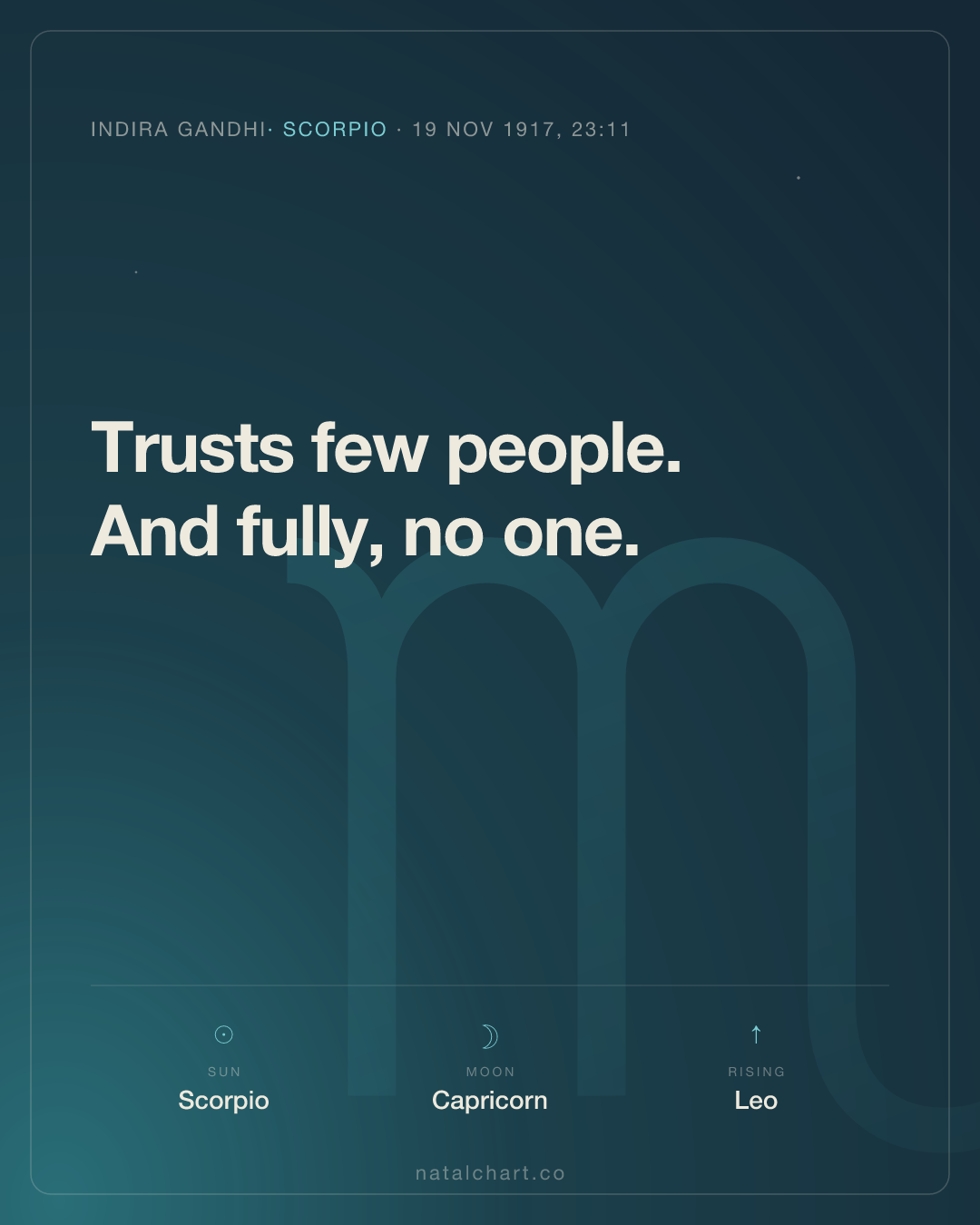
The first thing people noticed about Indira Gandhi was the bearing — Leo Rising, the Ascendant, the face one meets the world with. Regal, composed, with the particular stillness of someone who has decided in advance not to flinch. Saturn and Neptune both sit in Leo in the first house alongside that Leo Ascendant, which complicates the picture considerably. Saturn here is discipline worn as armor: the public image of unshakeable control was not natural ease but deliberate construction, held in place by will. She was Jawaharlal Nehru's daughter — a position that gave her a stage and imposed an impossible standard simultaneously. The Leo Ascendant wanted the stage; Saturn in Leo made sure she earned every step onto it and refused to let her forget the cost.
Neptune in that same Leo first house adds something more elusive. It is the quality her critics noticed as opacity and her allies experienced as an almost mythic authority — the sense that behind the composed exterior lay depths that nobody was quite allowed to see. She was not easy to know, even for those who served her for decades.
Scorpio Sun, Hidden Foundation
The Sun in Scorpio in the fourth house — the house of home, origins, private foundations — gives the central key to Gandhi as a person rather than as a figure. Scorpio is the sign of transformation under pressure, of what survives and what gets stripped away when circumstances become unforgiving. In the fourth house, that intensity turns inward and backward: toward family legacy, toward what was inherited and what was privately reckoned with. She grew up in the middle of the Indian independence struggle, in the Nehru household that was simultaneously a home and a political command center. That is a Scorpio Sun in the fourth house in the most literal sense: the private and the historical were never cleanly separated, and the self was forged in that crucible.
That Sun makes a flowing connection with the Capricorn Moon in the sixth house — the emotional interior and the daily work are synchronized, not in tension. What she felt and what she did were the same current. The work was not separate from the self; for Gandhi, governance was something closer to a vocation in the original sense of the word, a calling that she answered at the cost of considerable personal life.
The Capricorn Moon: Emotion as Architecture
Moon in Capricorn in the house of work and daily responsibility describes an emotional life that found its expression in structure, in institution, in the accumulation of long-term positions rather than in warmth or spontaneous intimacy. Capricorn Moon people are rarely the ones who wear their feelings plainly; they are the ones who build, who endure, who take the long view. The charge that Gandhi could be cold — that she governed by control and calculation rather than by connection — has its root here. But the Capricorn Moon is not the absence of feeling; it is feeling that has learned to become useful, to take the form of strategy and endurance rather than expression.
Venus also sits in Capricorn in the sixth house, joining the Moon. The things she valued — loyalty, precision, effective institutions, people who delivered — were also Capricorn in character. She trusted demonstrated competence more than declared affection. The relationships in her life that lasted were working relationships as much as personal ones. Venus and Mars flow together easily here, with Mars in Virgo in the second house: the values and the drive are aligned, both precise, both practical, both applied to the question of what actually works.
The Mind That Moved Between Worlds
Mercury in Sagittarius in the fifth house describes a mind that thought in large frames rather than small ones — drawn toward ideology, toward the long arc of history, toward the question of India's place in the world order. Gandhi was not a technocrat; she was a thinker who operated from a framework. Mercury here makes a flowing connection with Neptune in the first house, which produced something unusual: the ability to communicate a vision in terms that felt almost mythic to her listeners. Her speeches in the 1971 election — "Garibi Hatao," eliminate poverty — were not policy platforms in the ordinary sense. They were Sagittarius Mercury shaped by Neptune into something closer to a national story.
That same Mercury is in tension with Jupiter in Gemini in the eleventh house, a pull in opposite directions. Jupiter in Gemini gathers information, stays flexible, thrives on multiple angles; Sagittarius Mercury wants the single governing principle, the unified narrative. In practice this manifested as the tension between Gandhi's genuine pragmatism — her willingness to shift alliances, to use whatever worked, to govern from the center and the left and even authoritarian ground when she judged it necessary — and her loyalty to certain fixed ideas that she never abandoned. The Emergency period of 1975–77 is, in part, the story of what happens when that Sagittarius Mercury wins the argument against Gemini Jupiter's caution.
Mars in Virgo: The Exacting Drive
Mars in Virgo in the second house — the house of what one builds and what one considers worth protecting — describes a drive that was precise, exacting, attentive to detail at the operational level in a way that surprised people who expected only the visionary. Gandhi's administrative style was notably hands-on; she read files, she questioned officials, she insisted on specifics. Mars in Virgo does not delegate carelessly. It needs to know, in concrete terms, what is happening and whether it is correct. The "Garibi Hatao" campaign was not only a slogan; it came with the bank nationalizations of 1969, the abolition of privy purses, the specific legislative instruments. The vision (Sagittarius Mercury) and the working mechanism (Virgo Mars) were both present.
Mars makes an easy flowing connection with Pluto in Cancer in the twelfth house — a quiet but substantial reservoir of determination that could be called upon when ordinary resolution would have exhausted itself. Pluto in Cancer in the house of the unseen is the part of Gandhi that operated on a level others could not quite track: the instinct for national feeling, the ability to read what the country was experiencing as a collective body, the refusal to be finished when she was supposed to be. After her 1977 electoral defeat, almost every analyst wrote her off. By 1980 she was back in power. Pluto in the twelfth does not announce its recoveries.
Jupiter and Saturn: The Eleventh and the First
Jupiter in Gemini in the eleventh house — the house of alliances, movements, and the broader world — describes the appetite for coalition, for connecting different constituencies, for building the kind of cross-India presence that translated Nehru's Congress Party inheritance into something she could genuinely call her own. But Jupiter in Gemini at its overextended worst is also the tendency to scatter, to hold too many alliances simultaneously without being able to honor all of them. Gandhi's political history is marked by exactly this: the formation and rupture of coalitions, the cultivation and sudden abandonment of allies, the party splits of 1969 and 1978.
Saturn in Leo in the first house has been mentioned as armor; its deeper function is the discipline that converts ambition into lasting achievement. The long-term structural legacies of her tenure — the Green Revolution that reduced India's dependence on food imports, the nuclear program, the 1971 war that resulted in the creation of Bangladesh — all bear the mark of Saturn's patience and its willingness to absorb short-term costs for long-term position.
Chiron in Pisces: The Wound in the Eighth House
Chiron — the point in a chart that marks an old wound which, over time, becomes a source of unusual understanding — sits in Pisces in the eighth house, which is the house of shared power, of what one inherits and what one must eventually surrender, of the irreversible. The Pisces quality here suggests that the wound was not clean or sharp but permeable — losses that could not be fully contained, griefs that could not be fully processed and therefore had to be carried. The deaths that surrounded Gandhi — her mother Kamala when Indira was eighteen, her husband Feroze in 1960, her son Sanjay in 1980 — do not explain her but they mark the territory that Chiron in the eighth describes: a repeated encounter with loss that cannot be controlled, coming in the place where power and powerlessness meet.
The North Node in Capricorn — the direction of genuine growth — points toward exactly the path she took: toward institutional authority, toward building durable structures, toward the long work of governance over the quick satisfaction of popularity. She grew into this, at real personal cost.
The Midheaven in Taurus: What Endures
The Midheaven — the public and career point at the top of the chart — falls in Taurus. In a chart this charged with Scorpio, Capricorn, and Leo, the Taurus Midheaven introduces something worth noting: the ambition, finally, was for something tangible and lasting. Not abstract power but the concrete transformation of material conditions. Food security. Nuclear capability. A recognizable national sovereignty. Taurus builds to last. Gandhi's reputation — contested as it is, and likely always will be — is not the reputation of someone who sought the ephemeral. She wanted to change what India was, in permanent terms, not just to hold power.
The Closest Aspects: What Runs the Chart
The most precise connection in Gandhi's chart is between Jupiter in Gemini and Neptune in Leo, flowing easily together with less than a degree between them. This is the signature of someone whose vision and whose public authority were genuinely fused — someone for whom the dream and the platform were not separate registers but one continuous current. It produced the quality that her followers experienced as inspiration and her critics as grandiosity: the sense that her political project was not merely a program but a historical role.
Mercury's flowing connection with Neptune doubles down on this: the communication of vision in terms that feel larger than the ordinary transaction of politics. And Mercury's tension with Jupiter — the two ends of a permanent argument about scale versus flexibility — kept that vision from becoming purely abstract. The square between Mercury and Mars in Virgo added a further pressure: the framework-thinker and the operational implementer were not always in agreement about timing or method, which produced both the energy of her governance and some of its most consequential miscalculations.
Portrait
Indira Gandhi's chart is a portrait of someone who built her authority entirely from the inside out — from Scorpio depths to Capricorn endurance to Leo projection — and who paid the full price of that architecture. She was not made comfortable by power; she was sustained by it and, in the end, consumed by it. The Capricorn Moon that kept feelings in the service of work, the Virgo Mars that needed to know the precise operational reality, the Leo Ascendant and Saturn that held the public image at the cost of considerable personal warmth: all of it points to a person whose relationship with herself was as complex as her relationship with the country she led. The chart does not explain whether she was right or wrong in her choices — no chart does. What it explains is the coherence of the person: that this woman and these choices were, in some fundamental way, the same thing.
The chart
How to read it →Frequently asked questions
What is Indira Gandhi's zodiac sign?
Indira Gandhi's Sun sign is Scorpio — the Sun was in Scorpio at birth (1917).
What is Indira Gandhi's moon sign?
Indira Gandhi has the Moon in Capricorn. The Moon sign describes the emotional and instinctive layer of the chart.
What is Indira Gandhi's rising sign?
Indira Gandhi's rising sign (ascendant) is Leo — the sign on the eastern horizon at the moment of birth.
When and where was Indira Gandhi born?
Indira Gandhi was born in 1917 in Allahabad (Prayagraj), India.